
Delhi rape accused deserve a fair trial – and they’re not getting one

Sometimes, a matter of domestic law – a murder, a kidnapping, a rape – can be so horrifying that it is keenly felt, and keenly watched, around the world. This was the case with the gang rape of a 23-year-old physiotherapy student in Delhi last year, and now the trial of the five men and one teenager…

Hgpchxgp-1358815162
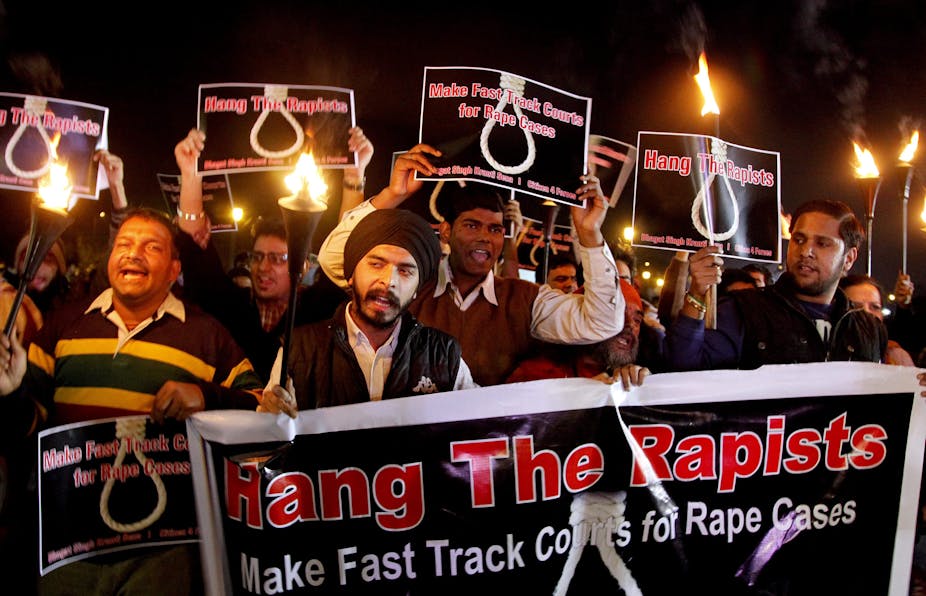
With global attention and the Indian public so invested in the Dehli rape case, the rights of the accused to a fair trial are in jeopardy. AAP/Anindito Mukherjee

Sometimes, a matter of domestic law – a murder, a kidnapping, a rape – can be so horrifying that it is keenly felt, and keenly watched, around the world. This was the case with the gang rape of a 23-year-old physiotherapy student in Delhi last year, and now the trial of the five men and one teenager accused of the crime has commenced.

This is a case where the public has an interest in seeing justice meted out against the offenders, and an appropriate sentence given. The accused face the death penalty, or chemical castration, if convicted. Prosecutors allege they have strong evidence, including forensic evidence, to prove guilt.

But concerns about the trial process mean that the trial may be unfair, and that the ultimate verdict may rest on unstable evidentiary grounds.

The rights of an accused to a fair trial are set out in international law, particularly the International Convention on Civil and Political Rights, which India signed in 1979. India’s national laws, including its constitution, also prescribe some rights of an accused.

These rights protect the accused, set against a system with the power to take the liberty (or even, in this case, the life) of that person. These rights also serve to protect the basis for convictions and assist the court to reach its conclusion on guilt. They ensure that evidence is rigorously tested and any problems are exposed. If the evidence cannot establish the case, the accused should not be convicted. These rights therefore protect the legitimacy of the trial and ultimately the system of law.

But in this case, there are several major concerns.

First, the trial is being fast-tracked, and held in a specially-constituted court. Prosecutors hope to finish the trial within months. There are considerable concerns about India’s fast-track courts. Some have noted that while justice delayed is justice denied, justice hurried is justice buried.

Second, the accused have not had easy access to a lawyer. Under the ICCPR, and the Indian Constitution, an accused has the right to a lawyer of their choosing. The Indian case A.S. Mohammed Rafi v. State of Tamil Nadu held:

Every person, however wicked, depraved … or repulsive he may be regarded … has a right to be defended in a court of law.

An impartial and capable lawyer will ensure the complicated court processes are adhered to, evidence is appropriately tested, and the case is proved “beyond a reasonable doubt”. Defence lawyers therefore ensure that any conviction is based on strong evidence.

In this case, however, the accused were held in custody for almost three weeks without a lawyer. The District Court Bar Association, representing 2500 local lawyers, has voted not to represent the accused. One of the Bar Association members said that “it would be immoral to defend this case”, and that the lawyers had decided to “stay away” in order to ensure “speedy justice”. This severely limits the accused’s ability to choose a lawyer. While several of the accused now have lawyers, there are still concerns about the exact arrangements.

Third, the presumption of innocence has not been respected. The vice-president of the Bar Association said the men committed a “heinous” crime, before they had been presented to the court. The prosecutor commented that the accused are guilty. However, the accused have not yet been proven guilty – they should be presumed to be innocent. In a case so emotionally charged that demonstrators are burning effigies of the accused, it is crucial that there are no comments which presume the guilt of these men.

Fourth, the case is being held in closed court, without media. The ICCPR upholds the right of an accused to have a public trial, except in exceptional cases, as does the Indian Code of Criminal Procedure. Holding trials in open court ensures transparency. Scrutiny of process should protect the accused from arbitrary punishment, and encourage public confidence in the trial and the justice system: justice is both done, and seen to be done.

Finally, the lawyer representing three of the accused alleges that they have been tortured into making false confessions. Human Rights Watch has documented the prevalence of police brutality in India. Given these men were held for three weeks without lawyers, this could indeed have occurred. Allegations of torture undermine the veracity of any confession.

So the accused are being presumed guilty, may have been tortured into confessing, have been unable to choose an appropriate lawyer, and the evidence against them will not be tested in an open, and appropriately constituted, court. This is almost a check-list of how to ensure a show trial.

The charges are serious, and violence against women is a serious problem. This case deserves a serious trial. An unfair trial will deny this victim’s family the possibility of a guilty verdict that rests on solid ground. The lack of lawyers for the accused could lead to an appeal of any conviction, and there may be other appeal points that arise from breaches of the accused’s rights.

This crime was shocking. Those who perpetrated it should be appropriately punished. That’s why the court processes should be strong; the evidence rigorously tested; and the verdict above disrepute. Especially in cases where liberty, life, or bodily integrity may be taken as punishment, the rights of the accused must be upheld and the trial must be fair.

Articles also by This Author

Sign in to Favourite

Want to follow The Conversation?

Sign up to our free newsletter to get the day's top stories in your inbox each morning, with a special wrap on Saturday.

Spinner
Help us have better conversations — donate

Join the conversation

14 Comments sorted by

  1. Geoffrey Edwards

    logged in via email @gmail.com

    “it would be immoral to defend this case”

    I am still struggling to comprehend this. Isn't the risk of an innocent person receiving a death sentence kind of, you know, morally suspect as well?

    In meme speak: Legal Theory Fail

    There is so much that is wrong here but thanks for the article.

    report
    1. Geoffrey Edwards

      logged in via email @gmail.com

      In reply to Geoffrey Edwards

      I don't mean wrong in the article - just the wrongness of the legal process for the accused.

      report
  2. Stephen John Ralph

    carer

    I'm reminded of an infamous case in 1986 - the Anita Cobby rape and murder.

    Here there were 5 accused and all were convicted. I wouldn't have minded (at the time) if all five were hanged in Hyde Park and then drawn and quartered. But hey times change.

    I also find it a little strange that in a mysogynistic and paternal society such as India, this case has created so many headlines and so much anger. A good thing really, but given the attitude and treatment of women in India, particularly rural areas, it seems to be an isolated outcry.

    report
  3. Rajan Venkataraman

    Citizen

    Thanks for the article Sophie

    I agree with Geoffrey Edwards' comment. I think it is shocking that a bar association thinks it is entitled to pick and choose which defendants are worthy of legal representation. If lawyers feel squeamish about defending clients, they have no business being admitted to the bar. And what makes them think this particular rape case is different to all the other? The publicity? I suspect their assertions of morality are just a cover for their concerns about the bad publicity that could follow from taking on this case. And the ironic thing would be if their claims to morality led to a court finding that the defendants had been denied a fair trial.

    report
  4. Chris Aitchison

    logged in via Twitter

    I wonder if it could be as biased as the US court system when terrorism is involved.

    A retrial for a murder suspect was recently ordered because
    "there are special rules that govern a trial whenever a defendant is charged with "terrorism", and these rules are so permissive, so designed to ensure conviction, that it is inherently unfair to convict someone under these rules who is not charged with terrorism"

    http://www.sott.net/article/254854-New-Yorks-top-court-highlights-the-meaninglessness-and-menace-of-the-term-terrorism

    He was charged as a terrorist originally because allegedly his gang was terrorising the town.

    report
  5. Peter Ormonde

    Peter Ormonde is a Friend of The Conversation.

    Farmer

    Very disturbing business - from the crime itself to the reaction of the community and the defence lawyers.

    The reason though for the "special treatment" is due the repeated constant failure of the Indian legal system from the coppers to the judges to deal adequately with rape and sexual violence which is endemic in many parts of India.

    The system is under immense pressure to deliver the goods and to do so quickly. But really something far more fundamental and wide-ranging is what is really needed. Like equitable treatment and access to the law's protection.

    Not bloody likely.

    report
  6. Sonali Craddock

    logged in via Twitter

    The accused face chemical castration? for a murder case in India? where did you find this information?

    as to the allegations of torture, only one of the accused came up with this and has since withdrawn the allegation and changed his lawyer.

    as for a fast track trial, as most trials in India never see the light of day, a 'fast track' in the indian legal system will still take months and you see this as unreasonable? Incredible.

    report
    1. Geoffrey Edwards

      logged in via email @gmail.com

      In reply to Sonali Craddock

      "...you see this as unreasonable?"

      It is not "unreasonable" that believe that the accused receive a fair hearing. I am not sure why anyone would believe that these men should be denied the basic legal rights. Unless they have abandoned that most basic right, the presumption of innocence.

      The fast tracking of the case would not be an issue if none of the other factors described were not in play. You cannot simply isolate it from the other factors and claim that is not an issue.

      As the author…

      Read more
  7. Dalit Prawasi

    Auditor, Accountant, Trade Teacher

    Tragic death of Miss Amnat desrves a fair trial, everyone agrees. This is probably the first case in thosands of years a low caste pack of men have raped a high caste woman. It is no wonder the lawyers and other high caste are after the capital punishment. The rule and law of India is dished out according to the Caste of the person, be it the victim or the killer. This concept was put to good use by the British in their dominions. The best example is Mohandas Karamchand (Mahathma Gandhi) who did work as a Magistrate in South Africa dishing out similar justice. Indian legals were widely used by the British. Killing of women from conception to death bed are part of the culture and is part of the baggage of overseas Indians. Please think of millions of low caste girls sexually assaulted by high caste men.

    report
  8. Baron Pike

    logged in via Facebook

    "Defence lawyers therefore ensure that any conviction is based on strong evidence."
    They ensure that, in the adversarial system, by knowingly presenting false statements from the defendant and suppressing as much of the evidence that will help convict him as possible. I applaud the attorneys who refuse to participate in that hypocrisy when the consequences might lead to the freedom of these clearly dangerous thugs. Yes, I've looked at the evidence, that lawyers would try to exclude from the jury…

    Read more
  9. Peter Hindrup

    consultant

    Sophie:
    You are much, much kinder than I am. Unless there has been a major blunder in presenting the story, the quicker these ???! are deprived of life the better. That includes the 'teenager'.

    As for 'innocent until proven guilty', what about the US Drone program where people assumed to be 'terrorists' are murdered, along with the innumerable 'collateral damage' deaths. This seems to me to be a far more urgent problem than the quality of trial that these ???! might get. ,

    report
  10. William Hughes-Games

    Garden weed puller

    The worse the crime, the more important that the trial be completely fair, exhausting all the legal arguments that the accused can bring to bear. If some unfairness has been practised, the accused can tie up the courts for years with appeals and avoid their just punishment. Even more important, the Indian legal system is on trial here. Can they apply justice even in extreme cases like this one.

    report
  11. Jan Jedryka

    logged in via Facebook

    My introduction to india was this: I and my partner were aproached by a western woman journalist whos asked us to make sure that she got to her hotel safely if she negotiated the taxi from the airport. "Women often do not reach their destination when they get into a taxi at the airport - they are, more often than not, found at the bottom of some well somewhere". What followed was a nightmare of behaviour of Indian men towards my western woman traveling companion, behaviour that would be considered…

    Read more