
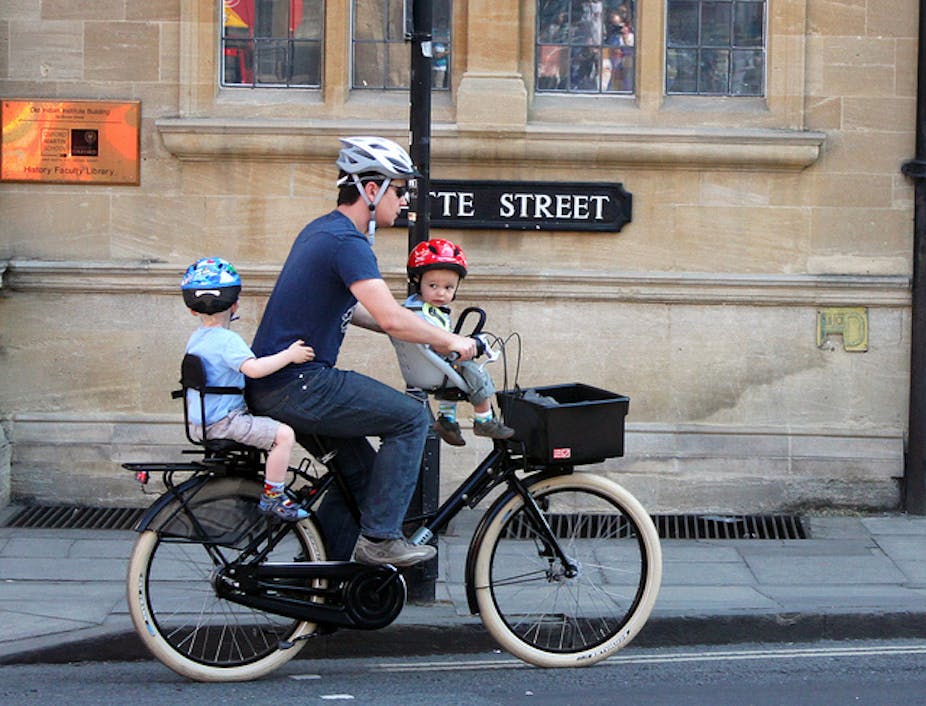
Convincing more Australians to get on a bike would undoubtedly deliver health improvements that come with reduced waistlines. But ditching bike helmets isn’t the answer.
The health benefits of more cycling would need to be multiplied countless times before they could offset the loss of life and health harms caused by serious head injury.
Benefits of helmets
Bicycle helmets have long been recognised as the best protection against head injury. As far back as 1977, Standards Australia approved a helmet design for cyclists to reduce their risk of head injury.
Throughout the 1980s the Victorian Government promoted cycling and encouraged the use of helmets with a bulk-purchase subsidy scheme, compulsory helmets for the schools Bike Ed program, a television and radio campaign, and a $10 per helmet rebate on purchases each December from 1984 to 1988.
Observational surveys show that the campaigns worked and helmet use grew each year in the 1980s, mostly among primary school children and also in teen and adult commuting cyclist groups.
As helmet use grew, the risk of head injuries reduced. The number of cyclists killed or hospitalised with head injuries reduced by about a third in the 1980s.
The number of other injuries actually increased, though it’s not surprising given there were greater numbers of cyclists on the road.
When the Victorian compulsory helmet laws passed on 1 July 1990, helmet wearing rates more than doubled — from around a third to three quarters — by March 1991. The increase was smaller for primary school children, who were already avid helmet-wearers.
Rates of cyclist head injury fell by 48% and 70% during the first and second years of the law.
It’s been suggested that helmet laws contributed little to the reduced injury rate, and that Victorian cyclists benefited most from road safety improvements, such as random breath testing, speed camera enforcement and supporting mass-media campaigns.
These initiatives may explain some of the reduction in the total number of cyclists killed and hospitalised during the early 1990s.
But the additional reduction in head injuries in the first two years of the law was consistent with the rise of helmet-wearing in those years.
Cyclist rates
So, there’s no doubt that mandatory helmet laws reduced head injury and improved cyclist safety. The problem is that it also reduced rates of cycling in some groups.
Teenage cycling decreased by 43% and 46% in the first and second years of the law. Rates of primary school student cyclists also dropped slightly.
But it wasn’t all bad news.
More adults began cycling after the introduction of mandatory helmet laws. Adult bicycle use increased by 88% from 1987/1988 to 1991, and doubled by 1992.
Overall bicycle use had increased by 9% in 1991 and by a further 3% in 1992.
So focusing on reduced bicycle use by teenagers, and to a lesser extent by younger children, gives a misleading impression of the overall impact of the helmet law on bicycle use.
New generations of cyclists
It’s interesting to speculate on what would happen if helmet laws were repealed.
Because the bicycle-use surveys weren’t repeated throughout the 1990s, we won’t ever know if helmet laws continued to discourage cycling.
If they did, we would have to ask whether repealing the law would increase cycling and bring about sufficient health improvements to offset the increased risk of head injury.
Valuing the benefits of exercise through cycling is outside my area of expertise. And I am yet to see a full analysis of these benefits comparable to an objective analysis of the costs of increased cyclist trauma, especially head injuries.
But failing to prevent serious trauma on our roads isn’t just a transport problem or even a public health issue — it’s both an ethical and economic dilemma.
Investment in preventing a road death is now valued at about $6 million in the National Road Safety Strategy. A serious head injury resulting in permanent brain damage, which a bicycle helmet can often prevent, could cost our health system a lot more.
More than two decades after they came into effect, it is likely that cyclists — and parents of child cyclists — have accepted that helmet wearing is a normal part of cycling.
Only those who are ideologically opposed to their legal obligation to protect themselves would choose not to wear a helmet.
What’s clear is that our community values preventing road deaths and serious injuries much higher than it did in the past.
Ultimately, the health benefits of increased bicycle exercise have a long way to go before they can offset the increased costs of cyclist death and serious head injury.
Chris Rissel from the University of Sydney kicked off The Conversation’s debate about mandatory bike helmet laws in March, when he said ditching helmets would encourage more people to get on a bike and get to fit. Read his article here
Continue the conversation in the comments field below: Should mandatory helmet laws be maintained to protect cyclists against serious head injury?
References:
Cameron, MH, Vulcan, AP, Finch, CF, and Newstead, SV. Mandatory bicycle helmet use following a decade of helmet promotion in Victoria, Australia – An evaluation. Accident Analysis and Prevention, 1994, 26(3), 325-337.
Wood, T, and Milne, P. Head injuries to pedal cyclists and the promotion of helmet use in Victoria, Australia. Accident Analysis and Prevention, 1988, 20(3), 177-185.
Werner Hammerstingl
logged in via LinkedIn
I find the use of percentages without a baseline number a significant hindrance to a full evaluation of the arguments. After all a 50% decrease can describe a change from 2 to 1 or 150 to 75....
Troy Barry
Postgraduate student
Helmet laws could be relaxed without being entirely rescinded. For example, helmet use could be optional on bike paths and on streets where the traffic speed limit does not exceed the suburban speed limit. Selecting the cut-off point would require a closer look at the statistics and an ideological compromise from both sides of the discussion.
Peter Robinson
logged in via email @nex.net.au
Troy, this is a good approach and I have written many emails and letters to polititians over this very question. Why are there no common-sense exemptions when there are for every other safety intervention? There is an infuriating vacuum where there should be an answer to this question. They WILL NOT ANSWER this question. Instead we have a situation where one is actually breaking the law if one straddles a bike in any public space without a helmet. This is puerile beyond belief in a purported free country.
Dave Kinkead
logged in via Facebook
Troy - in the NT, it is legal to ride on a foot/bike path without a helmet. Interestingly, despite having a per capita road toll 3 times higher than the rest of the country, their cycling fatality rates are identical to southern states. The NT has not suffered for relaxing the laws.
All states have some, rather strange exemptions. Often, unicycles aren't defined as bikes and therefore not covered by the laws. Pedicabs are normally exempted (for paying passengers only - it seems that when money changes hands, people become safer. But not the riders, they always have to wear one).
Finally in QLD, you can get an exemption from your GP. As the skin cancer capital of the world, we have around 2000 deaths annually from skin cancer, but less than 40 from cycling. Given that you can't wear a wide brim hat with a helmet, most GPs are willing to write an exemption on these grounds if you ask.
Bob Bobsson
Mr
You make a compelling argument, and are obviously significantly more aware of the studies around this than I. But what about the fact that more people on bikes results in greater awareness of them by motorists? This should result in motorists being more careful around those cyclists than they are now.
If you compare the rates of cycling deaths by the Dutch (who have no mandatory helmet laws and who cycle *much* more frequently) with those of Australians, you'll see that the Dutch cyclists are…
Read moreThis is a highly recommended comment.
Peter Robinson
logged in via email @nex.net.au
Back in the late '60s the Danish had a high cyclist road toll. Like anywhere in Australia, Copenhagen was car-clogged.
Read moreThey were loosing 300 cyclists a year.
What they then did brought the toll down to 19 by last year.
It was not helmet law.
They did it with advanced infrustructure and laws that favour cyclists.
A few years ago the issue of helmets came up.
But, citing the "Australian Effect", they voted 90 to 20 not to have a helmet law.
They could see that it had not worked in Australia.
What happened…
This is a highly recommended comment.
Sue Abbott
logged in via email @virtualgypsies.com.au
Your references are archaic, and have been well & truly refuted.
Standards Australia is an agent for SAI-Global, a company in the business of manufacturing and trading in standards. The amended standard, AS/NZ2063 still has not incorporated a test for an oblique impact for various reasons; ethics, lack of equipment, lack of biomechanical knowledge, funding constraints, time constraints.
Given that Australian academics are still squabbling on this issue, it ought to be a matter that is left to the realm of personal choice. The rest of the world (New Zealand being an unfortunate exception) manages very safely without mandatory helmet laws to the point where they have more cyclists sharing the roads with considerably more motorised vehicles than we have here in Australia.
It's time for us to grow up and acknowledge what the world already knows - bicycle helmet laws are dangerous for our health!
Linda Ward
Biostatistician
Sue
Read moreContrary to your claim that Prof Cameron's references have been well and truly refuted, numerous (more recent) studies have shown that helmets substantially reduce the risk of fatal, brain and head injuries . . .
A 1999 study by Hendrie et al (An economic evaluation of the mandatory bicycle helmet legislation in Western Australia) found that after the helmet law there was
- a 20% reduction in the ratio of the proportion of cyclists with a serious head injury, compared to the proportion of…
Dorothy L Robinson
logged in via email @gmail.com
Linda seems to have confused risk of injury with the odds ratio of head vs other injuries for cyclists who crash.
The distinction is important because the Australian population aged nine years and over grew by 58.4% between 1986 and 2010 but the daily average number of bicycle trips grew by only 20.9%, representing a per capita decline in cycling - http://cyclehelmets.org/1207.html?NKey=95
Census data on cycling to work is also substantially less:
Read more1986: NSW: 1.09%; Aust: 1.68%.
2006…
Sue Abbott
logged in via email @virtualgypsies.com.au
How interesting we can both use Rune Elvik's meta-analysis to support our different positions! To me Elvik's paper 'indicated no net protective effect' of bicycle helmets, a position I mentioned in my submissions to the ACCC last year. In fact I recall that Elvik highlighted in his paper at the section headed "5. Discussion" that 'these findings raise a number of issues':
- 'In the first place, why do recent studies show a smaller protective effect of bicycle helmets than older studies…
Read moreLinda Ward
Biostatistician
You seem to have overlooked the results presented in Elvik's paper with respect to fatal and brain injury, and misinterpreted what Elvik said in the conclusion. The results presented in section 4 of the paper showed that, compared to non-helmeted cyclists, in helmeted cyclists the risk of
Read more- fatal injury was reduced by 77% (table 1, 6 studies, random-effects model)
- brain injury was reduced by 53% (table 1, 8 studies, random-effects model)
- head injury was reduced by 53% in older studies, by…
Linda Ward
Biostatistician
Re the claim that the Australian population aged nine years and over grew by 58% between 1986 and 2010 and there was a per capita decline in cycling . . .
58% is considerably more than the 42% I calculated (using ABS population counts):
- in 1986, the Australian population was 16,018,350 with 2,387,973 aged 0-9 years
- in 2010, the population was 22,328,847 with 2,826,476 aged 0-9
- this represents a growth in population between 1986 and 2010 of (19,502,371-13,630,377)/13,630,377=43%
Figures…
Read moreLinda Ward
Biostatistician
Re your description of the Walker study as showing the author was given 'significantly less room' when wearing a helmet . . .
For a non-helmeted cyclist, the average overtaking proximity varied from about 1.2m to 1.45m, depending on the cyclist's distance from the road edge. For a helmeted cyclist, the average overtaking proximity was about 5 cm less. Your description of this difference as 'significantly less' appears to be referring to statistical significance. In health research, such a trivial difference (less than 0.5%) would be described as clinically insignificant, ie. the 5cm difference in overtaking proximity (in the context of an average overtaking proximity of about 1.3m) is unlikely to have any effect on the outcome of being hit by a car.
Linda Ward
Biostatistician
Re cycling to work between 1986 and 2006 reducing from 1.1% to 0.8% in NSW, and from 1.7% to 1.2% nationally . . .
Read moreA study by Mees et al (Travel to work in Australian capital cities,1976-2006: An Analysis of Census Data) provides some insight into possible reasons for the decrease in cycling to work. According to the census data presented in Mees' paper
- in Melbourne, there was no difference in the proportion of people cycling to work in between the censuses immediately before (1986) and after…
Linda Ward
Biostatistician
Re the NZ cost-benefit analysis found that the reduction in head injuries was somewhere between zero (if trends were fitted in a model) to a maximum of 13 cents per helmet per year . . .
Read moreThe 2nd sentence of the 2nd paragraph of the Taylor and Scuffham paper states that the evolution does not include the cost savings in preventing death, and is limited to evaluating costs with respect to hospital admissions averted. (The claim of an 'absence of evidence on the effectiveness of the HWL in preventing…
Linda Ward
Biostatistician
Re ' . . . per capita cycling injuries have increased . . . the risk of head injury has increased' . . .
Read moreABS travel to work data and ATSB road fatality data indicate that, nationally, between 1986-1990 and 1992-1996 there was a (considerable) decrease in cyclist per capita risk (of death), not an increase:
- cycling to work reduced by 13%
- cyclist road fatalities reduced by 41% (annual cyclist road fatalities averaged 84 between 1986 and 1990, and 40 between 1992 and 1996, there were 41 fatalities…
Colin Clarke
logged in via email @vood.freeserve.co.uk
The RTA detailed the drop in cycling by 1992;
· road intersections in Sydney down 41%
· number of high school children cycling in Sydney down 53% and 42% in rural locations
· rural recreational areas and primary schools, both down by 37%.
From the above information for children and also adults it is obvious that a main effect of the helmet legislation was to discourage cycling.
The 1990 survey was conducted in the spring and poor Sydney weather conditions. Walker reported, “As it turns…
Read moreColin Clarke
logged in via email @vood.freeserve.co.uk
Correction
Should have stated;
The RTA detailed the drop in cycling by 1992;
There was a 14% decline in the number of adults cycling and a 36% decline for children. The largest children declines recorded were:
· road intersections in Sydney down 41%
· number of high school children cycling in Sydney down 53% and 42% in rural locations
· rural recreational areas and primary schools, both down by 37%.
Doug Rand
logged in via Facebook
These tiresome statistics tell us nothing about the real risk of cycling on an individual basis. A reduction of a very tiny, tiny risk, is still a tiny, tiny risk.
I wonder if you or Cameron have any cycling experience at all. I've ridden on roadways in traffic for over six decades. In my lifetime, I've accumulated in excess of 300,000km without suffering a head injury
Helmets don't reduce accident risk and may even increase it. Cycling experience and logic tells me they offer the false sense of security that could increase risk taking. Behaviour is critical.
The most effective means, estimated as high as 80%, of reducing a cyclist's risk is lawful and competent cycling.
Here in Canada, of all serious head injuries 49% involve motor vehicles, 1% involve bicycles. The question arises as to who should wear helmets.
... is this just an academic exercise in order for you to interfere in the life style of a group of which you are not a member?
Gary MacDonald
logged in via Facebook
You state that "Valuing the benefits of exercise through cycling is outside my area of expertise". I would argue that writing articles promoting helmet use is also outside your area of expertise. With all of your "statistics" above you seen to have forgotten to substantiate these claims with actual research data. There are numerus study which suggest that the health benefits from cycling (with or without a helmet) outweigh the risks by 20:1 (see Hillman M, Cycling and the promotion of health., PTRC…
Read moreWill Ross
Medical Officer at Victorian Infectious Diseases Reference Laboratory
I'm not sure how statements like "Only those who are ideologically opposed to their legal obligation to protect themselves would choose not to wear a helmet." fit in a respectable piece about public health.
Not only is it a logical non sequitur, it is also empirically false. Large numbers of Australians ride bikes in Europe, and when they do, they will tend to conform with the prevailing norm and law. When I ride a bike in Copenhagen, I'm not choosing to ride without a helmet due to some ideological disagreement with you! I suspect, however, that if you *did* wear a helmet, that in itself may be a more ideological act.
This is a highly recommended comment.
Paul Martin
logged in via email @me.com
"If helmets protect against brain injury, why not wear them?"
If this is something which you firmly believe then you must insist, given the greater benefit, that helmets should be mandatory for all car occupants too. If not, why insist that ALL bicycle riders, under ALL conditions, must wear them? The reason is that it is a minority and utility cycling (ie. not cycle sport) a minority yet again.
You might want to update your old references too... 1994 & 1988? Good grief.
Will Ross
Medical Officer at Victorian Infectious Diseases Reference Laboratory
Excellent point. Helmet wearing is ultimately a security measure; it protects against a harm. All security measures involve tradeoffs, which is why we don't adopt even very effective ones.
For example, bullet-proof vests reduce the risk of being shot and killed. I choose not to wear one, however, because of the low risk, it is expensive, heavy, and makes me look stupid.
Why can't A/Prof Cameron write a piece that honestly addresses the issue of the security tradeoffs rather than thinking the argument is proved when he can establish that a countermeasure reduces a harm?
BicycleTim Stredwick
logged in via Facebook
If there is a positive health case for compulsory helmet wearing, then there is a greater case for compulsory wearing of helmets in cars. There are far more people killed and injured due to head injuries in car crashes than cycling accidents.
Peter Teow
logged in via email @yahoo.com
Firstly, removal of the Mandatory Helmet law is very, very different from 'ditching bike helmets' - if people who ride bikes, skateboards or even drive their cars, can still choose to wear helmets, just like in the many countries of the world with better cycling safety without MHL.
Secondly, Standards Australia AS/NZ 2063 legislation is another classic enforcement shoved down the throat of the Australian public. A purported $20,000 to test a helmet so that you get a silver sticker for the helmet…
Read moreColin Clarke
logged in via email @vood.freeserve.co.uk
It says
"helmet wearing rates more than doubled — from around a third to three quarters — by March 1991"
In 1990 Melbourne surveys had 3121 cyclists with 1006 wearing helmets, by 1991, 2011 cyclists with 1303 wearing them. About 10% extra wore helmets, 297 in number, compared with 1110 fewer cyclists. Injury data suggest a larger reduction in cycling in regional areas of Victoria.
Robinson DL; Head injuries and bicycle helmet laws; Accid Anal Prev, 28, 4: p 463-475, 1996 http://www.cycle-helmets…
Read moreEtienne de Briquenel
logged in via Twitter
You are quite correct in claiming that "cyclists have accepted that helmet wearing is a normal part of cycling". The problem, however, is that we are talking about most established cyclists here; you know, the ones that make up around 1-2% of the population. The huge number of potential cyclists who have been turned off by the enormously exagerrated "dangers" of cycling certainly do not share this view, nor do a considerable number of established cyclists who either do not comply with the law or…
Read moreDave Kinkead
logged in via Facebook
Wow Max - is this really the standard of logic and analysis we can expect from C-MARC?
It seems from your article that you are confusing two issues: the efficacy of helmet usage with the effectiveness of mandatory helmet laws. I would expect most people, especially those with experience in accident research, would be able to tell the difference between the two but you have proven me wrong.
On the issue of helmet effectiveness, the jury is out. Clearly, there are a number of situations where wearing…
Read moreAlan Todd
logged in via Facebook
The debate about bike helmets has been dogged by belief based on little or no evidence. It is disappointing to find that Max Cameron's latest contribution is in this category. Take just the opening sentences:
"The health benefits of more cycling would need to be multiplied countless times before they could offset the loss of life and health harms caused by serious head injury."
"Bicycle helmets have long been recognised as the best protection against head injury."
In 2010 Piet De Jong published…
Read moreLinda Ward
Biostatistician
Alan
Read moreRe your claim that the Elvik meta-analysis showed a 'reduction in the severity and extent of head and face injury of 15%, with later data showing a reduced effect' . . .
The paper reported odds ratios
- for brain injuries of 0.42 using a fixed-effects model, and 0.47 using a random-effects model (table 1)
- for fatal injuries of 0.23 with both models (table 1)
- for head, face and neck injuries combined of 0.73 in the fixed-effects model, and 0.85 in the random-effects model (table 2…
Colin Clarke
logged in via email @vood.freeserve.co.uk
Hi Linda
I think the evidence for allowing people a choice in helmet use is substantial.
eg
NSW survey data shows a reduction in children cycling following legislation from 1991 to 1993, 6788 to 3798 counted, a 44% reduction. With 44% fewer cycling but only 9% extra wearing helmets the main outcome was to discourage cycling. Survey counts of students riding to/from NSW schools: 1991 – 3107, 1993 – 1648, a drop of 47%.
Australian data
Read moreThe 1985-86 Day to Day travel report details for…
Alan Todd
logged in via Facebook
Hi Linda,
Sorry to take so long to respond - I had to dig around for the original paper by Elvik. I think Dorothy Robinson has probably answered your question, or at least highlighted a source of misunderstanding in the confusion of risk of injury with the odds ratio of head vs other injuries for cyclists who crash.
But dealing specifically with your question of how I arrived at the 15%. I didn't arrive at it by way of fixed-effects odds ratios quoted in table 2. It is taken directly from…
Read moreThis is a highly recommended comment.
Dan
logged in via Twitter
What an extraordinary article! I note the this website promises 'academic rigour'; it is a shame that Mr Cameron seems entirely unable to provide it.
His second sentence, for example, can be refuted with a simple literature search. There are a number of studies that have been done that conclude that the negative health benefits of helmet laws (because people stop riding) outweigh the positive benefits form head injury reduction. One of the most pertinent was conducted by Professor Piet de Jong at…
Read morePaul Richards
Paul Richards is a Friend of The Conversation.
The UCI - Union Cycliste Internationale have adopted helmets for protection.
Read moreTheir model carries the weight of superior experience, knowledge, and wisdom regarding cycling.
No amount of logical argument, statistics, supposition and dare I say cognitive bias will ever compete with their insurers actuarial data.
Yes, insurers carry a bias, toward reducing risking their profit. Insured riders are killed, injured permanently disabled in and out of competition, but they are insurable. The underwriter…
Harvey C
Cyclist
The UCI adoption of helmets wouldn’t have anything to do with the sponsorship income earned from helmet manufacturers?
This authoritative and uncompromising argument is ridiculous, dismissing any form of rational discussion. You could use the same argument to claim that, since racing car drivers wear helmets, every car driver must wear an helmet.
Dorothy L Robinson
logged in via email @gmail.com
In the first and second years of Victoria’s bicycle helmet law, the numbers of *pedestrians* with concussion fell by 29% and 75%.
Pedestrians weren’t forced to wear helmets. So other factors, e.g. safer roads, probably had a much greater effect than helmet laws. 93 pedestrians were killed in Victoria the year helmet laws were introduced (1990), compared to 159 the previous year. Comparing the 24 months before and after Victoria’s helmet law, pedestrians and cyclists had identical changes in…
Read moretimgummer
logged in via Twitter
Helmets are a sign of a failed cycle culture. Like flouro hi-viz [nice idea.. give riders road worker status.. that’ll be a big sell…) they send a very clear and unambiguous message that cycling is unsafe that turns off potential new cycle riders, thereby ensuring less cycle riders on the roads, and a more dangerous environment. As has been pointed out, successful cycle cultures are lidless, and their accident rates are far lower. UK research (bath university.. check it out) has shown that car drivers…
Read moreThis is a highly recommended comment.
Harvey C
Cyclist
"A serious head injury resulting in permanent brain damage, which a bicycle helmet can often prevent"
That is not true. The cause of serious head injury resulting in permanent brain damage is diffuse axonal injury (DAI). The main cause of DAI is rotational acceleration. Not only helmets cannot protect against rotational acceleration but they can increase it. In other words, helmets can CAUSE permanent brain damage, or make it worse.
Here is a well-researched article that covers helmets effectiveness…
Read moreHarvey C
Cyclist
It would also be worth checking out the AS/NZ 2063 standard for bicycle helmets, especially what they are tested for. The tests are low speed (19.5km/h), and only straight on. Not all sizes are tested (notably absent are small children’s helmets). There are no oblique test or test for rotational acceleration. Essentially, the most common helmet today (the soft-shell helmet) is a thin layer of polystyrene that crumbles very quickly on impact, and cannot absorb much energy at all. This crumbling…
Read moreLinda Ward
Biostatistician
Re 'European countries have not introduced a helmet law because they have done studies that demonstrate it would result in an increase in health care costs', is this the article you are referring to:
http://www.ecf.com/wp-content/uploads/2011/11/Cycle-helmets.pdf?
Frank Krygowski
At this point, joining the chorus of well-stated disagreement with this pro-helmet article may seem redundant. Yet there is one point I'd like to emphasize.
Almost all analyses of the effects of bicycle helmets are founded on an unspoken assumption: that bicycling is an unusually important source of serious head injury, and that therefore some form of protection is obviously necessary.
My study of available data shows this to be a myth.
As an example: John Pucher of Rutgers University has…
Read moreKarl Stade
logged in via Facebook
Great comment Frank. I honestly am surprised that there is even such a debate about helmets for cyclists considering that such a debate does not seem to exist for other, higher risk actives such as walking or driving a car. It seems that helmets are an easy target, effectively placing further responsibility on cyclists for their own safety - rather than on motorists to drive slowly, safely and be aware of other road users. We need to stop blaming the victims - instead we should focus on making cycling a common activity like it is in places like Holland and Denmark. More cyclists on the streets/paths travelling at normal speeds, better quality and designed infrastructure, vulnerable road user laws, lower road speeds and reduced travel distances will do far for for the safety of cyclists and pedestrians than a helmet law ever will.
Anony Mous
Have just been back in Australia a few months after living in the UK for 15 years. Was a non-helmet wearer in the UK, cycling to work reguarly in London and on the occasional jaunt to Europe. I cycled about 30,000 km over this time - without a helmet and without any head injuries. Coming back here, I find it quite hard to adjust to having to wear a helmet. Firstly, I find them quite awkward and uncomfortable on my head. Also, you cannot fit a cap comfortably underneath - to provide some shade from…
Read moreJustin Wood
logged in via Facebook
I have nothing to add other than to endorse the range of comments here pointing out the seriously questionable claims that bicycle helmets actually even represent a safety benefit.
I would challenge Max to respond directly to those points. It is telling that he in no way addressed the specific statements on the lack of protection from serious head injury raised by Chris Rissel in his original article.
SaveNaturefree Here
logged in via Facebook
I never use a bicycle helmet in daylight hours. I never pay bicycle helmet fines ether, haven't paid one for over 18 years. Cycle helmets are not recommended for outdoor use. Forcing a child to use one is unlawful,
(see s326 Queensland criminal code)
Exposing a child to harm outdoors or doing something that is likely to cause preventable exposure is unlawful.. This fact means the current Bicycle helmet legislation isn't worth the paper it's written on. It's back to the drawing board for the Government that wasted millions implementing this law and issuing fines to thousands of cyclist in error.
We have almost 5 deaths per day from Skin cancer in Australia. The highest rate of childhood obesity in the world and one of the worlds the highest rates of teenage suicide.
Alan Todd
logged in via Facebook
If you want to sign a new petition opposing our infantile helmet laws, go to www.freestylecyclists.org