


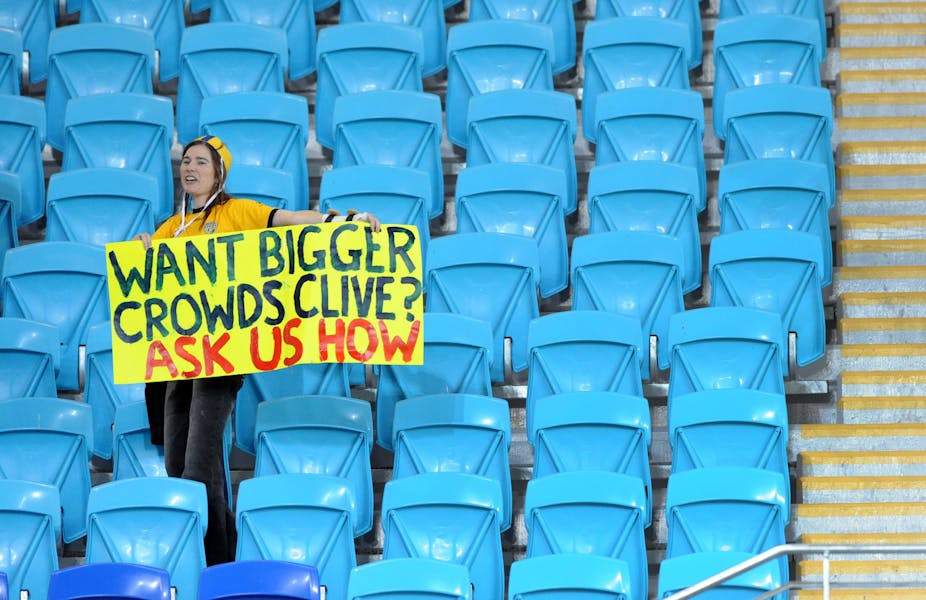
The decision taken by Football Federation Australia to revoke the Gold Coast United licence should come as no surprise.
GCU owner Clive Palmer has been highly critical of the FFA in recent weeks. He slammed the league’s management then went on to breach the league’s participation agreement by removing the major sponsor’s name from the players’ shirts, replacing it with a slogan that read “Freedom of Speech”.
This was apparently a response to FFA advice he was demonstrably disloyal to the league by claiming it had done nothing to assist GCU in sustaining its operations.
Suddenly, good will between Palmer and the FFA vanished in a couple of rush-of-blood-to-the-head decisions.
Who is to blame?

But this stoush is a sign of something much deeper than who is to blame for the dismal performances of GCU over recent times.
It is really about the economic viability of FFA in its current form, and its capacity to support a national league where nearly every club is battling to break even, and its national spread is dependent on the generosity of franchise owners.
Clive Palmer is a case in point. For all his bravado and off-the-top-of-the-head pronouncements on the league’s governance and management, he has sunk a lot on money into a team that was never going to be viable. The idea that Gold Coast could ever break even by having a team roster of full time professionals and attracting 4,000 fans to its weekly fixtures was pure fantasy.
But Clive Palmer should not be blamed for the current crisis. In fact he should be applauded for his risk-taking ability, and his preparedness to give it a go in full knowledge he was throwing his capital into a bottomless financial pit dug by FFA.
Doomed to fail
Gold Coast United was never going to make a profit for its owner, and because of its limited resource base, it was never going to attract the big name players, or secure the best credentialed coaches. It was never going to attract a large fan base, especially in the light of NRL team the Gold Coast Titans’ solid supporter base and the Gold Coast Suns’ 2011 crash-bang entry into the AFL with a massive promotional edge in recruiting Karmichael Hunt and Gary Ablett.
It should also be noted that the early demise of an A-League franchise is not new. Townsville was touted as a team of enormous potential a few years ago.
But it became clear early on that the franchise was not going to survive unless it was able secure not only a remarkably generous corporate partner, but also an exceedingly wealthy benefactor-come-owner who would be quite comfortable throwing away money in order to keep a big name national league franchise in a frantically aspirational town somewhere in northern Queensland.
Shaky ground
The current fracas between Palmer and FFA highlights the economic fragility of the A-League. It might, on paper, have a nice spread of teams across the big cities. It has certainly secured a number of highly skilled players. It now has a few nice stadia in which to play its games with some solid coverage on Fox Sports, and it has managed to build up some good corporate partnerships. But it is also an exceedingly unbalanced competition from a financial perspective.

Once Melbourne – in the form of the Victory and Heart – is taken out of the equation it all falls bit flat.
Perth and Adelaide will never become commercial drivers of the A-League’s vision to become the major football competition in Australia.
Brisbane has been captured by rugby league, with the AFL riding on its coat-tails, northern Queensland and the Gold Coast no longer have the confidence to support an A-League team any time soon, and a western Sydney franchise will take a lot of time and money to establish.
All that is left is a belt around Sydney comprising three teams, none of which have captured the hearts and minds of as many fans as first imagined. This is not a good foundation for building the soccer brand, and matching it with the big-boys of the AFL and NRL.
A sign of things to come?
The A-league is clearly a loss leader, but it is has difficulty doing what loss leaders are supposed to do, which is to capture a solid share of the market, and make it bigger sooner rather than later.
And if the A-League cannot secure a lot more support over the next few years, it will be just a matter of time before the whole commercial edifice comes under serious challenge, or even worse, collapses into a massive pile of sporting rubble.