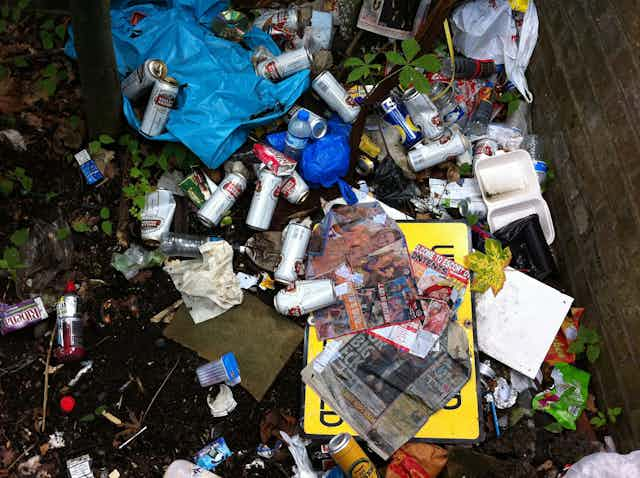

Cognitive dissonance is that uncomfortable feeling we have when we know we should invest in solar panels but the 46″ wide screen TV wins out; we know we should catch the bus but we take the car anyway. It’s that sense of discord that arises when emotion and reason don’t get along. And unfortunately, it’s alive and well, sabotaging the climate change debate.
We’ve evolved to feel a single sense of self, but our minds consist of multiple voices. Our emotional brain has first go at making sense of our world, instantly telling us how to behave and what to believe, based on instincts reinforced by upbringing. Sometimes our rational brain is then called upon to endorse our intuitions, which then become beliefs. Problems that are unusually difficult or surprising will recruit our rational brain, but reasoning takes effort and we avoid it when we can.
Unfortunately our emotional brain is encouraging us to pursue perceived self-interest even if that means trashing the planet. This leaves our rational brain to try to justify our actions, even while the walls come tumbling down and the temperatures keep rising.
If we are to have any chance of a future we need to understand why our intuitions are so poor, and how we might temper them by engaging our ability to reason.
We haven’t evolved to be successful in the modern world. Civilisation arose only 12,000 years ago; in evolutionary terms that’s just the blink of an eye. Ninety-nine per cent of human evolution occurred during the Stone Age, so our evolved instincts, personality traits, and even some of our cognitive “short-cuts” are much better suited to this Pleistocene world.

Evolution didn’t care about the future; it was simply driven by those who survived and left the most descendants. So our ancestors were the ones who were best at competing for food and status, securing mates and having babies. They were materialistic, living very much in the present and rarely constrained by sustainability. They ate a broad range of foods, and if resources became depleted they could expand their territories or move on, behaviour that led to the extinction of many animals and to extensive migration.
A level of altruism did evolve, but it was circumscribed by benefits to kin, expectations of reciprocal reward, and an obsession with fairness. Altruism can often therefore be trumped by self-interest.
We might expect that intelligence and language would have been game-changers; they were, but not necessarily for the better. We learnt to tame nature and harvest its bounty, to build great cities, and to harness the laws of physics and chemistry. We may celebrate the Industrial Revolution as the beginning of modern civilisation, but it also ushered in burgeoning overpopulation, resource exploitation, pollution and climate change.
So if we evolved to exploit nature, and to be blind to the consequences, what now? Our only chance is to wrest control away from our emotional brain, and construct a new reality where our rational brain can take control.

We need to design a new kind of democracy where many government decisions are made cooperatively, with multi-party representation and the input of experts. Such think tanks must have strategies in place to promote critical self-analysis and to “frame” policy to reflect the long-term reality. The cost of climate change mitigation can then be shown to be minute compared to the cost of inaction.
If we value a sustainable world, the GDP must be replaced by a measure of a country’s wealth, including resources, social capital and the cost of pollution. Costs should reflect the inclusive cradle-to-grave value of products and services, so that choices reflect out true long-term interests. Conspicuous consumption might be curbed further by offering workers the choice of more leisure rather than a salary increase, and by rewarding excellence with honours and privileges, rather than fat pay packets and obscene bonuses.
Education must produce adults who can think critically and understand what’s at stake and why our judgement is flawed. To counter self-interest, the government should use incentives and disincentives to guide public behaviour. We need to encourage altruism by instituting reciprocal, incremental improvements, and by showing leadership.
We are at the crossroads. Unless we recognise the less-adaptive aspects of human nature and devise ways of keeping them in check, the world we bequeath to our children will be a diminished one. We have the means to do this, but do we have the will? Evolution may have made us the most intelligent animal on Earth, but it makes no promise that we will be survivors.
Fern Wickson
Researcher at GenØk - Centre for Biosafety
There is much I agree with here - however I am not at all sure that I would say evolution made us the most intelligent animal on Earth. What do you mean by intelligence exactly? We may be remarkable tool makers and users, but we are remarkably foolish ecological citizens.
Michael Shand
Michael Shand is a Friend of The Conversation.
Software Tester
You can be really intelligent and commit suicide - intelligence does not equal survival, you cant say ohh we are not as smart as ants because we are destroying our environment....no we are still smarter than ants and dolphins and anything else on this planet. I agree with you that we are foolish and maybe not as smart as we think we are but we are magnitude's smarter than our closets cousin species, in almost any way you define intelligence we are still the smartest species on the planet, however thats not really a huge accomplishment given the competition
Dan Smith
Network Engineer
"we are remarkably foolish ecological citizens" ... surely that's part of the point the author was making?
To rephrase your question: Can you come up with a definition of intelligence that doesn't put humans on top by a long margin?
Animals that don't destroy their environment aren't exhibiting an intelligence of forethought and planning; they're subject to an environment/ecology that, for whatever reason, is not allowing them to. Our current global planning skills are pitiful in comparison to what we're probably capable of, but they're still light years ahead of other species. Our brains got us into this mess, and we're going to need them to get us out.
Fred Pribac
logged in via email @internode.on.net
Great passion. Many sentiments I support. But unfortunately ... poor logic. My prediction is this article will get ripped to shreds.
Mike Hansen
Mr
My prediction is that this article will get trolled to threads if The Conversation's own Andrew Bolt, Gerard Dean gets wind of it.
Helen - I agree with the sentiment but disagree with elements of the argument. For example - the bus vs taxi photo - if the bus was cheap, safe and reliable and it was also fun to catch because it was full of your peers, why would you catch a taxi? We need a new way of living that is not only sustainable but is more enjoyable than our current stressful dog eat dog existence. Then the cognitive dissonance disappears.
Ian Donald Lowe
Seeker of Truth
I could pull this article apart for the flaws in it but I will refrain from doing so.
Early man lived in communities and those communities shared everything. Early mankind would never turn a peaceful stranger away from their hearth and every effort was made to be as hospitable as possible. Unless there was a conflict in progress (very rare compared to modern man), when tribes met, they would trade and exchange knowledge and technologies and when it was needed, or desired, large groups could come together to work in co-operation to achieve a specific goal. (Stonehenge didn't build itself.)
Early mankind used natural materials to create the things they needed, gathered from nature and discarded or swapped or given away when no longer required. We always were amazing creatures with incredible talents but we lost our way somewhere, perhaps when greed became more powerful than need (or when the pyramid builders took control).
Gerard Dean
Managing Director
YIppeeeeeeeeee
James Wookey
Paramedic
Good point, we need soloutions that attractive to people if they're ever going to work. The current measures are all stick and no carrot.
Ashley Hooper
Farm worker
Of course, implicit in your proposal, James, is the assumption that we can create 'solutions' that are both effective and attractive to people.
Michael Shand
Michael Shand is a Friend of The Conversation.
Software Tester
I would still catch the taxi, if im going to or from work the last thing i want is to be surronded by people
Michael Shand
Michael Shand is a Friend of The Conversation.
Software Tester
Way to disneyfy history mate....early man would of welcomed you into his tribe and made you a cup of tea without asking, early man would of given you a foot rub and a copy of the paper while you rested.
Early man would of burned you alive if he thought you possesed magic or were cursed, he would get angry if you disrespected any of his property including his women after all he owns her, etc
Its as bad as the muslims or the christians who talk about before the fall of man, before the apple was eaten BS, Remeber the apple was from the tree of knowledge, knowledge lead to sin, sin lead to pain and war and confusion....is basically what you are saying, early man was more peaceful because he was ignorant.
I like to think we have made at least some progress
Ian Donald Lowe
Seeker of Truth
The nearest living example of early man we have (and I mean no disrespect at all) is the native peoples of this land and the events of first contact. There have been numerous recorded incidences of a peaceful white man being accepted into the camp and offered sustenance but also offering aid or comfort to lost adventurers is also on the historical record. Respect is something that should be shown in any case, this is a great flaw in our characters, this lack of respect for others who may be different in some way. It's a very individualistic attitude.
You shouldn't mock what you don't understand either, that is very disrespectful Michael.
James Wookey
Paramedic
Of course we can create effective and attractive solutions, it largely depends on the will to act. At present there is little effort being put into designing more effective systems that exceed the performance of the current systems. There is too much reliance on "guilting" people into adopting the current crop of ill fitting half measures. There needs to be a personal upside to adopting sustainable measures.
Mike Hansens comment about the bus is exactly my point. If the bus was clean cheap and ran on time it would be a more practical alternative more people would use it because there is a personal benifit involved. No one is going to catch a slow, dirty and expensive bus that may not even show up even if they are guilted for choosing an alternative (in this case a taxi) which actually delivers what the individual wants.
Carol Daly
Director
You make the disrespectful mistake that Australian Indigenous culture was that of 'early man'. Read Bill Gamage's The Biggest Estate on Earth and any of Henry Reynolds historys
.
Ian Donald Lowe
Seeker of Truth
Perhaps I should have said closest instead of nearest example? By that I mean closest in the natural lifestyle the native peoples lived, with an overlay of cultural, social and technological development that is uniquely Australian. I really didn't mean any disrespect at all because I don't see early man as any less intelligent or capable than modern man and I really do not believe the human brain has evolved at all in 6,000 years.
I have read The Biggest Estate on Earth but nothing by Henry Reynolds, as far as I can recall.
Dr Graham Lovell
logged in via Twitter
Only good leadership has a chance of reorienting the thinking of six billion people to a new more co-operative way of thinking and living.
I agree that it would be most efficacious if we could re-orient our society to a less consumerist approach. Here we definitely need leadership, and a new way of thinking, where we consider the needs of others as well as our own needs. It also needs to appeal to both "brains," as you put it.
We cannot force solutions on the rest of the world. This is the…
Read moreGerard Dean
Managing Director
I will go along with some of what you say Doc.
Some.
I agree that an international ETS is hopeless, it will be scammed, rorted and manipulated until it collapses. Like wise, your comments on the good old Communist systems are apt.
However, I do take issue with your call for good leadership. Australia is a democracy, which means that our leaders reflect us in all of our duplicitous and erratic behaviours.
Also, although the present federal government has blown away John Howard's savings…
Read moreIan Donald Lowe
Seeker of Truth
In the last 6,000 years or so the human brain has evolved not one little bit.
But that's fine because we have a wonderful brain already when we bother to use it right. I would suggest that civilization in the form of city-states and empires and so on, has created the wars, the greed and the selfishness of today.
Materialism is an empty existence that can never be satiated, so it is destructive to ourselves and our community and our country and our planet. Having a comfortable life doesn't require a warehouse full of stuff.
Wants and needs are confused in the modern world, thanks to the influence of advertising but we have few basic needs such as clean food (nutrient), clean water, clean air, shelter, protection from the elements (clothing) and love. We can have more and that's fine but do we need to have it all?
Mark Harrigan
Dr
Read "Thinking, Fast and Slow" by Daniel Kahneman, 2002 winner of the economics Nobel prize for his work on decision making and how, as irrational humans, our intuitive judgements and rapid heuristics frequently (if not always) control our more rational effortful attention.
Cognitive shortcuts win and effortful attention is mostly marshalled to justify what our emtions demand - it takes considerable effort to change. Unless we can change that - then we may well be about to have reached our evolutionary limits
Ian Donald Lowe
Seeker of Truth
Speak for yourself mate.
My major decision making is entirely rational with only some minor decisions being emotive. Many of my choices are prohibited or restricted and the available options are often all compromised choices. That is thanks to the ruling classes and the sciences deciding they know better than I do. Well guess what? They have been getting it wrong for 226 years in this country alone, and now it might cost us the Earth. Perhaps it's time to question the scientific mind about it's poor choices and stop trusting the scientific mind to form real solutions to complex problems? Every effort so far has had negative impacts, that has to say something about the scientific mind, doesn't it?
What's the point anyway? Continued existence is a waste of time, so step up to the suicide booth for the final solution? Talk about Doctor Death, Karvorkian has nothing on you guys.
Mark Harrigan
Dr
You have no idea do you oh "Seeker of Truth". I'm sure you believe you are entirely rational. Try reading Kahneman's work for a wake up call. You might also learn from this, though probably not ;)
http://www.ted.com/talks/kathryn_schulz_on_being_wrong.html
Ian Donald Lowe
Seeker of Truth
Think what you like Dr. Death but you don't know me and you don't know anything about me except what I write on this site. I had my wake up call a while ago and I realised just how wrong I had been, in so many ways, for most of my life.
That was a bitter pill to swallow but it was necessary and it was worthwhile because now I can face my flaws without fear and deal with them as best I can, with an understanding of why the world is the way it is and why I was like I was and why I am not the same now.
I watched a few minutes of the video and that was enough. I dont need any more 'experts' telling me what a failure I am and how wrong I am, thank you. I've had that my whole life and I have had more than enough of it!
I am, therefore I am.
Dan Smith
Network Engineer
Angry seekers of truth aside, I can second Mark's endorsement of Kahneman's work. I came across his and Amos Tversky's work via other sources, and it's fascinating stuff.
Mark Harrigan
Dr
Ian - you claim to be "rational" - then you call me "Dr Death" which is clearly an emotive response based on no information.
If you are a seeker of truth that you claim - have a look at some of the sources I have provided on this topic. inform yourself, and then make up your mind. It would not seem to me to be rational to be certain and close minded on the topic
Ian Donald Lowe
Seeker of Truth
"we may well be about to have reached our evolutionary limits" That was you, wasn't it? It's more than a little grim, that prognosis.
Sorry Mark, I don't wish to be re-programmed for 'society', so no thanks on your sources.
Mark Harrigan
Dr
Ian - it is your choice to be close minded then. That hardly seems rational, or an attribute of a "Seeker of Truth". You presumed to make judgements about the resources I pointed you too without actually seeing all they had to offer. Surely a rational "Seeker of Truth" such as you claim to be is capable of actually being informed and then making a judgement - as opposed to making a judgement to choose to be uninformed?
As far as my statement - "we may well be about to have reached our evolutionary limits" - it's an observation, not a prognosis. The point of the article is that most of the evolutionary pressures that shaped our cognitive abilities have changed dramatically. We developed rapid heuristics to make judgments that, mostly, served us well. It's just possible that those heuristics are no longer so useful. Goggle Kahneman - you really might ;learn somthing that would enlighten you :)
Gerard Dean
Managing Director
Ms Camakaris.
Thank you for the first article on The Conversation that clearly articulates our duplicitous behaviour when it comes to sustainable living. That's good, however I do not believe your suggested solutions have a chance in hell of getting up. Let me show you why.
We have to pass over your "bus versus the taxi scenario" and confront one much closer to the bone of many The Conversation readers - discretionary burning of non-renewable JetA1 fuel for holidays and international conferences…
Read moreComment removed by moderator.
Comment removed by moderator.
Michael Shand
Michael Shand is a Friend of The Conversation.
Software Tester
Seriously? the old, why dont you stop breathing because it creates CO2 argument
there is a good reason why we need to breathe and why we need to travel long distances in short times
Are you really this ignorant that you think that the only options are the extremes? you either hold your breath or burn oil in your backyard 24/7 - you dont see some middle ground, you cant see the multiple shades of gray here - are you really this dense or are you just repeating tired conservative talking points
Dan Smith
Network Engineer
"That is why I am not so sure idea that making people better critical thinkers or introducing measures to make people less self interested or more altruistic will work. Why?
Because people love to fly to Europe for holidays because it is exciting and educational."
Soooo ... we shouldn't try to encourage critical thinking because ... Europe is awesome?
You seem to be saying -- leaving aside the obtuse example -- that because there isn't enough critical thinking about issue X, there's no point encouraging critical thinking, because we don't think critically about issue X already? On that circular logic, the sooner we start with some critical thinking courses the better.
Gerard Dean
Managing Director
Mr Smith
Putting it more simply.
The author, Ms Camakaris suggest that if people are taught to think critically,it will help them make more informed decisions about the merits of climate change mitigation and sustainable living.
I suggest that this is not correct. I prove my contention by pointing out that most readers of The Conversation consider themselves educated critical thinkers, yet they still choose to fly on discretionary holidays and conferences, and in doing so, consume non-renewable JetA1 fuel.
If Ms Camakaris is correct, then these flying readers are not critical thinkers, whereas if I am correct, they are hypocrites.
Thank you.
Gerard Den
Gerard Dean
Managing Director
Mr Shand
I don't have any issue with those who drive a car to work, run a milling machine, fly a plane, drive a truck,operate on the sick, teach kids, program a computer or any of the thousands of ways we use energy in our day to day life.
BUT, I do have issue with people who tell me I should live a sustainable lifestyle and lecture governments to stop using fossil fuels, but who then CHOOSE to fly and burn JetA1 fossil fuel for holidays and conferences.
The choice of a holiday destination is entirely discretionary. It is not essential, it is not like having to put petrol in your car or light your home or switch on the split system, it is a pure choice.
The choice to fly or not for a holiday is the purest indication of a person's true committment to global sustainability.
Gerard Dean
David Paxton
Veterinarian
Helen, this is a great conversation, and your paper The Poisoned Chalice is specially impressive. In past eras, traditional taboos and totems did work to protect the environment (it is thought) though there were downsides in unfairness. The same sort of "traditions" powers other animal cultures. Now our own culture has just enough knowledge to scoff at cultural constraints in lieu of sanctioned self gratification. But technology could provide a solution. What if pollution could identify the polluter…
Read moreComment removed by moderator.
Gerard Dean
Managing Director
Ms Camakaris
You have confused me again.
In your article you stated, "We need to design a new kind of democracy where many government decisions are made cooperatively, with multi-party representation."
Given your apparent 'disquiet', for want of a better word, about the leader of the opposition, Mr Abbot, why are saying he should be one of the multi-party representation that makes cooperative government decisions.
It appears that you have contradicted your own publicised views? Why should the leader of a party that was not elected to government be part of the cooperative decision making process? Is this your idea of a "New Kind of Democracy", where even if you don't win the majority, you still get to govern?
Or am I wrong.
Gerard Dean
Helen Camakaris
Honorary Fellow in the Department of Microbiology and Immunology at University of Melbourne
A multi-party think tank should include representatives from the Opposition, as they should at least contribute to the debate. Of course such a structure won't generate consensus, but it could reassure the public that all the issues are addressed. In a Democracy all views should be heard, but the Government would still govern. I believe the public would support such a policy, and would regard it favourably as part of an electoral platform.
Ian Donald Lowe
Seeker of Truth
So much for democracy then?
How can I value my vote if everyone get's a seat at the table?
Gil Hardwick
Anthropologist
Yes, I agree, this 'cognitive dissonance' approach is too full of holes to pass it's own 'critical thinking' parameter.
First, deal with the mass alienation, sense of helplessness, need for short attention span and with it convenience in order to continue avoiding the pain of being alone in the world despite the masses of surrounding people, the pressure and angst of late modernist self-trajectory, the perpetual need to achieve.
Second, keep the pollies and governments and the rest of them…
Read moreGeoff Russell
Computer Programmer, Author
Excellent article which proves its main assertion in its first sentence ... only a stone age brain driven by romantic mumbo jumbo considers solar panels superior to fast nuclear reactors.
James Hill
Industrial Designer
The Stone Age Brain? This is just an untested assertion surely?
Read moreApparently the brain, as it is, recognises approximately 500 people by sight.
So perhaps the sustainable community should be built upon this number if the full experience of community is to be realised.
Decision making, according to a study by the British Council of Trade Unions, an entity committed to democracy in action, is best undertaken by a limit of seven people, beyond which factions develop based upon misunderstandings, something…
Mary Fish
Co Producer
Let's use some critical thinking on this article.
You said: Cognitive dissonance is that uncomfortable feeling we have when we know we should invest in solar panels but the 46″ wide screen TV wins out; we know we should catch the bus but we take the car anyway. It’s that sense of discord that arises when emotion and reason don’t get along. And unfortunately, it’s alive and well, sabotaging the climate change debate.
Or: MOST people on this planet do not have these choices. Most of us are…
Read morekrin
logged in via Twitter
this reminds me of the resource based economy that Jacque Fresco talks about with his Venus Project: http://www.thevenusproject.com/en/the-venus-project/resource-based-economy
John Weber
orchardist/gardener
I agree with these thoughts.
The below is from an essay: http://sunweber.blogspot.com/2011/05/we-are-here.html
Consider it this way. If humanity is seen as a person who is 100 years old, the first 99 years of her life would have been spent as gatherer and hunter. She would have only one year to adapt to the changes in family structure, living arrangements, child rearing and all the other pressures and stresses that the shift to agriculture brought. This same 100 year old person would have…
Read more