Driven to despair in Australia’s outer suburbs

In cities all over the industrial world, people are driving less. Changes to society and the structures of our cities have made jumping in the car less popular. But what does this mean for people who have no choice but to drive? In most American and Australian cities, car use has been declining since…

Train_bike_flickr_hunter-desportes
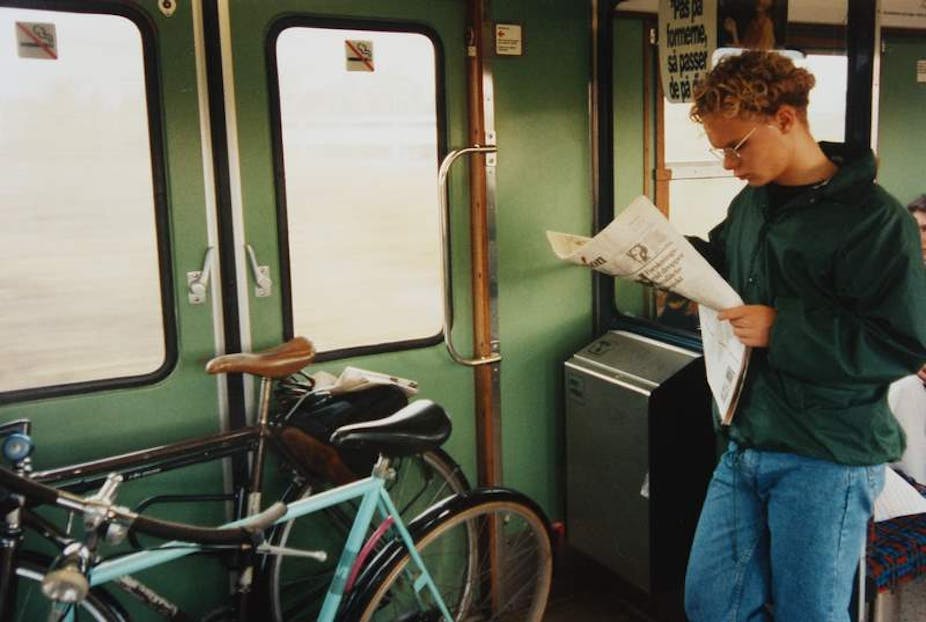
Getting out of the car: easy for some. Hunter Desportes/Flickr

In cities all over the industrial world, people are driving less. Changes to society and the structures of our cities have made jumping in the car less popular. But what does this mean for people who have no choice but to drive?

In most American and Australian cities, car use has been declining since early this century. Stanley and Barrett’s 2010 study found car use has been dropping per capita in Australian cities since 2004. Between 1995 and 2005 our data showed no growth in car use at all.

So why is it happening?

There are many factors to which declining car use can be attributed.

The first is a cultural shift. Younger people want a more urban lifestyle, one where they don’t have to drive as much. They want to be around friends and around urban activity without long commutes from distant suburbs.

We’re even seeing this among older Australians, who want to live somewhere they can drive less and walk more, particularly as it becomes more difficult for them to drive.

At the same time, we’re hitting the wall with sprawl. A city can only grow so far before it becomes dysfunctional.

In most Australian cities, suburbs have been going out for a long time, and freeways have been built to bring people back in. But now the freeways are full, and commuting is just taking too long.

Marchetti’s Constant tells us that most people – no matter where they live or how they travel – won’t commute more than an hour a day. For many people in Australian cities, this “travel time budget” is being breached.

When people have to commute for longer than that, they can get angry. And we’re seeing that for a lot of these people, the solution is to move back into the city.

At the same time, fuel prices are going up. The acknowledgment that petrol isn’t going to get any cheaper is to some extent killing off the idea that cars are a critical part of life.

In fact, for many people, cars have become less a desirable commodity, and more of a burden. For people who are dependent on their cars, it can become very hard to keep control of the budget when fuel prices are so unpredictable.

Many of these people don’t have the option of moving closer to the city. High real estate prices and poor public transport mean the only option is outer suburbs and long, car-bound commutes.

The future for these people isn’t promising. The outer suburbs will become places where only the poor will live. Opponents of development, such as Save our Suburbs, have campaigned against inner-city densification on the grounds it will create ghettos, but the real ghettos are going to be on the urban fringes.

The wealthy are moving. They’re finding places to live where it’s easy to get to activity, where there’s plenty of public transport and where there are good walking conditions. City centres are becoming kind of eco-enclaves: you can see that in the Greens vote.

But it’s more and more desperate the further out you go. Australia’s 50-year suburban experiment isn’t delivering all the wonderful things we’d hoped for. The great Australian dream is actually a bit of a nightmare.

Governments aren’t really addressing this issue. They talk about developing polycentric cities with substantial employment and activities in the suburbs and small cities. They say there should be good public transport linking them all together.

But in most cases they haven’t worked out how to fund or implement these plans. It’s just talk. In fact, most of the planning bodies in government departments still assume further sprawl and still assume more car use.

There are always going to be journeys that are too difficult to make by foot, bike or public transport. There will always be places that are difficult to reach without a car. And for many people with disabilities, a car is vital.

But cars need to be just a part of the package, not the soul of our transport system. We’ve been planning as though we can’t live without cars. We have almost killed our cities in the process.

Join the conversation

11 Comments sorted by

  1. Steven Mascaro

    logged in via email @voracity.org

    The urban fringe (interpreted literally) is unlikely to ever harbour ghettos because it is typically low density and it isn't possible to have a low density ghetto. Rural areas cannot have ghettos for the same reason. This isn't just semantics. Many of the problems that occur in ghettos --- high crime rates, racial segregation, concentration and unrest, crumbling infrastructure, lack of open space --- are only possible when there are high densities.

    I am certainly not suggesting high density causes…

    Read more
    1. michael mcgreevy

      logged in via email @live.com.au

      In reply to Steven Mascaro

      Without getting into semantics, the poorest and most marginalized residents of Australia live in very low density suburbs often far from basic services and employment opportunities. What ever you call them they are risky places to live as energy prices inevitably rise. a far better option would be for a relaxation of planning restrictions to allow more housing diversity in areas with good services and employment.

      report
  2. Peter Newman

    Professor of Sustainability at Curtin University

    Steven
    All the evidence points to a serious deterioration at the urban fringe. In the US now there are whole suburbs abandoned. When fuel prices rise to the levels we are experiencing there are problems paying mortgages and rent. In most Australian cities the wealthiest areas are the highest density. In Sydney the inner suburbs have salaries 2 or 3 times the outer suburbs and drive something like ten times less. I think you are just passing on a very old idea that flats are for the poor. I worry about the endless outer suburbs when oil hits $200 a barrel. Peter

    report
    1. Steven Mascaro

      logged in via email @voracity.org

      In reply to Peter Newman

      If you feel that the thrust of my comment was the idea that 'flats are for the poor', then I'm very disappointed because that was nothing like my intent.

      I am strongly in favour of higher densities.

      report
    2. Tony Recsei

      Environmental consultant

      In reply to Steven Mascaro

      There have been small declines in car travel (-0.9% per capita in Sydney since 1995) but this has more than been made up by an increase in air travel.(78% up) - one assumes a large share of longer distance car demand has shifted to air as has occurred in the USA.

      Hardly grounds for getting excited about. Meanwhile the general tendency in large cities around the world is a greater portion of people to settle in suburbs than in city centers. They do not all have to commute to the city center. As cities decentralize jobs and other attractors move to the suburbs. This is what the vast majority of people prefer – living in a stand-alone house rather than being cooped up in a unit. Studies show the lower the density the happier and healthier people are. What is more, total greenhouse gas emissions per person are less in the lower density outer suburbs than in high-density inner suburbs. There are no grounds for forcing people into apartment living against their will.

      report
    3. Steven Mascaro

      logged in via email @voracity.org

      In reply to Steven Mascaro

      (I was not finished. It is too easy to hit 'post comment'...)

      As I was saying, I am strongly in favour of higher densities but there are many people who are not. Their reasoning is not entirely invalid. Blindly increasing population densities, without planning for improvements to infrastructure such as transport, education, health, open space and so forth *will* produce worse outcomes than we have at the moment. Similarly, permitting (pun intended) low quality developments without an eye to improving…

      Read more
  3. Cole Hendrigan

    logged in via LinkedIn

    "low density won't create a ghetto under any circumstance"
    Low density suburban ghettos can certainly exist. Evidence in many areas around Vancouver where there is squalor and rampant drug problems whilst in the inner city of Vancouver condos people simply go jogging and drink lattes.

    Vancouver is a special case, but it isn't a special case by accident. Planning for the pedestrian first, cyclist second and transit third, followed by delivery vans and then...somewhere after taxis comes the private…

    Read more
  4. Tony Recsei

    Environmental consultant

    The evidence does not point to a serious deterioration in the urban fringe. In the United States the population movement is mostly to the suburbs compared to the urban cores. This also applies to the number of jobs per working resident.

    I have problems with the research released by the University of Melbourne that Jane refers to. It assumes that people, no matter where they live, will drive to the central business district daily. This is a completely unrealistic assumption. Only 9.9% of employment…

    Read more
  5. Daniel Grixti

    real estate manager

    Some people may find it cost effective and healthy to live within the city but I still believe that the issue of urban sprawl does not necessarily equate to the issue that suburban areas are " places where only the poor lives" as what this article says. There should be balance in all activities in the big city as well as in small cities to avoid traffic congestion.

    report