
Droughts & flooding rains: what is due to climate change?

While most people now understand that the enhanced greenhouse effect means a much warmer planet, communicating regional shifts in weather remains a significant challenge. As with most complex science, nuance is everything. But how do you communicate complexity and nuance in a world increasingly geared…

Xggzrmc2-1335234365
Scientists' job is to brief us on how future climate might affect our lives, even when all the data isn’t in. Rae Allen

While most people now understand that the enhanced greenhouse effect means a much warmer planet, communicating regional shifts in weather remains a significant challenge.

As with most complex science, nuance is everything. But how do you communicate complexity and nuance in a world increasingly geared to a 140-character limit? This is part two of a series looking at the relationship between climate change and rainfall. Part one is here.

I thought the drought was due to climate change?

The issue of recent rainfall trends, what caused them, and future rainfall projections has become very conflated in the public discourse.

Perhaps the first place to start to untangle this is to isolate the recent rainfall trends that are the most significant.

The most notable trends are the reduction in rainfall during the cooler months of the year across southern Australia; and increases in summer, monsoon rainfall across northern Australia.

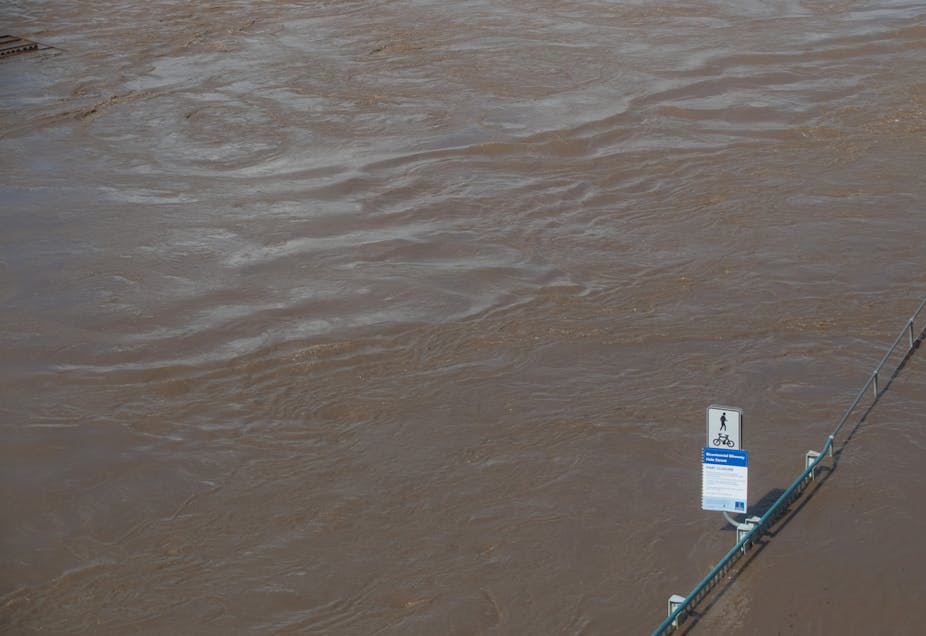
These two changes have happened concurrently. Increases in tropical northern rainfall have more than offset winter decreases across southern regions, such that rainfall averaged over the whole continent is increasing. It has also been dry, on average, over Eastern Australia during the last few decades — particularly south-east Queensland and the southern Murray Darling Basin – the last two years of heavy rainfall notwithstanding.

The high, natural rainfall variability in Australia makes determining any rainfall trends a difficult job. In fact, the apparent trends in rainfall over most parts of the continent, including the recent heavier summer monsoon, are not statistically distinguishable from the background of highly variable, decade-to-decade and year-to-year rainfall changes.

However one important rainfall trend does stand out. The reduction in winter rainfall over southwest Western Australia is a clear trend in the observational data. Similarly, the loss of late autumn and early winter rainfall over the southeast of the continent is also notable, but less statistically significant than the reduction in the west.

And it is here that we can zero in on the changes that the scientists have been mostly concerned with, and have mostly been talking about.
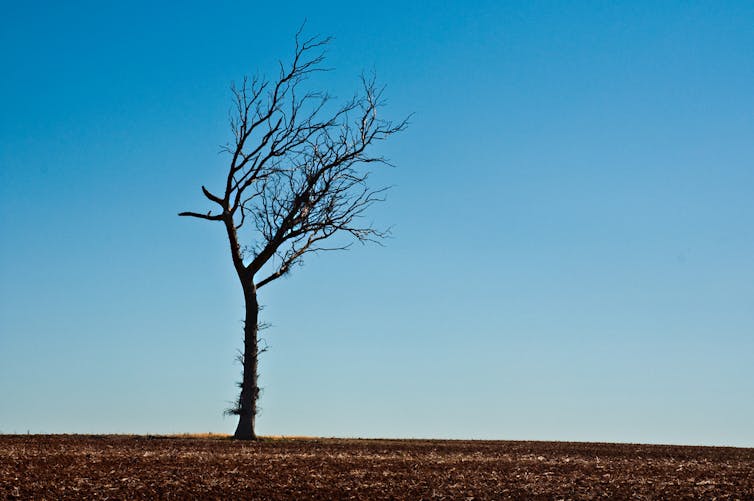
Reduction in winter rainfall in southwest WA has been most notable. Phillip Capper

Changes to autumn and winter rainfall in the Mediterranean climate regions of Australia can have large impacts. Typically, these regions receive the largest chunk of their annual rainfall during this period. This is delivered by cold fronts and storms that sweep across the coast from the Southern Ocean from April through to November.

The massive temperate forests and open woodlands found in both the southwest and southeast corners of the Australian mainland are evidence that cool season rainfall in these regions has been historically high and relatively reliable, over a very long period of time. Over the last 200 years, the rainfall has also supported some of our most significant agricultural areas. The natural water supplies of Perth, Adelaide and Melbourne are also highly dependent on rainfall during autumn, winter and spring.

However something significant happened to rainfall in the southwest of Australia in the second half of the twentieth century. The observational data shows a sustained 10-20% drop in winter time rainfall, starting in the late 1960s. Two decades later, a similar sustained reduction in rainfall occurred during autumn and winter in the southeast. This represents a significant change in the seasonality of southern Australian rainfall. Drying during the regular growing season is now apparent across large tracts of the southern agricultural zones.

The causes of this reduction in autumn and winter rainfall are an area of active research. Nonetheless, there is certainly evidence that the long-term drying is not just natural variability. Research conducted to date has shown that certain aspects of the rainfall changes are consistent with an enhanced greenhouse effect.

Research at the Bureau of Meteorology and CSIRO has shown that the rainfall reductions are due to changes in atmospheric circulation during the winter half of the year. In southwest Western Australia, the drying has been associated with reduced rainfall from storm systems and fewer storm systems in general.

These changes are consistent with higher atmospheric pressure that has been measured over the region. Studies have shown that aspects of these changes are, in turn, consistent with greenhouse gas increases, and decreases in stratospheric ozone in the Southern Hemisphere.

You could think of the effects of climate change on Australia, as regions ‘migrating’ from one climate zone to another. dwdyer/Flickr

A simple lay person explanation is that global warming pushes storms that track across southern Australia even further south — towards the poles — as the planet heats up. It’s a bit more complicated than that, the temperature gradient between the warm equatorial and cool polar regions ‘fuels’ mid-latitude storm systems. Global warming changes the strength and position of this gradient, which leads to a change in the mean position of the storms. The rain is still falling, but its falling out over the Southern Ocean. It is reasonable to think of this as the tropics expanding and temperate regions moving poleward.

If this is the mechanism at play, then you might expect the changes to have occurred in the southwest earlier than the southeast. Since it lies further to the north, a southward shift of the storm systems should affect Western Australia before the southeast — and this is indeed what we observe.

We have now had 40 years of lower winter rainfall in the southwest. During 2010, with the rest of the country awash with water, southwest Western Australia experienced its driest year on record. The last decent wet year in the southwest was in 1965, and such years were fairly common in the preceding six-and-a-half decades of rainfall observations.

It is important to note here that even in the southeast, the heavy rainfall of the last two years has fallen outside of the autumn and winter period. The rainfall was tropical in origin, and generally associated with La Niña – in fact the 2010-11 event was one of the strongest La Niña’s of the past century. The bulk of what fell was out-of-season rainfall, and not the typical southeast rainfall delivered by winter-time cold fronts and storms.

Indeed, between the La Niña event of 2010 and the weaker event of 2011, late autumn and early winter rainfall returned to below average, continuing a trend that has lasted for more than 15 years. It is this trend that climatologists have been following, and it continued through the last two La Niña years.
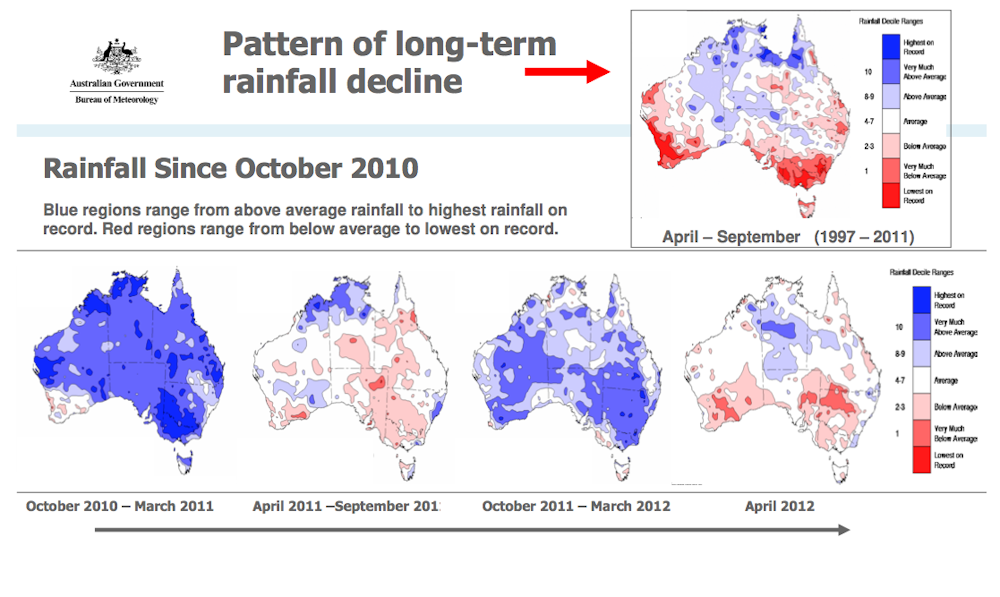
It is inevitable that a wetter-than-average autumn or winter will occur again in future, but a single wet season is unlikely to have climate scientists revising their conclusions. It’s the long-term trend that is important.

The reduction of rainfall during autumn and early winter has significant hydrological and agricultural impacts. Heavy rainfall in spring and summer might help recharge reservoirs, but it is not necessarily helpful to grain growers. In addition, we can’t rely on these Mediterranean climates getting consistent heavy rainfall over the summer months without the help of La Niña.

Was the recent heavy rainfall due to climate change?

Attributing recent extreme events to climate change is a difficult, but emerging, part of the science. It’s also an emerging piece of evidence: extreme climate events are increasing all over the world.

Rainfall over 2010 and 2011 was the highest on record for Australia, beating the previous record for a two-year stretch in 1973 and 1974. A double La Niña event has been associated with both records, highlighting the role of natural variability in driving the heavy rainfall.

However, climate scientists have noted that some of the background conditions for the recent rainfall were consistent with expectations in a warmer world. Most notably, sea surface temperatures around Australia have been the warmest on record over the past two years. We know from the science behind seasonal rainfall prediction that elevated local sea surface temperatures are a key driver of above average rainfall for Australia, not just through the increased atmospheric moisture that they provide, but also — most importantly — due to the way they change local atmospheric circulation.
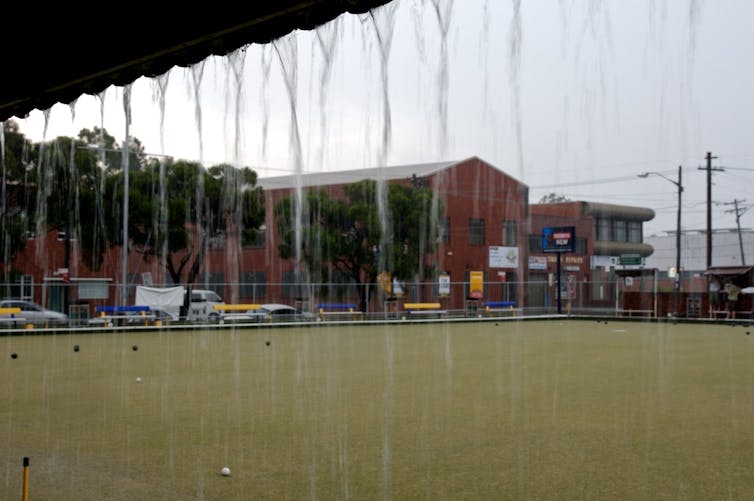
Rainfall over 2010 and 2011 was the highest on record for Australia. Brian Yap

Scientists over the next decade, will explore the role of elevated ocean temperatures on the record rainfall of 2010 and 2011 in closer detail.

So what on Earth (or twin Earth) are we to make of all this?

Recent rainfall trends observed across Australia are, in many ways, consistent with a warming world; that is, decreases in southern Australian winter season rainfall, and increases in the tropical monsoon.

The severity of the drought, followed by the record breaking summer rainfall, is also consistent with projections for a warmer world.

In saying that, the big proviso here is that scientists have been careful not to overstate this case, and in releases such as the recent State of the Climate report, BoM and CSIRO highlight that we are still researching these issues.

The most consistent feature of modelling studies shows a likely future drying over southern and parts of eastern Australia, and less conclusive projections elsewhere. It is important to remember that these are projections for 2030 and 2050, and we should not necessarily expect to see such changes clearly right now, unless climate change is progressing more rapidly than the climate models have shown.

Scientists are still researching how a warming climate will affect flooding. daisy.r/Flickr

However we can use recent events as a heuristic for future climate change in a sensible and reasoned manner. We know that warming due to increasing greenhouse gases will change future rainfall patterns. We know that there is uncertainty in that, but that this uncertainty – coupled with the speed of changes to the climate system – serves to increase the risk in many regions.

Hence we can legitimately ask questions as to what we might do if recent, long-term rainfall changes turn out to be permanent.

Within this context, climate scientists have pointed out that the rainfall declines across the south have some consistency with what we would expect due to global warming. We also point out that the changes in the southwest have been very long lived. It is pertinent to draw the link between more recent rainfall reductions across the southeast, and the longer-term declines in the southwest.

It’s too early to make a definitive call on all of those issues, and another ten years of data will provide more concrete evidence. But the scientists’ job is to brief people, including the primary industry sector, water managers and ecologists, on what the best available current data and science is showing.

The experience of the Bureau of Meteorology has been that these science stakeholders are coming to understand the complex nature of the challenges that they are planning for, and are increasingly sophisticated users of climate information. That’s good news.

Tomorrow James Risbey from CSIRO explains how greenhouse climate change expresses itself through the natural modes of the climate system and what that implies in assessing the evidence of runs of wet and dry years.

Join the conversation

29 Comments sorted by

    1. Mike Hansen

      Mr

      In reply to Marc Hendrickx

      Dr Troll advising patient.

      "We know that smoking causes cancer but there is still some uncertainty in the x-rays. So keep on smoking until we can see the cancer unambiguously - by then it will be too late to do anything but at least you will not have had to change your lifestyle in the very unlikely prospect that those dark spots we are seeing are a false alarm.

      report
    2. Marc Hendrickx

      Geologist

      In reply to Mike Hansen

      Nice straw man there Mike Hansen. By now you must have built enough for a whole city. Tell me, do you give them names, or are they just faceless crusaders of misrepresentation and alarm?

      Odd thing about "Kookites" like Hansen who advocate climate Armageddon, is that they are more likely to post red herrings about smoking and cancer than they are likely to discuss the moderate response of the climate to human influences.

      report
    3. Glen Daly

      Retired

      In reply to Marc Hendrickx

      What is it about geologists? "Still too early to tell" !

      The whole point of the article was that the sure signs of global warming,such as ocean temperatures,are there for all to see.What is debatable is just how this will impact on our weather (in the short term) and our climate (in the longer term).The article is written in the conservative mode which is what I would expect from a scientist,especially in this controversial field. And it is controversial mainly because of the attacks of the deniers/sceptics who are,in general,a peculiarly stupid,ignorant and arrogant cohort.

      I would like to be a fly on the wall when Karl is discussing these matters with his fellow climate scientists. Those conversations are not,of course,for publication.

      report
    4. David Boxall

      logged in via Facebook

      In reply to Marc Hendrickx

      The simple and inescapable fact remains; the vast majority of the best qualified warn of substantial risks, for which humanity is probably responsible. Independent studies, employing different methodologies, have yielded similar results: of the best qualified, 97% agree, 2% unsure and 1% disagree.

      Marc Hendrickx places himself with the 1% but, given the majority opinion, wouldn't any sane and decent person support prudent precautions?

      By the way Marc, could you point me toward the climate science papers you've had published in reputable peer-reviewed journals?

      report
    5. Ron Chinchen

      Retired (ex Probation and Parole Officer)

      In reply to Mike Hansen

      Excellent parallel Mike Hansen. I suspect people will start to take things a little more seriously in the next few years when the signs become a little less ambiguous.

      report
    6. Peter Lang

      Retired geologist and engineer

      In reply to Glen Daly

      Apparently, only geologists have a concept of time and the the limits of planetary processes that are relevant to discussion of climate change.

      report
    7. Peter Lang

      Retired geologist and engineer

      In reply to David Arthur

      The most rapid extinction underway right now is that of the AGW Catastrophists.

      As geologist Bob Carter makes clear :

      <blockquote>Over the last 18 months, policymakers in Canada, the U.S. and Japan have quietly abandoned the illusory goal of preventing global warming by reducing carbon dioxide emissions. Instead, an alternative view has emerged regarding the most cost-effective way in which to deal with the undoubted hazards of climate change.</blockquote>

      As the recent Galaxy pole (conducted…

      Read more
    8. David Arthur

      n/a

      In reply to Peter Lang

      Wrong again.

      Atmospheric climate change is a decade to century scale problem, oceanic climate change is a century to millenium time-scale problem.

      report
    9. Peter Lang

      Retired geologist and engineer

      In reply to David Arthur

      Wrong again.

      You don't understand.

      The planet operates within a temperature range. It is currently near the lower end of the range. Its normal temperature is near the upper end. At its normal temperature life thrives. At its lower temperature, life struggles, and the climate is highly variable (unstable). Warmer is better.

      Furthermore, we are in a long term cooling trend (for past 50 million years), and we have just passed the interglacial peak in the 100,000 year glacial-interglacial cycle, so the trend is cooling for the next 80,000 years or so – with some sudden, large, rapid temperature drops!

      If you want to get people to believe warming is scary, you need to explain why, convincingly and simply. That has not been done.

      report
    10. Ron Chinchen

      Retired (ex Probation and Parole Officer)

      In reply to Peter Lang

      I remember a line out of an old SciFi film where a scientist is asked what would humanity do if they knew a species ending asteroid was en route to Earth and needed solutions to solve the problem. The answer was that humanity would just go on squabbling with themselves and acting finally when its too late. Histroy shows this of humanity time and again. Just like the World's failure to act in time against the rise of Nazi Germany when they could have solved the problem quickly, they continued to squabble…

      Read more
    11. Ron Chinchen

      Retired (ex Probation and Parole Officer)

      In reply to Peter Lang

      Quite right Peter Lang except that you forgot some important ingedients. Life does exist better in warmer environments, but humans are Ice Age adapted creatures. To raise the temperature too much for humans could have serious health implications.

      Further grasses are Ice Age products.They exists because the Earth became colder and drier and unable to sustain forests as well in many area. Grasses are suited to colder-drier climes than Earth's usual average temperature range. And grasses supply…

      Read more
    12. David Boxall

      logged in via Facebook

      In reply to Ron Chinchen

      Ron Chinchen: "Humanity's problem is that it acts too much on faith and a delusion that somehow we are going to be saved ..."
      So far, so good. We'll only get to be wrong once.

      report
    13. Ian Ashman

      Manager

      In reply to Peter Lang

      Bob Carter is a stooge for oil and coal interests. He is affiliated with the right wing denialist group called the Heartland Institute. He has no credibility.

      report
    14. Mike Hansen

      Mr

      In reply to Peter Lang

      This would be the Bob Carter who gets a monthly stipend from the infamous Heartland Institute whose recent conference was funded by the Illinois Coals Association.

      Expect future posts from Lang on why Philip Morris think smoking is good for you. On why the Australian Clubs Association thinks that talk of problem gambling is alarmist.

      http://www.guardian.co.uk/environment/2012/may/22/heartland-beating-climate-conference

      Comment from the conference

      "John Dunn, a Heartland policy adviser…

      Read more
    15. Mike Hansen

      Mr

      In reply to Peter Lang

      More pseudo science from Peter Lang (note the lack of links to peer reviewed science) who imbibes heavily from the Heartland Institute/fossil fuel industry propaganda.

      Here is a comment from the recent Ilinois Coals Association sponsored Heartland institute conference of climate science deniers.

      "John Dunn, a Heartland policy adviser, sees his role as fighting "enviro-fascist madness". In his speech, he sought to ridicule recorded evidence of growing drought and heatwaves due to climate change. "Warm is good for people, and it's particularly good for people as they get older," said Dunn. "The people that warm spells kill are already moribund."
      http://www.guardian.co.uk/environment/2012/may/22/heartland-beating-climate-conference

      That's right - anyone dying during a heat wave must have been near dead already according to Heartland.

      Anyone wondering where Lang gets his ideas from need look no further.

      report
    16. David Arthur

      n/a

      In reply to Peter Lang

      The planet is presently past the top of the temperature range which has prevailed since the mid-Pliocene. That is, it is already outside the temperature range to which life has been adapted for over three million years, and well outside the range in which human agriculture and built infrastructure developed.

      report
    17. David Arthur

      n/a

      In reply to Peter Lang

      Gday Mr Lang, who writes: "If you want to get people to believe warming is scary, you need to explain why, convincingly and simply. That has not been done."

      Personally, I'm not interested in getting people to "believe" that warming is "scary". I endeavour (evidently with little success, in my discussion with yourself) to "explain" to people what causes warming (primarily fossil fuel use; "Historic fossil fuel use and cement production data (Oak Ridge National (US) Laboratory Carbon Dioxide Information…

      Read more
    18. David Boxall

      logged in via Facebook

      In reply to Ken Swanson

      If you have evidence to refute Mr Ashman's claims, then provide it. As it stands your post is no more than puerile abuse; it does you no credit.

      report
  1. Fred Pribac

    logged in via email @internode.on.net

    Excellent articles - thank you for taking the time.

    report
  2. Michael Brown

    Professional, academic, company director

    Marc is correct - this hypothesis of CO2 affecting rainfall is a very long way indeed from confirmation. The known information doesn't go anywhere near meeting any of the normal criteria for establishing a cause-and-effect relationship, including those laid down by Austin Bradford Hill in the 1960s when the tobacco debate was raging. For example, you need to categorically exclude the effects of other influences - those influences are mostly unknown and those that are known are poorly understood, and barely quantifiable. We still have no idea what the underlying influences are which affect ocean temperatures leading to the El Nino cycles, or much of anything else.

    report
    1. Mike Hansen

      Mr

      In reply to Michael Brown

      Complete and utter nonsense.

      "For example, you need to categorically exclude the effects of other influences - those influences are mostly unknown and those that are known are poorly understood, and barely quantifiable."

      This is the "holy grail" of denialism - that there is some other mysterious, yet to be discovered, hiding under the bed "unknown" forcing causing temperatures to rise - the "ABC" thesis - "Anything But CO2"

      The web site Skeptical Science (http://www.skepticalscience.com

      Read more
    2. David Arthur

      n/a

      In reply to Michael Brown

      "... hypothesis of CO2 affecting rainfall is a very long way indeed from confirmation ..." Wrong.

      1. Climate consists of the movement of matter and energy around the earth in atmosphere and ocean (much as a car's motor cooling system has radiator fluid as its working fluid, earth has oceans to transfer heat around and atmosphere through which heat is received from the sun and dissipated to space).

      2. Rainfall is part of climate.

      3. CO2 affects climate.
      a. Sun irradiates earth with short-wave energy.
      b. Earth re-radiates long-wave energy.
      c. Greenhouse gases retard transmission of long-wave energy, not short-wave energy, thus altering thermal energy balance of the climate system

      report
  3. Marc Hendrickx

    Geologist

    Kurt, you seem to have missed this article in your discussion of rainfall reductions, such as in southwest Australia. Remember to consider all the forcings and not just limit to CO2. see...

    Nair, U.S., Y. Wu, J. Kala, T. J. Lyons, R.A. Pielke Sr., and J.M. Hacker, 2011: The role of land use change on the development and evolution of the West Coast trough, convective clouds, and precipitation in Southwest Australia. J. Geophys. Res.-Atmos., 116, D07103, doi:10.1029/2010JD014950. Copyright (2011) American Geophysical Union.
    http://pielkeclimatesci.files.wordpress.com/2011/05/r-357.pdf

    report
    1. David Arthur

      n/a

      In reply to Marc Hendrickx

      Good to see some consideration of land use management, even if the research is motivated by Denial of effect of atmospheric composition on climate.

      report
  4. Karl Braganza

    Manager, Climate Monitoring Section at Australian Bureau of Meteorology

    Here is a (non-exhaustive) list of reading in relation to changes in Southern Hemisphere circulation in our region. Cheers.

    Arblaster JM and Meehl GA (2006) Contributions of external forcings to Southern Annular Mode trends. Journal of Climate 19: 2896–2905.

    Cai W, Shi G, Cowan T, Bi D and Ribbe J (2005) The response of the Southern Annular Mode, the East Australian Current, and the southern mid-latitude ocean circulation to global warming. Geophyiscal Research Letters 32: L23706, doi:10.1029…

    Read more