


For the first time perhaps in all of Egyptian history, its citizens have chosen their own leader. The election of the Muslim Brotherhood’s Mohammad Morsi as the president of Egypt is a major historical moment.
In a tough election, Morsi beat former air force general Ahmed Shafik by a narrow margin, around 51% to Shafik’s 49%. His presidency too will not be easy, as he attempts to deal with a stagnant economy and a powerful military establishment that is not willing to cede power easily.
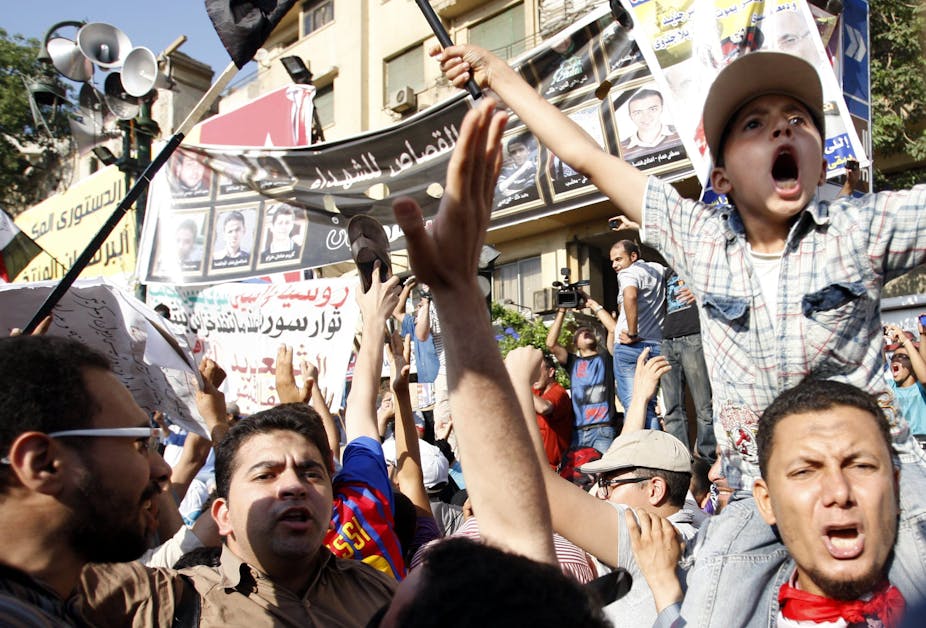
During last year’s uprising, the leading chant was “e’eish, horreya, a’adala’h ijtima’iya!” or “bread, freedom, social justice!”. This simple yet ingenious chant captures in a few words the revolution’s unmet economic, political and social demands.
It is these three challenges that president-elect Morsi will need to overcome if he is to realise the aspirations of millions of Egyptians.
Bread
While the uprising has empowered Egyptians politically, undeniably it has had a devastating economic effect. In its immediate aftermath, the Egyptian economy shrunk, slipping into recession earlier this year.
It has now partially recovered but foreign reserves have more than halved to $15.6 billion USD, and tourism, an economic lifeline, has dropped 32%. The official unemployment rate is a staggering 12.4%, unofficially, it will be much higher.
But the current economic conditions cannot be blamed solely on the uprising. The structure of the Egyptian economy itself under Mubarak, his crony capitalism and economic mismanagement, as well as the legacy of previous presidents have been the major factors. It is clear that if a Morsi administration is to achieve an economic breakthrough, some painful decisions have to be made.
The issue of subsidies is high on the agenda; they currently eat up an average of 8% of GDP and absorb 28% of government expenditures, two-thirds of it on fuel and energy, the rest are mainly food subsidies, predominantly wheat.

It is no coincidence that eei’sh (bread) was the first demand of the revolution; it is the daily staple of millions of Egyptians. Egypt is the largest per capita wheat consumer and its largest importer in the world.
While food subsidies will be very tricky to touch for any political leader, fuel subsidies will have to be partially eliminated in order for the economy to survive in the long term.
Externally, Arab and international Foreign Direct Investment (FDI) will have to resume. But investors will need a stable political environment, amiable business-labour relations, and for the state to adhere to its contractual obligations. Unfortunately, confidence in all three has been deeply shaken and will take time to return.
Should these economic conditions not be addressed, the Egyptian economy will risk further social upheaval.
Freedom
Economic reform should go hand-in-hand with political reform. The 2011 parliamentary election has seen the rise of the Islamists, personified by the Muslim Brotherhood (MB) and the Salafists. The first round of the 2012 presidential elections cemented the view that there are two major powers at play: the army and the Islamists.
Under a Morsi administration, there must be a development of the political values of Egyptians, who after years of apathy, are now forced to think about what kind of state they would like to live in.
With continued political reform, the coming years will have to bring a new social contract that organises the relationship between the state and the individual in a way that has never been done before in any Arab country. If achieved, it will be considered as a breakthrough locally and regionally.
In his book, Egypt and the Politics of Change in the Arab Middle East, former Australian Ambassador to Egypt Robert Bowker argues that for political reform to occur there needs to be “competitive, inclusive, secular political movements, capable of contesting effectively the Islamists’ claim to have a monopoly on social justice in all its forms.”
Social justice
Social justice is another one of the demands of the revolution that remains unfulfilled. To this day, the disparity in wealth continues to increase. The Mubarak regime did attempt to reform the economy from the 1990s, but this was at the expense of the lowest echelons of society.
Toby Dodge from the London School of Economics writes that across the countries of the Arab revolutions:
“Neoliberal reforms produced a politically connected but small nouveau riche, with the majority of the population excluded and increasingly resentful. The transitional governments need to reformulate economic policies in a way that delivers meaningful growth to this previously alienated majority.”
Since last year’s revolution, conditions have not gotten any better. There are demands that are yet to be fulfilled, chief among them, raising the minimum wage and universal health cover. Clean water, education and sanitation are also issues that occupy the minds of the average Egyptian.
Social justice issues will be high on the agenda for President Morsi. Government subsidies must be redirected to the segments of the population that need it most.
If some of these social justice demands are not met, this could mean further unrest in the coming years under the Muslim Brotherhood’s leadership.
The future
The uprising is a rare opportunity for Egyptians to shape the kind of Egypt they would like to live in. However, this opportunity carries immense risk with local, regional and international forces not in favour of change.
The one clear gain of the uprising is that, for the first time in several millennia, Egyptians are no longer afraid to challenge their leader.
Governing Egypt will not be an easy task for Mohammed Morsi, as he navigates the multitude of demands and needs. Should the demands highlighted here not be heeded, there will be instability in the years to come.
The coming days will show if Morsi will be able to deliver.
This is based on an article later published in the Canberra Times.