

Electric bikes at 250 watts … the view has opened up nicely

If you’ve not ridden an electric bicycle yet, chances are you know someone who has. Or maybe someone rode past you on one and you thought it was a conventional bike. Changes in permitted power output means you’ll likely be seeing more, and better, electric bikes coming your way (or riding past you…

R6v7rjhs-1351729601
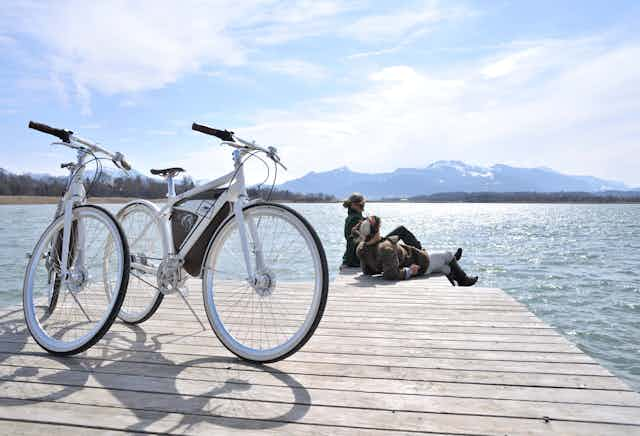
Changes to the Australian Design Rules have altered the landscape for electric bikes. Chiemgau - Bayerns Lächeln

If you’ve not ridden an electric bicycle yet, chances are you know someone who has. Or maybe someone rode past you on one and you thought it was a conventional bike. Changes in permitted power output means you’ll likely be seeing more, and better, electric bikes coming your way (or riding past you).

If you’ve been lured by an electric bike, my colleagues and I would like to hear from you, as I’ll discuss a little later. But first, for the uninitiated, let’s start with the basics: what is an electric bike?

An electric bike has motorised assistance that allows the cyclist to ride further with less effort. Think of it as having a reliable tailwind to help you on your way up hills.

The distinct difference is how the motorised assistance works: pedal assist or handlebar throttle. Confusion arises because both pedal assist and handlebar throttle are often referred to as electric bikes, or e-bikes for short.

Pedal-assist or pedelec bikes require the rider to pedal to gain the advantage of the electric model. Put simply, for a pedal-assist bike, no pedalling equals no power.

In contrast, an e-bike with a handlebar throttle, a simple flick of the switch or twist of the handlebar will propel the bike forward – without pedalling.

Electric bike manufacturers and retailers have been building and importing powered bicycles in Australia for more than two decades but a change is in the wind thanks to new government regulations.

A change of gear

In May, the Australian government amended the Australian Design Rules to adopt the European rule (EN 15194:2009), and this changed some of the rules around electric bikes. The biggest change was the increase to their permitted power output from 200 to 250 watts.

Motorised assistance will cut out at 25km/h. You can go faster than 25km/h, but you need to be pedalling – the battery will not provide any extra push.

While some countries, and some states of the US, allow electric bikes of up to 1,000 watts, any bicycle powered by an auxiliary motor that exceeds 250 watts in Australia will be classified a motorbike and must be registered and ridden by a licenced rider.

In addition to further clarifying the definitions of electric bikes, the government’s changes to permitted power outputs have brought Australia inline internationally.

While 50 watts more may not seem a big increase, it’s potentially a game-changer for electric bikes.

For riders, it means going up hills will be a little easier, with extra torque, although the top speed will still cut out at 25km/h and the distance you can ride with electric motor assistance will be about the same.

The real improvement is the variety of electric bikes that can now be sold in Australia.

Out with the old

Internationally, 250 watts is a common standard power output; subsequently, many electric bikes being designed and manufactured globally have 250-watt motors.

As a result, the electric bikes available in Australia until now have been a mixed bag. At one end, small businesses that specialise in custom-built electric bikes offered a quality product that has improved with each new generation of bike, better battery technology and advancements in design.

But the market has been flooded with cheap electric bikes, sold over the internet or imported in containers and sold from warehouses in cardboard packing boxes.

While initially inexpensive for the consumer – in the region of A$1,000 – these products lack after-sales service and support. When something (inevitably) does go wrong, the consumer is left with a very heavy bike.

In with the new

The amended Australian Design Rules mean sophisticated new electric bike designs with the latest technology are legally available, and what was once a boutique industry with a discrete custom market share is about to go mainstream.

Quality electric bikes with excellent after-sales service and support range from A$2,000-A$3,000. More expensive than a standard pushbike, electric bikes are significantly cheaper than many high-end bicycles, which range from A$5,000-A$10,000 and beyond.

Electric bikes are already mainstream in one Australian company – Australia Post. While some companies are replacing one fleet vehicle with e-bikes for short trips made by staff, Australia Post is the poster child for electric bikes with more than 1,000 electric bikes in their fleet.

Australia Post has worked with bicycle designers and manufacturers to improve the design of the bicycle to maximise the safety and efficiency for posties en route – and this has impacted the geometry of the bikes and their luggage capacity.

Each generation of battery also further improves the distance the e-bikes can travel on a single charge.

Get in touch

Our study at the Institute of Transport Studies at Monash University is investigating what influenced people to buy an electric bike and what their experiences have been using them.

Our findings will assist to develop future policies aimed at increasing the safety and sustainability of the transport system, including electric bikes.

Whether the electric bike provides a stepping stone from the car to a pedal bike remains to be seen. But the individual benefits that can be gained by reducing people’s reliance on cars and increasing their physical activity will also help reduce congestion and vehicle exhaust pollution on our roads.

While some bicycle models are clearly electric bikes with a battery pack plain to see, many of the models are not visibly electric and are difficult to differentiate for other road users.

As with all cycling activity, the question of safety also impacts electric bike riders and feeds into the issue of adequate and connected bicycle facilities on and off roads, as well as behavioural issues with other road users.

So you ride an electric bike, or know someone who does? Do let us know and, of course, safe riding!


You can participate in this study online.

Join the conversation

73 Comments sorted by

  1. Seamus Gardiner

    Citizen

    " Quality electric bikes with excellent after-sales service and support range from A$2,000-A$3,000. More expensive than a standard pushbike, electric bikes are significantly cheaper than many high-end bicycles, which range from A$5,000-A$10,000 and beyond."

    True but I imagine that the true competition will be standard push bikes or cheap cars/mopeds/ public transport not high end carbon race bikes.

    I think that the electric bike offers versatility that the aforementioned transport modes do not but infrastructure still needs to catch up (charging at work, school etc). It'll sure make those hills less of an excuse not to ride.

    report
  2. Bob Buick

    Retired medical consultant

    Thanks for this timely article, but I have a sad tale to tell and perhaps the inclusion of petrol-powered bikes might have helped.
    Shortly after retiring a few years ago, I spent about $3500 on two 200 watt bikes for my wife and myself as we live in a hilly area and the power assist enabled us to do most of our travel without running our 4WD, which we require for several reasons. Our bikes have a top powered speed of 22-24 kph and use about a litre of petrol every couple of months, enabling us to…

    Read more
    1. Matthew Thredgold

      Software Engineer/Secondary Teacher

      In reply to Bob Buick

      As a rider of 2 x 250W electric assist bikes (in NZ where they have been legal for a while) I fully support the Queensland's decision to outlaw petrol driven bikes. The engines are 2 strokes, and the noise, and the significant pollution from 2-strokes engines is very, very unwelcome on cycleways. (Whilst its harsh on you, I think you could have anticipated a ban, just as I encourage people not to buy other polluting technologies, like woodheaters, because they are hopefully going to be banned, so…

      Read more
  3. Rosie Hayes

    Retired

    Bob Buick - would it not be possible to convert your bikes to electricity which would be a very small amount of power to use considering we live in all-electric homes? At least in that way you could still ride which is the important thing. Personally I would like to see more encouragement for seniors to ride bikes of any kind.

    report
    1. Bob Buick

      Retired medical consultant

      In reply to Rosie Hayes

      Rosie,
      You're quite right, but we'd still have lost most of the original value of our petrol-powered bikes and would have the expense of fitting electric motors, batteries, controls and new rear wheels.after that, we'd lack the range to return 20 km home from our yacht against more than a light head-wind, we'd have the inconvenience of frequent re-charging and our electric power would come from coal-fired power stations.
      I agree wholeheartedly with you that more encouragement for seniors to ride would be far better than the present policy of forbidding the few petrol-powered bikes that are still about and forcing us to use our 4WD for everything.

      report
    2. Rosie Hayes

      Retired

      In reply to Rosie Hayes

      Bob Buick - I understand - I'm just sorry that you no longer have the joy of riding.

      report
  4. Rick Baartman

    logged in via Facebook

    It would have been helpful, for comparison with other forms of making power, if the author had pointed out that 250 Watts is 1/3 horsepower.

    report
    1. Geoffrey Edwards

      logged in via email @gmail.com

      In reply to Rick Baartman

      also potentially helpful:

      Most healthy people have little trouble sustaining an output of 100W on a bike.

      Elite cyclists can produce sustained efforts in the 300 to 400W range. (+ more for the Elite of the Elite)

      A healthy person on e-Bike producing 250W could probably turn in a pretty handy Time Trial result at le Tour.

      report
  5. Jennifer Daly

    Research Administration Officer

    Thank you for your timely article. I have been researching electric bikes in the ACT on and off for about 6 months. I live 18kms from work and want to commute daily to increase my level of physical activity, so charging availability is important (40-45kms). My research to date has increased my confusion about the types of bikes available in Australia, although the recent Choice article was very helpful. After sales service is important and also weight because if it breaks down, I will need to be…

    Read more
    1. Ian Donald Lowe

      Seeker of Truth

      In reply to Jennifer Daly

      No, the time trial times would not be good because the eletric motor cuts out at speeds over 25km an hour. Even I could manage better than 25km an hour under my own steam and I am overweight, over 50 and unfit. This limitation is why the electric bike will continue to be a toy and not a serious transport choice. How could it ever be taken seriously when small children could run past you laughing?

      Yuppies will buy these toys as part of their consumption patterns and they will boast about how eco-friendly they are but it is likely the bike and the battery will be fully impoted and like you Jennifer, they will carry the bike around in or on their 4WD to places they can ride from coffee shop to coffee shop. It's all a bit of a joke really and will never make a dent in the Australian car culture.

      report
    2. Geoffrey Edwards

      logged in via email @gmail.com

      In reply to Jennifer Daly

      Ian wrote:

      "eletric motor cuts out at speeds over 25km an hour."

      That is not how I first read it, but that does indeed seem to be the case, which puts the lie to my earlier comments.

      I would in part agree with his conclusion - that is a toy, not a mode of transport. Obviously not something that a regular cyclo-commuter would seriously contemplate.

      A few weeks of riding a regular bike and you would be much better off, and have paid much less.

      report
    3. David Collett

      IT Application Developer at Web Generation

      In reply to Jennifer Daly

      @Ian Donald Lowe

      "How could it ever be taken seriously when small children could run past you laughing?"

      25 km/h is incredibly fast for a small child.
      What are they feeding them where you live? And could you send me some.

      report
    4. Stephen Prowse

      CEO at Wound CRC

      In reply to Jennifer Daly

      Any technology that takes even a few cars off the road would seem to be valuable. Even a small dent is better than no dent at all. There is no single answer to our traffic problems; just many small contributions.

      I live in a very hilly area and riding a conventional bike is challenging, especially in the Brisbane summer. As a yuppie, I am definitely going to look into this as an alternative to my car to get to my favourite coffee shop.

      report
    5. Gary Cassidy

      In reply to Jennifer Daly

      @Ian Donald Lowe & @David Collett

      The motor cuts out at 25km/h, although on a suitably geared elecro bike you could peddle faster if you wanted to. Personally I think somewhere between 28km/h and 32km/h would have been more reasonable. However, for a commuter bike I think even if the assistance cuts out at 25km/h that would enable many more people to commute moderate distances who otherwise would not be capable.

      report
    6. Dennis Alexander

      logged in via LinkedIn

      In reply to Jennifer Daly

      @IDL. I too am over 50, overweight and not terribly fit. When I was less overweight, less unfit and less over 50 I used to cycle my hybrid to and from work on a not totally flat but not very hilly route. I could average 24-26km/h over 13-17 kms with a max of 48-52km/h. SO, while you might be able to get yourself up to 25km/h or better, sustaining it over more than 10km might not be as easy as you think. I know 1 person who rides an ebike on commutes - they used to ride an ordinary bike - and they are not a yuppy or a technophile, they did the research and the calculations and bought the bike as the most effective and efficient option for their commute. While not a 40+km/h time trial possibility, it is not a toy. I think some of us need a reality check on our actual capabilities every so often.

      report
    7. Quiet Rush

      logged in via Twitter

      In reply to Jennifer Daly

      eBike racks do exist from Thule and other manufacturers here in Australia, such as GripSport. I personally use a GripSport one on the back of my car so I can do a hybrid trip of car to urban fringe-> ride to CBD. You just need to ensure you match up the weight of the bike to a suitably specc'd rack. I'm based in the ACT, happy to show you the rack that I use.

      report
    8. Slow rider

      stuff

      In reply to David Collett

      whilst hitting the finish straight at around 55km/hr a 13 year old came past me doing at least 65km...dont underestimate the power to weight ratio of kids...just go hit the pool when the kids are doing squad and I doubt you could keep up either

      report
    9. Ken Taylor

      Research Scientist, CSIRO ICT Centre at CSIRO

      In reply to Slow rider

      Unless you were on a descent this is very unlikely, Dennis Alexander's speeds are far more reasonable.

      Luke Durbridge won the 2012 national Time Trial at 49.5 km/h in 2012 http://tensport.com.au/news/theroar/Cycling-Luke-Durbridge-wins-Aus-National-time-trial-Bobridge-crashes-out.htm and again at 51.1 km/h in 2013 http://www.sbs.com.au/cyclingcentral/news/41400/durbridge-defends-time-trial-title . To get an idea of what 950 good riders can do see https://theconversation.edu.au/how-did-amateurs-compare-with-pros-at-the-tour-down-under-11946#comment_115266 .

      report
    10. Slow rider

      stuff

      In reply to Ken Taylor

      I didn't say time trial at 55km....note "finish straight" my max speed ever was 58km at crits and 61km/hr at track (sprint night). I could never time trial at 49km...more like 32 best ever over not so flat 55km. Our c grade crits average around 38km/hr, b is around 44 and a around 46(by doing it the hard way cruise at 42 then kick to ~55, back to 42). Need to compare regular rider vs tour de france elites hitting around 85km hr on the last 250mtrs. I am not quick but use pack riding to its best advantage. the kid did better.

      report
  6. Robert Nelson

    Associate Director Student Experience at Monash University

    Thanks Marilyn

    For anyone anxious about cycling, electric bikes are terrifically helpful, with their reassuring grace of an eternal tailwind. My theory is that while ordinary bikes are a sustainable mode of transport, cycling is not morally sustainable, because most people give it up with the smallest adversity, exponentially augmented by anxiety.

    My study of electric bike riding—Moral Sustainability and Cycling: an Ecology of Ambition for a Hyperactive Planet (http://www.st-andrews.ac.uk/sasi/media/sustainability_and_cycling.pdf)—might be of interest.

    Good luck with the ongoing research in this valuable project!

    report
    1. Gary Cassidy

      In reply to Robert Nelson

      Hi Robert,

      Your link doesn't work? Even with ")--might" removed.

      Would be interested in reading this.

      Cheers.

      report
    2. Graeme Smith

      Citizen

      In reply to Robert Nelson

      Gary @monash.edu - re ".. link doesn't work? ..interested in reading this."

      Some undetermined issue blocks access to the pdf file, but I found a cached copy available there as text.

      The link given above, (http://www.st-andrews.ac.uk/sasi/media/sustainability_and_cycling.pdf)—might , results in an error notice page. On that page enter "sustainability_and_cycling" (with or without quotes) in the search box. On the search results page then select "Text Version".

      Perhaps some content, images etc., may be missing in that version?

      Perhaps not as googling returns a link for Robert's pdf book file at http://www.fichier-pdf.fr/2012/04/23/sustainability-and-cycling/ with lo res preview pages readily available. I steer away from proprietry downloaders requiring installation! Most google returns ultimately link the st-andrews file.

      Cheers.

      report
  7. Gary Cassidy

    My dad got involved with electric bikes a couple of years ago and formed a small club with his buddies. He rides socially most weekends and loves being able to ride longer distances and up hills without exhausting himself. He also enjoys tinkering with his bikes. I'll pass this article onto him.

    I still ride a conventional bike for leisure and commuting, but love the concept of peddle-assist bikes. I will probably seriously consider a peddle-assist as a commuter bike sometime in the future. Safe well connected cycling infrastructure is still lacking in many areas though. Bicycle lanes on designated minor arterial roads would be a cheap way of improving the safety of commuting moderate distances between suburbs.

    report
  8. Rob Crowther

    Architectural Draftsman

    The problem for cycling is infrastructure. That is, cars and bikes do not mix very well.

    I for one are happy to peddle up to 10Km but don’t because cars are bigger than me and bike paths are either riddled with broken glass or non-existent.

    Contacting the appropriate authority meets with there is not the demand for better cycling facilities. Once you step outside of the hallowed halls of the public service reality kicks in and there is the realization that demand is low because there are minimal…

    Read more
  9. Gordon Royle

    Professor of Mathematics at University of Western Australia

    My university has just announced free (solar-powered) charging and secure parking stations for electric bikes - currently at smallish scale, but with the intention of scaling up as required.

    I think this is a great idea - while I personally can easily cycle a pushbike to work, there are numerous people for whom an electric motor, even limited to 25km/h, would tip the balance between arriving at work dishevelled and sweaty and arriving comfortably. They may live a few km further away, or be a bit older, or face some hills, or - living in Perth - have to contend with the strong winds.

    I don't know the stats, but I bet that a substantial portion of the noise, congestion and parking problems around campus arise from staff and students living less than, say, 6 km away.

    I don't think anyone is suggesting that an electric bike can replace a car, but even if it replaces the car for the "sub-10km commute" then that's going to have a noticeable effect.

    report
  10. Ron Chinchen

    Retired (ex Probation and Parole Officer)

    For someone like myself, I operate on the principle that if a destination is within walking distance, I walk. Beyond that I catch public transport or drive. As a large person and now elderly person (62) needing the exercise, I have tried hard to stick with that rule in my later life.

    But I must admit, this concept opens another door, for those medium distance trips that I could make rather than use the car, and in addition be increasing my health, through having to at least do some pedalling…

    Read more
  11. Quiet Rush

    logged in via Twitter

    Great to see this article come out on The Conversation, thanks Marilyn and Monash for undertaking this work. As a supplier of Australian made off-road oriented eBikes (I'm based in the ACT) I have a lot of conversations with people who are interested in ebikes or who currently own one, including bikes conforming to the new pedelec standards.

    I'm regularly displaying at Electric Vehicle festivals, so we tend to have reasonably informed people approaching us. I've ridden both the ebike and pedelec…

    Read more
    1. Robert Merkel

      Lecturer in Software Engineering at Monash University

      In reply to Quiet Rush

      Very few riders on conventional bicycles can maintain 40 km/h for any length of time without a strong tailwind, a downward slope, or a peloton assisting.

      I agree that there's room on some roads for 2-wheeled vehicles with larger motors and higher top speeds than these pedelecs. However, such vehicles aren't bicycles, and shouldn't be regulated as such.

      report
    2. Robert Attila

      Business Analyst

      In reply to Robert Merkel

      Anyone can easily pass 80 kmh (yes 80) down a suitable gradient, as i have with just a brief quick peddle at the top. Dangerous but possible.

      Thus the current 250w/25kmh reg is ridiculous & once again nanny state gone mad & bureaucratic incompetence from people who obviously dont ride or who would have trouble using a hammer & nail or do anything remotely physical. They r therefore not qualified to pass cycling regulations. ;)

      report
    3. Chris Rider

      Electrical Engineer

      In reply to Robert Attila

      80km/h is extremely fast for a bicycle, hehe, i think most people would be scared to go that fast. 250W is pretty good actually, the main aim is to give really good assistance, and it actually works well.

      But i do agree, that the power should be up to 350W - 500W, to give great acceleration up hills without pedalling. But maybe just have a speed limiter at about 45km, for safety reasons.

      The Reef Predator http://www.reefbikes.com.au/products/Predator-Offroad-Electric-Bike.html electric bike is an offroad mountain bike at 500W, and i tell you what its pretty fast and scary to ride.

      report
    4. Robert Attila

      Business Analyst

      In reply to Chris Rider

      yes, it is dangerous considering the lack of margin for error hence why i havent done it since. ;)
      I guess if i wore motor cycle gear then it wouldnt be such an issue considering how often motor cycle riders come off at much higher speeds while racing with just gravel rash.
      The Reef is a nice bike & well designed unlike the many retro-like build only for city cruising. But its too slow for my liking, so I suspect its designed for steep hill work rather than speed. While the hills i face r very steep they arent too long (1km in total). My current unit will do them at 30-35km with ease but still push me to 45km on the flat. My previous motor was faster at 50kmh due to its longer cable winding' but weaker up hills.

      I'm hoping a boost to a 46v LifoPO4 battery will up my speed compared to my current 36v battery.

      report
    5. Chris Rider

      Electrical Engineer

      In reply to Robert Attila

      I guess everyone is different, there are people that can handle high power, and want to travel fast to commute. And there are other that just want some help getting back into cycling.

      report
    6. Robert Attila

      Business Analyst

      In reply to Chris Rider

      Indeed. I found that once you become used to something, like a certain speed, then you tend to want 'more' or 'better'. Just human nature.

      On weekends i tend to avoid the e-bike because i am not in a rush.

      But i guarantee you that it is addictive. People who haven't tried have no idea.

      report
  12. Robert Merkel

    Lecturer in Software Engineering at Monash University

    For what it's worth, I still think the new regulations are a little tight for Australian conditions.

    I live in Melbourne's inner north, which probably has more commuter cycling traffic than anywhere else in Australia. Australian commuter cyclists typically travel at over 25 km/h on flat ground where road conditions permit; 30 km/h is more typical. Allowing a slightly higher top speed (perhaps 32 km/h) would allow e-bikes to fit in to this traffic flow more easily.

    That said, the top speed makes very little difference to actual commute times.

    report
    1. Markie Linhart

      Rouleur

      In reply to Robert Merkel

      Robert, if you've got the legs you can ride an e-bike any speed you like - it's simply the power-assist component that limited to 25km/h especially down hill…

      report
    2. Robert Attila

      Business Analyst

      In reply to Robert Merkel

      Agree Rob, reality needs to be the primary factory in regulations not velvet protecting people from their own incompetence. Regulations r getting out of hand & r becoming a liability.

      i can easily do 35-45kmh on the flat on my racing bike, & 60km on a slight gradient, & 30kmh on my mtn bike on the flat.

      therefore regulations limiting speed below that of cars is unnecessary.

      cheers :)

      PS why should there be limitations beyond current road rules anyway? Rules for the rules sake is costly incompetence.

      report
    3. Gary Cassidy

      In reply to Robert Attila

      Robert Attila, the regulations are for class of "un-registered" vehicles. Get a registered vehicle and the regulations would allow more speed and more power. Note however that registered vehicles still have various regulations.

      Adding 250W (motor) to 50 - 200W (person) provides big increase in power over a non-motorised bike.

      report
    4. Robert Attila

      Business Analyst

      In reply to Gary Cassidy

      Sorry, no it doesnt. Adding my power to the bike provides very little speed increase in my 2 yr e-bike experience. The bike is just too heavy with the battery & motor & bit n pierces, plus the extra head wind at higher speeds. I notice a 2-3 kmh barely sustainable increase at best.

      Why should i have to register my bike to do what i can achieve on my own power anyway? Its ridiculous & its cherry picking who gets the benefits & who doesnt. 250w lacks the speed & power i desire & demand.
      I want…

      Read more
  13. Keith Thomas

    Retired

    What nonsense! Sad nonsense. Bicycles with electric motors are – with a few important exceptions – about as useful as battery-powered pepper grinders, electric tin openers, and other gadgets spewing out of Chinese factories on their way to Australian shops, Australian garages, Australian U-Store facilities and then Australian landfill.

    Ian Donald Lowe’s cynicism is spot on: they are a yuppie toy; they provide yet another means for consumers to say “Hey, look at me, I’m cool!”. Yes, they may make…

    Read more
    1. Matthew Thredgold

      Software Engineer/Secondary Teacher

      In reply to Keith Thomas

      I find this comment to be a mixture of snobbery and ignorance, and oh so judgmental.

      I guess you've never ridden one Keith.

      report
    2. Andrew Remely

      logged in via Facebook

      In reply to Keith Thomas

      I’m with Keith - I hate ‘powered’ bike. If you won’t ride a decent bike on a typical commute then having an electric motor is not going to help. Unless you have a serious medical condition or a disability riding a bike is easy and it’s actually very good for you. $2k is a really nice human powered bike that most people would find a pleasure to ride.

      In relation to reducing car dependency electric bikes are a distraction.

      report
    3. Gary Cassidy

      In reply to Keith Thomas

      @Andrew Remely

      Why do you "hate" electric bikes? I don't see how they could have a negative effect on society.

      " If you won’t ride a decent bike on a typical commute then having an electric motor is not going to help."
      I disagree, for many non-bike riders this could tip the balance.

      "$2k is a really nice human powered bike that most people would find a pleasure to ride."
      I agree, probably even for $1k. However this is exclusive to the following statement: for $2k you could buy a nice electric assisted bike that many people would find a pleasure to ride.

      report
    4. Gordon Royle

      Professor of Mathematics at University of Western Australia

      In reply to Keith Thomas

      What a bizarre comment. Sounds like someone with a chip on their shoulder.

      Firstly, e-bikes are hardly "cool" - they either look a bit dorky or you can't actually tell that they're e-bikes without knowing where to look.

      Secondly, in Perth with regular summer temperatures in the high 30s, I know many people who do not ride to work because they need to wear suits and/or formal clothes at work, and have no convenient shower facilities and/or lockers at their workplace. Not wanting to work all…

      Read more
    5. Andrew Wakeling

      Actuary

      In reply to Keith Thomas

      Oh how smug you antis are! So keen to denigrate those who'd appreciate some help up the hills. How mean.

      report
    6. Jonathan Maddox

      Software Engineer

      In reply to Keith Thomas

      My elderly parents have a battery-driven pepper grinder. It was bought for them when a friend noticed that my mum asked my dad to do the grinding on account that it hurt her arthritic wrists.

      report
    7. Ron Chinchen

      Retired (ex Probation and Parole Officer)

      In reply to Keith Thomas

      Trouble is JM that pepper grinders are hard to peddle down the street and very uncomfortable to sit on.

      report
    8. Robert Attila

      Business Analyst

      In reply to Andrew Remely

      rubbish.
      1. Hating anything is childish & immature.
      2. "If you won’t ride a decent bike on a typical commute then having an electric motor is not going to help" WRONG! I rode < 5 times per yr to work (16km ea way), now with my 450W motor i ride almost EVERY day. Your mistake is assuming everyone thinks like you.

      3. "riding a bike is easy" Wrong! Not if you need to get somewhere in a hurry up big hills, with heavy luggage.

      4. Obviously you havent ridden an electric bike otherwise u would…

      Read more
    9. Robert Attila

      Business Analyst

      In reply to Gary Cassidy

      I fitted a 450w kit to my mtn bike 2 yrs ago, $300 for the kit & $550 for the 36v 10 amp LifePO4 battery, $150 for the pack rack & saddle bag.

      i just bought a 48v 10A battery for $350 (incl pack rack) - so that i can go even faster. 45kmh is too slow.

      report
    10. Robert Attila

      Business Analyst

      In reply to Keith Thomas

      Obviously you talk from experience? LOL

      I ride to work every day because of my 450w 36v 10Amp kit. 16km each way. does 45-50kmh.

      approx 10,000 km thus far over 2 yrs.

      your logic is pure cherry picking & can apply to cars more easily.

      some kits reach 120kmh!

      report
  14. Ian Wood-Bradley

    Town Planner/urban designer

    I have an Ezeebike sprint which is a 200watt pedelec. I live in Canberra and regularly commute 26km each way mostly on off-road cycle paths and i don't have wear lycra. It is blissful and a number of people who have tried my bike have decided to purchase one. It is an attractive choice for people who want to commute over 15k each way. Almost complete freedom in an urban context. No license, registration, minimal servicing, insurance etc and recharge costs are relatively insignificant. Power…

    Read more
  15. David Arthur

    n/a

    I understand that a standard PV panel these days can generate ~230W.

    I expect that we'll soon be seeing pedal tricycles with ~250W assisting motors, and photovoltaic cells atop the sunshade - which also serves as a rain shelter on wet days.

    Shopping mall vehicle parks could fit many more pedelec tricycles than Toorak tractors.

    report
  16. Gary Cassidy

    Since reading this article I've been paying more attention to my cycling speed and efforts. Most of the time on my 10km commute I am doing well below 25km (due to hills, stopping at intersections, slowing down to check for cars, bike path crossing a road, slowing down for pedestrians, etc.). Only really on long flat, or downhill sections would I comfortably do above 25km/h (these were also the times that I was more likely to check my speed as at other times I needed to concentrate on my surroundings more).

    Also according to "Strava" (which takes my Garmin GPS data and provides a power output estimate) I am outputting below 250W most of the time.

    Putting these two things together, if I were to commute on an electric bike I would require a lot less effort, my peak speeds would probably be a bit lower (although this would depend on the bike gearing), but my average speed would probably be a bit higher.

    report
    1. Quiet Rush

      logged in via Twitter

      In reply to Gary Cassidy

      @Gary Your post prompted me to go and so some real world tests so we can have some data informing this discussion to help people understand the contribution that power-assist makes to a persons ride.

      I've just posted the results up at http://store.quietrush.com.au/1/post/2012/11/can-i-get-a-decent-workout-on-an-ebike.html noting that it is Average Speed that is most benefically affected, especially when hill-climbing. I've also put in a test option that shows the benefits of a higher power output…

      Read more
  17. Coco Coco

    logged in via email @hotmail.com

    Gosh - all these bike Nazis condemning e-bikes as toys, for look at me noisy colours or shock horror - ONLY being used by yuppies to go from one coffee shop to another. Last time I looked toys were - shock horror - fun. Not everyone wants to be covered in padded racing lycra from neck to ankle or be teeth grindingly serious about bike riding. These purists can go off and be pure with each other and leave those of us who want some fresh air, a bit of fun and coffee shop runs to get on with it…

    Read more
    1. Markie Linhart

      Rouleur

      In reply to Coco Coco

      Coco Coco, forget about the MAMILS out there, pretending you're up for a stage of the Tour de France every time you roll out for a coffee or whatever isn't actually real cycling - it's role playing.

      As my years roll by (I've been riding a bicycle on and off for well over 55 years) and when my knees cry "enough" I'll be looking at an e-bike for sure cos the alternative is too depressing to contemplate, especially round here in the Central Highlands where it's hard to avoid a hill no matter how long the long way round is.

      I was speaking to the Australia Post guy at the recent AusBike Show in Melbourne and he said the posties prefer their e-bikes to the Honda 110s that they used to use plus they have a level of fitness not attainable on a motor bike.

      No Coco Coco, you e-ride on with a smile on your face…

      report
  18. Brian

    logged in via Twitter

    I've been using an electric bike for nearly 3 years and it hasn't missed a beat. I've done about 7000km around Rockhampton Qld (which is mostly flat) but it would have been a lot more if the last 2 very wet years hadn't kept me off the road so much.

    I started with a mid range Lancaster 24V bike for around $1300 and it sits comfortably around 25km/h on level roads. Reasonable performance on low hills but the newer 250W 36V ebikes are much improved. I tried a couple of sub $1000 36V ebikes from…

    Read more
  19. Alison Pearce

    PhD Candidate, Centre for Health Economics Research and Evaluation at University of Technology, Sydney

    I ride an e-bike to work a few days a week - it is not far (~10km each way), and my alternative option is to catch the bus. But it is a lot more fun on the e-bike, takes the same time as the bus, and I get some fresh air. For me it is not necessarily about the exercise (which I know will shock some hard core cyclists) but merely an alternative form of transport.

    report
    1. Coco Coco

      logged in via email @hotmail.com

      In reply to Alison Pearce

      Yay Alison - someone else using the word "fun" and the phrase "fresh air" in relation to e-bikes! And some wonder why bicycles in general and e-bikes in particular aren't taken up by more people. Re-designing cycling helmets so they don't make our hair look like we've been dragged backwards out of a bayou and even more current non-cyclists will climb on.
      The current cyclists digging about with GPS and 25,35, 40 kmph and doing calculations on this and that - frankly, they are already heavily committed…

      Read more
    2. Ron Chinchen

      Retired (ex Probation and Parole Officer)

      In reply to Alison Pearce

      Well said Coco Coco. As a very infrequent push bike rider, 62 years through life and much girth to accommodate, the idea of an e-bike is very tempting to help me get decent exercise other than my regular walking, without have a heart attack up some prolonged slope. Give us a break oh athletic types. E-bikes look mighty tempting to me and would get me back doing what I know I should have been doing 20 years ago.

      report
    3. Ian Wood-Bradley

      Town Planner/urban designer

      In reply to Alison Pearce

      I am with you Alison. I think that a lot of people would find that an ebike is a serious alternative to public transport (and cars). For me it takes significantly less time (45-50 mins compared to 60-90mins one way) but riding at night and when it is wet is an issue and so viable public transport is important. I frequently ride in a suit or casual work clothes and don't need to shower. Maybe people are too polite.

      report
  20. Ken Taylor

    Engineer

    Most Australian electric bikes probably exceeded the previous requirement. For those bikes that didn't, the change to "continuous" means motors are potentially a lot more powerful than a 50 W increase would imply. The continuous motor rating power is only loosely related to instantaneous power. For an explanation of motor power see the Regulation section at http://blog.urremote.com/2013/01/a-stealthy-motor-to-cycle-fast.html

    report
  21. Ken Taylor

    Engineer

    You said "While 50 watts more may not seem a big increase" previously it was not more than 200 watts and now its motors rated up to 250 watts continuous. The continuous motor rating power is only loosely related to instantaneous power so it is a lot more than the 50 W increase would imply. For a full explanation see the Regulation section at http://blog.urremote.com/2013/01/a-stealthy-motor-to-cycle-fast.html

    report
  22. Markie Linhart

    Rouleur

    I recently bought the December-January issue of Ride On magazine (which in itself is a useful publication) and on page 49 there's an ad for an outfit called niubike who appear to specialise in e-bikes.

    As an old-school purist, I have to say I was quite pleasantly surprised at the 'look' of some of their bikes. A lot of the technology appears to be hidden within the frame and the battery has the looks of an over-sized bidon.

    At first glance the 'racer' model looks for all the world like a randonneur.

    Kind of puts paid to the 'clunker look' argument…

    p.s. e-bikes aren't supposed to be a replacement for 'real' bikes - they're for people who otherwise couldn't ride at all. If as a dedicated cyclist who found one day you weren't able to ride your pushie in the accustomed manner ask yourself what would you do. Take the bus? I don't think so…

    report
  23. Chris Rider

    Electrical Engineer

    The most important part of an electric bicycle is the Battery, we have seen many companies come and go from the market, because they have been using unreliable chinese batteries in their bikes. So i recommend that is something to look at, and pay extra for, for the reliability, i am a technical engineer at www.reefbikes.com.au we have had years of producing electric bicycles here in Australia, and also testing many components. From our experience we use Panasonic batteries only, they can out last…

    Read more
  24. Robert Attila

    Business Analyst

    The current regulations applicable to electric bicycles are vastly excessive & unrealistic based on my 40 yr semi-professional cycling experience not to mention common sense. My mountain bike has a 450w 36v 10a kit. Soon it will have a 46v kit so i can ride even faster.

    I therefore ignore the 250w rule because it is childish nanny state mentality based not on the reality of riding but on what seems like guesswork by academic book worms. Rules for rules sake 'me thinks'.

    BTW, riding e-bikes…

    Read more
  25. Simon Batterbury

    Associate Professor at University of Melbourne

    The 250 w limit is not really enough. If we want to have more sustainable transport, there are people in suburbs and small towns who live outside normal bike commuting range (well over 20 k one way). Distance and speed is important for them (to keep them out of their cars). They should be free to ride and design what works, and set their own levels of risk.
    There are, of course, much more powerful bikes on the streets already - see various discussions over at 'Melbourne Cyclist'. These allow people…

    Read more
    1. Robert Attila

      Business Analyst

      In reply to Simon Batterbury

      Yes, its an arrogance that some people have irrespective of what they drive/ride. Like guns, E-bikes are no more dangerous than any other bike, IF handled properly and respected. There is definitely much ignorance not only in the general community but also conventional cyclists regarding e-bikes. I was no different of course.

      Some cyclists think e-bikes are “cheating”, as some have felt free to ‘educate’ me as I ride past.

      Just goes to show the level of “intellect” (or lack thereof) of some people. Since I’m just riding to work I am not obliged to conform to conventional bike ‘race’ rules. So I guess what they actually mean is that they are jealous that they haven’t the intellect or $ to have an e-bike so prefer to see everyone ride once a year like them rather than virtually every day like me.

      report