The Victorian Government is severely limiting areas where onshore wind farms can be built. The New South Wales Government might soon attempt to follow.
So, if Australia is to cut its greenhouse gas emissions, could offshore wind power be part of the answer?
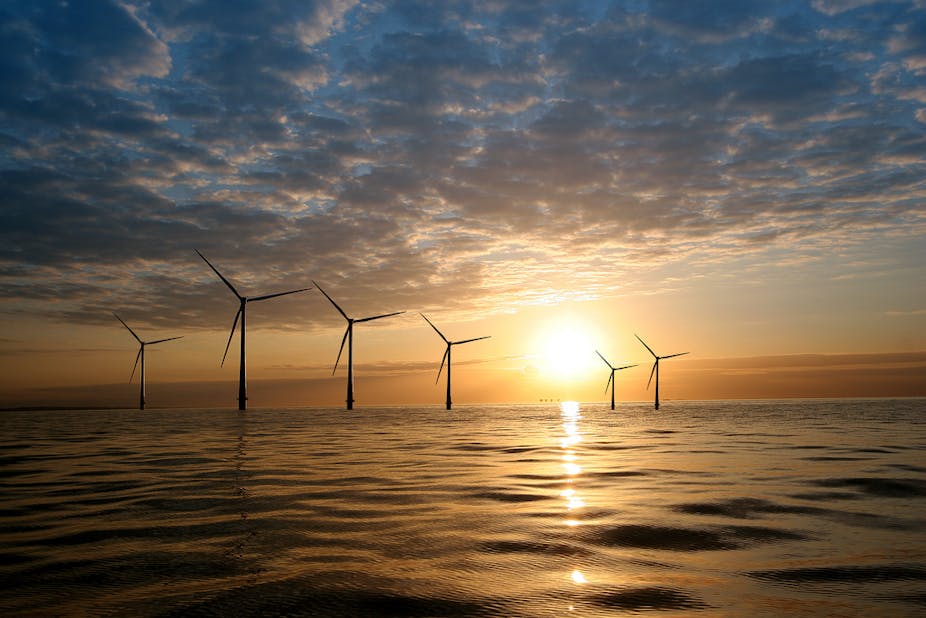
In the first six months of 2011, 101 new offshore wind turbines were connected to power grids across the UK, Germany and Norway. These turbines mean Europe now has a total of 1,247 grid-connected, offshore wind turbines with a total generating capacity of 3,294 megawatts. Roughly speaking, that generates enough electricity to power one million households.
Although this might only be a very small fraction of the total wind power capacity in Europe (roughly 4%) and an even smaller fraction of overall electricity generation, this is just the beginning. Offshore wind energy has been identified by the European Union as “a key power generation technology for the renewable energy future”.
So, if offshore wind power is the way of the future in Europe, are there good reasons why we don’t have a single offshore wind turbine in Australia? After all, it’s a technology with a number of significant benefits:
Offshore wind farms can utilise higher and less-variable wind speeds than onshore farms.
There is often more suitable (and available) space to build wind farms in offshore waters than there is on land.
Offshore wind turbines are far less visible than onshore turbines, which matters to a small minority of people.
Unfortunately, the capital and maintenance costs associated with offshore wind farms are, at present, roughly double that of onshore wind farms. However, as the offshore market expands, it’s hoped these costs will decline to the point where the advantage of higher electricity output will outweigh higher set-up and operational costs.
Why are the vast majority of the world’s offshore wind farms in Europe? Well, there are a number of reasons:
Europe is densely populated and so the amount of land available for onshore wind farms is limited.
Europe has large areas of coastal waters with a depth less than 30 metres. Current offshore technology builds the foundations of wind turbines into the ocean bottom and construction in deeper waters can be very expensive.
The European Union has a strong commitment to cutting greenhouse gas emissions, with renewable energy as a major technological solution to this challenge. The EU is therefore willing to invest in expensive offshore wind farms in order to bring their costs down as the market expands.
Germany is also relying on renewable energy, mostly wind, to replace a large fraction of its nuclear power stations which are being phased out.
Australia is in a very different situation. It still has plenty of potential sites on land, which would generate much cheaper wind power than current offshore technology.
In addition, most of Australia’s coastal waters are too deep for current wind turbine technology and it will be a long time before floating wind turbines – which are still at the pilot stage – are commercially available.
Despite these factors, there is some potential for the development of offshore wind farms in Australia.
In a research paper published in 2009, Eleonora Messali and I identified potential sites in Australia where offshore wind power may be feasible in the future. The sites had to meet a number of criteria, including:
- medium to high wind speeds;
- shallow waters;
- proximity to electricity users and the transmission grid;
- environmental and other constraints, such as marine parks and shipping lanes.
Some potential sites are located off the Western Australian coast near the South-West Integrated System (SWIS) electricity grid, while others are near the cities of Whyalla (South Australia), Gladstone (Queensland), Rockhampton (Queensland), Bundaberg (Queensland), Mackay (Queensland) and Melbourne (Victoria).
It’s hard to say how long it will be until we see the first offshore wind farms in Australia, but until the costs come down, Europe will continue to lead the way.
Further reading:
Chris Harries
Environmental consultant
Timely article, Mark.
I'm wondering why the issue of bird strike was not canvassed – it is my understanding that offshore wind farms generally pose a lesser problem in this regard than do wind machines located on the otherwise most favourable wind sites, coastal hills.
And does Bass Strait offer opportunities for offshore wind? The strait is not deep, being a land bridge during the last major ice age. I would have thought that there would be a number of favourable sites offshore of Tasmanian and Victorian coasts.
With regard to 'proximity to electricity users', since land-based wind generators are sited, more often than not, a long way from major cities, provided there is a reasonably short link to the land based power grid or to any township then I would have thought similar distance issues would apply for offshore wind farms?
Marc Hendrickx
Geologist
As a counter to Mark's simplistic argument in favour of sinking billions on wind farms that will ruin our coastal environment and never provide reliable base load, readers would benefit from listening to Graham Palmer's recent discussion on Ockham's Razor.
It is long overdue that Australia got over its baseless aversion to nuclear and started investing in next gen. thorium based reactors. Start by replacing the aging brown coal plants in the Latrobe Valley.
See...Coal dependence and the renewables…
Read moreMike Hansen
Mr
Great idea Marc.
Lets build a nuclear plant on our coast ... say like Fukushima in Japan.
That would never ruin our coastal environment ...
Marc Hendrickx
Geologist
Gee Mike, what a simplistic response.
Mark Duffett
logged in via Facebook
Unconstructive comment x 1000. Australia has thousands of kilometres of coastline that isn't facing an active subduction zone. And in any case, Fukushima Daiini and several other newer (than Fukushima Daiichi) reactors on the Japanese coast showed that it is eminently possible to construct nuclear reactors capable of surviving worst-case, magnitude 9 quakes and 15-metre tsunamis. I wonder if the same can be said of offshore wind turbines?
Dejan Tesic, PhD
logged in via Twitter
For once, I am close to agreement with Marc Hendrickx. Unfortunately, there are reasons to be sceptical towards wind and solar, and I emphasise "unfortunately" (for I would love them to work). See here, German experiences are not that good (as it would appear on surface): http://www.spiegel.de/international/business/0,1518,606763,00.html
Also, on Barry Brooks blog, there are disconcerting statements about wind turbines having no net positive effect on CO2 emissions. I am not sure how true are those statements (by Peter Lang, I believe), as I am not an energy expert.
The bird strike rate is the least of our worries (particularly as cats and cars do a much better job at killing birds than wind turbines).
Chris Harries
Environmental consultant
Hi Dejan,
Keep in mind that wind and nuclear devotees (most unfortunately) are at each others throats and both lobbying groups go out of their way to undermine the credibility of the other technology. So need to beware of some of the exaggerated information flying around. There are, similarly, web articles available that try to argue the case that nuclear provides no net emissions – owing to energy intensity of mining and processing... and so forth.
There's no need to go in hard and barrack all out for one or the other.
Regarding bird strike, cars and cats do not pose the same problems for bird life that wind machines can do – the main potential victims being migratory birds and raptors. Not always a problem but siting of wind machines can be very critical to ameliorating the problem.
Dejan Tesic, PhD
logged in via Twitter
Thanks... I share the same feeling about the people barracking for "their" technology of choice. Sometimes they may feel that they *have* to do that, as there appears to be so much misinformation on their preferred energy source (Barry Brook writes about that regarding NE on his blog; he does not oppose wind & solar developments, although he does not believe that at the present time there is potential for a "100% renewable energy" solution, and I am with him on that).
Regarding the birds, you probably have the point there. The information about cars and cats as the main bird-killers I've learnt from David McKay's book (which is pretty convincing in that - and other - respects, and is I believe as non-biased as possible... anyway, I'd love to hear if there's anything better out there.)
Mike Hansen
Mr
"I wonder if the same can be said of offshore wind turbines?"
http://www.theonion.com/articles/official-poster-for-terminal-gust,20878/
You may have a point Mark.
Mike Hansen
Mr
Here is a more recent article on the German experience with renewables which offers a different perspective.
http://news.businessweek.com/article.asp?documentKey=1376-LRXKVR6TTDSA01-37MGL9VUN6V4887L1PK7U4HU1P
There is no doubt the rapid increase in renewables and associated price drops is overwhelming existing regulatory regimes. This is something that Garnaut touched on.
Chris Harries
Environmental consultant
Excellent, Mike.
I've long held a view that the worst mistake human civilization could make at this juncture in history is to try to make dilute renewable energy sources do what concentrated fossil fuels have done to date – on the grounds that 1) it is impossible and 2) even it we try to do so then the environmental impost would be horrendous.
I still hold that view, but there are much more optimistic folk around.
Clearly we are on a sharp learning curve and the jury is not in as yet. Here's a view that I partly disagree with, but still pay heed to: http://energybulletin.net/stories/2011-10-03/renewable-revolution-ii
Again, it is a mistake to become too doctrinaire in the pursuit of our favoured solutions.
Mark Duffett
logged in via Facebook
Not sure if you intended it to be, Mike, but it's certainly not clear to me that the Business Week piece you pointed out is a good news story. Renewables send broke or otherwise suppress investment in baseload generators due to compulsory offtake regulations circumventing normal supply/demand price drivers - then what? What happens when the sun isn't shining and the wind isn't blowing? This is presumably why the Germans are planning for 20 GW of new fossil (peaking gas?) generators.
Indeed existing regulatory regimes are being overwhelmed - and I predict compulsory offtake for renewables will be the first element to go, very soon after the first blackout caused by a lack of baseload generators.
Mike Hansen
Mr
Only if you see it in terms of barracking for your side. Prof Diesondorf made the point in a recent Age interview that the move to renewables has plenty of challenges - he described them as large potholes. There is also going to be no shortage of naysayers along the way.
As someone who does not deny climate change science, I see it as inevitable and believe that society will work through the regulatory and baseload issues.
Having worked in IT&C for a number of years, I have seen the 4 stages of grief play out a number of times as new technology swept away the old. I see it again with the current revolution underway with renewables.
Mark Duffett
logged in via Facebook
It's not really true to say that "Germany is also relying on renewable energy" to make up for the crash shutdown of their domestic nuclear capacity. Rather, they are planning 20 GW of new fossil generating capacity (http://www.treehugger.com/files/2011/06/angela-merkel-germany-needs-20gw-fossil-fuel-power-plants.php), and importing nuclear electricity hand over fist (http://www.spiegel.de/international/business/0,1518,786048,00.html).
Chris Harries
Environmental consultant
Mark Duffett's nuclear stance is valid, but needn't be counterpoised against wind energy per se. In terms of energy return on energy investment (EROEI), wind energy stacks up well, certainly better than most other forms of renewables.
At present there is not too much public objection (in Australia) to wind farms, though this may change in time as wind generators begin to dominate almost every landscape around, as has happened in some parts of Europe. When the best land based sites are committed…
Read moreFran Barlow
teacher
Firstly, since it has been raised, ... what Mark Duffett and Mark Hendrickx said on nuclear power . We wouldn't be building the a 1960s nuclear plant in 2011 or the foreseerable future. Contemporary nuclear plants are built with passive safety systems. Had Fukushima been built with an isolated generator to run the cooling system, there'd have been no issue, but for reasons that have everything to do with the state of governance in Japan and nothing at all to do with nuclear power, this was never…
Read morewilma western
logged in via email @bigpond.com
Near Melbourne would include Bass Strait I would have thought. It's ironic that one of the refrains of wind opponents was "they ( Bracks and Brumby) should try putting turbines in Port Phillip Bay " - on the assumption this wouldn't be tried due to city slicker opposition, whereas country cousins were being oppressed as usual. Quite a few farmer country cousins and many other rural residents are of course very happy to have wind turbines on their farms or in their districts but the organised opposition probably hasn't disappeared just yet. Good to know that the Bald Hills windfarm has now released its construction schedule .
Tom Keen
BSc
"It’s hard to say how long it will be until we see the first offshore wind farms in Australia, but until the costs come down, Europe will continue to lead the way."
It would be more accurate to say "until the costs come down enormously, fossil fuels will continue to lead the way." This is actually evident in Germany, where they're building far more fossil fuel than renewable generating capacity to replace their nuclear reactors - contrary to what is implied in this article. Talk about needing to get priorities straight.