Explainer: storing renewable energy

Storage is one of the highest technological barriers to the spread of renewable energy. When the sun is shining, the tide turning or the wind howling, how do we collect that energy and keep it to use when generation is down? There are many different types of energy storage technology available or under…

2zfffgvp-1329781191
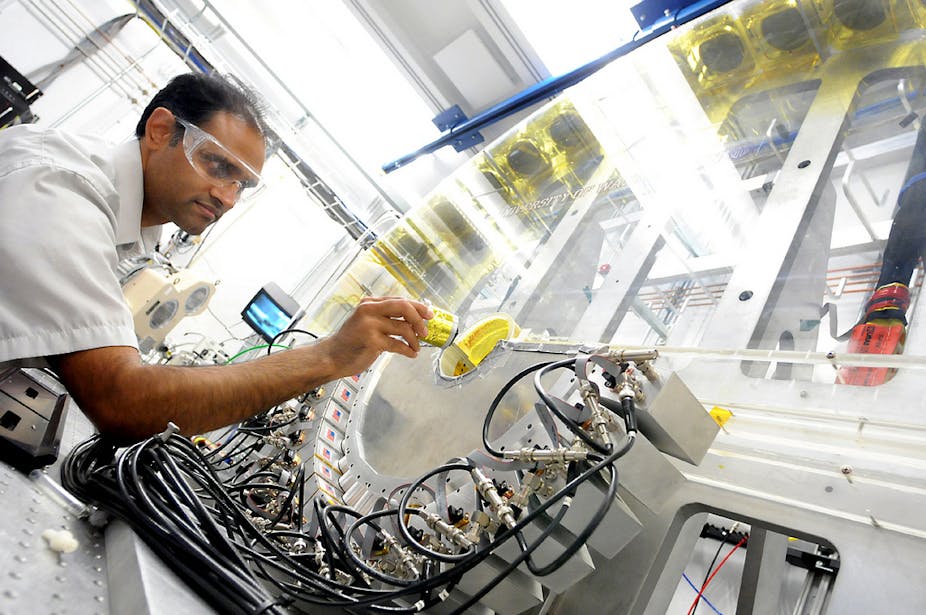
Battery research is improving renewable energy’s ability to provide power around the clock. Argonne National Laboratory

Storage is one of the highest technological barriers to the spread of renewable energy. When the sun is shining, the tide turning or the wind howling, how do we collect that energy and keep it to use when generation is down?

There are many different types of energy storage technology available or under development. But each technology has some inherent limitations or disadvantages that make it practical or economical for only a limited range of applications.

Some technologies are mechanical (flywheels, pumped hydro, compressed air). These have low energy efficiencies and slow response times. Pumped hydro and compressed air storage systems are also restricted by special geological and geographical requirements, high investment costs and long construction times.

Electrochemical energy storage systems – batteries – offer many benefits and advantages compared with other forms of energy storage.

Amongst the different types of battery technologies currently available, the ones receiving the most attention for large-scale energy storage applications are: – lead-acid – lithium-ion – sodium sulphur – flow batteries.

Lead-acid batteries

Lead-acid batteries are low cost. But their application for large-scale energy storage is limited by their short cycle life and limited rechargability.

Lead acid batteries are reliable, but with limited application. tomblois/Flickr

CSIRO has recently developed the UltraBattery. This hybrid energy storage device integrates a supercapacitor with a lead acid battery. The UltraBattery can be charged much faster than conventional lead-acid batteries.

This type of battery is well suited to hybrid vehicles and could be used to smooth out short-term power fluctuations in wind turbines (though this ability has not yet been demonstrated).

Lithium-ion (Li-ion) batteries

The main advantages of Li-ion batteries, compared to other advanced batteries, are:

  • high energy density – they can store a large amount of energy in a smaller physical space
  • high efficiency
  • relatively long cycle life, but still not adequate for many application.

Lithium-ion batteries perform well and are widespread in portable devices, such as mobile phones.

But a number of challenges need to be overcome if they’re to be used in large-scale grid-connected applications.

The main hurdle is the high cost (above $600/kWh). Li-ion batteries need special packaging and internal overcharge protection circuits to overcome safety issues that can lead to fires and potential explosions. Some of these safety issues have been addressed with the use of new electrode materials that operate at much lower voltages, but this reduces their energy density (and thus the main advantage of Li-ion).

Research is looking at keeping Li-ion batteries safe Argonne National Laboratory

Several companies are also working to reduce the manufacturing cost of Li-ion batteries. The electric vehicle industry is pushing this development.

Sodium-sulphur (Na/S) batteries

The sodium-sulphur or Na/S battery has a liquid (molten) sulphur positive electrode and liquid sodium negative electrode separated by a solid beta alumina ceramic electrolyte. Na/S battery cells are about 89% energy efficient.

The battery has to be kept at above 300°C to prevent electrolyte freezing and irreversible damage to the cells. These batteries also have safety issues.

The main difficulty with the Na/S technology is producing the solid beta alumina tubes that act as both separator and solid electrolyte. These are difficult to mass produce at an affordable cost.

Despite their high cost however, the Na/S technology has been extensively implemented in a large number of energy storage field trials and demonstrations around the world.

Sodium batteries have to be kept at a very high temperature. PNNL

Flow batteries

Flow batteries are a cross between a conventional battery and a fuel cell. They have up to 80% energy efficiency. In contrast to conventional batteries, the power generation (kW) and energy storage capacity (kWh) can be independently varied to suit the job the battery is doing.

Flow batteries are the cheapest energy storage technology for applications requiring storage of more than four hours, such as large-scale renewable energy storage.

Of the different types of flow battery chemistries that have been explored, only two types – zinc bromine (Zn/Br) and all-vanadium redox (VRB) – have reached commercial fruition.

VRBs are a promising way to store energy from large-scale renewables. UNSW

Three companies are developing the Zn/Br battery commercially. RedFlow, an Australian company, says they will release an improved battery this year. This is a 120 kVA, 240 kWH grid-connected energy storage system designed to store off-peak electricity for time-shifting and network stabilisation.

VRB was pioneered at the University of New South Wales, Australia. The largest VRB installation to date is a 4 MW/6 MWh demonstration system built by Sumitomo Electric Industries to store energy at a windfarm on the island of Hokkaido in Japan. Up to 200,000 charge-discharge cycles were demonstrated over the three-year life of the project, as well as very high energy efficiencies and fast response times that enabled output power stabilisation for the wind turbines.

The cost per kWh of generated energy of a VRB system can be less than half that of an equivalent lead-acid battery system for storage capacities in excess of four hours. This makes the VRB one of the cheapest energy storage technologies for large-scale renewable energy storage.

Several companies are now commercially manufacturing VRB systems, and VRB is likely to be of the leading battery technologies in the expanding global energy storage market being fuelled by the push towards renewables and the smart grid.

Sign in to Favourite

Want to follow The Conversation?

Sign up to our free newsletter to get the day's top stories in your inbox each morning, with a special wrap on Saturday.

Spinner
Help us have better conversations — donate

Join the conversation

53 Comments sorted by

  1. Mark Harrigan

    Dr

    Thanks for this interesting article. It appears there is a way to go but promising progress.

    The ability to reliably store energy in quantity with an acceptable charge rate at a viable economic price point will, I think, be a vital element in the technological armory to reduce emissions from fossil fuel generated energy.

    It would be good to see some of the learning cost curve reductions of the various technologies as well as to understand how far away they are from achieving a viable price point.

    report
    1. John Coochey

      Mr

      In reply to Mark Harrigan

      It is good for once to see an intelligent article in The Conversation which addresses the key point with renewables/unreliables. Crack that and most of the problem goes away. The real issue at the micro level is cost. The last Cool Power battery I bought was 35 amp hours and had a list price of $365! I recently replaced two car batteries one deep discharge 720 amp and they were $198 and $214 dollars. I have personal experience of household solar and the best all round available at the moment…

      Read more
  2. David Jones

    Engineer

    Pumped hydro is a mature technology which already provides grid level storage the world over. It can achieve efficiencies of up to 80% and typically lasts many decades before needing any significant maintenance.
    Wivenhoe Pumped Storage Scheme in Queensland involved creating the small Splityard Creek dam above Wivenhoe (Brisbane’s main water storage) with two short tunnels and a power house on the shore of Wivenhoe. For comparison, Wivenhoe PSS provides 500 MW and about 3000 MWh of storage. It can change from idle to full output in 14 seconds and even when not pumping or generating it helps with frequency stability of the grid.
    Australia has about 500 dams of over 10m height. Many of these would be suitable for such installations and some of these dams could support pumped hydro on a much larger scale than the Wivenhoe scheme.

    report
    1. Peter Davies

      Bio-refinery technology developer

      In reply to David Jones

      Not sure where the 80% figure comes from. I live adjacent to the Snowy Mountains and used to work in an engineering office in Cooma. I was told at the time by engineers managing Snowy hydro that the "off peak" coal power was used to pump water back up hill between storage's as a "Hydro battery" as a way of increasing the utility of the scheme, which had to balance electricity demand with releases for irrigation. This also provided a useful load for the thermal power stations in the Hunter Valley that had to keep their turbines spinning. The claimed efficiency of this at the time was 6% of the energy used to pump the water.

      What is the real number for pumped storage?

      report
    2. Stephen Morton

      electronics tech

      In reply to Peter Davies

      Wow, well it has to be somewhere between those two numbers, eh?
      Pumped hydro is an excellent method of storing kinetic energy directly but requires the proper geology. A dam in proximity to a mountain lake.

      This topic is huge and hugely interesting.
      Using the electricity produced by a hydroelectric dam to manufacture solar cells is a form of energy storage.
      The lower (and greener) the cost of production, the faster the energy deficit is recouped and the longer the panels can harvest sunlight.

      Stored compressed air can be used to turbocharge natural gas turbines and make them burn cleaner and more efficiently.
      Liquid salt thermal storage is proven and reliable and durable. Strides are being made in the geometry of mirror arrays to heat it.
      Electric car batteries will prove to have a great utility value for the homeowner and a large secondary market is expected for them.
      Those flow battery specs are impressive. Especially the cycle capacities.

      report
    3. John Coochey

      Mr

      In reply to Peter Davies

      Once again great to read something from someone who knows what he is talking about and acknowledges the need for spinning reserve on thermal schemes.

      report
    4. Philip Dowling

      IT teacher

      In reply to David Jones

      It occurred to me a while ago that using unreliable renewable energy technologies such as wind and solar to recycle water for hydro purposes might be viable in some cases.
      Of course, the cost of the original production and the loss in energy at each stage would need to be considered.
      Lithium batteries of course face the hurdle of adequate affordable supply, as China has a large proportion of capacity and is determined to be the manufacturer of products using it, rather than merely the supplier.
      Another source is potentially Bolivia. However the government has been slow to capitalise on this.
      It would be ironic for a poor country like Bolivia to have soudium/sulphur batteries, or batteries based on other elements to supersede the need for lithium in batteries.

      report
    5. John Browne

      John Browne is a Friend of The Conversation.

      Surveyor

      In reply to Peter Davies

      There is already considerable pumped storage (reverse hydro) capacity installed in the South East electricity grid. Apart from the Wivenhoe PS there is the Tumut 3 hydro power station near Tumut in southern NSW, part of the Snowy Mountains Scheme. It has been in service since 1973. Three of the six 300MW hydro units are fitted with under slung pumps that can pump water from Jounama pondage back up into Talbingo reservoir (over 150m). Talbingo is a huge storage of over 160 gigalitres.
      Also the Jindabyne pumping station acts as type of pumped storage in its function of pumping water from Lake Jindabyne over the dividing range and into the Murray side generators.

      report
    6. John Coochey

      Mr

      In reply to David Jones

      Yeh, OK, and the next one will be? That is about it. Somewhere on this Conversation someone indicates that reverse pumping is about six per cent efficient, that is not very good. Anyone in a position to amplify or verify this figure?

      report
  3. Daryl Deal

    retired

    Well, the clock is ticking, and we only have eight years to go, before the big oil world wide crunch time, hits like a tsunami!

    report
  4. Peter Sommerville

    Scientist & Technologist

    Maria,

    Thanks for a factual and easily understandable article. The issue of storage is absolutely critical to any implementation of so-called sustainable energy sources. I hope those that believe in this path read your article and gain some understanding of the enormity of the problems that remain to be solved.

    The article did not address the potential of heliostats and related technologies where the storage is in the heat capacity of molten salts. Perhaps a future article.

    report
  5. John Newlands

    tree changer

    It seems to me we either need cheap longlife batteries for houses and cars or gigawatt-hour scale storage that retrieves energy at a levelised cost of a few cents per kwh. The latter has been claimed for pumped seawater hydro at scales much larger than the demonstration plant in Okinawa Japan. If PV becomes sufficiently cheap we could almost entirely cover rooftops in panels to store several kwh in batteries.

    I note the new Holden Volt has a 16.5 kwh lithium ion battery worth many thousands. If they could be refurbished perhaps they could be used in houses to help run air conditioners in the late afternoon or make tea and toast for breakfast. In winter or cloudy weather they could be topped up from the grid, not unlike rainwater tanks in some semirural subdivisions that also have piped water.

    report
    1. Philip Dowling

      IT teacher

      In reply to John Newlands

      And they could be sold without any identification, in the same way that RAM was often stolen and onsold.
      Battery rebirthing?

      report
  6. Peter Davies

    Bio-refinery technology developer

    Interesting, but unfortunately I could not find anything in the article that comes close to the low cost and flexibility of the renewable storage system we use...Biomass.

    This naturally occurring solar energy storage system has an energy density equivalent of 1kWhr/kg. Can be stored safely and left growing to accumulate more energy until needed. Moreover coupled with an appropriate gasification system and downstream processing can be converted to not just electricity but into a range of useful co-products including heat, plastics, liquid fuels & fertilisers, not to mention safe, natural soil amendments that also sequester atmospheric carbon & reduce soil nitric oxide emissions.

    Wouldn't inventing this be a breakthrough!

    report
  7. Bruce Waddell

    logged in via LinkedIn

    My thanks for a very informative article. Your item signals it may be some time before I can afford to switch off from the mains. This is disappointing because friends of mine have been off grid since the 80's. Albeit with low light output. Fortunate LED's have mastered that fault. It is a bother to me that efficiencies I have made to my house haven't reduced my power bill in the same ratio. This is because the retailer keeps adding more to the distribution costs. In some ways I now value the local distribution service I once enjoyed until 10pm each day. In those days the local distributer only had a few hundred poles to worry about not thousands and the distribution cost was minimal to it. That is why I submit that a local distribution service has value for householders. But that proposal ignores the problems of storage your article addresses. I'll wait. However keep researching. The solution could save householders heaps.

    report
  8. Gil Hardwick

    Anthropologist

    Well, yes, to restate the obvious, a battery is merely a capacitor, and vice versa. This is a key insight.

    I am forever intrigued by the way we put things into words, and how reality shifts every time we do so.

    What we are talking about here is not 'storage', merely the smoothing out of fluctuations. In that we have long considered the utility of hybrid systems rather than single source. Hybridity in itself smooths out system fluctuations, most commonly solar panels coupled with wind generators…

    Read more
    1. Stephen Morton

      electronics tech

      In reply to Gil Hardwick

      Well I guess you can think of capacitors and batteries as having relatively the same effect in the circuit but the electrical characteristics and method of action is very different between them.(I think we need both words.)
      So called 'boost' capacitors are effective in implementing regenerative braking schemes. They provide fast recharge and very high recycle capacity.

      Perhaps electric vehicles will someday be sold with recharging garages to park them in. It's nice to have them in the shade of solar panels. The roof and hood of the car itself for that matter.

      http://pluginbayarea.org/fileadmin/materials/zero_emissions/EV_and_PHEV/Solar_Fuel_Station_Brochure.pdf

      report
  9. Peter Lang

    Retired geologist and engineer

    The Electricity Storage Association provides comparisons of the costs of the various electricity storage technologies:
    http://www.electricitystorage.org/technology/storage_technologies/technology_comparison

    Energy storage is orders of magnitude too expensive to make intermittent, unreliable, non-dispatchable renewable energy technologies economic.

    There is not chanve of the costs of both renewable energy and of energy storage becoming commercially viable (I am referring to non-hydro renewable energy.)

    report
    1. Gary Murphy

      Independent Thinker

      In reply to Peter Lang

      Interesting that compressed air seems to be cheapest. And I imagine you could do it pretty much anywhere.

      report
    2. Peter Lang

      Retired geologist and engineer

      In reply to Gary Murphy

      Gary,

      No, compressed air energy storage cannot be done anywhere (it needs suitable geology). Also it uses gas. And it is not suitable for the scale required. See the other charts.

      report
    3. Peter Lang

      Retired geologist and engineer

      In reply to Gary Murphy

      Gary,

      Let’s look very simply (limit analysis to get a ball park picture) of costs to power the NEM with PV and energy storage. PSH and CAES cannot do it because of suitable sites are not available. The next best option is probably NaS batteries. Let’s do a simple analysis. Here are some inputs:

      NEM peak winter demand = 33 GW
      NEM average demand = 25 GW
      NEM minimum demand in winter = 20 GW
      Energy supply for 10 days = 6000 GWh
      On overcast days, say 20% is supplied by PV and the remainder…

      Read more
    4. Peter Lang

      Retired geologist and engineer

      In reply to Gary Murphy

      Gary,

      Just for interest, this just in: “El Hierro To Become World's First Renewable Energy Island”
      http://www.huffingtonpost.com/2011/07/05/el-hierro-clean-energy-island_n_890587.html

      But this is not comparable with what Australia could do because we do not have significant, economically viable pumped hydro storage capacity.

      Here’s a straightforward way to calculate the cost of electricity from this wind/storage system:

      Construction cost is $8 per nameplate watt.
      If wind’s capacity…

      Read more
    5. Gary Murphy

      Independent Thinker

      In reply to Peter Lang

      You have used 20c / kwH in your calculations. This is the upper end of NaS costs and you have completely discounted Pumped Hydro and other cheaper options - why is that?

      I note from your links that you are a proponent of nuclear power. What do you think of Thorium?

      report
    6. Peter Lang

      Retired geologist and engineer

      In reply to Gary Murphy

      Gary,

      No. 20c/kWh is near the lower end. It is a log scale. 20c is a little below half way between 1c and 100 c.

      (Are you looking at the correct figure? this one: http://www.electricitystorage.org/images/uploads/static_content/technology/technology_resources/capital-cost_large.gif ).

      I trust after you have read and understood what I've provided above you'll feel able to acknowledge the point I made.

      Did you find the two links I provided of interest? If you haven't looked yet, and if you are genuinely interested in the cost of renewables, I'd urge you to consider them (I'd suggest you download the PDF and read it because it contains the appendicies).

      report
    7. Peter Lang

      Retired geologist and engineer

      In reply to Peter Lang

      I made a mistake in the estimate of the capital cost of PV. I'll give the correction below. However, I should explain this is extremely simplified and needs lots of explanation. I'd refer you to the "Solar Power Realities: supply - demand, storage and cost" paper for better explanation.
      http://bravenewclimate.com/2009/08/16/solar-power-realities-supply-demand-storage-and-costs/

      Here is the revised section for my above comment:

      "Add PV capital cost
      (average power / winter capacity factor over worst 10 days x capital cost per GW)
      (assume PV minimum capacity factor in winter = say 10% over worst 10 days)

      = 25 GW / 0.10 * $5/W = $125 billion"

      A lot of optimising could be done between PV capacity and storage capacity and different PV capacity factors and hours of generation at the rate needed to supply demand and provide energy to storage. I haven't attempted any pof this in this simple calculation.

      report
    8. Peter Lang

      Retired geologist and engineer

      In reply to Peter Lang

      Gary,

      Sorry, I've made more errors in writing the previous comment, but there is no change to the result.

      Wrong sentence says: "No. 20c/kWh is near the lower end. It is a log scale. 20c is a little below half way between 1c and 100 c."

      The sentence should read:
      "No. $200/kWh is near the lower end. It is a log scale. $200 is a little below half way between $100 and $1000."

      These figures are the cost for enery storage capacity that would be required (very roughly).

      My original estimated capital cost for the enegy storage capacity is unchanged at $960 billion. I revised up the estimated capital cost of the PV from $75 billion to $125 billion. This is a very rough estimate for reasons explained.)

      The total cost, therefore, would be about $1.1 trillion, which is around the times the cost of a nuclear solution which is also near zero emisisons).

      report
    9. Gary Murphy

      Independent Thinker

      In reply to Peter Lang

      I am looking at this chart:
      http://www.electricitystorage.org/images/uploads/static_content/technology/technology_resources/cycle_large.gif

      which takes into account the lifetimes of the technology and breaks the costs down into cost per kwH of energy stored/discharged.

      The costs range from 0.1 to ~2c per kwH for pumped hydro. Flow batteries anywhere from 100 down to 5c and 9 to 20c for NaS (but again the exponential axis - hard to tell exactly).

      So if you average it out it looks like 10c/kwH per cycle. Certainly not "orders of magnitude too expensive".

      I really am genuinely interested in your opinion of Thorium.

      report
    10. Peter Lang

      Retired geologist and engineer

      In reply to Gary Murphy

      Gary,

      We can get to your questions about thorium later. Let’s resolve this cost of storage issue first.

      You are misunderstanding the chart you are looking at. It is not the Levelised Cost of Electricity (LCOE) (which is what you are looking for). The figure you are looking at is pretty meaningless the way it is presented. It could also be misleading for many readers who do not fully understand what it is.

      To calculate Levelised Cost of Electricity (i.e. in c/kWh or $/MWh), which is what…

      Read more
    11. Gary Murphy

      Independent Thinker

      In reply to Peter Lang

      I appreciate your condescending tone Peter - and I don't doubt that you know more about the technicalities than I do. What I do doubt is your objectivity.

      Your figure of 30c/kwH is still not "orders of magnitude too expensive". To be "orders of magnitude too expensive" (plural) it would have to be at least 100x too expensive. Also you have still not explained why you have completely discounted pumped hydro and other cheaper technologies.

      report
    12. Peter Lang

      Retired geologist and engineer

      In reply to Gary Murphy

      Gary,

      Thank you for your further response. You say:
      “I appreciate your condescending tone Peter - and I don't doubt that you know more about the technicalities than I do. What I do doubt is your objectivity.”

      Sorry if my tone seemed condescending. Given the many comments from you in the past, where you have made condescending statements, unsubstantiated assertions and have invariably refused to acknowledge when you are wrong, I’d ask you to consider whether your opening remark is appropriate…

      Read more
    13. Peter Lang

      Retired geologist and engineer

      In reply to Gary Murphy

      Australia's existing pumed storage hydro facilities can stora about 5 GWh per day and about 20 GWh in total. The rough calculation in a earlier comment indicated we'd nee about 4,800 GWh of energy storage to power the NEM wiht PV.

      That gives you some idea of the scale of the problem. Another way of looking at it is we'd need sufficent PV to provide all the demand for power on overcast days in winter as well as pump three Sydney harbour volumes of water up 200 metres to a dams close by (within a few kilometers) every day over about three or four hours and release it every night over about 20 hours.

      The you have the problem of you need continuous reliable power to pump such huge volumes of water. You can't be turning the power on and off.

      If you want more on this see this comment:
      http://bravenewclimate.com/2010/04/05/pumped-hydro-system-cost/#comment-133008

      report
    14. Gary Murphy

      Independent Thinker

      In reply to Peter Lang

      The reason I haven't been able to admit I am wrong is because you haven't convinced me. I don't have the time or the background knowledge to go through every line of your analysis and question every one of your assumptions and the only links you provide are links to more of your own analysis. How about some expert opinion other than your own?

      It's good to see that you have backed off the "orders of magnitude" bit - what about the "not chanve[sic] of ... becoming commercially viable"? Can you see into the future?

      Feel free to admit you are wrong about making such an unsubstantiated all-encompassing statement.

      I am sorry - I am getting condescending again. It is what happens when I see people making ridiculous assertions.

      BTW Questioning someone's objectivity is quite appropriate.

      report
    15. Peter Lang

      Retired geologist and engineer

      In reply to Gary Murphy

      Gary,

      “ It's good to see that you have backed off the "orders of magnitude" bit - what about the "not chanve[sic] of ... becoming commercially viable"? Can you see into the future?

      Feel free to admit you are wrong about making such an unsubstantiated all-encompassing statement.

      I am sorry - I am getting condescending again. It is what happens when I see people making ridiculous assertions.

      BTW Questioning someone's objectivity is quite appropriate.”

      I sort of knew it would end up…

      Read more
    16. Gary Murphy

      Independent Thinker

      In reply to Peter Lang

      You are correct. I do want to continue to believe renewable energy can meet our energy requirements. This is not because of ideology - it is because I don't see any other viable options.

      We have to stop burning coal because it is very dangerous for the climate. So you should stop cost comparing everything with coal-fired electricity.

      The options are nuclear and/or renewables. Nuclear is dangerous, dirty, slow to implement, and inflexible - once you build a plant you are stuck with that…

      Read more
    17. Gary Murphy

      Independent Thinker

      In reply to Peter Lang

      $200 /kwH for 2000 cycles - it still works out at 10c/kwH for the energy you need to store. Financing & O&M could push it up to 15c.

      The total cost will depend heavily on how much energy you need to store (P.Lang thinks a huge amount - 80% of 10 days demand). But he did choose a generating technology that does not work well in winter(?).

      So if you got a suitable mix of renewable technologies including some that work well in winter the total cost would be reduced dramatically.

      report
  10. Glenn Tamblyn

    Mechanical Engineer, Director

    One of the cool ideas in this mix is the flow batteries. Maria describes it but maybe doesn't make it clear enough for those who don't know about the technology.

    Essentially they are made up of a working fluid that is pumped through a reaction chamber. Pump it one way and the fluid goes from a discharged to a charged state; you are storing energy. Pump it the other way and you are discharging energy. And the 'charged' and 'discharged' fluid is held in two separate tanks So essentially you pump…

    Read more
  11. Glenn Tamblyn

    Mechanical Engineer, Director

    Another big area that Maria's article doesn't discuss is the grid.

    Essentially our power grids are designed to distribute power from a small number of very large generators and spread it out through ever smaller 'pipes' until it reaches us.

    They aren't designed as general purpose energy distribution systems that can gather power from many places and distribute it to many other places. While selling our excess domestic solar power back to the grid is currently allowed, it isn't really done…

    Read more
  12. Paul Moonie

    PhD student, solar energy

    Thanks for a great article Maria.

    Energy storage is often forgotten in the energy debate/communication, more please!

    report
  13. Ken Fabian

    Mr

    Thanks Maria. I'm a bit disappointed that VRB's haven't made an impact as an alternative to Lead acid batteries for remote area power systems - seems to me there would be a ready market in all those homes that aren't on the grid especially given that simply having sufficient volumes of electrolytes would allow the ubiquitous back up generator to be dispensed with entirely. A delivery and replacement service for electrolytes could work as an extra back-up.

    As for grid scale storage there are other…

    Read more
  14. Gerard Dean

    Managing Director

    Professor Skyllass-Kazacos

    Fantastic read that really showed how good The Conversation can be.

    You have stuck to the scientific facts, you have explained the major points of current battery technology without waffling and without an agenda.

    And, as a result, look at the comments. Commentators who often rave and blather on other articles are putting forward reasoned comments. (That includes me)

    Bravo Professor, Bravo

    Gerard Dean
    Glen Iris

    report
  15. Dean Ashby

    Company Owner at Ezestore Storage Sydney

    Energy storage facilities can be complex at times because they are not the normal and usual tangible objects and items that we store in cabinets/drawers/boxes in our daily everyday lives. They need to be stored away properly in order to maintain their usability and to avoid them from being contaminated or become obsolete. Even their disposal methods need to be done following the proper procedures.

    report