


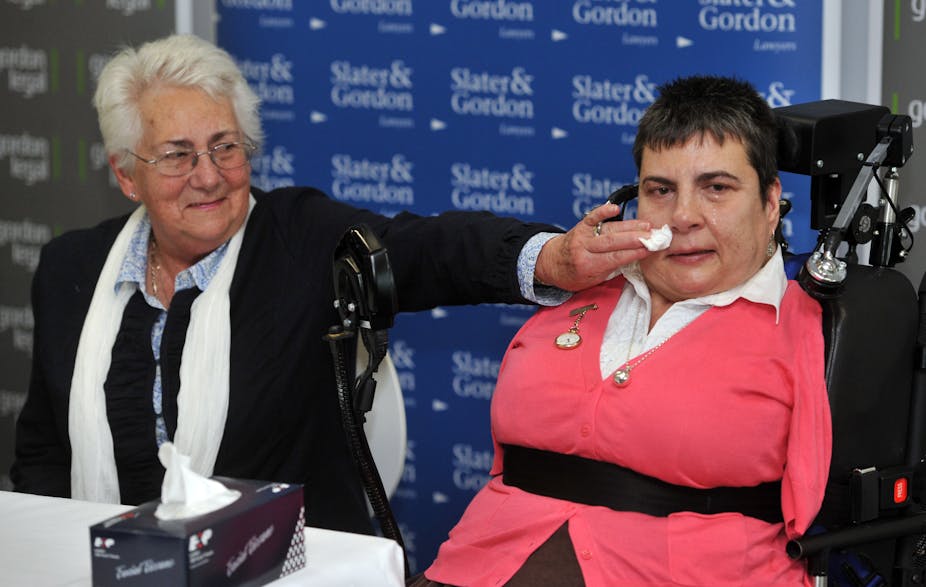
Melbourne woman Lynette Rowe was yesterday awarded a multi-million dollar legal settlement after suffering birth defects as a result of her mother taking anti-morning sickness pills containing the drug thalidomide in the 1950s.
Although thalidomide remains dangerous for pregnant women, it can be used safely to treat leprosy and the blood cancer myeloma. Professor Miles Prince, Director of the Centre for Blood Cell Therapies at Peter MacCallum Cancer Centre and Professor of Medicine at The University of Melbourne, explains.
Originally thalidomide was developed for its potential use as a sleeping tablet. At the time only barbiturates were available. The problem with barbiturates was twofold: they made people feel very sleepy the morning after, and there was the potential for overdose.
When thalidomide came along in the 1950s, it was developed as a sedative and sleeping tablet. Researchers also discovered it was a useful anti-nausea drug and was prescribed to patients who had morning sickness.
Part of the issue was that it was sold in some countries without a prescription. There were parts of the world, in Europe, Australia, and Canada, where people could simply buy it over the counter.
What side effects did it cause?
At the time, the patients taking thalidomide had minimal side effects. There was a bit of nerve irritation if taken in large doses but it was an effective sleeping tablet and anti-nausea tablet.
But if pregnant women took it during a critical time of baby development - between eight to fourteen weeks - it could lead to birth defects. It was in late 1959 and early 1960 when birth defects were starting to be detected.
How did thalidomide cause such harm? How did early testing not discover this?
There were a couple of things. At the time, drugs were developed in the context of fairly limited regulatory oversight. Many of these drugs were being developed with limited pre-clinical data and limited clinical testing in the population when they were released.
Specifically with thalidomide, what we now know is it’s not metabolised in the same way in small animals as it is in humans. So the original testing using small animals was unable to detect the extent to which birth defects could occur.
At the time, researchers didn’t know how thalidomide caused birth defects. There was a theory it was due to spinal cord development during a critical time of foetal development. As a result, researchers defined a number of birth defects “classic thalidomide birth defects” - the shortened limbs, the certain ear defects, certain blood vessel formation defects.
What we subsequently discovered is the sorts of defects caused by thalidomide were probably far more extensive and variable than was previously recognised. At the moment, there are a number of people who have defects which have been disregarded and not considered as thalidomide related.
How is thalidomide used now?
Thalidomide was also used in the late 1960s and 1970s to heal ulcers in patients with leprosy. It is now approved in numerous countries around the world to treat types of leprosy.
It was discovered that they way thalidomide works, both in treating leprosy as well as causing damage to the babies, is that it blocks critical blood vessel formation, or “angiogenesis” - “angio” as in “blood” and “genesis” as in “the first growth”.
In the 1970s and 1980s, researchers recognised the so-called “soil and seed phenomenon”. For a cancer to grow the “seed” cancer cells must multiply. At the same time it is critical for there to be a good fertile microenvironment - the “soil” in which the cancer cells grow.
Blood vessel proliferation is important for cancer growth. Even if some cancers grow to only a millimetre in size, they start to stimulate new blood vessel formation, and those blood vessels will bring to the cancer oxygen and nutrients which will help it grow. It’s a way in which the cancer can help itself proliferate.
So researchers tested thalidomide as an anti-angiogenic. In other words, a way to try and “strangle” that blood vessel formation, to stop oxygen and nutrients from coming to the tumour and hopefully starve the tumour. It worked in animal models for a variety of cancers and in the mid 1990s in the United States there were some very early clinical trials involving thalidomide and myeloma (a blood cancer related to leukaemia).
In 1999, the seminal study published in the United States showed thalidomide had a response rate of around 30% in patients who were not responding to chemotherapy, and who’d failed all other treatments. Thalidomide really exploded on to the scene as a saviour for a treatment for people with myeloma.
We still to this day don’t exactly know why thalidomide works best in myeloma over all other sorts of cancers but it seems to be a combination of effects - on blood vessel growth as well as stimulation of the immune system and blocking critical cytokines that make myeloma cells grow.
Since then we have witnessed the development of the next generation of thalidomides: lenalidomide and pomalidomide. Lenalidomide is now replacing thalidomide**; it is better tolerated and somewhat more effective than thalidomide in myeloma.
Should we be concerned about the use of thalidomide today?
Its fair to say thalidomide has modest side effects in patients who are not pregnant. The rediscovery of thalidomide has saved thousands of lives. There are tens of thousands of people who have been treated by thalidomide around the world for myeloma and it has improved their survival. It has gone from a terrible drug to a drug that, if used in the right way, can save lives.
**This sentence has been amended to remove a claim that lenalidomide “doesn’t cause birth defects”. To date there have been no reports of human birth defects with lenalidomide. However it is not prescribed to pregnant women and regulators warn it may cause birth defects.
See more Explainer articles on The Conversation.