Failure to launch: what happened to Indigenous recognition?

The Gillard government has finally confirmed it will not be asking Australians to vote in a referendum for the constitutional recognition of Indigenous peoples in this term of parliament. Although agreeing to pursue this constitutional change at or before the 2013 federal election was important in obtaining…

B5qfcd3t-1348114528
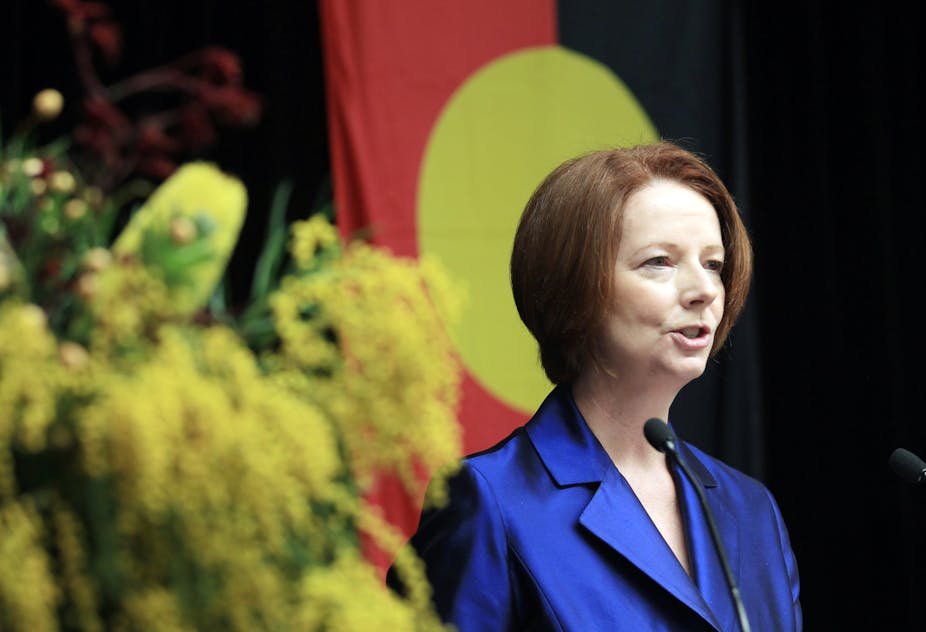
Why did the government drop the ball on constitutional recognition? AAP/David Crosling

The Gillard government has finally confirmed it will not be asking Australians to vote in a referendum for the constitutional recognition of Indigenous peoples in this term of parliament.

Although agreeing to pursue this constitutional change at or before the 2013 federal election was important in obtaining the support of the Greens and Independents Andrew Wilkie and Rob Oakeshott for Labor’s minority government, yesterday’s announcement does not come as much of a surprise.

Indigenous leaders will breathe a sigh of relief that the government will not push ahead with the referendum.

The members of the government’s Expert Panel on Constitutional Recognition of Aboriginal and Torres Strait Islander Peoples were emphatic in their final report: nothing could set back relations between Indigenous Australians and the rest of the community more than a hasty campaign for change that was rejected by the electorate.

Prominent Indigenous voices, including Professor Marcia Langton and Aboriginal and Torres Strait Islander Justice Commissioner Mick Gooda, have been frank in their more recent comments that it would be unwise to stick with the original timetable and better to wait.

But did it really have to work out this way? And does the government’s announcement bury or merely shelve Indigenous constitutional reform?

In receiving the panel’s report in January, the Prime Minister said:

As a nation we are big enough and it is the right time to say yes to an understanding of our past, to say yes to constitutional change, and to say yes to a future more united and more reconciled than we have ever been before.

Although the Coalition expressed some concern that the prohibition on racial discrimination might, in the words of opposition leader Tony Abbott, amount to a “one clause bill of rights”, it had gone to the 2010 election supporting recognition through a new preamble and also seemed willing to remove obsolete racially discriminatory provisions.

But after that, there was hardly any further discussion of the substance of reform – and any momentum from the panel’s report appeared to stall. What happened?

Certainly one factor that always pushes against of plans for constitutional change to generating traction, is the other more pressing and immediate issues that crop up and demand political responses.

In the life of Gillard’s minority government the distractions have been plentiful. The introduction of the carbon and mining resources rent taxes and the perennial nightmare of asylum seeker policy are just the tip of the iceberg. But while we have indeed been living in an unusually hot political climate, competition for media attention is nothing new. It is a challenge that must be overcome by any reform campaign in any era. The real problem lies deeper than this.

The proposal for constitutional reform in the interests of Indigenous Australians drifted for two main reasons: insufficient community awareness and a lack of bipartisan support. Studies on successful referenda in the past have proved that both of these are essential for achieving constitutional change.

In a statement explaining the deferral of the referendum to some future, unspecified date Minister Jenny Macklin highlighted the deficiencies in community engagement as a justification.

There is no doubt the public has to be informed and appreciative of the reasons underlying any proposed change to the constitution. But it is hard not to see political leadership – the other essential prerequisite for success – as pivotal in this regard.

Like the chicken and the egg, which comes first – a clear political commitment to specific reforms or community support for the same? In the hierarchy of obstacles facing the referendum, arguably the bigger deficiency appears to have been the stance of our elected representatives.

The government is certainly open to a charge of passivity. In the nine months since receiving the report, no formal response whatsoever to its recommendations had been made. It is strange to expect others to expend energy on proposals about which the government has signalled so little enthusiasm. Complaining about a lack of community leadership is a bit rich when the ball is in your court.

The failure to grasp the momentum of the Expert Panel’s consultations created an opening for the opposition to claim the issue. Shadow Attorney-General Senator George Brandis has stated that the referendum should not occur under Julia Gillard, arguing that only Tony Abbott would be able to convince conservatives to vote for change.

In this context, it’s not surprising that the referendum timetable has been postponed at least until after the next federal election. Given the way things have played out – or rather, haven’t – it is almost certainly for the best.

The lesson from this is that it is unrealistic to think the community can really advance the case for change without clear leadership from Canberra.

Having been neglectful in the carriage of Indigenous constitutional reform, it is perhaps heartening that in Macklin’s announcement she reveals plans for the Commonwealth Parliament to pass an “Act of Recognition acknowledging the unique and special place of our first peoples”.

This might be seen as a poor consolation prize, but looked at more optimistically the proposed statute is probably a good way of finding common ground between the two major parties in a setting that is not as high-octane as a bill to amend the Constitution.

Referenda may be all about the will of the people, but they can’t be run by the people alone. The public responds to political leadership on issues of national importance. When that is absent, so is the community’s interest.

This article was co-authored by Jennifer Goh, Social Justice Intern, Gilbert + Tobin Centre of Public Law, UNSW

Articles also by This Author

Sign in to Favourite

Want to follow The Conversation?

Sign up to our free newsletter to get the day's top stories in your inbox each morning, with a special wrap on Saturday.

Become a friend of The Conversation and donate

Join the conversation

53 Comments sorted by

  1. Chris Harper

    Engineer

    I just wish the whole thing would go away.

    Scrap section 51(xxvi) of the constitution, and don't reinsert race anywhere else.

    Equality under the law for all, and assistance for those who need it, judged on the basis of need, not race, colour, ethnicity or cultural background.

    report
    1. Terry Mills

      lawyer retired

      In reply to Chris Harper

      Together with 51 (XXVI) we also need to dump S.25 which was originally inserted to discourage racism in the states but is now spent, and that should really be it.

      As has been pointed out elsewhere, to go further in recognising ATSI peoples means that you probably need also to recognise the contributions made to this country by immigrants and that may be a slippery slope.

      report
    2. Julian de Ross

      Company Director

      In reply to Chris Harper

      Hi Chris, I think there is something very much being missed in all white conversation about indigenous people.
      I note also, that most of the convo and comments comes from an identifiable 'white/western' world view. I'm white, but married to an indigenous person from Asia. I learned wayyyy more by livng with them (and their language and culture), and experiencing many of the same things and watching others (such as exploitation by Muslim and Chinese cozy bedfellows rather than white in this case…

      Read more
    3. Frank Baarda

      Geologist

      In reply to Julian de Ross

      Julian, your contributions to this disccussion reminds me of a wittisism that I think emanated out of the Pacific: "When white-men first came, we had the land and they had the Bible. Now we have the Bible and they have the land".

      I'd like to defend the much maligned Charles Darwin. Darwin actually was a deeply religious man (as were most intellectuals of his time). It is not his fault nor others like Malthus that their writings should have been seized on and used by opportunists to justify the worst excesses of colonialism.

      As for us secular Australians, you are right. We will never succeed in "bringing the Aboriginal Aussies into modern life" You know why? Because we don't think it is our prerogative to do so and also because they are already there (modern life that is)

      report
    4. Julian de Ross

      Company Director

      In reply to Frank Baarda

      Another good comeback Frank. But you are referring there not to the Churches, but to the Colonialists. The line between Church and Colonial settler/administration is often blurred in historical remeniscences. My family is living evidence of how it works when it goes God's way rather than mans. The 3 missionaries (from Australia) who founded the Borneo Evangelical Mission, had absolutely zero 'land' aspirations, they were concerned for the souls (to put it evangelically). They did build some rather…

      Read more
    5. Black Knight

      writer

      In reply to Julian de Ross

      I agree that something important is missing from the work of naturalists when it comes to depicting life. I call it the sum total of existential considerations.

      From my understanding of the Ways of First Peoples in Central Australia, the whole of life is subject to trans-signification, not merely the bread and wine of the Christian religion (coming from a horticultural society).

      Country is the eternal soul.

      Those wishing to find out more need to move beyond Christ and into the realm of the Holy Spirit to rise to the challenge presented coming to terms with this country.

      I recall this was a good read:

      Title To Learn a New Song: A Quaker Contribution Towards Real Reconciliation with the Earth and Its People
      James Backhouse lecture
      Author Susannah Kay Brindle

      report
  2. Frank Baarda

    Geologist

    I agree that no referendum is better than a failed referendum.
    It does all remind me of Warren H. Williams' reaction when the proposal was put by the PM. Warren H. thought it an insult that the question had to be asked at all!

    I find it very ironic that Minister Macklin's statement included this:
    "However, we recognise that there is not yet enough community awareness or support for change to hold a successful referendum at or before the next federal election."
    So where was the 'community awareness or support' when the Stronger Futures legislation sailed through both houses of parliament virtually unopposed?
    The so called 'Stronger Futures' is the next decade of Intervention in these remote communities. Obscene amounts are being spent on 'Closing the Gap' initiatives. Very little of this money 'hits the ground' while the social fabric of these communities is being torn apart. 'Community awareness or support'?
    A pox on both your houses I say!

    report
  3. Black Knight

    writer

    Well, that may have been the last chance for Anglo-Australia, as established under the British Act which is the 1901 Constitution, to put it's house in order of its own volition. A loss for enlightened self-interest.

    The problem for this country's First Peoples, now captive within a modern nation state founded on the denial of their realities, has been the absence of a competitor to the British colonisers. A third player is required on the procees of ensuring recognition of indigenous peoples.

    The French underwent revolution at the historical moment they could have played his role here.

    What will the 21st century offer, in ths regard, I wonder?

    report
  4. Rajan Venkataraman

    Citizen

    Thanks for the article Andrew.
    One reason I suggest why the community did not become sufficiently excited about the proposed constitutional amendment was that a convincing case was not put that such a change was necessary to the material improvement in the lives of indigenous people or that it would greatly advance the cause of reconciliation between indigenous and non-indigenous people.

    Now, I am not suggesting that Australians are completely immune to the power of symbolic measures, but such…

    Read more
  5. Anthony Nolan

    Ruminant

    It didn't get up because the ALP under Gillard is incapable of driving the reconciliation agenda. No political will for the change. This, against an historical background of genocide and continuing denial of same, which denial itself is one of the prime markers of genocide, means that the nation remains a redneck wonderland and racist sh*thole. This is a deep failure because the main institutions for terror and genocidal policies against Australian First Peoples were and remain the institutions of the state - the police, corrective services, child protection, the judiciary and all of those state service providers who fail to ensure equitable distribution of resources according to need.

    report
    1. Julian de Ross

      Company Director

      In reply to Anthony Nolan

      Anthony....I'd love to know what your understanding of 'reconciliation' is ?

      Keep in mind, there are political forces behind a lot of this, and while the 'face' might be black, the string puller is often white. I rang a Melbourne Aboriginal rights group some time back and asked quite simply "What...do you want?" you ought to try that some time. Makes for interesting conversation. ummm would you believe complete sovereignty over all Melbourne and Victoria ?

      report
  6. R. Ambrose Raven

    none

    Several massive barriers to any serious improvement of marginalised Aboriginal society arise from selfishness, self-interest and a post-mercantilist ideology that directly continues the dispossession of 1788. Despite the white noise of racism and historical dispossession which is a constant drone in the background of their lives, many Aboriginal people do try, inevitably against the odds.

    Those barriers comprise politics, the denialists, the media, transnational economic ideology, and the bureaucracy…

    Read more
    1. John Coochey

      Mr

      In reply to R. Ambrose Raven

      I remember a couple of "aboriginal spokespersons" who visited Canberra at I assume taxpayers expense to demand more facilities in remote areas. The politically correct interviewer referred to a Productivity Commission Report that aborigines could choose between geographic isolation or better facilities. The absence of facilities is equal depending on location. I had no more sympathy for them than an apparently middle class family I saw complaining about the transport problems getting their kids to school as the parents worked as opal miners in a remote area. If that is the lifestyle you choose you cannot expect a tertiary college and a teaching hospital at the end of your drive.

      report
    2. Frank Baarda

      Geologist

      In reply to John Coochey

      Not sure what this means.
      In Yuendumu the Intervention erected a large Centrelink building at I assume taxpayers' expense. The building arrived on the back of five semi-trailers all the way from Bendigo in Victoria (a distance of 2,008 Km as the crow flies). I am not aware of any "aboriginal spokesperson" that demanded this facility.
      Centrelink's motto: "giving you options" (how oxymoronic is that?!)
      I'm also not aware of any Warlpiri people in Yuendumu seriously hanging out for a tertiary college and a teaching hospital at the end of their drive (if they have one). Their demands are quite modest: A bit of respect and dignity and the right to run their own lives and not to be pushed from pillar to post by an ever increasing army of public servants, law enforcers and "service delivery agencies"
      Whether they are mentioned in the Constitution or not doesn't seem to bother them all that much either.
      I've heard their wishes expressed as "Yampiyalu Nganpa" .... Leave us alone!

      report
    3. Black Knight

      writer

      In reply to Frank Baarda

      Have you heard any of the senior lawmen saying that they would like their system of law recognised?

      report
    4. Frank Baarda

      Geologist

      In reply to Black Knight

      Warlpiri society is much less hierarchical than our 'western' (for want of a better word) society. Such terms as "elder" and "senior lawmen" don't quite hit the nail on the head. Subject to the above, the answer to your question is yes.
      On many occassions (I've lived here a long time) I've heard Warlpiri people express frustration at "our way" (the Warlpiri way that is) being not understood, ignored or put down.
      "Our Way" includes what has become known as "customary law" and which is explicitly…

      Read more
    5. Black Knight

      writer

      In reply to Frank Baarda

      Well, "senior lawmen" seemed to hit the nail squarely on the head with my experiences with working on land claims in Central Australia during the 1980s and i really doubt, Frank, if things have changed that much since then.

      Agree that the term "elder" is often applied by non-indigenous people in a way which would not be matched by First People's themselves, where a "young fella" may be 60 years old. Ditto too the use of term, much beloved by mainstream media and politicians of "Aboroginal leaders…

      Read more
    6. Frank Baarda

      Geologist

      In reply to Black Knight

      That's OK with me. "Senior lawmen" is fine, especially as you know what you're talking about! It's however a bit like 'Jukurrpa' which when translated into English as "The Dreamtime" loses much of its deeper meaning.
      You are so right in that "we need to fashion new ears" if we aren't to be forever doomed to come out with "a one-sided cultural monologue, which can only produce a one-sided solution"
      At Kalkaringi last year (45th Anniversary of the Wave Hill walk-off) Rosalie Kunoth-Monks declared…

      Read more
    7. Black Knight

      writer

      In reply to Frank Baarda

      Well said.

      In Warumungu, (Tennant Creek, Barkly etc) "kuwarta-kupurtu" ears lacking - never listens.

      And the word "warunga" (not sure of spelling) is used for people who may be deaf, heedless, or crazy - cut off from their surroundings in one way of another.

      In terms of soft-hard ground - a useful metaphor "blocked" when used with ears - while I have long been aware of the effects of the Cuban heeled cattlemen it was only when reading Bill Gammage's book recently that I learnt of the…

      Read more
    8. John Coochey

      Mr

      In reply to Frank Baarda

      I was dining with a NZ nurse who works as a contractor on an aboriginal settlement that used to be an extensive market garden when it was a mission, now it produces nothing. In her role as "district nurse" she criticized a mother for having a fitly child for not washing it. The reply was it was not part of the mother's culture to was her child. The nurse then demanded she hand over her mobile phone because that was not part of her culture either!

      report
    9. Frank Baarda

      Geologist

      In reply to John Coochey

      What nonsense. Stereotyping anecdotes were used by Mal Brough and Jenny Mackling to justify their policies.
      I use anecdotes to counter the assimilationist attack on my friends and neighbours, so here goes:
      The Northern Territory Education Department provides housing and all sorts of incentives to interstate recruits. "Education" housing is denied Aboriginal local recruits. Yuendumu school had a functioning bilingual programme with a Warlpiri person "team teaching" in front of almost every class. Several people used to come to our "Education" house (my wife is a school teacher) to have a shower in the morning before work. Our "Education" washing machine was in constant use. It did not occur to my wife to deny access to the shower and washing machine to people by reason of it "not being part of their culture".

      report
    10. Black Knight

      writer

      In reply to John Coochey

      Hi John,

      Before my time in Central Australia (1980s) the "settlement" of Warrabri is said to have had a great garden of some kind, which folded when the single non-indigenous person who made it happen departed. A common pattern in my experience, as seen in some "Aboriginal" organisations which function well while certain people remain, and can turn rotten very quickly when they depart and their place is taken by carpetbaggers.

      But your N Z friend could have done well to reflect on the great…

      Read more
    11. Frank Baarda

      Geologist

      In reply to Black Knight

      "...Change itself does not destroy a culture. All societies are constantly evolving. Indeed a culture survives when it has enough confidence in its past and enough say in its future to maintain its spirit and essence through all the changes it will inevitably undergo."
      ― Wade Davis, The Wayfinders

      Black Knight, I have witnessed the heavy lifting you speak of. The changes that Warlpiri society has made to itself in the several decades I have lived here are almost unbelievable.
      The authorities that are tearing at the social fabric of these remote Aboriginal places are mostly ignorant of these changes and most certainly unwilling to give credit where it is due.
      I fear for these societies because they have virtually no say over their futures.
      Stronger bloody Futures indeed. Shame Jenny Macklin, shame!

      report
    12. Black Knight

      writer

      In reply to John Coochey

      PS

      I should add, also, John that there can be major problems with etablishing horticultural enterprises, such as gardens, in some parts of Central Australia due to soil salinity and less an ideal bore water. Initial successes may not last long.

      However, there are some enterprises near Ti Tree which have been around for a while. Frank would know a lot more about that.

      Simple point - nothing is straight forward.

      report
    13. Black Knight

      writer

      In reply to Frank Baarda

      Frank,

      "leveli" is a word which you may know from Warlpiri senior men, used so we English speakers might understand.

      Two peoples coming level.

      Got this key concept via linguists who worked with Warlpiri people, so I think it is a good one to add to the mix here.

      What do you think?

      In my view, the mainstream Anglo-Australian idea of level playing field - during the last century at least - was akin to a sheer vertical cliff. Them on top.

      report
    14. Frank Baarda

      Geologist

      In reply to Black Knight

      Indeed, have heard the English word "lippel" invoked on many occasions, most often during discussions regarding the fervently hoped for re-introduction of bilingual (or 'two-way') education.
      "English and Warlpiri should be lippel" accompanied with a gesture in which both hands are held at the same vertical height.

      report
    15. Julian de Ross

      Company Director

      In reply to R. Ambrose Raven

      Ambrose.. you are doing it too... "approaching an indigenous issue with a white western secular mindset"

      Evidence: Far from being merely annoyances, they are greater barriers to fundamental betterment of Aborigines as a group than the disadvantage of Aboriginals themselves.

      You use two words of interest "Betterment" and "Disadvantage" but I'll bet you define those terms in your own head in a materialistic way. "services/ housing/health/education" etc....am I right?

      ooh you have a lot to learn :)

      report
    16. R. Ambrose Raven

      none

      In reply to Julian de Ross

      Not from empty vessels, Julian.

      Solvent-sniffing would by any rational standard - I can't speak for yours, Julian - involve disadvantage. It is hard to see how the mental disarrangement caused by hallucinations, and emotional disturbances could not affect culture, learning and social behaviour.

      Aborigines did not as far as I'm aware - I can't speak for your awareness, Julian - prefer starvation to pleasant sufficiency.

      We may take it that it is possible for non-Aborigines to understand the issues.

      ooh you have a lot to learn :)

      report
    17. Julian de Ross

      Company Director

      In reply to R. Ambrose Raven

      Good comeback Ambrose... I like that. (even if I might disagree a tad).. I suppose I'm saying we need to step back a bit and try to see the bigger piccy rather than the specific. Let me illustrate, in the case of the Bornean tribe, they only received an initial exposure to the teachings of Christ (between 1932 ish and 1939 and then the the 'culture wrecking missionaries' (as secularism loves to taunt) had to get out due to the war. (Japs) during the war they were left to themselves. During that…

      Read more
    18. Julian de Ross

      Company Director

      In reply to Frank Baarda

      Frank... if I may make the point again.... .. you are speaking about people being 'distinct'... ok.. but there are difficulties with that. The more 'distinct' people are and unique their culture, it is inevitable that there will be a clash on one level or another with the dominant culture. At that nexus, one of two things must happen. Black culture is sidelined or white culture is sidelined. I don't see much middle ground if there is a direct conflict of perceived rights.
      I'd be interested in…

      Read more
    19. Frank Baarda

      Geologist

      In reply to Julian de Ross

      The Sioux Indians did not stop being Sioux when they gave up the bow and arrow any more than an American stopped being an American when he gave up the horse and buggy... Wade Davis said something like this.
      I think he had a point.

      Interesting what you say:
      "Keep in mind..that what the Yor Yiront lost in the arrival of steel axes, was male identity and clarity of position in society. Once that is destroyed, the blokes are not too far behind on the downward spiral.. See my drift ?"

      It wasn…

      Read more
    20. R. Ambrose Raven

      none

      In reply to Julian de Ross

      This simply emphasises the complexity of the issues, which is why denialism, the media, and self-focussed public services are themselves an obstacle to any solution.

      report
  7. Peter Ormonde

    Peter Ormonde is a Friend of The Conversation.

    Farmer

    This is a sad thing isn't it - that after all we've done and seen we are still unable to acknowledge our own history.

    But they are right. Quite obviously this proposition - no matter how meagre - would be seized upon by the Opposition to feed more fuel into the fire of "outrage" they have been stoking for several years.

    And given the serious problems confronting Aboriginal communities and families, the recognition proposition is probably a symbolic distraction - there are other more urgent needs and priorities.

    Pathetic really - but none the less a sensible pragmatic political decision. Postponed but never shelved. The price of opportunist and unprincipled politics.

    report
    1. Julian de Ross

      Company Director

      In reply to Peter Ormonde

      Peter..not sure what you mean by 'our own history' and your use of "'serious problems"

      Let me make 2 points.
      1/ the history you speak of came from secular scientific thinking about the world.
      2/ The serious problems? are you thinking in secular materialistic terms? I suggest you are.

      report
    2. Frank Baarda

      Geologist

      In reply to Peter Ormonde

      That'll be for them to work out, and for the rest of us to let them!

      Did you know that Yuendumu with its less than 1,000 inhabitants has seven initiatives/projects/agencies involved in Early Childhood Development?
      The competition for "locals" to draw into various (and numerous) schemes is intense. Oddly, locals aren't falling over each other to embrace these initiatives! What is wrong with them?

      report
  8. Gary Foley

    historian

    The stupid and pointless idea of constitutional recognition was never going to make it to a referendum in these racist times. The 1967 referendum was passed after a decade long public campaign and at a time when 90% of the Australian people supported Aboriginal rights. But today, after a decade of Hansonism, Howardism and the History Wars, the Australian electorate is more likely to 90% reject constitutional change in support of Aboriginal rights.

    Minister Macklin and Pat Dodson can try and put…

    Read more
    1. Peter Ormonde

      Peter Ormonde is a Friend of The Conversation.

      Farmer

      In reply to Gary Foley

      Nice pup.

      I think you're right - this recognition business was never going to do anything concrete or real for Aboriginal people Gary. It was about us lot not so much about you lot. About us coming to terms with our own history and presence here.

      That's not a bad thing... maybe a necessary thing - a precondition for getting serious. But there's a lot of folks who don't want to look at or think about that - where our good fortune comes from in this "Lucky Country" and how we got it. Too ugly a mirror.

      report
    2. Frank Baarda

      Geologist

      In reply to Gary Foley

      Minister Macklin...positive spin... inane statements...all in the one sentence!

      When the Australian government was dragged kicking and screaming into endorsing the UN Declaration on the Rights of Indigenous Peoples, Minister Macklin duly made inane statements and gave it a positive spin.
      Special rapporteur Anaya's criticism of the Intervention (" further stigmatises already stigmatised societies") was ignored or denied or dismissed.

      None of the UN Declaration has been implemented and the Intervention has been extended another decade.
      All we get out here in remote Aboriginal Australia in these racist times is positive spin and inane statements.

      report
    3. Black Knight

      writer

      In reply to Gary Foley

      Have to disagree that recognition of Australia's First Peoples as First Peoples will never do anything concrete or real for them.

      The history of colonisation here has been one of the "unrealisation" of First Peoples, and to acknowledge them and their Ways (languages, cultures, cosmologies, world views ...) as real is a major turn-around in the genocidal and ethnocodal practices which arrived in 1788.

      It will do something for us non-indigenous people. Something important too.

      I think part…

      Read more
    4. Frank Baarda

      Geologist

      In reply to Black Knight

      In 1994 Indigenous Rights were added to Argentina's Constitution.

      Artículo 75, Inciso 17 de la Constitución Nacional:
      Reconocer la preexistencia étnica y cultural de los pueblos indígenas argentinos. Garantizar el respeto a su identidad y el derecho a una educación bilingüe e intercultural; reconocer la personería jurídica de sus comunidades, y la posesión y propiedad comunitarias de las tierras que tradicionalmente ocupan; y regular la entrega de otras aptas y suficientes para el desarrollo…

      Read more
    5. Frank Baarda

      Geologist

      In reply to Frank Baarda

      Have had another think on this. Let me rephrase the analogy/metaphor.
      Black Knight is on about leveling the playing field and to have identical goal posts at each end. Gary Foley doesn't see any point in this, in that his team is banned from playing.
      To be invited to field a team is pointless if the playing field hasn't been fixed in the first place. This is what happened in the so called "consultations" that preceded the launch of "Stronger Futures".
      On the other hand I'm not convinced that so called "Constitutional Reform" goes far enough, and Australia would have been left with something like Native Title, lots of symbolism and very little else. Or the Apology for that matter: "sorry" but nil compensation and a new round of Stolen Children (in the guise of the Interverntion and Stronger Futures). The methods have changed but they're being stolen none the less.

      report
    6. Black Knight

      writer

      In reply to Frank Baarda

      Well, let me add that I don't regard competitive sport between two opposing teams as is found in modern Australian life is the way to do things.

      I know this is big in many parts of contemporary life, including Central Australia.

      In that ritual cultural form a draw is regarded as a bad outcome.

      One side seeks to slay the other.

      Domination is regarded as a good thing.

      We need to move for trying to dominate life to learning how to respectfully relate.

      This example seems appropriate…

      Read more
    7. Julian de Ross

      Company Director

      In reply to Gary Foley

      Aaah.. at last an opportunity to discuss with Gary Foley. "Historian"
      Gary.. I've made quite a few points in other replies, but in your case I would like to ask you a couple of questions.

      1/ What.....do you want? Can you give us a bullet point list of 'demands' so to speak?

      2/ In your history studies, you will be fully aware that if it was not whites who came here, and settled/dispossessed the indigenous, it would have been the Portugese or the Japanese or perhaps even the Indonesians. Evidence…

      Read more
    8. Frank Baarda

      Geologist

      In reply to Julian de Ross

      Why is it that people like Gary Foley almost always have their opinions questioned and are asked to justify themselves?
      When he refers to 'these racist times', that's it. That is what he said, no more no less.
      I happen to agree with him.
      A decade ago a quarter of a million people crossed Sydney Harbor Bridge in a show of 'reconciliation' with the First Australians. Recently in these racist times the Stronger Futures legislation sailed through both Houses of Parliament hardly noticed.

      report
    9. Julian de Ross

      Company Director

      In reply to Frank Baarda

      Hi Frank.. it's most important that Gary outline his 'demands' and also what he means by 'racist times'. Because todays 'racially discriminated minority' is tomorrows 'racist' majority (if racism is a reality).. It strains the brain to almost breaking point that the only 'racists' are the majority (whites) here in Australia,- If another mob were in charge..'they' would attract the same accusation. So.."racist' this or that is a very convenient cliche which is well past it's use by date. Imagine…

      Read more
    10. Peter Ormonde

      Peter Ormonde is a Friend of The Conversation.

      Farmer

      In reply to Julian de Ross

      Oh dear Julian, I'm really not sure where to start. I suspect you've had little to no direct experience with Aboriginal communities have you?

      Assimilation was tried, tried and tried again - it doesn't work here. It is also the final act of dispossession isn't it? We actually don't want to do that.

      Most - no not most apparently - many of us want to create the conditions in which Aboriginal people have a direct interest in the country and its resources. That is gradually happening - albeit through a slow and cumbersome legalistic process.

      As for "demands" - it's not as simple as a negotiation over say employment conditions - it's about respect and autonomy as a start. But I wouldn't be putting too much store in chats with "someone" on the phone ... not really a genuine effort to find anything out was it Julian?

      report
  9. Black Knight

    writer

    Australian Government commits to less than 50 cents per Australian for Constitution reform campaign. Less than a postage stamp per person.

    See latest media release from You Me Unity.

    http://www.youmeunity.org.au/uploads/custom/f44eeb1b4e5548cb5fc2.pdf

    For those of us who think "You Me - two fella same but different" I propose we lay claim to the first full moon after the Southern spring equinox each year as the time to gather to do something new for both Peoples.

    Step one - next weekend, look at the Moon through the eyes of many First Peoples cosmologies here, as representing rebirth.

    Next year, who knows how a genuine peoples movement grows?

    Rebirth.

    report
  10. R. Ambrose Raven

    none

    All the above would seem to reinforce the points I made in my earlier post.

    Plausible deniability is the real policy. Billions wasted is acceptable, because it lets the politicians look like they’re trying, then implicitly blame the victim when it inevitably fails. Public support for Aboriginal programmes is therefore limited and ambiguous. One of the justifications for an effective ATSIC-equivalent is because real public support for effective measures to advance Aboriginal society is likely…

    Read more