Fairfax delays paywall, dismisses threat from The Guardian

Fairfax chief executive Greg Hywood has dismissed the threat from the impending Australian launch of UK media group The Guardian, telling shareholders it is not a strong competitive brand in Australia. “The Guardian is an extremely good brand in some suburbs of London,” Mr Hywood said, after Fairfax…

Ddqy6cp3-1361413693
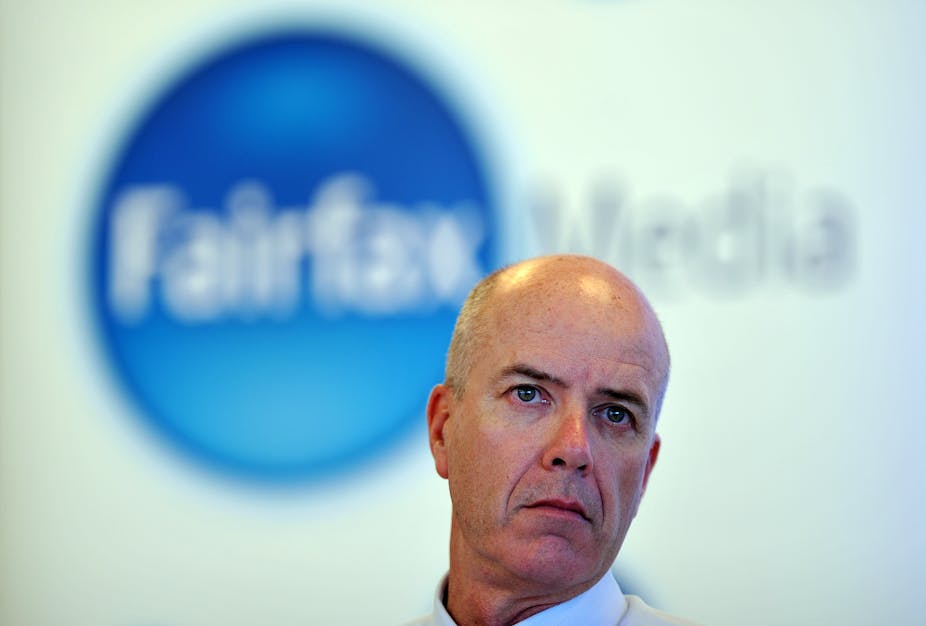
Fairfax chief Greg Hywood says The Guardian is not a competitive brand in Australia. AAP/Paul Miller

Fairfax chief executive Greg Hywood has dismissed the threat from the impending Australian launch of UK media group The Guardian, telling shareholders it is not a strong competitive brand in Australia.

“The Guardian is an extremely good brand in some suburbs of London,” Mr Hywood said, after Fairfax Media announced a first-half net profit of $386.3 million.

The sale of Fairfax’s remaining stake in Trade Me and its US agricultural publishing business made a significant contribution towards the profit result, as the company chose to reduce its debt.

The results show Fairfax spent $69 million in redundancy payments during the half, as part of the Fairfax of the Future transformation program. This is now expected to deliver improved savings of $251 million by 2015.

Fairfax also revealed its plan to introduce domestic paywalls to its metro websites, originally slated for March would proceed in the June quarter. It will however deploy the paywall to international readers within the next month.*

“I think this shows the level of concern about the long term decline for print newspapers,” said Andrea Carson, PhD researcher at the University of Melbourne, adding that this is the third quarter in a row that circulation figures for Fairfax showed significant declines.

Mr Hywood today argued circulation figures were no longer a relevant measure of the performance of the business, with 75% of the audience of the metro SMH and Age businesses now accessing the brands digitally.

“It’s not up to us to say to our audience you have to buy a newspaper,” Mr Hywood said, adding that Fairfax would remain in the newspaper business for as long as it was profitable.

However digital advertising revenues remained soft and volatile during the half. December revenues were 5% below the same period last year, with second-half revenues in the first six weeks 9 to 10% lower.

“While they’ve got the paywalls on ice they’ve yet to realise a sustainable revenue model to deliver the kind of revenues the print newspapers have done,” Ms Carson said.

Ms Carson said the upcoming launch of The Guardian in Australia would have played a role in the decision-making process related to Fairfax paywalls.

“I think The Guardian is a direct competitor with Fairfax and it’s going to have a lot of interest.

“It’s the third largest read online site in the world behind the Daily Mail and the New York Times.”

Mr Hywood dismissed the threat however, and argued it was Fairfax and News Ltd brands that had the strongest relationship with Australian readers.

“The brands that dominate the public agenda in this country are Fairfax brands and to give our direct competitors some credit, News Ltd brands.

“They have the relationship with audiences, the depth of journalism and the credibility of the long-term standing of the brand,” he said.

Mr Hywood said Fairfax was focused on substantial change without compromising the quality of its journalism.

“Our work on and in the business is about more than taking cost out … no one cuts to greatness.

“We’re taking a fresh look at territories once considered sacred cows and smashing silos that once seemed untouchable,” Mr Hywood said.

“While we are optimistic about our future there is not a single pair of rose coloured glasses in the building.”

Fairfax’s ongoing cost cutting program mirrors that being undertaken at other newspaper publishers around the world.

It comes on the back of a $2.8 billion write-down of its assets last year.

Yesterday Seven West Media posted a $109 million loss for the December half, after it made a $260 million write-down to the value of its magazine business and stake in Yahoo!7.

Brian McNair, Professor of Journalism, Media and Communication at QUT, said media sector cost cutting was clearly a short-term measure in response to an immediate crisis.

“In the longer term the risk is the very thing that makes traditional media viable – the quality of the journalism – can be put at risk."

Professor McNair said while new technologies provided real opportunities to cut costs, cost cutting had not stopped the decline in print circulation in the UK.

“There’s been a lot of rationalisation of services and many regional and national groups, but it hasn’t stopped circulation decline, it’s just led to criticism of decreasing standards and quality.”

  • Article updated to reflect the nature of the paywall deployment planned for March.
Sign in to Favourite

Want to follow The Conversation?

Sign up to our free newsletter to get the day's top stories in your inbox each morning, with a special wrap on Saturday.

Spinner
Become a friend of The Conversation and donate

Join the conversation

13 Comments sorted by

  1. George Michaelson

    Person

    I have been polled about my paper reading intentions. I have also done the week long media survey by the book.

    Both times, I was asked about what international and domestic news sources I knew.

    So I call liar liar pants on fire, Hywood knows perfectly well the demographic who buys his content on- and off- line, and he knows perfectly well that we see 'the guardian' newspaper as a viable alternative for domestic and international news.

    He knows this. He just isn't willing to say it.

    He's also displaying some ignorance. The Guardian is a Manchester masthead historically, and played to the left leaning middle and working classes nationally and not just the London set. If you want parochial southernism, you get 'the Independent' which was an SDP/LibDem stalking horse. It too would play well in Australia as a domestic news brand.

    I think Hywood is wrong, and Carson is right. Its a direct competitor, and Hywood knows it.

    report
  2. Pat Moore

    gardener

    "Brand"....how many times did "brand" appear in Hywood's putdown of The Guardian? Those who seek true information aren't worrying about brands. Media sources aren't appliances. The brand would look after itself if the information source/newspaper would engage in its true function of honest reporting and investigation. As McNair says "the quality of the journalism is the very thing that makes traditional media viable". Is the function of Fairfax branded selling to make profit or is to inform…

    Read more
  3. Sal Kennedy

    logged in via Facebook

    One thing I'll say for The Guardian that I can't for Fairfax - they know their way around a spell-check.

    Fairfax's version of high-brow is gratuitously publishing which school people of interest went to.

    report
    1. Will Thurston

      Research scientist

      In reply to Sal Kennedy

      I assume that is some kind of joke, The Guardian is famously known as The Grauniad because of its poor spelling.

      report
  4. Sally Boteler

    customer service officer at health & leisure

    I can't wait for the Guardian.
    In particular, i will be looking for a better standard of political reporting
    I might have hoped to find that at the Conversation but, no.
    Plenty of other good things here though, so now i just don't read the political articles and just enjoy many interesting and broad views in other areas.

    report
    1. craig sambell

      environment journalist (ret)

      In reply to Sally Boteler

      You bet. At long last we might get some real professional journalism
      in this country, long overdue. Lets see if the locals are intelligent enough to read and understand it.

      report
  5. John C Smith

    Auditor

    I wonder what suburbs in London isGuardian is read? I thought thr Fairfux is the same as Guardian. These days I read Xinhua and Prvda. The FF shares are not worth a sack of coal or thr paper it is printed on.

    report
  6. Ronald Ostrowski

    logged in via Facebook

    It is my understanding that The Guardian has over a million Australians currently accessing its pages. It's Australian investors are confident that when it arrives it will provide a huge return on investment as thinking Australians, seeking an alternative to the MSM/ABC fact-impaired, biased and shallow political soap opera offerings, will subscribe to it. It is free and it is big, and as evidenced by the UK Levenson Inquiry it has political clout. Online pay walls are a business model joke, and…

    Read more
  7. Miles Ruhl

    Thinker

    “They have the relationship with audiences, the depth of journalism and the credibility of the long-term standing of the brand,” he [Hywood] said.

    Oh yeah okay! It is far too early for bad jokes. Not sure where he has been for the last few years or if he lives under a rock but his 'brand' is shit; stinking, rotting filth with no hope for improvement.

    Pathetic. Keep running Greg, and don't turn around. While you're leaving, would you mind grabbing Rupert on the way out? Thanks.

    report
  8. john ocallaghan

    professional skeptic

    I am convinced of at least one certain thing after reading Mr Hywoods comments,he,and his MSN cohorts are afraid of competition because at the moment they hav'nt got any,well ,none that carries any real threat at the moment. I welcome all genuine reporting be it right left or centre,and thats how it should be,but at the moment all we are getting from these stables is horse shit perfumed up as genuine reporting and serious journalism and he knows people are getting sick of it.

    report
  9. Jeremy cavanagh

    Engineer

    "The Guardian is an extremely good brand in some suburbs of London"

    As an Australian resident in Saarf London that is just an ignorant comment.

    Hywood is right in one respect the SMH and the Guardian are two different newspapers. One has a history of campaigning on societal issues and covers society in all its forms around the world allowing people from all walks of life to express what is happening from where they are and with what they do while the other is a daily life style magazine, reflecting the chronic parochialism of the city where it is based, with the 'serious' articles acting as a fig leaf for its reputation i.e. masquerading as a serious news paper (the the old joke about Playboy magazine could be updated to describe it).

    report