

Five ways to prevent more asylum seeker tragedies

Last weekend, an overcrowded fishing boat sank off the coast of Indonesia with more than 200 asylum seekers on board. In Australia, the political blame game started soon after with both sides trying to get the upper hand in the controversial policy area. Tony Abbott has been under pressure from Liberal…

M5h6gg54-1324437800
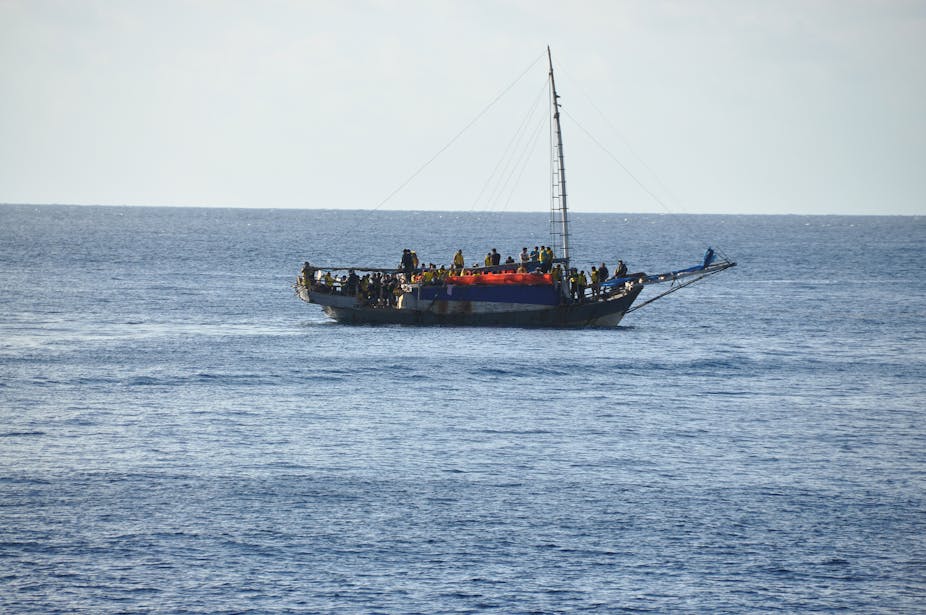
How can we stop people putting themselves in peril? AAP/Josh Jerga

Last weekend, an overcrowded fishing boat sank off the coast of Indonesia with more than 200 asylum seekers on board.

In Australia, the political blame game started soon after with both sides trying to get the upper hand in the controversial policy area.

Tony Abbott has been under pressure from Liberal party elders Alexander Downer and Philip Ruddock to reach a workable solution with the Gillard government, but the situation remains at an impasse.

As we begin to come to terms with the second major refugee boat disaster in less than 12 months, The Conversation asked key experts to take a considered look at the problem of refugees who risk the journey to Australia by boat.

We had two simple questions – what is the problem? And, most importantly, how can we do better?

This is what they told us.

Andrew Markus, Pratt Foundation Research Chair of Jewish Civilisation, Monash University

The asylum debate has raged in Australia on and off since the mid-1970s, with little progress towards reasoned understanding. The advocates for a humanitarian response recycle myths and simplicities, as do others with their prescriptions.

Just look at some responses to the latest drowning tragedy. Julian Burnside argues on The Conversation that “if we took 10,000 refugees each year from Indonesia, and took them in order of lodging an application in Indonesia for protection, the incentive to get on a boat would disappear.”

Would disappear?

The Age editorialises in similar terms: “The best way of destroying the people smugglers' business would be to increase substantially our humanitarian intake from refugee camps in neighbouring countries.”

Without a regional agreement, it is more likely that if Australia took 10,000 refugees from Indonesia many more than 10,000 would arrive in that country seeking entry into Australia, and the incentive to get on a boat would be just as great, if not greater.

The flow of refugees is dynamic, not static, driven by numbers that defy solution. At the end of 2009 United Nations High Commissioner for Refugees (UNHCR) figures indicate that there are more than 11 million refugees, asylum seekers, internally displaced populations and others of concern in five Asian region countries: Pakistan, Thailand, Iraq, Iran and Myanmar.

For some it is debasing and humiliating to talk of numbers in the context of desperate human suffering – and it is. But governments must make decisions. There is insufficient funding to meet competing needs, including the need to provide adequate foreign aid.

Globally there are more than one billion people living in extreme poverty. Where do the estimated 22,000 children under the age of five who die each day from preventable causes figure in the calculus?

The reality is that with one choice taken, be it passive or active, another choice is foregone. Australia maintains a world class resettlement program, taking more refugees per capita than any other country.

It is an expensive program but let’s agree that we should do more, starting with a doubling of the present intake. But having agreed on a number, how is a limit to be observed, given that demand will greatly exceed the available places?

Professor Robert Manne, Personal Chair in Politics at La Trobe University

There is no possibility of finding a solution to the problem of asylum seeker boat arrivals that will not be seriously morally, legally and politically flawed in one way or another. In particular, no workable solution will be discovered by former opponents of the Howard policy that will offer the psychological reward of what James McClelland once described as “the warm inner glow” – the permanent but usually illusory hope of the Left.

There is probably now no alternative to some form of offshore processing. Public opinion is opposed to the spontaneous arrival of asylum seeker boats. We now know that onshore processing — even when combined with harsh deterrent measures like mandatory detention and temporary protection visas — will not stop the boats of (mainly) desperate human beings arriving. We now also know that because of the unscrupulous nature of the people smugglers, boats sailing from Indonesia to Australia will never be even remotely safe.

Once offshore processing is established, the legislation permitting mandatory detention should be repealed. The memory of the dreadful things that happened in the Australian asylum seeker detention camp archipelago will most likely puzzle, perplex and shame later generations of Australians.

If there are almost no more spontaneous boat arrivals, Australia should move at once to the policy now favoured by both the Labor Party’s Immigration Minister, Chris Bowen, and by the Greens—an increase in the annual quota of refugees from 13, 750 to 20,000. Some emphasis should be placed on finding homes for those people who have been found to be refugees but who have been marooned for several years in Indonesia.

This is part of a longer piece that can be found in Robert Manne’s blog, Left, Right, Left on The Monthly’s website.

Kate Gauthier, migration law, Monash University

We often hear the issue of boat arrival asylum seekers described as a “problem” that must be solved. But is it actually a problem for Australia?

The media obsesses over boat stats like footy scores, but no-one seems to care about the much larger number of asylum seekers arriving by plane, who have a far lower rate of being found to be in need of protection. And when you compare Australian asylum arrivals to European numbers, the idea that we are being overrun becomes a weak joke.

Some say boat arrivals are a border security issue. But there are around 1 million visitors in Australia at any given time, who enter Australia on temporary visas without any in-depth security check.

Some think that unauthorised arrivals threaten an orderly migration program. But just how does one flee a crisis or war-zone in an orderly manner?

And lastly, the greatest “problem” of all, the safety issue. Everyone can agree that taking an asylum boat to Australia is a dangerous journey. But imagine this scenario: there is a hospital giving life-saving treatment on the other side of a dangerous freeway. There is no pedestrian crossing and many sick people are hit by cars as they cross seeking medical help.

Doesn’t it seem a bit heartless (and pointless) to build a fence to stop people entering the freeway? In a matter of life and death, won’t they just climb the fence?

There is bipartisan support for reducing the number of people dying in an attempt to reach Australia. But that support can be viewed as hypocrisy since the debate is, to continue the analogy, about how to build a better fence to stop people travelling to the hospital instead of how to help people get there, or even how to provide medical care at the source.

There is only one approach that policy experts agree would reduce boat arrival numbers. That is to increase Australia’s refugee and humanitarian intake numbers and to give more resettlement places to refugees in our region. If refugees see there is a credible chance they will get a resettlement place then there is less chance they would risk their life.

Dr Anthony Billingsley, Middle Eastern and international studies, University of New South Wales

The recent disaster off the coast of Indonesia again brings us face-to-face with the human side of refugee flows to Australia but also points to their origins. People are risking their life at sea in order to escape the horrors of civil conflict at home.

While the focus is rightly on the search for survivors and the circumstances of the voyage, this disaster, and others before it, should also highlight what is called the “push factor” in refugee flows. This is at the nub of the problem faced by many countries, including Australia.

Australians accept we have a moral obligation to help people in trouble and have welcomed many people from countries experiencing civil disorder. Importantly, we are also legally obliged to accept refugees because Australia is party to the Convention on the Status of Refugees and its accompanying Protocol.

The politicised nature of the debate about these obligations is unfortunate as it distracts us from our duty as global citizens. But it also overlooks the actual cause of the problem and only responds to the symptoms.

The problems in key source countries means we can only expect the refugee situation to get worse. Security in Afghanistan is likely to continue to deteriorate with the impending withdrawal of Western forces. Similar security problems will worsen in Iraq after now that the US military have withdrawn. Civil order is breaking down in Iran, Syria, Sudan, Somalia and many other countries.

Despite widespread formal support for the Refugee Convention, Western countries have been less than committed to the underlying problems that cause refugee movements.

The world paid great attention to Afghanistan during the Soviet Union’s occupation of that country. But once Soviet forces had withdrawn, we abandoned Afghanistan to its fate, a situation that President Hamid Karzai has been insisting must not happen again. Similarly in Iraq and Somalia we have lost interest in the terrible conditions faced by people.

If we are to relieve the problems of refugees and to limit the risk of more boat disasters, we must work actively to seek political, not military, solutions to the problems of troubled countries. As long as countries are plagued by violence and we do nothing to help resolve their problems, refugees will appear on our doorstep seeking help.

James Jupp, Director, Centre of Immigration and Multicultural Studies, ANU

The “boat people" problem is undoubtedly a political, not administrative, one. Administrative devices have been tried by governments ever since mandatory detention was introduced twenty years ago. This kicked off a process of avoiding the United Nations Convention on Refugees, and increasing legal intervention.

At that time, the refugees admitted annually was 25,000, with special consideration given for those coming from the crises in Yugoslavia, China and Indochina. Little harm and much good resulted.

Now, there are three major problems: control of the boats by privateers inadequately supervised by maritime authorities in Asia, the recalcitrance of governments, and popular opinion blaming asylum seekers. Unfortunately, asylum seekers are seen as those who must be punished and controlled, rather than assisted, within the terms of the convention.

These asylum seekers come from war-torn and oppressive conditions in Afghanistan, Iraq, Iran, and Myanmar unlike their predecessors from Vietnam and Cambodia. Their plight is urgent, with many belonging to persecuted minorities. In many cases they are seeking family reunification with those already in Australia.

Reform of the refugee system would alleviate, but not necessarily solve, the problems created by wars in which many thousands of civilians have died, wars in which Australia has been actively engaged.

But an extension of the refugee program and the re-adoption of the Special Humanitarian Program abolished by the Howard government would help.

Increasing the capacity of overseas immigration posts in Pakistan, Indonesia and Thailand would permit more refugee applicants to use the legal avenues. Co-operation with Indonesia in supervising overloaded boat departures and criminal involvement would be the first step in a regional policy similar to that once adopted for the Vietnamese.

The vital objective must be to adhere as closely to the convention as is possible, and to reverse the punitive approaches adopted since the more liberal days of the Whitlam, Hawke and Fraser governments.

Join the conversation

25 Comments sorted by

  1. Stephen Larsson

    Consultant

    As soon as I read:

    "Last weekend, an overcrowded fishing boat SUNK off the coast..."

    I stopped reading, as it appeared the article was written by a rugby league player.

    Can learned authors PLEASE use correct grammar.

    report
    1. Megan Clement

      Deputy Editor, Politics + Society at The Conversation

      In reply to Stephen Larsson

      Thanks for pointing this out Stephen, the error has now been fixed.

      Best wishes,
      Megan Clement

      report
    2. Sam Chafe

      Retired scientist

      In reply to Nick Kermode

      Mr. Kermode, it appears you are not familiar with the concept of irony.

      report
  2. Andrew Glikson

    Earth and paleo-climate scientist at Australian National University

    Since WWII (and before) the military powers have wreaked havoc on the 'wretched of the Earth' in several parts of the world, spending $trillions and causing the death and injury of millions of people, destroying the infrastructure of these countries.

    This in addition to fast changing climate conditions and the increasingly frequent occurrence of extreme weather events, including droughts, floods and cyclons, as reported in the daily news and which, as shown by the doubling frequency of such events between 1998-2008, is attributable to carbon pollution of the atmosphere..

    No wonder desperation in these parts of the world is driving people to desperate measures, many ending up drowning at sea.

    The only long term solution: instead of spending $trilions bombing these populations, spend on infrastructure, agriculture, health and education, as well as take effective measures to curb dangerous pollution.

    report
  3. Gideon Polya

    Sessional Lecturer in Biochemistry for Agricultural Science at La Trobe University

    Civilized, informed and humane comments by James Jupp , notably: "Reform of the refugee system would alleviate, but not necessarily solve, the problems created by wars in which many thousands of civilians have died, wars in which Australia has been actively engaged."

    Recognition of Australian complicity in the generation of over 20 million Muslim refugees would be a huge step forward for look-the-other-way Australia - in addition to humane, timely on-shore processing of all refugees.

    There…

    Read more
    1. John Phillip

      John Phillip is a Friend of The Conversation.

      Grumpy Old Man

      In reply to Gideon Polya

      Gideon, you must start up your own guilt industry outlet - that anti semetic rant was SPECTACULAR! Nowhere in the above did you address the concerns raised by Andrew Markus regarding the effects on the 'boats' by the adoption of (some of) your policies. Additionally, when assigning guilt, you have notably failed to mention the wonderful contribution to this litany of horrors by those extreme elements of the Islamic faith, the Chinese, Pol Pot's social experiment in Cambodia and Uncles Joe's efforts in the old USSR. A bit of balance, thought and considerably less vitriol would help.

      report
    2. Gideon Polya

      Sessional Lecturer in Biochemistry for Agricultural Science at La Trobe University

      In reply to John Phillip

      "Anti semetic rant" is false, highly offensive, ad hominem abuse.

      Zionism is racism in theory and in genocidal practice (1.5 million Palestinians killed, 0.1 million killed violently, 7 million Palestinians refugees, 4.3 million Occupied Palestinians deprived of all human tights under racist Zionist guns) and 12 million Muslims killed in the Zionist-promoted US War on Muslims, 1990-2011, and over 20 million Muslim refugees due to genocidal, Zionist-backed US Alliance violence.

      Eminent Jewish…

      Read more
    3. John Phillip

      John Phillip is a Friend of The Conversation.

      Grumpy Old Man

      In reply to Gideon Polya

      Gideon, I appreciate your reply and apologise if you were personally offended. I still think you need to address the argument put forward by Andrew Marcus regarding the 'pull' factors involved in increasing the number of 'boat people' allowed. Surely, if you step back from something you clearly hold dear to your heart, you can see a degree of bias in your position. If you include the numbers of dispossessed created by the (former) soviets, Pol Pot, the Sunni/Shia religious wars your position would be more balanced and bias would be eliminated.

      report
    4. James Walker

      logged in via Facebook

      In reply to Gideon Polya

      @ Gideon - This is Australia. A collection of *colonies*. This country was *colonised* by the UK, stripped of resources firstly to feed the British economy, and then stripped again during the world wars to maintain the Allied war machine.
      We were still on rationing in 1947.

      And guess what? This country is *awesome*! We are living proof that being 'western imperialism' is the best thing that can happen to a country. NZ and Canada are the same. Japan and Germany were bombed flat during WWII - and Occupation was the best thing that ever happened to them.

      Any country so socially bankrupt that it blames its' problems on West is a failed state.

      report
  4. Sam Chafe

    Retired scientist

    The most important consideration by government in accepting refugees is the maintenance of Australian sovereignty. When it comes complying with international agreements, countries will always put their interests first. If it is deemed advantageous, the country will take in refugees; if it is not, it won't. A display of hand-wringing and concerns of humane treatment by various parties will have little effect in convincing government.

    The severe limiting of refugee numbers, espoused by both main…

    Read more
  5. Bruce Moon

    Bystander!

    .

    Until recently, my view was that relatively wealthy asylum seekers (and some economic refugees) made their way to Indonesia in their pursuit of a life in Australia.

    With that view, I aligned my thinking towards the humanitarian side of the debate.

    The reports from the survivors of this last tragic boat trip indicate the occupants had been flown from the middle east to Jakarta, loaded on a bus and taken to the port whereupon they embarked on their ill-fated trip. Clearly, given the cost…

    Read more
    1. Sam Chafe

      Retired scientist

      In reply to Bruce Moon

      Very confused, I think. Is Mr. Moon for or against?

      report
    2. Bruce Moon

      Bystander!

      In reply to Sam Chafe

      Sam

      Sorry, my use of English confused you. It was quite clear to me.

      Let me try and elaborate.

      Once, I thought 'asylum seekers' were (largely) those people fleeing social/political/civil unrest &/or persecution, AND wealthy enough to get to Indonesia and get on a boat....

      Recent events, coupled to more information reveals that a goodly number (if not most) are wealthy people seeking to exploit opportunities for economic benefit/s.

      - - -

      My view is that Australia meets its international obligations by 'processing' those seeking asylum outside of Australia.

      AND...

      that any people arriving at Australia's doorstep WITHOUT a visa and exit stamp be deported to the country of (last) embarkation (or a country of other choice where that can be arranged).

      - - -

      My point is to differentiate away from people smuggling.

      - - -

      Hope that males it clearer for you.

      Cheers

      report
    3. Nick Kermode

      logged in via email @hotmail.com

      In reply to Bruce Moon

      Bruce,

      1.Australia's international obligation (as a UNHCR signatory) is to process those seeking asylum WITHIN Australia. You have it backwards.

      2. Australia's Migration Act specifically allows arrivals to our country WITHOUT a visa so long as they seek refugee status / asylum and make that known upon arrival. They are in fact lawful non-citizens. Parliament tried to change this part of the Migration Act but was blocked by the High Court you will remember recently. AFTER(!!!) their arrival…

      Read more
    4. Sam Chafe

      Retired scientist

      In reply to Nick Kermode

      Don't beat around the bush, Mr. Kermode, tell it like it is!

      report
    5. Bruce Moon

      Bystander!

      In reply to Sam Chafe

      Nick

      You wrote...

      "People have such strong opinions on this matter without understanding many of the laws, obligations and real statistics."

      Rightly so. If the matter was less intractable, people would probably be less opinionated.

      Your reply is similarly opinionated, and delivered (unnecessarily) forcefully.

      Please note that I did not attempt to discuss the merits or otherwise of gov't policy, nor gov't interpretation of international obligations.

      Nevertheless, I will be frank…

      Read more
    6. James Walker

      logged in via Facebook

      In reply to Sam Chafe

      "Is Mr. Moon for or against?"

      - the reason for the ongoing tragedies is that people are too interested in which "side" they are on, and not sufficiently interested in seeking solutions. Anyone who is attempting to find a solution - which Mr Moon is - has to ignore the childish us vs them mentality that has characterised the "debate" to this point.

      report
  6. Ron Hoenig

    logged in via Facebook

    Kate Gauthier’s analogy raises a significant issue. Clearly, if there is a hospital on the other side of a busy highway, the solution is to build a bridge.

    Building a bridge – or providing an appropriate service to bring people form Indonesia toAustralia – will reduce the death numbers and destroy the people smugglers’; business model.

    How we can appropriately order the transport of people form Indonesia and Malaysia in a a reasonable way is a very different issue. That’s what we actually…

    Read more
    1. James Walker

      logged in via Facebook

      In reply to Ron Hoenig

      "Clearly, if there is a hospital on the other side of a busy highway, the solution is to build a bridge. "

      Or, if you consider the hospital overloaded - build a hospital on the side where it is needed.

      IIRC Geoffrey Blainey suggested that we train up 1% of the world's refugees as engineers etc, then send them home to turn the refugee camps into modern cities. Of course, he was promptly lambasted by the trendy set.

      report
  7. Jamie Anderson

    logged in via Facebook

    Why not just cut out the people smugglers by letting refugees pay $10,000 at our embassy in Jakarta and we fly them here.
    Some of the contributions by scientists are a bit of a worry. Maybe lord Monkton isn't as mad as I thought.

    report
  8. Robert Lonnee

    Retired

    I believe all the displaced people in the world have chosen to take any means possible to leave their country under which they have been ruled by tyrants governing their lives and welfare. We have seen the likes of Pol Pot, Markos, Hussain and the list continues.
    These rulers have down trodden their people since the beginning of time killing all who will not succumb to their ideals. Yet we do nothing about it unless it profits those who have an interest in that country.[Oil]
    It would be appropriate…

    Read more
  9. Faryal Ali

    logged in via Facebook

    who ever is saying that asylum seekers are wealthy enough as they are paying thousands of dollars to be in australia for better life,then here your answer goes.

    as you people are living a comfortable life out there in Europe Australia etc, but if you would see how these people are struggling to get one penny and have savings to search for a better life in a better country. there parents burn there stomach for there children to provide them safety they sold there every thing even they don't have…

    Read more
  10. Faryal Ali

    logged in via Facebook

    check out these videos then you will understand why do these innocent people becomes asylum seekers.

    http://www.youtube.com/watch?v=KQu71602CQk
    http://www.youtube.com/watch?v=K_i4QAlkOcc&feature=related
    http://www.youtube.com/watch?v=r8AyjNwW7jw&feature=related

    who ever is really able to see these innocent to die like this then its better to sink on the boat instead to be killed like this. who is there to help them to support there families. their my be a family having one child or a person who was the only one earning for there home.who is able to bring them back for there family.

    think about them and make a better way for these refugees who are already a stranger in there own country

    report
  11. Scott Wallace

    Technical Analyst

    Hi, the following is pretty much what I have posted on the other article the other day with a few quick edits, it is quite relevant to this discussion as well.

    I'd like to contribute a considerable amount of thoughts on where the issue is currently at in Australian politics and what options we could explore from here.

    Unlike Mr Rudd who pretended there was no issue and ignored the problem allowing more misinformations and anger to flourish Ms Gillard started out well, setting the debate in…

    Read more