
Fixing Australia’s bad drug deal could save $1.3 billion a year

The Commonwealth could save A$1.3 billion each year by reforming the Pharmaceutical Benefits Scheme (PBS), according to a report released today by the Grattan Institute. The report, Australia’s bad drug deal, shows that if the PBS simply paid prices for drugs that many Australian public hospitals or…

Pz6scqcr-1363312275
There’s no reason the Australian taxpayer should pay such high prices for medicines when our overseas cousins don’t. Image from shutterstock.com

The Commonwealth could save A$1.3 billion each year by reforming the Pharmaceutical Benefits Scheme (PBS), according to a report released today by the Grattan Institute. The report, Australia’s bad drug deal, shows that if the PBS simply paid prices for drugs that many Australian public hospitals or New Zealand’s national pharmaceuticals purchaser pay, the government could be on its way to a budget surplus.

If Australia also encouraged doctors and patients to replace some drugs with others that achieve a similar result, at least another A$550 million could be saved every year

These are savings too good to miss. So why has Australia missed them?

The Grattan report compares spending on the 73 top drug-dosage combinations which are prescribed most often or that we spend most on. These 73 drugs account for almost half of PBS spending.

We looked at prices negotiated by New Zealand’s purchaser, by Western Australia’s public hospitals and by public hospitals in an anonymous state. The difference from PBS pricing is dramatic. Of the 73 drugs we looked at, the PBS got the best deal for only five.
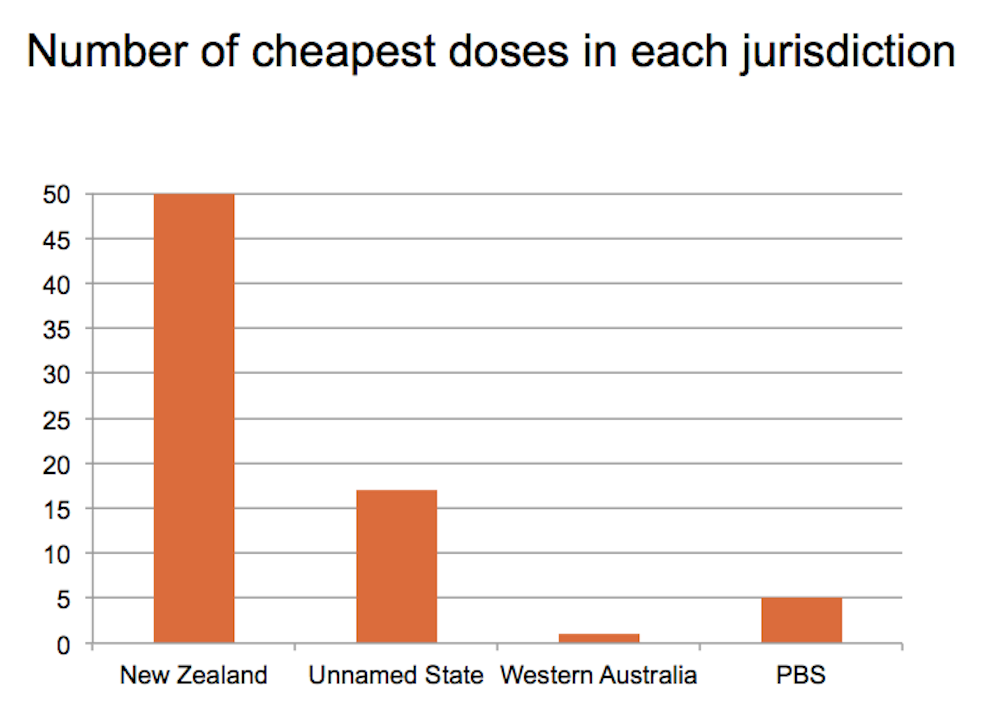
Grattan Institute

Most of the savings that New Zealand and Australian public hospitals have made come from off-patent drugs, known as generics. These provide an equivalent therapeutic effect to the branded product.

The marginal cost of manufacturing off-patent drugs is very low, so there can be big battles over market share and big profits to be made. This provides the PBS with a golden opportunity to save money in negotiations with drug companies, but the opportunity is being missed.

Take atorvastatin, a cholesterol-lowering drug that is one of the most commonly prescribed medicines on the PBS. The PBS pays manufacturers A$51.59 for each 30-pill packet of the 40 milligram version of this drug. New Zealand, by contrast, pays a mere A$1.94 for the same number of pills for a generic version of atorvastatin. Western Australian public hospitals pay A$4.44.

If the PBS paid the same as New Zealand across all doses of atorvastatin, it would save A$1.4 million every day. If Perth users of atorvastatin (who are not on concession cards and are below the safety net) could buy the drug at a retail pharmacy at the same price the public hospital down the road pays, they would save A$19 every time they purchased a 30-pill pack, even after retail markups.
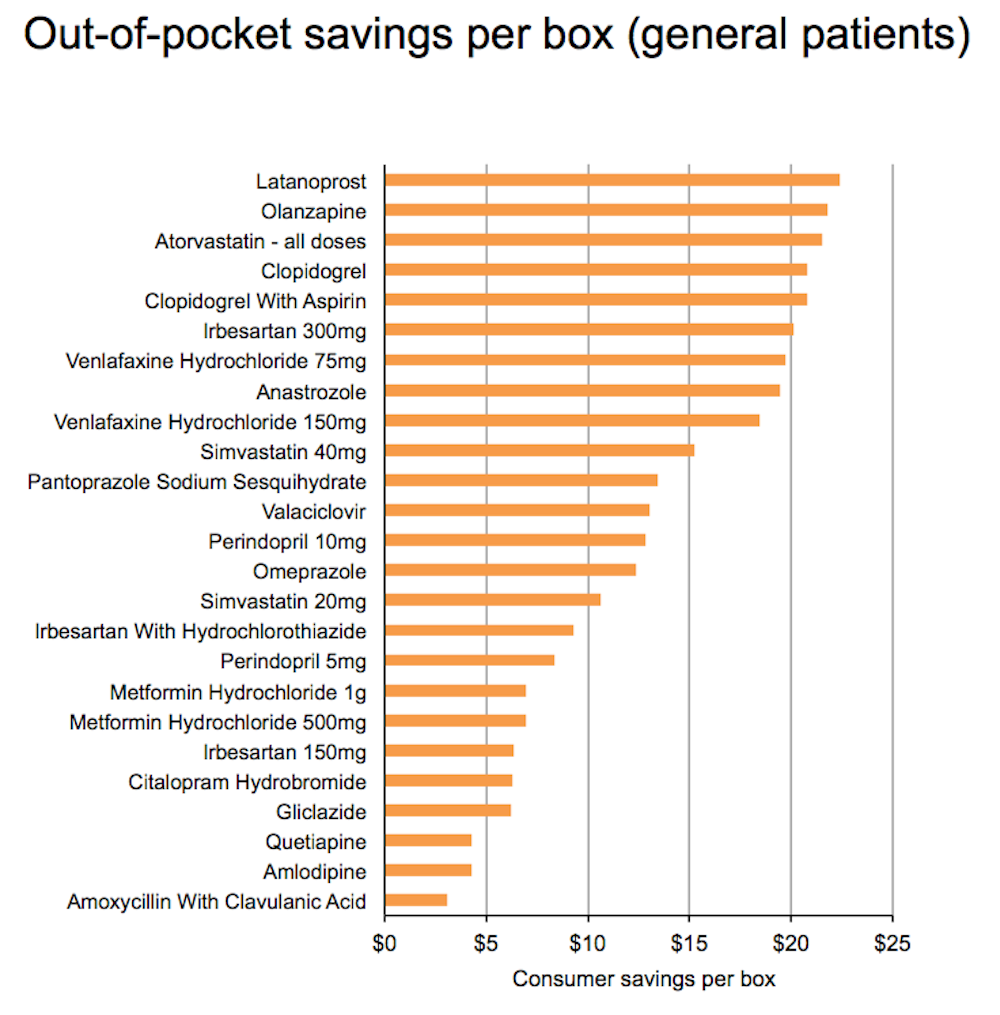
Grattan Institute

It’s a ridiculous situation, and there are many reasons we got to it. First, the politics of listing new drugs is topsy-turvy. For a time, every new drug listed had to be approved by Cabinet, a process a Senate committee described as “wasteful” and “duplicating an existing process, albeit without the appropriate qualifications or information available to the Pharmaceutical Benefits Advisory Committee”.

Now the Cabinet only decides on drugs with a total cost of more than A$10 million, but even this involvement is subject to the same criticisms previously levelled by the Senate committee. Of course, allocation of public funds involves political decisions, but the politics should be at the beginning of the process, in determining what the total budget will be, not at the end, in second-guessing experts.

The whole framework for negotiating prices is part of a political accommodation. The main pricing body, the Pharmaceutical Benefits Pricing Authority, is a representative body. It has two members out of six nominated by the pharmaceutical industry, which gives vested interests too much power.

The government has signed a deal with the main pharmaceutical manufacturing lobby group, Medicines Australia, which gives them a rent-free holiday for five years, with the government promising not to make any changes to pharmaceutical pricing in that period other than those announced and signed off at the start. Luckily, the agreement expires next year, and there is an opportunity for reform. What should it be?

A three-step plan for reform

Our report proposes a three-step plan to set PBS pricing on the right track.

The first step is getting the framework right. We need to reverse the politics. Politicians should be involved at the start of the process, not at the end. Parliament should set the budget for drugs and then get out of the way of sensible decisions about what drugs should be listed on the PBS and at what price.

Australia needs something like the process New Zealand has adopted, in which an indexed budget determined by government sets the context, but then an independent expert board makes the priority choices (with public consultation) and negotiates prices.

The second step is to follow other countries and expect big price reductions when drugs come off-patent. At present, the PBS cuts manufacturers’ prices by 16%, but this figure is far too small compared with reductions achieved in other countries. To get to best practice quicker, prices of new generics should be at least halved immediately and then benchmarked internationally.

After these changes have been bedded down, the new expert board should encourage more cost-effective drug use by focusing on sensible substitutions within classes of similar drugs.

As our health budget continues to rise, it’s time for Australia to get tougher in negotiations with international drug companies. There is no reason the Australian taxpayer should pay such high prices when taxpayers in other countries do not.

Join the conversation

46 Comments sorted by

  1. Trevor Kerr

    ISTP

    Stephen, your last sentence could be expressed another way. That is, there must be reasons why Australian taxpayers "pay such high prices when taxpayers in other countries do not."
    Is it incompetence, or worse?
    We are more than entitled to ask the question, while US citizens can read http://projects.propublica.org/docdollars/ to start finding out how much their doctors have been paid by the pharmaceutical industry.
    Is the management of conflicts of interest at the very top of our medical establishment the best it ought to be?
    Medical opinion-leaders who seek to sway public opinion on medicines should declare how they have been gifted by Pharma, and let the public be the judge, not themselves.
    The evidence you present suggests we may be able to make progress only by having a Truth & Reconciliation tribunal.

    report
    1. Rotha Jago

      concerned citizen

      In reply to Trevor Kerr

      Didn't Australia have an independent drug evaluation committee when Hayden set up the original scheme? It was finally destroyed by Howard from memory.

      report
    2. Robert Tony Brklje

      Robert Tony Brklje is a Friend of The Conversation.

      retired

      In reply to Rotha Jago

      This of course happened not in a vacuum but under direct economic threat from the US government and their corrupt lobbyists.
      Why is Australia paying too much for pharmaceuticals just look at what is going on in the US their government Medicaid is forbidden by law to negotiate for cheaper prices.
      Those same criminal lobbyists then sought to attack the Australian PBS schemes and have it shut down under the guise of the Free Trade Agreement between Australia and the US, they ultimately failed but…

      Read more
  2. Eric Ireland

    logged in via Facebook

    Why does the PBS pay so much more for atorvastatin, specifically?

    OK, so cabinet has to approve it, and the PBPA has two out of six members nominated by the pharmaceutical industry, but that still doesn't answer the question, really. Cabinet wouldn't want to throw money away for no reason (you'd think!) and if four out of six members of the PBPA can be trusted to act in the public interest, we should be paying the same as NZ..

    report
  3. Peter Ormonde

    Peter Ormonde is a Friend of The Conversation.

    Farmer

    Top bit of research. And very sad.

    Twenty years back we had a constant stream of visiting overseas health authorities coming over to look at the PBS and why it was so effective. Even more telling, we had the international pharmaceutical industry screaming about it, demanding that the US press for scrapping the PBS in any and all trade negotiations. Not any more.

    Two significant variables have changed - generics and the process of listing. And I'd have another one of my hunches that it is the latter (under US pressure) that is at the heart of it.

    Tragic. Howard's vandalism. But easy to fix.

    Incidentally I am on a constant stream of five of those drugs on your graph - as are half the folks in town. I feel like I am caught in the cross-hairs of some demographic rifle sight.

    report
  4. William Hughes-Games

    Garden weed puller

    The solution is simple. Get an organization started in Australia like the New Zealand Pharmac. It would help us too. The Americans would dearly love to shoot down Pharmac as part of the much anticipated free trade agreement (note that America is only interested in free trade in sectors where they come out on top). You would form a bulkwark to help us keep our Pharmac.

    report
    1. Colin MacGillivray

      Retired architect

      In reply to William Hughes-Games

      Actually an even simpler solution would be to give NZ's Pharmac the job. Food Standards Australia New Zealand, the governmental body responsible for developing food standards for both nations exists. If Pharmac was negotiating drug deals 6 times as big as present it would get even lower prices. So why re-invent the wheel? (Also it is independent but it has experience of government interference with herceptin. http://www.nzherald.co.nz/nz/news/article.cfm?c_id=1&objectid=10524525 )

      report
  5. Sean Lamb

    Science Denier

    Whats the business with the Unnamed State?
    Do they fear being targeted by Big Pharma if their comparatively modest savings over the PBS becomes public knowledge.
    Or is it in fact Tasmania and they are skimping on drugs because they have no revenue?
    I imagine life in the Unnamed State must be rather blissful. Without names the news is nothing more dramatic than various pets being stuck up trees. Elections are rather a hit and miss affair as people put ticks besides anonymous boxes representing nameless parties.
    The people spend a lot of time either at The Beach (unspecified) or in The Bush (generic) - city tourism is impossible because that would require a name.
    No, as soon as I find out how to get to the Unnamed State, I am out of here.

    report
    1. Stephen Duckett

      Director, Health Program at Grattan Institute

      In reply to Sean Lamb

      Thanks everyone for your comments. One of our key recommendations is to get the politics (in its broadest sense) out of the pricing system. We've recommended an independent PHAMAC-like body, we shouldn't have an agreement like the one due to expire next year with Medicines Australia that prohibits further price reductions and so on.

      In terms of the unnamed state, they gave us the data to do this analysis on condition of anonymity which we want to honour. The data are real, the state is real and so we thought it provided a useful benchmark

      Stephen

      report
  6. Matthew Rimmer

    ARC Future Fellow and Associate Professor in Intellectual Property at Australian National University

    Interesting, thoughtful, and provocative report by the Grattan Institute. Timely work.

    The plan for reform, though, does not adequately deal with the question of patent law reform. The report notes the importance of patent law throughout the study - and flags that there are a number of inquiries underway, but does not answer what should be done in these areas. I would prompt the following questions:

    The Pharmaceutical Drug Patent inquiry. Medicines Australia are pushing for patent term extensions…

    Read more
    1. Stephen Duckett

      Director, Health Program at Grattan Institute

      In reply to Matthew Rimmer

      I agree Matthew, these are all really important issues which we didn't address, preferring to focus on pricing (directly) scoping out the patent law issues you raise (except as a footnote)

      report
    2. Robert J. Thomas, Sr.

      Retired corporate counsel

      In reply to Matthew Rimmer

      Here's a thought from a column by David Brook, the NY Times columnist, on this area. Why not have governments run contests wtih significant prizes to develop specific kinds of drugs, which would then be the government's to license or whatever. He mentioned the figure $10USD million, but it could be whatever figure based on circumstances. Maybe there are still some Pasteurs, Kochs or Curies out there.

      report
  7. Martin Male

    Somatic Psychotherapist

    Hi Stephen thanks for such a clear piece of research and writing. My background includes time as aPsychiatric nurse and doing aBSc @ ANU. Whilst there Idid a paper on the health systems of Australia Sweden and the US. At the time (90s) we were modelling off the Swedish system, now we are moving closer and closer to the American system, whichI consider perhaps the worst int he "developed"world.
    I agree with you recommendation of the need to review the need to change our pricing structure of thePBS. WhenI was nursing Valium was just coming off its "protected" period and the price charged by Roche plummeted by almost 70%.
    I would also have two other suggestions, get serious about preventive health measures (including honest food labelling and the reduction of sugar in our food) and prevent the pharmacy from directly marketing to the public whilst also reduce the same to Drs. I know these measure would have a dramatic effect on the prescription practices of Drs.
    Thanks again

    report
  8. Tyrone Berger

    PhD candidate (Law) at Monash University

    Have to agree - the report failed to address the current mechanisms of the patent system in which the Government is trying to remedy via a number of reviews (incl 'pharma extension'). Putting aside concerns about 'evergreening' (of which there is little evidence to date in Australia), the Productivity Commission has recently released draft recommendations to do with compulsory licensing: including a new 'public interest test' and other changes to the Act. Perhaps now is a good time to marry some of these debates.

    report
    1. Stephen Duckett

      Director, Health Program at Grattan Institute

      In reply to Tyrone Berger

      Agree that patent law review is important, particularly in the light of the current review. We opted for a tightly focused report - on pricing - as the issues here are big enough!

      report
  9. Jon Karnon

    logged in via Twitter

    a timely article and report, lets hope we can get meaningful change this time round.

    the current approach to generics is clearly absurd, and should be relatively easy to fix.

    the fix will also have follow-on effects, for example, the prices of new drugs will be reduced, as they have to establish cost-effectiveness against a cheaper comparator.

    if listed against a patent-priced comparator, the price of newer drugs should also drop when the comparator comes off patent.

    I'm not sure about…

    Read more
    1. Stephen Duckett

      Director, Health Program at Grattan Institute

      In reply to Jon Karnon

      Ideally we would have clear and explicit thresholds, possibly with a minimal size of effect criterion added. When I was Secretary I challenged the PBAC to be explicit and consistent about their implicit criteria, and indeed they became more so. More is yet to be done here though as you could expect different types of decisions (life-style enhancing, life extending) to have somewhat different decision criteria.

      report
  10. Blair Donaldson

    logged in via Twitter

    Stephen, thank you for the really insightful article. I was amazed to discover Cabinet must approve a new drug before it can be listed. How many politicians would have any understanding about the efficacy of a particular drug?

    As for Medicines Australia, seems to be another case of a powerful lobby group forcing a government to bend to their will. Let's hope the expiry of the current agreement leads to a more open and accountable outcome.

    One question, is there a need for education of doctors and specialists regarding the effectiveness of generic pharmaceuticals? The reason I ask is that my mother was told by her specialist that under no circumstances was she to use a generic version of the heart drug she is taking. Is there any sound reason for that advice?

    report
    1. Stephen Duckett

      Director, Health Program at Grattan Institute

      In reply to Blair Donaldson

      There's been a fair amount of literature on this point. My read is that education doesn't have much effect if well-funded counter education is also going on.

      report
    2. Blair Donaldson

      logged in via Twitter

      In reply to Stephen Duckett

      I have heard that pharmaceutical companies attempt to extend or renew patents by making minor changes to existing pharmaceuticals, is that correct and is there any plan to combat this artificial attempt to extend patents – and the extra income derived from supposedly unique drugs?

      report
  11. Liam O'Dea

    Principal at Livestock

    The reason we pay more is the AUS/USA Free Trade Agreement, signed in 2004. It contains chapters on Intellectual property and pharma. with much tedious and obtuse detail, and also side letters designed to further confuse the casual reader.
    The bottom line is it obliges the Aus Govt to permit big pharma to have a voice in decisions of the PBS, and impose, or at least threaten, severe penalties if Aus Govt decisions effecting the profit margins can be construed as restricting trade.
    Big pharma are pushing hard for patent extensions out to 99 years. And the Trans Pacific Partnership now being negotiated, is intended to achieve that.

    report
    1. Blair Donaldson

      logged in via Twitter

      In reply to Liam O'Dea

      It makes you wonder about the long-term value of so-called free trade agreements? Particularly when local producers and consumers are adversely affected.

      report
    2. Martin Male

      Somatic Psychotherapist

      In reply to Blair Donaldson

      Hi Blair I know it is off topic I am always intrigued by the 'fair trade" "argument, it always seem to mean that the transnationals determine what is best( surprisingly for them) !!

      report
    3. Blair Donaldson

      logged in via Twitter

      In reply to Martin Male

      Yes, the more I hear about so-called fair/free trade agreements, the more I think they were designed for multinationals rather than small businesses. The pull large pharmaceutical companies have over governments is disconcerting. I realise there are huge costs in developing new drugs but that should not be an excuse for these companies to extort patients who need those drugs. There is a middle ground somewhere but I won't pretend I know how to find it. However I do think there is a place for government funded pharmaceutical development. Particularly in the area of antibiotics.

      report
    4. John Holmes

      Agronomist - semi retired consultant

      In reply to Blair Donaldson

      Agree Blair.

      There is a problem here as there are few if any novel mode of action antibiotics in the pipeline as there is in the field of herbicides. New and novel approaches are needed.

      The Roundup Ready GMO crops are self limiting unless Monsanto & or others are successful in over coming resistant weeds. The concept of RNA "Keys' to block genes which convey tolerance to glyphosate was recently announced. Interesting approach with many implications.

      Often the original discover for…

      Read more
    5. Blair Donaldson

      logged in via Twitter

      In reply to John Holmes

      Thanks John, you've been reading my mind :-)

      I agree with every point you made and I think your comments regarding Bill Gates excellent work and "not all humans are born equal" is pertinent to the whole issue of drug availability.

      Given the long lead times for drug development along with the mandatory and expenses trials, I can see why companies want to make as much as they can for as long as they can but there seems to be a point reached where the ends are overshadowed by the means, and a fair bit of skulduggery appears to be involved getting drugs accepted by the relevant authorities and doctors if Ben Goldenacre's "Bad Pharma" is anything to go by.

      report
  12. Trevor Kerr

    ISTP

    Brendan Shaw was on radio (774) this morning to elaborate the point that the pricing deal struck between PBPA and MA (Medicines Australia) was to ensure that Australians continued to have access to the best medicines we could afford. As I understand what he said, the pricing deal acknowledges that Australian taxpayers pay an extra $1b or so per year, but it's all to the good to have the millions of citizens paying over the odds for their atorvastatin, etc, in order to subsidise many other treatments…

    Read more
  13. John Holmes

    Agronomist - semi retired consultant

    Having spent considerable time in the generic pesticide industry it is normal for when pesticides come out of patent, prices drop by up to 90%. Not seeing the same in drugs. Why?

    I guess this is our payment for the doubtful benefit of pretending to be protected by the USA defense umbrella. It is also an indictment on the negotiators who approved the USA / Australian free trade agreement to be set up. If I remember correctly, there was a huge amount of effort by the US to destroy our Pharmaceutical…

    Read more
    1. John Holmes

      Agronomist - semi retired consultant

      In reply to John Holmes

      Could we have a post posting edit function such as found on sites powerd by "Disqus" and others.

      An opps of mine " ...Memo to Canberra - you represent Austrians...." should be "...Memo to Canberra - you represent Australians...". Corrected spelling just wrong word.

      Thanks

      report
    2. Robert J. Thomas, Sr.

      Retired corporate counsel

      In reply to John Holmes

      I don't know of any attempt by the US to connect the commercial practices of its companies with any defense umbrella, and in fact from my knowledge the US does irritatingly little to foster its international commercial interests compared to such state capitalistic countries as China. As to the so-called dubious benefits of such umbrella, it seems to be an unusual statement to make at a time when North Korea's nuclear arsenal becomes more and more dangerous and at a time when the aggressiveness of the Chinese military continues to grow.

      report
    3. John Holmes

      Agronomist - semi retired consultant

      In reply to Robert J. Thomas, Sr.

      I would suggest that this is an implied rather than explicit situation. However, consider the history of the US Fruit company and of the US Oil companies in Venezuela in organizing local wars and the removal or attempting to remove unsympathetic persons who interfere with the rivers of gold, I would suggest that market share is maintained by all means including war. Here it has resulted in Customs investigations claims of dumping from China with the results suggesting that importers could get an even better deal out of China.

      My comments are more re the long termed perceived need (cringe?) for Australia to align its self with powerful allies even when not in our own best interests for our development and well being.

      report
  14. Ken Harvey

    Adjunct Associate Professor of Public Health at La Trobe University

    While N.Z. Pharmac style tendering clearly produces the lowest prices for governments and patients it does have the inevitable consequence of chopping and changing within a therapeutic group as drug companies compete to win tenders. This can cause perverse outcomes, see: "The sorry saga of the statins in New Zealand – pharmacopolitics versus patient care", http://journal.nzma.org.nz/journal/116-1170/360/.

    report
  15. Anna Zamecznik

    Broadcaster

    Dear Learned Sirs, in this debate you have all overlooked a key detail - "off-patent drugs, known as generics ... provide an equivalent therapeutic effect to the branded product". As I have found in the past, this equivalence can be terrifyingly life threatening, as the so called "inactive" ingredients can be important to the drugs efficacy or side-effects. I pay more for PBS drugs as I now specify to my pharmacist - no substitution. However, my most expensive drug is only on PBS for under 15s, so I actually have to pay the full price for it regardless, but I do so because the alternative treatment (which is on PBS and has nasty side-effects) means multiple annual hospital admissions. In this case the government would actually save money by paying for drugs as opposed to hospital costs.

    report
    1. John Holmes

      Agronomist - semi retired consultant

      In reply to Anna Zamecznik

      In a parallel universe, pesticides, both the product (active and source) and its formulation is approved by the regulators. To achieve registration, the efficacy/safety of the generic must be demonstrated before registration as well as the formulation used. If your formulation is significantly different to that of the original product, serious questions are asked, and some times one finds out that the original formulation has been altered some what since its original regestration, but as a generic…

      Read more
    2. Robert J. Thomas, Sr.

      Retired corporate counsel

      In reply to Anna Zamecznik

      Generics are generally fine in the U.S, since they have to have the same effect as proprietary drugs and they save a ton of money. My own anecdotal experience with a number of drugs is that they're fine, and I'm unalterably opposed to those who want proprietary drugs since they've been conditioned to want the best of everything, whether on their nickel or someone else's. But I'm also unalterably opposed to government programs which make it impossible to get proprietary drugs in the rare occasions when they don't work for the user.

      report
  16. Robert J. Thomas, Sr.

    Retired corporate counsel

    At the outset I'll say that when one speaks of "the Americans", as some commenters have, this phrase no longer includes 99% of the American people on any issue of importance, so marginalized have most Americans become. There are many examples, but an especially egregious one was the decision a few years back by the US Supreme Court that corporations have the same free speech rights as natural persons, which means that they can spend as much as they wish on issues (not candidates) in political campaigns…

    Read more
  17. Anna Zamecznik

    Broadcaster

    Several Years ago in a discussion with an astma educator, I commented on my experiences with a generic salbutamol inhalant not having the same efficacy for myself as the branded Ventolin during a strong attack - the educators response was that this was a known issue for seriously chronic asthmatics, yet, it seems to me that, most GPs and asthmatics are not being made aware of this. We have also had issues with generic antibiotics.

    report
  18. Julie McNeill

    I read and write

    Since I read and heard on the radio about your findings I have championed it to my Federal MP. My husband and I have a $200 per month pharmacy bill for chronic arthritis and psychiatric with some acyclovir and liptor thrown in to the mix.
    Always grateful to the safety net, but I'm very annoyed the New Zealanders have beaten us again on something vital to our well-being!

    report