


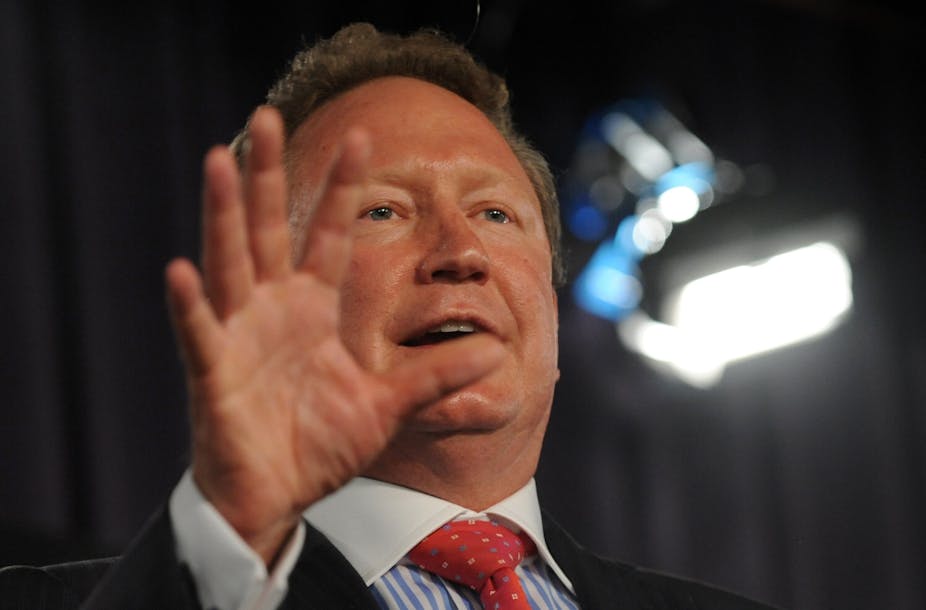
Perth-based mining giant Fortescue Metals Group has launched a last-minute High Court action against the mining tax, planning to argue the legislation - due to start on July 1 - breaches the Australian constitution.
Founding chairman of Fortescue and now non-executive chairman, Andrew Forrest has been a prominent critic of the tax and has previously vowed to oppose it through the courts. The challenge has been mooted for months.
In a statement to the the Australian Stock Exchange, Fortescue’s chief executive Nev Power said it was challenging the tax on the grounds it discriminated against the states, gave preference to one state over another, and restricts a state’s ability encourage mining. It also said it curtailed state sovereignty.
“We believe we have a good case for challenging the MRRT on constitutional grounds and we look forward to the resolution of these important issues by the High Court,” Mr Power said.
Constitutional law expert, Michael Crommelin, Professor of Law at the University of Melbourne, explains the legal arguments Fortescue will rely on.
Could you explain in detail some of the grounds Fortescue’s challenge is using?
I haven’t seen the documentation relating to the challenge but I think there are a couple of likely bases for the challenge. One is Section 51 (ii) which is the Commonwealth’s taxation power under the constitution. It provides that Commonwealth taxes must not discriminate between states or parts of states and that could well be one of the bases for the challenge. And linked to that is Section 99 of the Constitution which says the Commonwealth in relation to any revenue measure can’t give preference to one state over any other states. I think discrimination and preference issues will be involved.
The other possible basis is Section 114 of the Commonwealth, which says the Commonwealth can’t impose any tax on property of any kind belonging to a state. The minerals in question are state property as they exist in the ground.
One of the grounds it will use is that it curtails state sovereignty. What do you make of that?
This are difficult to understand because states don’t have sovereignty under out constitution; they are components of our federal system and within that constitutional system, they don’t have sovereignty.
So on the other points, how strong are these arguments?
That’s difficult to say because the provisions that I have mentioned haven’t received a great deal of attention in recent years from the High Court. There is some earlier authority in relation to them, and on that, the Fortescue case is probably not very strong.
But that authority is not recent, and really it’s going to be a question about what weight is given to that earlier authority.
How important an action is this in setting a precedent, and what are the wider implications?
It’s a very important case in terms of its potential to make a significant impact on the relevant law. It will be very closely followed.
It relates generally to the Commonwealth taxation power, so it’s not an issue specific to the activity of mining. So if Fortescue were successful - and that is a big if - then its implications would extend to all areas of Commonwealth taxation.
So could it open to the door to other appeals against other unpopular taxes - such as as the carbon tax?
It’s not apparent to me how the carbon tax could run into trouble here as it constructed on a quite different basis - but that’s not impossible; these things are always matters to be looked at.
But the first step is for Fortescue to win - and on present authority, it’s not obvious that it’s going to win.
There’s not a lot of time - the law is due to start on July 1. Could this delay things?
No, I don’t think the introduction of the law will be delayed by it. But if Fortescue were successful in establishing that the tax was invalid, that would have enormous implications, including possible repayment of any amounts that had already been levied by the Commonwealth.