




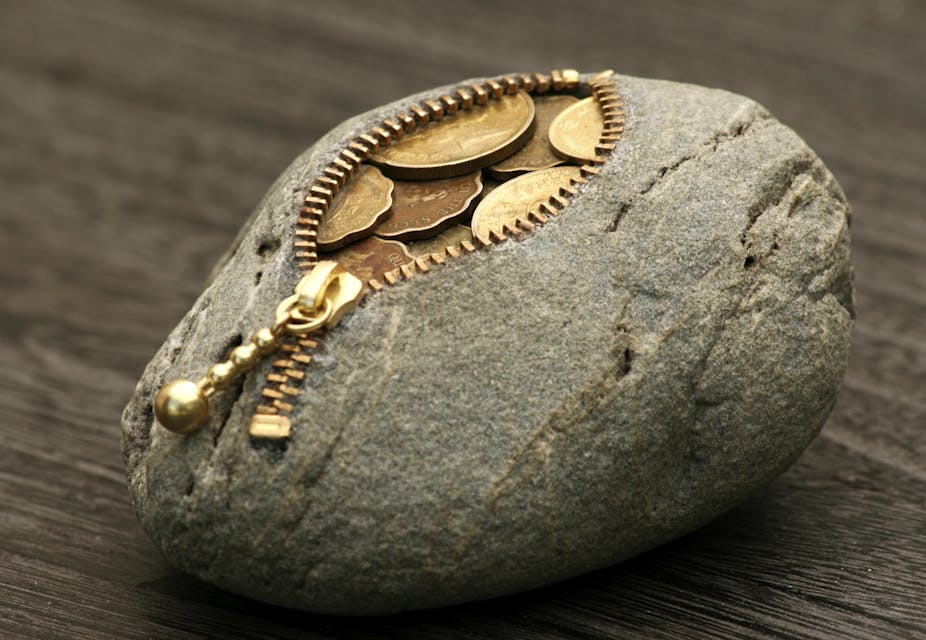
In 2012, public debate over the value of art and culture has reignited as conservative state governments in Victoria and Queensland cut arts funding from their budgets.
Queensland Premier Campbell Newman’s plan to scrap the Premier’s Literary Awards in April this year was met with predictable outrage by the arts community.
With the spectre of Joh Bjelke-Petersen stalking Queensland and that of John Howard taking possession of the leader of the opposition, are we then to expect a return to the culture wars we thought had been definitively dispelled by Kevin 07?

A central dispute of these culture wars concerned the contemporary understanding of Australian history and the new kinds of Australian identities that might be emerging. But there was another aspect: this new Australian culture would also be a new economic resource in the form of what Paul Keating called the “cultural industries” and what subsequently became known as the creative industries (a steal from his own Creative Nation).
Culture was no longer just about nation-building through heritage arts, but rather new forms of commercial and popular culture that articulated a modern multicultural Australia. As creative industries, they were to generate new jobs, animate urban economies and catalyse innovation in the new knowledge economy.
Howard’s conservatism was bad for contemporary culture and bad for the new creative economy that went with it. However, as with New Labour’s “Cool Britannia” in 1997, a politically attractive combination of cultural and economic modernisation hid some deeper tensions.
Though initially tied to a revitalisation of Australian culture, benefiting the Australian economy became the primary justification. Ironically, Howard’s government was quite generous to the arts; but under pressure to justify their subsidies and to deal with the powerful appeal of the creative industries, the arts and cultural agencies sought to make their case based on economic and social impact. That this also happened in the UK under a Labour government, and has continued in the Rudd-Gillard years should come as no surprise.
One difference between Tony Abbott and John Howard is that the latter’s weakness for the arts, his residual respect for their traditional social standing, is unlikely to be replicated by Abbott, for whom the arts belong to metropolitan elites, not “battlers”.
As for the creative industries, Campbell Newman has shown the way in calling their bluff: where is the evidence of their transformative economic impact? Set next to mining this is insignificant.
Does this mean draconian cuts for the arts? The example of Western Australia suggests not – in WA, the arts lend attractiveness and cultural legitimacy to the great urban showcases. This is something Campbell Newman will have to address; Brisbane’s image will tarnish if he keeps on the way he has. Abbott too will have to bite his lip if he comes to power.
But the deeper problem remains. Arts and culture have presented themselves as economically and socially useful, and any number of techniques have emerged with which to measure their impact. What is missing is a clear articulation of art’s value on its own terms.
This is not an argument for their “uselessness”, as Peter Acton characterised the humanities’ self-defeating plea, but that the value of the arts cannot be captured by economic impact or those quasi-economic models which “do-gooder” economists constantly foist on arts and culture in an attempt to get them to sharpen their act.
What the scrapping of the Queensland Arts Awards suggests then is not only that the new old-right has called culture’s economic bluff, but that the old new-left has no answer to this. Though they differ over what is economically important they are both concerned primarily with an economic imperative which no person who wants to be considered sane is allowed to question. But rather than retreating into the intrinsic value of the arts – pulling up the drawbridge and leaving commercial culture to its own devices - perhaps the time has come to try out some other options.
Try saying that culture and economics may be increasingly intertwined, but that this has brought some highly toxic consequences for culture. It is not so much that this or that cultural activity has been put out of business or subjected to relentless commercialisation (though this is clearly the case), it is more that the very possibility of arts and culture to articulate values apart from the economic has been severely diminished.
If you doubt this, try arguing for increased funding because of culture’s contribution to a civilised society or art’s ability to articulate uncomfortable truths that we nevertheless absolutely need.
Try saying that this does not just apply to art galleries but that the creative industries should also be promoted for their contribution to our cultural life. And while the laughter dies down try remembering that this was generally accepted wisdom thirty years ago.

We can’t go back to those days, but nor can we stay in the current impasse. The GFC and climate change have done more to puncture the absolute claims of the economy than the cultural left.
Cultural policy is dipping its toe in the waters of sustainability and finding dysfunctional urban infrastructures, the destruction of manufacturing, the discarding of craft skills along with the rampant gentrification of the urban core. The perceived win-win scenario of “what’s good for culture is good for the economy” does nothing to address these. Culture’s old oppositional stance needs to be revived, not to place art in a separate world apart from economics but to ask questions about what kind of economics we have. Rather than fall over itself to show how economically valuable it is, or drag its feet through yet another round of meaningless metrics, culture needs to take the fight to mainstream economics itself. What kind of life, what kinds of towns and cities is it creating around us?
New culture wars lie ahead, but we can rest assured, these will not be anything like the last ones.