


In what has been labelled a “bad day for the internet”, Google last week changed its search engine to include personalised results from Google+.
The introduction of Google Search plus Your World has led some commentators to claim the search giant has “changed the way search works”, in favouring posts from Google+ over relevancy.
But it’s possible to argue that you can’t break what has already been broken for some time.
In his book The Filter Bubble, internet activist Eli Pariser wrote about the increasingly personalised view of the world that search engines present. He noted that people may be struggling to access information because Google and others have made a decision about what an individual wants to see.
Of course, from Google’s perspective, the more personalised the search, the more personalised and targeted the accompanying advertisements can be. And the more targeted the advertising, the more money Google is likely to make.
When you search for something on Google, the results depend on more than 200 factors (or signals, as they are known within Google). The main signals affecting search are the country you are in and whether you are logged in to a Google product such as Gmail and/or Google+. Being logged in to a Google product then brings your search history into play.
To illustrate the dramatic effect location has on search results, I conducted a simple experiment. Using a clean browser (with no page history, cookies or other existing data) and not logged into Google, I searched for the term “Human Rights”.
Using virtual private networking (VPN) software, I was able to conduct the search with Google thinking I was in Australia, and then in the US. Of the ten results returned on the first page, only three were the same. Even the news items from international news organisations (that is, not from the US) were different.
(Bear in mind that the default setting on Google is to search the entire web and there is an option to restrict the search to Australian sites only.)
Somewhat bizarrely, the ABC’s page on human rights was returned high in the list of search results. I hadn’t asked Google specifically for information on human rights in Australia – something I could have done easily by adding “Australian” to the search term. The decision to display human rights information from an Australian site was made for me.
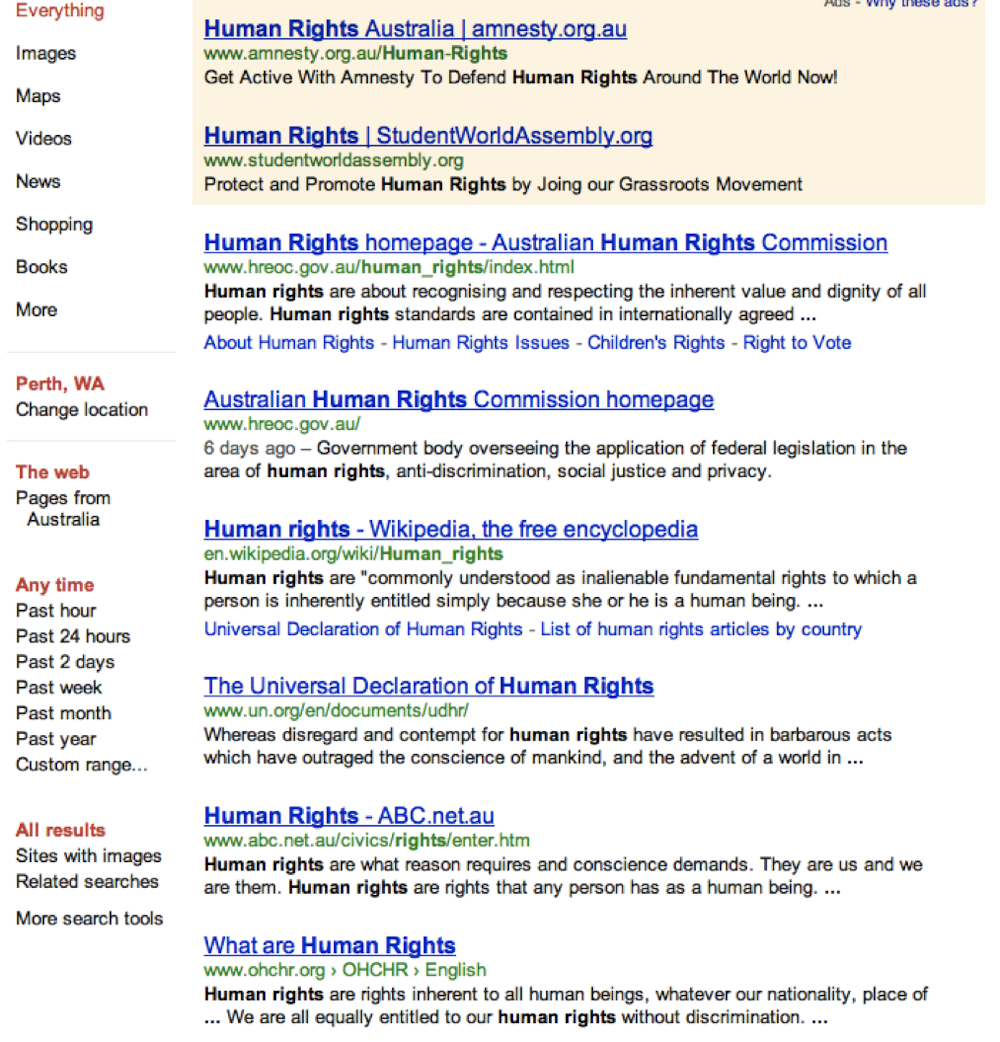
Google is not alone in this – search engines such as Bing return similar results in Australia.
To be fair to Google, creating a good search algorithm is very difficult. And when Google started in 1998, its algorithms were the best of any search engine at the time for returning relevant results. But in 2009, Google embarked on an ongoing quest to personalise search results.
With the advent of Google+ last year, searches started including posts from Google+ and search results were influenced by the people you were following. The idea was that relevance was going to be increasingly dictated by our likes and dislikes and through our social connections (or “social graph”). In this way, Google assumes we are mostly looking for what our friends, colleagues and people we follow like and dislike.
According to Google, people also want to use search to find information that is directly about themselves (known as “vanity searching”). The example given by Google Fellow and software engineer Amit Singhal is when that he searches for his dog’s name, he gets results about his dog and not the fruit it is named after.
Search plus Your World has taken the inclusion of Google+ content to a new level by promoting that content. Those who have been positive about this new development have used what are particularly banal examples, but essentially it comes down to “vanity” searches – a search for the name of one person’s dog, another search for the word “Werewolf” that returned pictures of the author.
Not everyone is so positive.
The change was enough to make one tech writer switch to Bing (even though – it should be pointed out – it’s possible to disable personal results in Google.)
Hitler is, of course, upset that he won’t be able to find Britney Spears’ Facebook page in Google any more. In a poignant comic, The Joy of Tech, Google founder Larry Page meets his future self and is appalled at what his search has turned into.
More seriously, the move has also caught the attention of the US Federal Trade Commission, which is investigating Google for antitrust violations through its search and mobile platform businesses. That investigation now includes Google+.

The changes to Google’s search platform have prompted discussions about whether Google alternatives could soon be used more widely.
Microsoft’s Bing search engine is one alternative, but it suffers from some of the same problems as Google with an attempt at “Filter Bubble” search.
One Google alternative that has made a point of not allowing “bubble” searching is DuckDuckGo. This search engine aggregates searches from its own web crawler, from crowd-sourced search sources and from other sites and search engines.
Google seems to be taking an increasingly perilous path with its move towards “socialising the web”. It is fast gaining a reputation for having progressed rapidly through the ages of corporate development and straight into senility. The changes it is making are somewhat random and unpopular, and with every change Google asserts that it knows best.
Google Search plus Your World may be a case in point.