
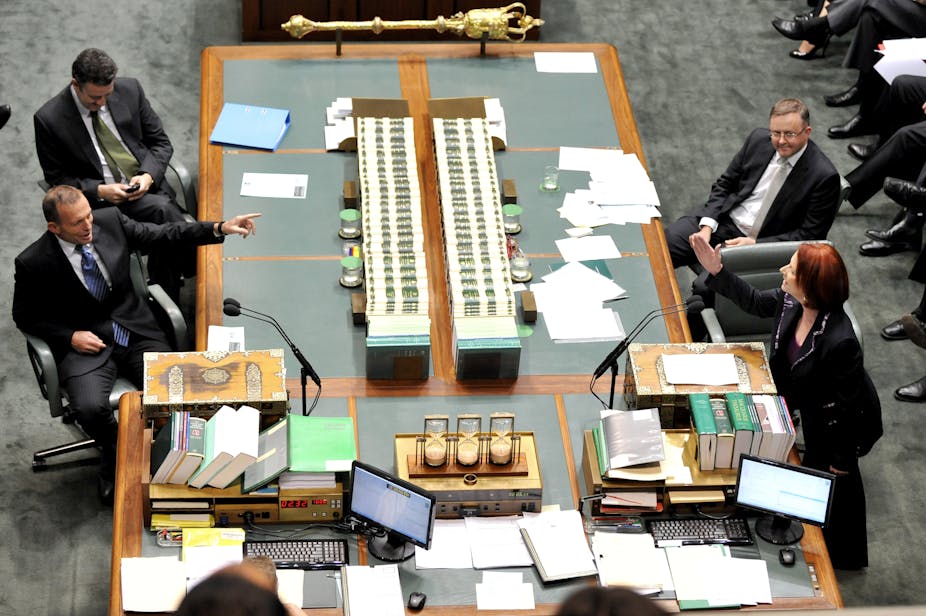
Last week, prime minister Julia Gillard told the Australian public they’d be able to tell the difference between campaigning and governing during this election year.
Over the following days, which saw a former federal Labor MP arrested for fraud, a former state Labor MP testifying before a corruption commission, the resignation of two senior government ministers and a senior Liberal comparing Gillard’s government to the final days of the Nazi regime, the Australian public would be forgiven for failing to do so, or at least wondering when the governing might actually begin.
It’s no wonder some commentators have expressed doubt about the sustainability of the distinction between campaigning and governing. They argue that once an election date is set, the “days of campaigning” begin, regardless of when the writs are issued.
The distinction between governing and campaigning has become more and more blurred in recent times, with campaigning now stretched across the three-year electoral cycle. This is the “permanent campaign” – the idea that politicians are now constantly in campaign mode, as a result of the increasing intensity of media coverage in an era of satellite TV and 24 hour news stations (see Pippa Norris’s book, A Virtuous Circle). When Australian commentators complain about the dominance of spin and the superficial nature of media coverage, this is partly linked to this idea of the permanent campaign.
What’s left for Labor?
One of the ironies of the current minority government, though, is that a toxic political environment, saturation media coverage, and constant sense of crisis have actually not prevented the government from governing. Despite the difficulties it has faced, the current Labor Government has managed to pass significant reforms, most notably, the introduction of the carbon tax and the mining tax.
Although its opportunities to achieve further reform are likely to be limited as it heads into the pre-election period, the government is likely to use its final “days of governing” to bring in the National Disability Insurance Scheme (NDIS) and the Gonski education reforms.
The government has already made a firm commitment to bringing in the NDIS, introducing a draft bill to Parliament in November and funding the first stage of the scheme. The prime minister has expressed overall support for the Gonski reforms, although detailed announcements regarding funding have yet to be made.
It would make sense for the government to prioritise these reforms in the limited time it has left before the next election. They could turn out to be the most important policy legacy of Labor’s six years in office, and are also in line with Labor’s traditional commitment to equality of opportunity and providing a strong level of social protection to citizens.
There may also be electoral advantages for the government in bedding down these reforms. It would mean a stronger case could be made for its reform credentials in the social policy area, appealing to its support base. These reforms are also likely to appeal to voters in marginal seats where issues such as education and financial security are particularly important.
Death of a legacy
With an election date in place, it is also worth considering what the likely consequences of electoral defeat will be for Labor’s agenda.
Once again, despite the relative pessimism about the state of Australian politics, on issues such as industrial relations, climate change, and taxation, there are important differences between the major parties.
In industrial relations, for instance, although opposition leader Tony Abbott has rejected a return to WorkChoices, he spoke positively of the reforms in his 2009 book, Battlelines, and he has been critical of the Fair Work Act.
This suggests that further labour market deregulation is likely to be on the agenda under a Coalition government, even if it does not go as far as WorkChoices. At his speech to the National Press Club last week, Abbott also reaffirmed his commitment to abolishing the carbon tax and the mining tax. Thus, three of the major policy reforms introduced by the Labor government – in industrial relations, climate change and tax – are likely to be overturned if a Coalition government were elected.
In the social policy area, there are also likely to be differences between Labor and the Coalition. Abbott has been critical of the Gonski reforms, questioning their affordability.
In contrast, he has indicated in principle support for the NDIS reforms, although funding appears to be dependent on the budget being back in surplus.
Given the opposition’s commitment to repealing the mining tax and the carbon tax, while retaining the tax cuts introduced by Labor, there must be some doubt over how soon the Coalition would be able to introduce these reforms.
The campaign we deserve
Despite how things may seem, there are, in fact, significant differences between the major parties.
The next election is likely to have important implications for climate change, taxation, industrial relations and, in all likelihood, social policy.
It would therefore be conceivable to have a seven-month lead-up to the election dominated by genuine debate over policy, with both major parties putting forward competing approaches, and media coverage focused on substantive issues rather than horse-race journalism.
But if the past week has taught us anything, it’s likely that this will be a forlorn hope. Sadly, the pattern that has taken hold over the past two-and-a-half years is likely to remain firmly in place.
Stephen John Ralph
carer
Reminds me of that old anecdote......
John Barrymore was appearing in a movie with Katherine Hepburn. Barrymore (an old roue) made one too many passes at Ms Hepburn and remarked to him - "Mr Barrymore if you don't behave I will stop acting."
He replied - "I wasn't aware you had started."
Stephen John Ralph
carer
Watching Nicola Roxon on the 7.30 report it is clear that politics is going to be more of the same old tripe, even if she herself is leaving. Taking a swipe at TA & the Libs for not presenting clear policies and costings, she stumbled over questions regarding the NDIS and Gonski costings........wait til the budget she proclaimed.
I couldn't bring myself to watch Vanstone AND Pyne together on Q & A - did I miss much?
Felix MacNeill
Environmental Manager
Stephen, I did gird up my loins and watched the dynamic duo on Q&A. Vanstone, as ever, was often quite sensible but couldn't help being partisan. Pyne bloviated as usual without really saying anything.
Labor's David Bradbury handled himself fairly modestly and creditably.
Urthboy made a few not-very-articulate but often sensible observations.
No, you didn't really miss much.
Venise Alstergren
Venise Alstergren is a Friend of The Conversation.
photographer, blogger.
Not a lot. Chrissy Wissy and Vanstone acted precisely as expected, although it was clear the Opposition is already reneging on putting its costings out ASAP. With an amazing piece of chutzpa, Chrissy Wissy says these cannot be done until the government brings out the budget. Ho hum!
Sarah James
Psychologist
What;s missing from this analysis are two things. One is the media which serves up this tripe on a daily basis, looks for it, loves it and thrives on it. And the citizens of Australia, who seem only to happy to swallow it in spades.
Stephen John Ralph
carer
Sarah
you are probably and sadly right.
I could say that if the supermarkets only sold tripe we have to get to like it!
I guess forums like this one give "US" the option to express our views.
I found it interesting that no-one had a positive thing to say about Michelle Grattan. Considering she was/is a name journalist in a major Oz paper, that says a lot to me.
And with a significant number of people commenting on the lack of positive qualities in today's Oz politics, I wonder why things haven't changed for the better. Or like Romney do they believe that they can wipe off a 47% bad rating and concentrate on the 53%?
Surely if enough peeps say we don't like the sub-standard state of politics and politicians in this country, and want a better standard of political debate and discourse, we might get somewhere.
As it is we seem to be left with a tragi-comedic act with 2 major players.
Felix MacNeill
Environmental Manager
There are other players in the game than Tweedledum and Tweedlenasty. They're a mixed bag but would have to be worth a try.
Despite the right-wing hysteria, I think the Greens have done a reasonable job - certainly been a more positive force than negative on balance.
And I have to say the Oakeshott and Windsor have turned out to both be people of substance and worth.
Wilkie is a little flighty and unpredictable, but more often good than bad. Xenophon likewise.
Despite the media bleating about the failings of minority government, the truth has been that while our politics have been a bit wobbly (as theatre) the legislative record is substantial and mostly positive.
So, go the small parties and independents!
Suzy Gneist
logged in via Facebook
I have to agree with you since the inclusion of small parties and independents seem to me to provide more of a balance for the demographics they represent - I would love to see more of this and have parliament turn into a space of deliberation and formulating agreements among represented groups rather than cross-party mudslinging.
Michael Shand
Michael Shand is a Friend of The Conversation.
Software Tester
Hey Sarah.....seeing as Michelle is a grand figure in Aus News esp politics.....and everyone is complaining about the state of the News and Politics......surely Michelle had over 40yrs to make a difference yeah? if we have this problem, why would someone from the mainstream media that has been shaped and molded for over 40years - why would you think they are the answer to the problem that is australian news journalism
We have a huge propblem with climate change and an opposition leader who has no plan to tackle that problem except repeal the carbon tax and has Michelle or anyone in the Mainstream Media highlighted this point? No, again and again they fail to hold politicians accountable and ask basic questions and your suggestion that this is what we need more of doesnt make sense to me
I look forward to seeing what she writes as an independent writer but do not hold out much hope
Colin MacGillivray
Retired architect
The Labor Government has introduced the carbon tax and the mining tax, which the Coalition has promised to reform. This simply confirms again that the Westminster system is an awful way to run a country. Imagine a business being run this way. Belgium carried on for over a year with caretaker politicians; the bureaucrats coped very well thank you.
Politics is a sport somewhere between gladiators and Toastmasters- with the Grand Final in September.
Marty Whitelaw
Solicitor
A very interesting read.
Nice to finally read something that goes beyond the media's 'minority government has been a disaster' narrative. The government could hardly be accused of inactivity or policy paralysis during the last three years.
The performance of the mainstream media over the last three years has been pathetic, although this is perhaps an issue for a separate article. They have shown a complete lack of interest in anything other than Rudd v Gillard, Jo Hockey's harrowing attle with obesity or gushing coverage of Tony Abbott's Putin like stunts. The Conversation's latest recruit has been one of the prime culprits in this area...one can only hope that she will improve in her new surrounds.
Stephen John Ralph
carer
Thank you Felix
as well you added a new word to my vocabulary - one that seems particularly apposite to the gentleman.
I too have appreciated the influence of most of the independents, partic Mr Windsor.
And it's not that the government hasn't done well in a number of areas, it's just that for every one step forward they seem to take two backwards. Just as Julia & Co make headway in voters' opinions, they "stuff" it up.
Apart from a few cringeworthy bits and pieces, they handled the GFC well and Australia seemed to be the better for it when compared to most other countries.
Felix MacNeill
Environmental Manager
Stephen - I think that's the key point - Gillard hasn't handled the pure politics very well, but that ends up having very little impact on the actual business of running the country.
You hear a lot of vague talk about displaying lack of judgement, on the assumption that if your judgement is poor in one area it means it wuill be poor generally. But I'm not sure how true this really is. Psychologists will tell you that there are a great many things that are very domain dependent and don't really generalise very well - or, as I vaguely recall reading somewhere, the evidence is that playing chess tends to make you better at playing chess, but there's very little evidence it makes you better at anything else.
So Gillard can be clumsy at times, but I honestly wonder how much that really matters in the things we really need governments to do.
Stephen John Ralph
carer
perhaps Gladdymasters.......colin
and in regard to the carbon and mining taxes - I can't seem to fathom if they are making any money for Australia,
or just being sidelined by tax-clever companies.
Stephen John Ralph
carer
Hello again
As a Victorian I lived thru the Kennett years. In my circle of friends Jeff was the devil incarnate.
But I liked him. He could be accused of many things I'm sure, but I liked him cos he was direct and most often told it like it was.
Weasel words is a very apt description of what we get these days.........but i'd love a politician to face the camera and say "this is the way it is".
Trevor McGrath
Pharmacist Hobby:climatology
While politicians are trying to communicate with an adult population, half of which have only the most rudimentary literacy and numerary skills, what can we except. It will be Sesame St. and "the count", or Ernie and Bert,…. “let’s call this cooperation” but with no laughs. John Howard came to calling anyone who could read and write, could work out the interest on their credit card, and could think for themselves “elitists”. Cheers