GP de-registration shows double standard for health practitioners

A New South Wales general practitioner, who was de-registered by the NSW Medical Tribunal for claiming he could treat any number of serious conditions by “spinal manipulation”, has lost his appeal to the Supreme Court. But the very same claims are made by numerous chiropractors and the same techniques…

5wg2sb2t-1346215878
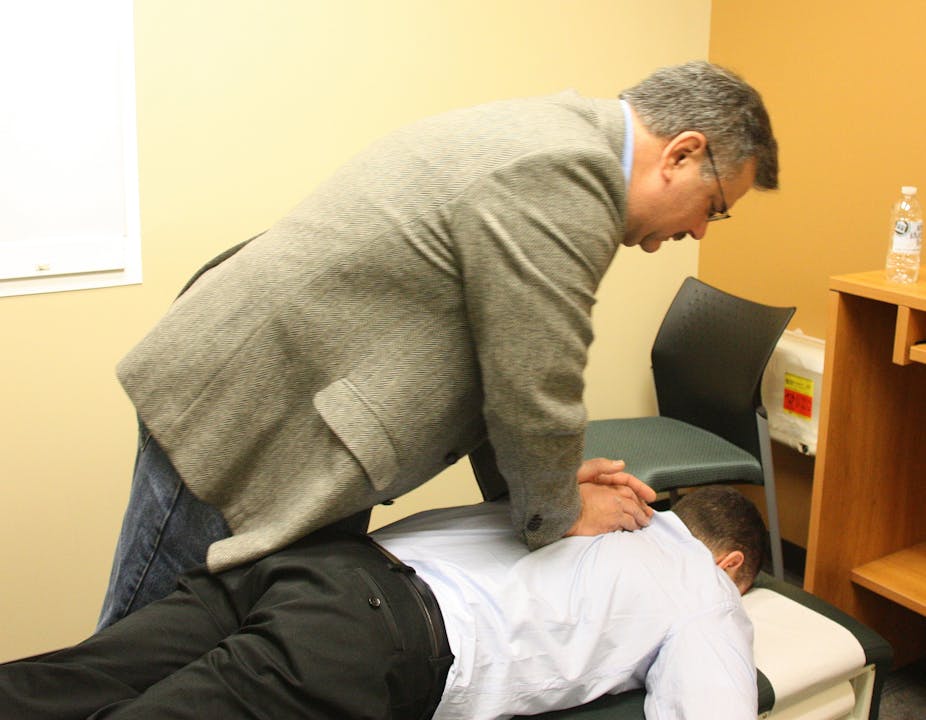
There is a soft evidence base for spinal manipulations being useful for musculoskeletal problems. Michael Dorausch

A New South Wales general practitioner, who was de-registered by the NSW Medical Tribunal for claiming he could treat any number of serious conditions by “spinal manipulation”, has lost his appeal to the Supreme Court. But the very same claims are made by numerous chiropractors and the same techniques used without a whiff of disquiet from the Chiropractic Board of Australia.

Indeed, there’s some support from the Board for spinal manipulation, which is endorsed by the profession’s peak body, the Chiropractor’s Association of Australia (CAA). So it seems we have one government-appointed registration board de-registering a member for practices that are not subject to any restrictions by another!

In September of 1895, the founder of chiropractic, Daniel David Palmer, noted that the janitor who cleaned his office and had been profoundly deaf for 17 years had a vertebra racked from its normal position. He racked it back into position and soon the man could hear as before.

Shortly after this episode, he noted similar spinal distortions in a man with heart trouble and again manipulation provided immediate relief. From these observations came the theory that 95% of what ails man is caused by spinal distortion of an energy flow (innate intelligence), the integrity of which is essential for health. Spinal cord adjustments, thought Palmer, could correct subtle even invisible distortions.

Many chiropractors dismiss this theory and limit their practice to definite musculoskeletal problems. And there is a soft evidence base to support these manipulations. But others endorse Palmer’s theory and use it to greatly broaden the scope of care they offer. Particularly disturbing are the claims being made for spinal adjustments of children to treat conditions such as autism, attention-deficit syndrome, colic, infections, asthma and bed-wetting.

Daniel David Palmer, the founder of chiropractic. Wikimedia Commons

The CAA describes chiropractic care as an alternative health system distinct from the mainstream that aims to “achieve a fundamental paradigm shift in healthcare direction where chiropractic is recognised as the most cost efficient and effective health regime of first choice that is readily accessible to all people”. Consumers have been warned of the potential dangers inherent in this ambition in a report by Choice Magazine.

The de-registered doctor manipulated spines to treat, among other things, influenza and poor vision. He was furious with the court and claimed to be a whistle-blower exposing the wider medical profession’s unconscionable failure to adopt his techniques. Reading media reports of the case made me wonder if he was somewhat delusional but many a chiropractor would have no such concerns and welcome him and his approach into their club.

The paradox highlighted by this situation is obvious and cause for concern. National registration of practitioners of chiropractic and traditional Chinese medicine was presented as an important advance in protecting consumers, as the new boards would hold members to the highest standards of ethical and credible practice. But when board members accept pseudoscience as ethical and credible, this premise disappears.

Even though modern research shows that (with a few exceptions) acupuncture is no more than a superb placebo, the traditional Chinese medicine board is hardly likely to recommend restricting its current broad and discredited application.

So while the Supreme Court tells a doctor he deserves de-registration, we have a self-serving rather than public-serving government-authorised boards supporting the same practices as if they were good medicine.

It’s time to challenge the Australian Health Practitioner Regulation Agency (APHRA) about registration boards holding members to a standard that rejects approaches to care for which there’s no support from good science or treatments that have been studied and found to be ineffective.

Join the conversation

18 Comments sorted by

  1. Ken McLeod

    logged in via Facebook

    I am always amazed at the difference in attitudes to public safety between the health industry and my industry, aviation.

    In aviation, the safety of the public is by far the greatest concern, and nothing stands in its way; not economics, not politics, not egos, and certainly not a deference to "professions."

    In health, the safety of the public seems to come much further down the ladder than deference to "professions," status, woo, psuedoscience, egos. And all of this aided and abetted by gutless politicians and regulators.

    Imagine the career prospects of an airline pilot who disputed the law of gravity.

    report
  2. Luke Weston

    Physicist / electronic engineer

    What we have here, basically, is a GP who was deregistered for believing in and practising the pseudoscience of chiropractic, the manipulation of magical "energy" undetectable to science that flows through the spine, which is responsible for essentially all disease if it doesn't flow "correctly".

    But if a GP is not allowed to practice the psedoscience of chiropractic manipulation, why the hell should anybody else be allowed to do it? Why the hell should a "legitimate chiropractor" be allowed to…

    Read more
    1. Rich De

      logged in via Facebook

      In reply to Luke Weston

      Actually if you took the time to investigate the facts you will find that the doctor's de-registration had NOTHING to do with the reasons why he was manipulating his patients (i.e claiming to cure organic diseases and the like) but rather the manner in which he did it, in addition to inappropriately prescribing addictive medications.

      I quote "An assessment of Dr Gorman’s professional performance in 2008 found Dr Gorman’s 'standard of care' in carrying out spinal manipulations was unsatisfactory…

      Read more
    2. Sue Ieraci

      Public hospital clinician

      In reply to Rich De

      You may not have read the entire transcript, Rich De.

      Here is an extract that contradicts what you say:

      " the HCCC particularised a series of rigid and firmly held views held by the appellant. During the hearing the appellant agreed that he did indeed hold the following views (which had been particularised at pars (a) - (l) of the Second Notice of Complaint):

      (a) There is an ubiquitous illness affecting all of mankind which can be treated by the very simple and safe treatment of spinal manipulation…

      Read more
  3. Graeme Hanigan

    logged in via Facebook

    If you go to a Medical Doctor you expect medicine, if you go to a Chiro expect quackery.

    report
  4. jerry sprom

    logged in via email @gmail.com

    You do realise that a chiropractor actually gave evidence against Dr. Gorman in this case? The panel also agreed that the spinal manipulation hadn't "been carried out in accordance with the standards applying to doctors, physiotherapists or chiropractors."

    Dr Gorman failed to take a proper history and conduct a proper examination, he failed to screen for risk, his method of spinal manipulation "fell below the standard of other practitioners who do use spinal manipulation", he did not give informed consent (or even understand what it was), he failed to correctly diagnose (or diagnose at all) and he failed to comply with the numerous restrictions set out in previous hearings against him (it looks like as far back as 1988). And after reading the Medical Tribunal of NSW reasons, it was unlikely he was ever going to change. It think t highly unlikey that any Rego board would let that slide.

    report
  5. Will Farrell

    logged in via Facebook

    Would be interesting to know if there was other factors in Dr. Gorman's case with regards to his professional conduct. Simply practicing manipulation would be unlikely to have sealed his fate given it is apparently beneficial to patients when orthopedic surgeons perform. Manipulative physiotherapists, chiropractors, and even some medical Dr's who are not a specialist level regularly experience the benefits of the practice first hand. I think it is important to realize when we criticize manipulative…

    Read more
    1. Jonathan Maddox

      Software Engineer

      In reply to Will Farrell

      Very big "yes" to the question, were there other factors. Gorman was not de-registered for spinal manipulation. Read the comment by Rich De above (in reply to Luke Weston).

      report
    2. Sue Ieraci

      Public hospital clinician

      In reply to Jonathan Maddox

      On the contrary, Jonathan - Rich De said "had NOTHING to do with the reasons why he was manipulating his patients (i.e claiming to cure organic diseases and the like) but rather the manner in which he did it.."

      But, if you read the actual transcript, it was mainly related to using manipulative therapy for all manner of conditions that did not have musculoskeletal pathology. What he was doing was very much like the original chiropractic theory that all disease is caused by spinal mal-alignment. This has now been debunked but some chiros still ascribe to it.

      report
    3. Jonathan Maddox

      Software Engineer

      In reply to Sue Ieraci

      We are speaking at cross-purposes. The information you present (which is of course entirely correct) does not contradict the information presented by Rich De (none of which is wrong).

      Practice of spinal manipulation is NOT a reason to prevent GPs, chiropractors, physiotherapists or orthopaedic surgeons from practicing this or any other treatment that is within the remit of their respective professions.

      *MAL*practice -- in the case of Dr Gorman clearly derived from his rigid subscription to…

      Read more
  6. Guy Curtis

    Senior Lecturer at School of Psychology and Exercise Science, Murdoch University

    It is not just boards without a strong scientific basis that are not meeting the standards of evidence-based practice that should protect the public. In it's most recent newsletter the Psychology Board of Australia outlined its curriculum for a national exam. It included knowledge of "contemporary" intervention methods and listed among its examples psychoanalysis! Psychoanalysis would be struggling to have been described as contemporary 50 years ago.

    report
  7. Iain Stuart

    logged in via Facebook

    Perhaps the author of this piece should be highlighted as a medical doctor whose profession is in a turf war over Chiropractic and other allied or alternative health services. One reading of the article would be that this is an attempt to use a medical tribunal hearing to cement the privileged position of Doctors

    I have been treated by manipulative physios and chiros and the level of care and more importantly caution was excellent. When I have queries some aspects of the treatment they were able to explain and discuss the issues.My experiences is that medical problems often require a multi-disciplinary approach to resolve.

    report
    1. Sue Ieraci

      Public hospital clinician

      In reply to Iain Stuart

      Iain Stuart - I don't see the author criticising manipulative therapy per se - he is criticising the use of manipulative therapy to manage every presenting symptom - whatever the pathological cause. This is potentially dangerous, as the underlying pathology (eg infection) remains untreated.

      There is no "turf war" between medical doctors and manipulative therapists - indeed, medical doctors refer patients frequently for manipulative therapy - both physios and chiros.

      The real issue here is the use of manipulative therapy for conditions that are demonstrably not caused by musculosketal problems.

      Many chiros no longer support the "spine controls all" theories of early chiropractic, but others continue to do so. Do you think this is reasonable, or should all practitioners be held to the same standards?

      report
    2. Jonathan Maddox

      Software Engineer

      In reply to Sue Ieraci

      Penalising someone for believing in, or speaking in favour of, a *theory* is persecution of a thought crime. There is no place in a democratic or liberal society for such penalty, any more than there is a place for a professional penalty for believing in patriarchy or some religion or political program.

      We are not to be judged on our beliefs.

      On the other hand actual medical treatment and information given to patients MUST be based on sound, evidence-based expectation of the consequences of possible treatments and actions.

      We are absolutely to be judged on our behaviour.

      report
    3. Sue Ieraci

      Public hospital clinician

      In reply to Jonathan Maddox

      Correct, Jonathan Maddox.

      This practitioner was not de-registered for his beliefs, but for applying those beliefs in his practice.

      report
  8. Tim Scanlon

    Debunker

    Just more proof that science has actual standards, whereas quackery has excuses.

    report
  9. Sue Ieraci

    Public hospital clinician

    A question for other readers:

    We accept that manipulative therapy is appropriate and often beneficial for issues of musculo-skeletal origin. (The strongest evidence for chiropractic is in low back pain - where it has equivalent efficacy to physio or other conventional therapy).

    This doctor was de-registered for using manipulative therapy for a range of health issues that were not of musculoskeptal origin (some of the cases are described in the Tribunal transcript).

    SHould chriopractors, who are also registered under AHPRA - be held to the same standard? Should chiros be sanctioned for using manipulative therapy for copnditions that are not of musculoskeptal origin, according to contemporary pathophysiological knowledge?

    report