
Growing old in the Chinese economy

China’s exceptional economic growth performance in the last three decades has coincided with equally remarkable demographic change. There is now plenty of evidence to suggest the potential demographic “dividend” associated with a country’s transition towards slower fertility and population growth, and…

H4nrt5y9-1355358729
China’s economic growth has been underpinned by a favourable demographic dividend – but China’s demographic story is not always so clear. Flickr

China’s exceptional economic growth performance in the last three decades has coincided with equally remarkable demographic change. There is now plenty of evidence to suggest the potential demographic “dividend” associated with a country’s transition towards slower fertility and population growth, and therefore a growing share of the population engaged in – rather than depending on – the workforce, can be quite substantial.

In China’s case, according to some estimates, this demographic dividend can explain as much as one quarter of its economic growth since the 1980s. As the world’s fastest growing economy, this has amounted to a substantial gift indeed.
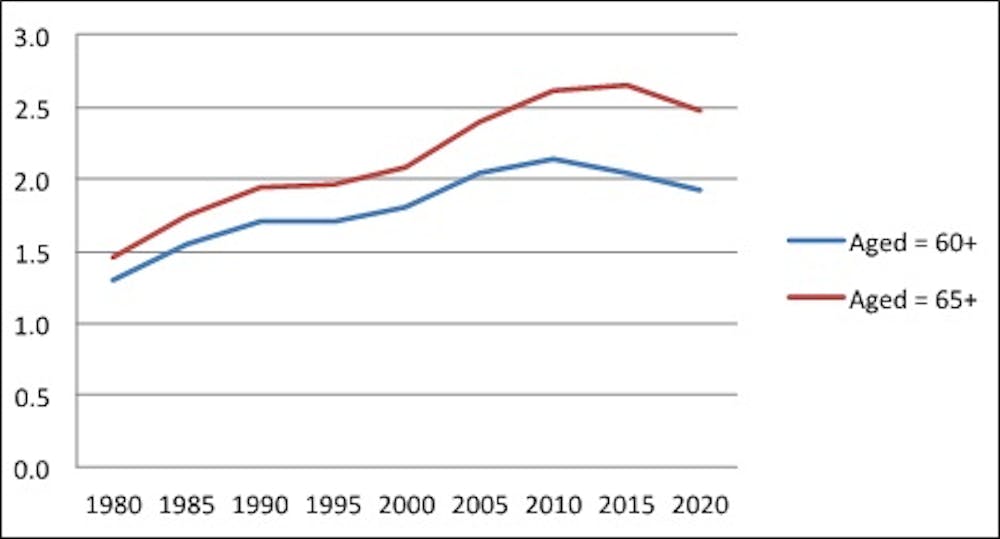
China’s working age to non-working age population ratio Jane Golley

Not all gifts are given freely, however. The demographic transition to slower population growth has been profoundly affected by China’s family planning policies, culminating in the one-child policy. Fertility rates would have been expected to follow declines seen in China’s Asian neighbours as the effects of urbanisation, female education, increases in labour force participation rates, improved life-expectancy of new-born children, and a myriad of other socio-economic factors become apparent.

Yet this should not detract from cost of the loss of freedom to choose the size of one’s own family, a choice that most of us take for granted and one that is impossible to place a value on.

A further cost of China’s rapid demographic transition is the onset of population ageing at a relatively low level of per capita income, giving rise to the uniquely Chinese phenomenon of “getting old before getting rich” (wei fu xian lao未富先老).

With a per capita income of just over $5,000 in 2010, 8% of China’s population was aged 65 or older, a percentage that will increase to 12% in 2020 and 23% in 2040. So just how serious is China’s pending demographic doom?

A few numerical comparisons can help to illustrate why this question is difficult to answer. The percentage of China’s population aged over 65 in 2040 is projected by the United Nations to be almost identical to that of Australia’s in 2010. So China has thirty more years to get rich before getting as old as Australia is now.

Would you rather face that challenge or that of Japan, nearly ten times wealthier than China in per capita terms, but with two decades of snail-paced economic growth behind it and close to 40% of its population already older than 65? Or would you prefer the wealth-age structure of India, with just $1400 per capita income and 6% of its population aged 65+ in 2010, a percentage that will increase to 12% by 2040, some two decades after China’s does? Placed in this context, China’s demographic change seems to be less of a “time bomb” than some have suggested.

Consider also that the percentage of “old” people in China, as elsewhere, depends on the definition of “old”. As shown in the figure above, if anyone aged 60 or older is classified as “old”, then China’s working-age population as a share of its total population peaked in 2010 (at 2.1 workers for every non-worker, young and old combined).

If you have to be 65 to be “old” then this peak doesn’t happen until 2015 (at which point there will still be 2.7 workers for every non-worker). Changes in the retirement age (currently at 60 years for Chinese men, 55 years for women) therefore provide just one example of how easy it would be to alter the economic impact of ageing, although by an amount that would depend on whether older employees remained willing and able to work, and on whether their younger employers remained willing and able to employ them.

A relaxation of China’s one-child policy may be just around the corner. azwegers/flickr

Improvements in the “quality” of the workforce – in terms of education, skills and productivity – would also reduce the negative impact of ageing on the country’s economic performance. Whether ageing itself brings with it continuous improvements in “quality” is a question that young and old will continue to debate for some time to come, and one of many that will affect the pace of change in this realm.

In a recent journal article, Professor Rod Tyers and I examined a range of factors that will impact on the duration and magnitude of China’s and India’s demographic dividends through to 2030. This research shows how changes in fertility and labour force participation rates could extend China’s demographic dividend by at least another decade, thereby reducing the negative impact of population ageing.

This suggests that the policy choices of the new Chinese leadership will be critical in determining just how gloomy China’s demographic future is, which in turn injects more uncertainty into the mix. There are rumours in Beijing that a further relaxation of the one-child policy is just around the corner, for example, but whether this materialises remains to be seen.

Further uncertainty surrounds the use of Chinese official numbers for doing any kind of future projections. Following the release of the Sixth National Population Census in 2010, ANU demographer Zhongwei Zhao did some careful calculations to show that China’s actual fertility rate is around 1.45, compared with an official rate (which is used by the United Nations in its population projections) that has barely moved from 1.8 for the last 20 years.

As Zhao notes, “Differences of nearly 20% in estimated fertility levels and of [over] 100 million people in projected population size are by no means negligible.” If actual fertility rates are as low as Zhao and many others now believe, China’s population is in fact ageing more rapidly than the official figures suggest.

So how serious is China’s pending demographic change? Seriously, it is really hard to say.

Articles also by This Author

Sign in to Favourite

Want to follow The Conversation?

Sign up to our free newsletter to get the day's top stories in your inbox each morning, with a special wrap on Saturday.

Spinner
Donate and become a friend of The Conversation

Join the conversation

15 Comments sorted by

  1. STABLE POPULATION PARTY

    Written & authorised by William Bourke, Sydney

    A problem with this analysis is that it fails to consider further population growth and economic development in the context of environmental limits, but luckily the modern Chinese leadership has not been so lax.

    China's demographic conundrum simply proves that there is no easy way out of gross overpopulation - so you don't want to end up there in the first place. To continue their Mao/Costello-style pro-natalism would simply condemn them to another great famine (or great war(s)).

    The OCP is China's least painful way out of gross overpopulation. It's a lesson India will likely learn the hard way. Thankfully Japan, another population basket-case that cannot provide enough energy or food for its bloated population, is now turning the corner.

    And yes, it would be MUCH better to be Japan than India - at least Japan is dealing with their population millstone. This will stand future generations of Japanese in good stead.

    report
    1. Colin MacGillivray

      Retired architect

      In reply to STABLE POPULATION PARTY

      Just over 40 years ago the Values Party in New Zealand stood in the November 1972 General Election on the platform - Zero Economic Growth. Sooner or later it will come to pass. Hopefully, when it does happen, the quality of life of the whole world's population, old and young will be satisfactory.
      We will be pushing up daisies so no need to fret.

      report
  2. Michael Lardelli

    logged in via Facebook

    I agree with William Burke. What is the more important human right? The right to "choose the size of one’s own family", (a choice the authors apparently believe is "one that is impossible to place a value on"), or the right not to starve to death? The Chinese government has acted very responsibly in attempting to limit a population size that had already become far too large. It is debatable whether, ultimately, they will succeed in reducing their population size in time to cope with falling water tables, declining energy resources and climate change as these reduce world agricultural production. The Indians on the other hand are headed with certainty to a very, very unhappy place. Let's hope that our population growth-obsessed politicians in Australia can be convinced to change their minds in time before declining resources collide with an increasing population and we are forced into widespread poverty.

    report
  3. Jane Golley

    Researcher ANU College of Asia and the Pacific at Australian National University

    Please note that just because I say there have been costs to the OCP (i.e. loss of freedom and rapid ageing) that DOES NOT MEAN that I do not recognise the benefits. If you have a chance to read the cited paper you will see that our model is in fact "population pessimistic" - that is, it reflects the fact that lower fertility rates RAISE per capita income. The analysis then shows that if India were to REDUCE its fertility rates further, this would INCREASE its demographic dividend, while if China were to INCREASE its fertility rates, this would come at a per capita income cost. For space reasons I did not spell this out clearly in this short article, although I now wish I had!

    report
    1. Michael Lardelli

      logged in via Facebook

      In reply to Jane Golley

      I tried to download the paper but my university library did not give me access - no subscription.

      report
  4. Wil B

    B.Sc, GDipAppSci, MEnvSc, Environmental Planner

    As I and many others have said elsewhere, if your model of economic success requires continued population growth as a fundamental pre-requisite, then in a finite world it's not demography that's the problem, it's the economic model.

    To quote Kenneth Boulding: "Anyone who believes exponential growth can go on forever in a finite world is either a madman or an economist. "

    report
    1. Chris O'Neill

      Telecommunications Engineer

      In reply to Wil B

      i.e. unbounded population growth is like a giant Ponzi scheme.

      report
    2. Jane Golley

      Researcher ANU College of Asia and the Pacific at Australian National University

      In reply to Wil B

      I'm not sure you've understood my last comment - we use a model in which SLOWER population growth is GOOD for economic growth, (i.e. so our model DOES NOT require continued population growth as a pre-requisite) and I certainly don't believe that exponential growth can go on forever, despite being an economist!

      report
    3. Mark Harrigan

      Dr

      In reply to Wil B

      Perhaps Wil - but there is an implict assumption in your approach that is questionable.

      It is not economic growth (or population growth) that is the (root) problem

      The problem is the unrestrained growth in the consumption of non-renewable resources beyond the ability of the plant to provide.

      Perhaps rather than just challenge the economic paradigm of growth - which has, after all, lifted billions out of poverty, you might be better off challenging the coupling of economic growth to resource consumption - as has been done here

      http://en.wikipedia.org/wiki/Decoupling_Natural_Resource_Use_and_Environmental_Impacts_from_Economic_Growth_report

      Food for thought?

      report
  5. Tony Xiao

    retired teacher

    A couple of points
    While there are rumblings from outside of government, the minister of the National Population and Family Planning Commission remarked on December 20 that China will stick to its family planning policy.

    The retirement age of 55 is for white-collared women. Blue-collared women retire at 50 and if a decreasing workforce does become an issue, then a lifting of the retirement age should alleviate the problem.

    The current family planning policy creates one problem for the economy…

    Read more
    1. Jane Golley

      Researcher ANU College of Asia and the Pacific at Australian National University

      In reply to Tony Xiao

      All good points Tony - many of which Rod and I talk about in detail in the cited paper. On the measurement question you are also absolutely right - there is a lot of guestimating going on, which is why the main point of my article is that it's very difficult to say just how bad a problem ageing actually is. I wrote a chapter on this topic "Uncertain numbers uncertain outcomes" in a book published last year by the Australian Centre on China in the World. This is easily googled and downloadable for free, in case you're interested.

      report
  6. Tony Xiao

    retired teacher

    Jane, unfortunately Chapter 4: Uncertain numbers... appears to be one of the few article on www.thechinastory.org unavailable in my location at the moment

    report
  7. Tony Xiao

    retired teacher

    Thanks for the article Jane,
    re: per capita income
    One problem for statisticians is there is no provision nor requirement in China for monthly wage and salary earners (the bulk of the employed) to submit annual Taxation Statements detailing assets, finances and income earned from other sources making it impossible to arrive at any figure remotely in the ball-park regarding per capita income, income inequality or grey money. It's also doubtful that the official stats include the periodic and sometimes…

    Read more