
Hard-headed politics: ask the right experts and you’ll get the answers you want

Politics drives policy, and not the other way around. If we ever needed a sober reminder of this democratic truism, we got it in the political responses to the expert panel’s report on asylum seeker policy on Monday. Tony Abbott immediately dismissed the bulk of report’s recommendations. The problem…

Zzrr52dj-1344928998
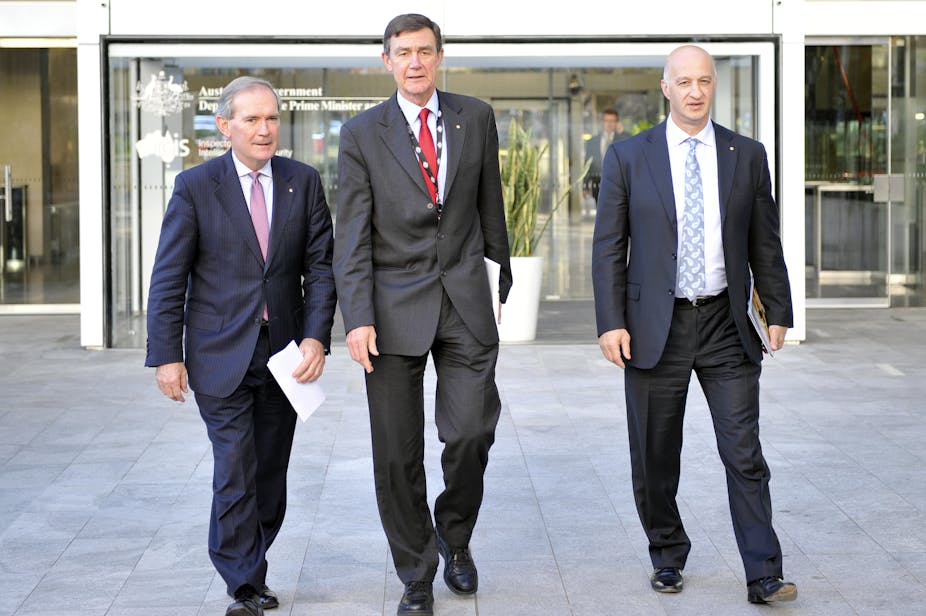
Gillard’s expert panel – Michael L'Estrange, Angus Houston and Paris Aristotle (L-R) – gave her exactly what she wanted. AAP/Alan Porritt

Politics drives policy, and not the other way around. If we ever needed a sober reminder of this democratic truism, we got it in the political responses to the expert panel’s report on asylum seeker policy on Monday.

Tony Abbott immediately dismissed the bulk of report’s recommendations. The problem for the Opposition leader was that the panel did not wholesale share his pre-existing views, and was therefore obviously wrong. The Greens likewise brushed off the experts’ central recommendations without detailed consideration.

Julia Gillard – who commissioned the report six weeks ago – enthusiastically endorsed it. So much so that an amended migration bill for parliament has already been prepared in line with the expert panel’s 22 recommendations. Well might we might dismiss the response of the Coalition and the Greens as predictable, but the government’s response was too.

This is because the Houston Report is exactly what the government asked for – a hard-headed compromise on asylum seeker policy to break the current political deadlock and hopefully prevent more tragic loss of life at sea.

As Australia’s longest serving federal politician, Fred Daley, infamously said, governments should never commission enquiries if they don’t know what the recommendations will be.

So what does this all mean for the role of experts in policy making?

As (mostly) independent outsiders with smarts and specific training, experts provide valuable information and invaluable legitimacy to government action – or inaction – especially where their advice accords with pre-existing policy predilections.

It is impossible for any one person to intimately understand the complexity and implications of every possible policy in every domain, be it transport infrastructure or the health of the Tasmanian Devil population. Experts can help politicians avoid clanging policy failures and, where policies are controversial, provide critical endorsement when selling them to parliament or the public.

But experts can also undermine a government. If their advice is politically unfeasible (such as the Gonski review’s central recommendation of a $5 billion funding increase for schools shared between the states and the Commonwealth); has little electoral support (such as the dramatic actions urged by the vast majority of climate scientists); or simply runs counter to the government’s deeply held preferences (such as Howard’s rejection of multiculturalism as an official government policy). In these scenarios, experts are often swiftly sidelined as disconnected elites. No amount of empirical data from them can change the government’s mind.

It is not just experts and other “elite” outsiders that are dismissed. In the era of electoral-professional “catch-all” political parties, insiders such as party members have minimal and declining influence on policies, much to their chagrin. This is a core driver of the mass exodus of members from both major parties.

Policy makers must be meticulous in their selection of experts, which is where things get complicated. Experts are more likely to be brought in when they agree with a party’s stance.

It may seem counter-intuitive, but expertise is very often driven by values as much as it is by cold facts.

Highly intelligent people support and oppose federalism – to take but one example – for good reasons. And they’re driven in part by their philosophical values.

When presented identical information, clever, dispassionate experts can reach radically different conclusions. This fact is more readily accepted in some disciplines than others, hence the joke that by asking two economists you get three opinions.

Some of these values are ugly, touching upon raw political and even animal nerves.

The Howard government’s mantra “we will decide who comes to this country and the circumstances in which they come” may appear to be based on nothing else but obstinacy and gut instinct, and impervious to evidence. Yet, however erroneously, these policies are founded on principle, in this case sovereignty, and buffered by electoral support.

Politicians are the experts in politics. And their key performance indicator – as much as we might dislike it – is winning elections and maintaining power. Not what is right or compassionate – two noble values whose definitions themselves can vary according to the experts asked.

Join the conversation

51 Comments sorted by

  1. Marilyn Shepherd

    pensioner

    Trouble is they are not experts and they failed to say the only useful thing they could have.

    Instead of building all these expensive prisons and going through all these deranged contortions of law and policy why not just advise that our overseas embassies must be opened to asylum seekers.

    Instead of all this continual punishment.

    report
    1. John Coochey

      Mr

      In reply to Marilyn Shepherd

      And how many million should we accept? And which ones?

      report
    2. Ken Swanson

      Geologist

      In reply to Marilyn Shepherd

      And there are fairies at the end of the garden.
      Thank God you are not governing this country we would have hundreds of thousands of these people here in no time and then you would really learn about taxation and social disruption.
      Get in the real world luvvie!

      report
    3. Fred Pribac

      logged in via email @internode.on.net

      In reply to Ken Swanson

      How about giving us something that has at least one reasoned argument and is not punctuated with a smug sexism?

      report
    4. Mark Harrigan

      Dr

      In reply to John Coochey

      We should accept as many as possible within the limits of our resources to manage economic well being and social cohesion.

      That number is a whole lot more than at the moment.

      We could sensibly rachet up the number each year as we built capability to manage. This would simultaneously improve the lives of more people at the same time as redicing the incentive to use people smugglers and put lives at risk.

      John Menadue's suggestion of processing as close as possible to the point of departure should also be considered

      report
    5. Marilyn Shepherd

      pensioner

      In reply to John Coochey

      How many times do you have to be told we don't have to accept anyone, we have to protect those who are here.

      report
    6. John Coochey

      Mr

      In reply to Mark Harrigan

      And you are sponsoring how many?

      report
  2. Craig Minns

    Self-employed

    The author says:"It may seem counter-intuitive, but expertise is very often driven by values as much as it is by cold facts.", which is very true of expertise in some fields, mostly concentrated in the Arts and Humanities areas. science is based on observation and test, so adherence to ideological or "moral" viewpoints is less likely to impinge on professional output.

    Unfortunately, we have a Parliament consisting largely of lawyers and as a result evidence-based decision making is less well regarded…

    Read more
    1. Fred Pribac

      logged in via email @internode.on.net

      In reply to Craig Minns

      Craig wrote: "science is based on observation and test, so adherence to ideological or "moral" viewpoints is less likely to impinge on professional output."

      While I agree with this in the longer context - in the shorter context (eg a typical political cycle) you can find differing scientific viewpoints to suit almots any contention. If that starts to fail then why not turn to publicly smearing the science with cooked up alternative science, vituperous blogs and shock jock smear campaigns to buy yourself another decade or two of public confusion.

      report
  3. John Newton

    Author Journalist

    The answer to a question depends on the question asked. In this case it was: how do we stop the boats.

    The question should have been: what is the most humane way of dealing with this problem?

    report
  4. Anthony Kaye

    Retired Vet. Surgeon

    There's an episode of "Yes Prime Minister" which will make anyone an instant expert on manipulating specialist Commissions, scientific reports etc.
    Very cleverly, it concerns the manufacture of "metadioxin", a supposedly ultra-safe form of dioxin. The scientist making his report on the safety of the manufacturing plant has his opinion swung through 180 degrees by the wiles of the politicians involved. Anyone remember it?

    report
  5. Bruce Forsaith

    Individual

    Bronwyn

    A great overview to one of the aspects of ministerial / governmental decision-making.

    Calling in the 'umpire' (as Beattie called it) is a good circuit breaker, but as you indicate, choosing the 'right' experts as 'umpire' needs considerable thought.

    Perhaps one aspect warranted greater consideration - why the necessity of the 'umpire'.

    I'll respond by pointing to the lead sentence of your concluding paragraph - "Politicians are the experts in politics".

    On that I strongly…

    Read more
  6. Jason Bryce

    logged in via Twitter

    "It may seem counter-intuitive..."
    Is this a year 11 student essay? You are just working out that experts opinions are driven by values? So much for expert analysis on the question of expert analysis. There's nothing new or insightful here and I want that 5 minutes back please.

    report
    1. Dianna Arthur

      Dianna Arthur is a Friend of The Conversation.

      Environmentalist

      In reply to Jason Bryce

      Jason

      In understand your point. However, sometimes it is necessary to put together the bleeding obvious to gain an overview which people can discuss.

      Such is the case here. I have found all the responses thus far to be interesting and insightful - even where I disagreed. The point is we do need to understand the basis on which an opinion is made - even if we think we already know.

      For example the people who support a woman's choice to obtain an abortion may all agree in principal but for…

      Read more
  7. Mister Anderson

    Student

    "The Greens likewise brushed off the experts’ central recommendations without detailed consideration." - Please substantiate this claim? I'd say The Greens are nothing if not thorough in their condemnation of this 'expert report'.

    report
    1. Marilyn Shepherd

      pensioner

      In reply to Mister Anderson

      The Greens are the only ones who want us to abide by the law. For the first time in decades refugee laws were working as designed and the media went into an hysterical over drive.

      Hartcher thinks she put lives before politics, which of course is a lie. Gillard has no interest in the lives of refugees because she would simply open up the overseas embassies to let people apply to come here.

      The thing again is that the genuine refugees will be punished while the rich frauds fly here and use the system for years on end.

      report
    2. Gary Murphy

      Independent Thinker

      In reply to Marilyn Shepherd

      "...while the rich frauds fly here and use the system for years on end."

      Good point Marilyn - why do we discriminate between those who arrive by boat and those who arrive by plane? Do some of those who arrive by plane just abuse the system so they can stay in Australia? If we opened up the borders and liberalised the system wouldn't we just get lots of people looking to abuse the system so they could stay in Australia?

      report
  8. Eric Huttlestone

    Public

    Yes (Prime Minister (sic) Bronwyn, cleverly put, almost with the succinct civil servant elaborations of the program "Yes Prime Minister". However, you need appreciate in politics people respond to a "people's" understanding of situations, and that is usually based to the most part on human emotion and rarely an elite and intellectual expertise. Although one might consider that expertise it simply isn't as simple as that.

    This is a good thing when those same emotions provide a more humanistic barometer of a nations will. The nation "cares" and is driven by conscience and not the hard realities of acumen.

    The greatest driving force is that of the "spirit" of the people.

    The generosity of charitable expenditure is an issue!

    report
  9. Peter Ormonde

    Peter Ormonde is a Friend of The Conversation.

    Farmer

    There were quite a few things wrong with this panel business right from the start.

    Firstly, they weren't "experts" ... well experts of a kind, but in managing problems, not in refugees and our legal responsibilities. If they'd wanted experts they would have had folks like John Menadue, Malcolm Fraser and that Foneyne fella from ANU. But they wanted an issue managed. And they got that.

    Secondly they set a very specific task - narrow and invariably partial in scope and outcome. The government…

    Read more
    1. John Coochey

      Mr

      In reply to Peter Ormonde

      So your solution is unlimited migration via open borders for anyone who was ever in a war zone?

      report
    2. John Newton

      Author Journalist

      In reply to Peter Ormonde

      So Peter please tell me why every other expert panel (including the one convened by this site) and refugee organisation are in line with the Greens policy?

      As i said, and as did you in a longer winded way, the government didn't ask the right question

      report
    3. Peter Ormonde

      Peter Ormonde is a Friend of The Conversation.

      Farmer

      In reply to John Newton

      I'm sorry to have taken up so much of your time with my windy words.

      I'll make this short:

      I disagree. The government asked exactly the right question - for a government. Get this thing moving.

      What this thing is, or where it goes - or indeed, refugees themselves are immaterial. As far as the government is concerned. And the opposition. And I reckon, the Greens.

      Simple questions: How many? Where? And how does that option stop people hopping on leaky boats?

      The Greens position of only doing it here ensures more boats. It is self-serving and self-defeating simultaneously. I expect better. So should we all.

      report
    4. Peter Ormonde

      Peter Ormonde is a Friend of The Conversation.

      Farmer

      In reply to John Coochey

      Well I don't know John...we've been pretty laid-back about letting folks in here in the past haven't we?

      There are pretty clear guidelines about what constitutes a refugee and how one is approved or rejected.

      As for numbers I think we should make a significant increase in our refugee take. The highest part of that will be from UNHCR camps elsewhere. People who will never be able to go home preferably.

      The trick is to put resources into those camps to make the system work, to get the queue moving and to take enough people to make a significant dent in the problem, given our size and resources.

      We should also be demanding that other rich countries up their intake - notably Japan and Taiwan in our region, the Kiwis too.

      Not rocket science - just a humane approach - like we used to do here. Maybe it is rocket science these days.

      report
    5. John Newton

      Author Journalist

      In reply to Peter Ormonde

      Then you'll have to ask yourself why so many experts - real experts - agree with the Greens position. And if you say it will end up with more boats, then I suggest you don't know the Greens position and should go to their website and read it

      report
    6. John Newton

      Author Journalist

      In reply to Peter Ormonde

      'put resources into those camps to make the system work, to get the queue moving and to take enough people to make a significant dent in the problem, given our size and resources.' That is part of the Greens position

      report
    7. Peter Ormonde

      Peter Ormonde is a Friend of The Conversation.

      Farmer

      In reply to John Newton

      John, to disallow any discussion or suggestion of off-shore processing means inevitably more boats trying to get here. There is no queue, and without off-shore processing - not a deterrent but a walking distance means of being assessed ... then people will hop into boats.

      The Greens are fooling about on this issue. Sarah Hanson-Young is doing a poor and easy job. More than this, please.

      report
    8. Marilyn Shepherd

      pensioner

      In reply to Peter Ormonde

      We already do offshore processing of almost all refugees, only thing is asylum seekers cannot apply.

      Ever. WE have made it illegal for asylum seekers to apply to fly here then we punish them because they do it anyway.

      We only let those approved already by the UNHCR and we only do that so we can reject them.

      report
    9. Marilyn Shepherd

      pensioner

      In reply to Peter Ormonde

      No, the Greens don't disapprove of off shore processing, they disapprove of dirty deals and push aways of those already here.

      report
    10. Gary Murphy

      Independent Thinker

      In reply to John Newton

      Their policy is here:
      http://greens.org.au/policies/care-for-people/immigration-and-refugees

      "27. ensure asylum seekers living in the community while their claim is assessed will be granted an AAV which will entitle them to travel, work, income support and access to ongoing educational and medical services anywhere within Australia while their claims for asylum are assessed."

      No pull factors there. Not a system that will be massively open to abuse by non-genuine 'asylum seekers'. It is more…

      Read more
    11. Peter Ormonde

      Peter Ormonde is a Friend of The Conversation.

      Farmer

      In reply to John Newton

      John,

      I have read the submission made to Houston's panel by Senator Milne. It provides more detail and a more constructive approach than Ms Hanson-Young's chanting about the Green's opposing off-shore processing. Better than expected and certainly not what is being presented by the Green's spokesperson on the issue.

      But still not enough - not enough detail, not enough of an effort.

      To be effective, offshore processing needs to be where the people are coming from: in particular: Pakistan…

      Read more
    12. John Newton

      Author Journalist

      In reply to Peter Ormonde

      You have forgotten one important plank of the Greens policy - and the recommendations of all all the experts and the asylum seekers themselves - go to the source that is the concentration camps - sorry refugee detention centres in Indonesia and Malaysia and process more people more quickly rather than leaving them festering there for years, these people who have done nothing more than you would have done if you found yourself in their position - flee what for many of them - Hazaris especially - is certain death. Accusations of forked tongues can be made of many people in this debate, but not the Greens. I;m signing out of this debate, which is pointless with someone who will not read the policy he writes about

      report
    13. Peter Ormonde

      Peter Ormonde is a Friend of The Conversation.

      Farmer

      In reply to John Newton

      I'm sorry John I have read the policy - and I have heard Ms Hanson-Young refuse repeatedly to entertain any notion of offshore processing in any form whatsoever. To be honest I don't think she actually understands what is being proposed.

      But without processing people offshore - efficiently, humanely and quickly - and close by to the countries they are fleeing - there will be inevitable boat trips.

      Not good enough John. And you know it. And so do they.

      report
    14. John Coochey

      Mr

      In reply to Peter Ormonde

      You are of course free to sponsor as many as you wish or can afford.

      report
    15. John Coochey

      Mr

      In reply to Mark Harrigan

      So if your/his solution is not open borders what is it? Given that there are millions of people who can claim refugee status (one camp in Kenya has half a million alone) and who would love to live in Australia what is your (second person plural) solution.

      report
  10. Tim Scanlon

    Debunker

    I don't like to label myself an expert, but when I do, I prefer that there be a sizeable paycheck and good quality scotch. For this I will quite happily deliver a report that will keep the government happy.

    What is the point of bothering with a review if it doesn't actually provide real evidence and data to base policy upon? In the information age we shouldn't be able to be fooled quite so easily.

    report
  11. Stephen Riden

    Research and Information Manager, DSICA

    Choosing the right experts is an essential skill in government, because through that choice you get the expert recommendations that you really want. It just takes a bit of research and knowing the academic literature.

    It is useful to consider how people come to be regarded as experts: by publishing academic work and their opinions. From this public record, it is easy to see how any particular expert will approach any given problem, and they may well have already published specifically on that issue. An expert is not going to overturn their views from that of their published work or their employing NGO.

    So it is pretty easy to stack the expert committee with known quantities so to speak, and choose the direction that recommendations will go.

    report
    1. Peter Ormonde

      Peter Ormonde is a Friend of The Conversation.

      Farmer

      In reply to Stephen Riden

      Not sure that's right - at least in this case.

      I'm unaware of any work or publications by Angus Houston or the other panelists on this issue. Their expertise lies elsewhere.

      They were brought in to resolve a political impasse - designing a set of proposals that would loosen the rigid entrenchment of parliament. Both the choice of panelists and the framing of the issue ensured a result something along these lines.

      report
    2. Marilyn Shepherd

      pensioner

      In reply to Peter Ormonde

      They have no expertise and ignored all the experts without understanding that the first thing the parliament would do is vote for extended punishment.

      And any good things will be ignored in the name of the surplus.

      Why do they have to make it so complicated when it isn't?

      There is nothing difficult about everyone has the right to seek asylum from persecution and there is nothing in that that implies good or bad refugees.

      report
    3. Stephen Riden

      Research and Information Manager, DSICA

      In reply to Peter Ormonde

      I was speaking generally, and in no way referring to the Expert Panel of Houston and the others.

      report
    4. John Coochey

      Mr

      In reply to Peter Ormonde

      Interesting article in the Australian today

      "Ms Nayif said her sister, brother-in-law Rawhi Mahmoud, 60, nephews Ammar, 24, and Abdul Nasser, 22, along with Abdul's 22-year-old wife, Tajalee, wanted to come to Australia for a "good life". The entire family, including Ms Nayif and her husband and children, fled war-torn Iraq for Syria in 2006.

      Ms Nayif and her immediate family sought asylum through the UN when they reached Syria and were granted residency in Australia in May. Her sister's family went on to Cyprus but this year resorted to paying a people-smugger to reach Australia after they were unable to find jobs. Ms Nayif believes they were on the boat that went missing between Indonesia and Australia in June."

      That to me is an economic migrant.

      report
  12. John Coochey

    Mr

    Interesting article in the Australian today

    Ms Nayif said her sister, brother-in-law Rawhi Mahmoud, 60, nephews Ammar, 24, and Abdul Nasser, 22, along with Abdul's 22-year-old wife, Tajalee, wanted to come to Australia for a "good life". The entire family, including Ms Nayif and her husband and children, fled war-torn Iraq for Syria in 2006.

    Ms Nayif and her immediate family sought asylum through the UN when they reached Syria and were granted residency in Australia in May. Her sister's family went on to Cyprus but this year resorted to paying a people-smugger to reach Australia after they were unable to find jobs. Ms Nayif believes they were on the boat that went missing between Indonesia and Australia in June.

    Now these people were not in danger they had fled the war zone and given asylum but they wanted to improve their lot. Can't say I blame them but at some stage you must loose your refugee status, how many countries can you have resided in and still be a refugee?

    report
  13. Carol Chenco

    Carol Chenco is a Friend of The Conversation.

    Research Officer

    Regardless of the Green's noble position, pragmatism has won out. The Greens were never going to get the support for onshore processing and certainly not within the time-frame before the next election. Gillard and Co want to get this off their plate so they can have some clear air leading up to the next election, especially since the most recent polls show a slight positive shift to Labor in people's voting intentions. I was expecting a lot better from Labor myself, but I'm afraid, I'm very afraid of the alternative - Tony Abbott for PM.

    report
    1. Dianna Arthur

      Dianna Arthur is a Friend of The Conversation.

      Environmentalist

      In reply to Carol Chenco

      Carol

      "pragmatism has won out."

      Not really. On-shore processing saves way more tax dollars than off-shore.

      "Onshore management of refugees is faster and cheaper, and delivers less-damaged people sooner. Provided with language teaching, social integration services, legal support and surrounded by members of their own ethnic community, refugees integrate into Australian society far sooner and better, and become a net economic benefit to the country, rather than a drain."

      http://www.abc.net.au/unleashed/2867874.html

      report
  14. Robert Boyne

    retired

    Fred Daly was not Australia's longest serving politician. That statistic belongs to William Morris Hughes. 51 years trumps 32 by a long way.

    report