
Health, environment and animal welfare – a recipe for peak meat

I sponsor two pigs. Emma and Eliza were runaway pigs. They escaped from a farm in Tasmania and live now happily in a farm sanctuary north of Melbourne. Needless to say that I don’t eat pigs, or any other animals. But am I part of a trend? Are people turning away from meat? There are certainly good reasons…

Crt56ddk-1338255075
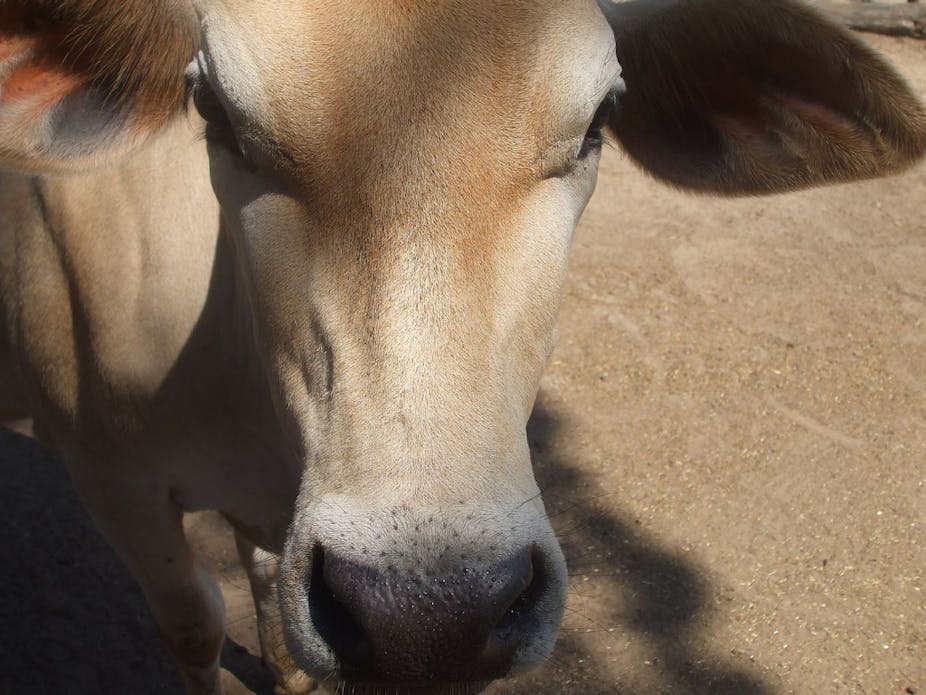
Australians have started worrying about how happy their meat cows are – but are they worrying enough to stop eating them? Jon Bragg

I sponsor two pigs. Emma and Eliza were runaway pigs. They escaped from a farm in Tasmania and live now happily in a farm sanctuary north of Melbourne. Needless to say that I don’t eat pigs, or any other animals. But am I part of a trend? Are people turning away from meat? There are certainly good reasons: the current level of production and consumption of meat is harmful to the environment and human health, and creates much suffering for the animals that end up on our dinner plates.

Over the last 12 months, meat has had bad publicity: cruelty to animals, health and safety issues at factory farms and research highlighting the health problems associated with eating meat. Add to that the impact of producing meat on climate change and environmental degradation.

The environment

The Food and Agriculture Organization (FAO) of the United Nations highlighted in 2006 the many harmful contributions of the livestock sector. Apart from greenhouse gas emissions (reported to be 18% of all emissions), the livestock industry is also a major source of land and water degradation, contributor to acid rain and the degeneration of coral reefs, and a driver of deforestation. For instance, in Latin America some 70% of former forests in the Amazon have been turned over to grazing. The 18% figure has since been revised by two World Bank scientists and estimated to be a minimum of 51%.

The contribution of livestock farming, in particular factory farming, to greenhouse gas emissions is massive. The FAO warned that the environmental costs per unit of livestock production must be cut by one half, just to avoid the level of damage worsening. This has not occurred and globally the demand for meat is growing.

Human health

Links between ill health and meat consumption have been reported for some time. Recent research has added to the increasing evidence. Factory farmed chicken meat can be a source of urinary tract infections. Red meat consumption is associated with an increased risk of diabetes and death from cancer and cardiovascular disease, while a vegetarian diet is associated with a lower risk of metabolic syndrome. A vegetarian diet has even been found to improve mood and attractiveness.

The Amazon forest is being cut down to make way for grazing meat animals. Leonardo F. Freitas

Dr Dean Ornish from the Preventive Medicine Research Institute and Department of Medicine, University of California, San Francisco summarised the emerging consensus among most nutrition experts with these words: “What is personally sustainable is globally sustainable. What is good for you is good for our planet”. He referred to a healthy way of eating that includes no meat or very little red meat, a diet high in “good carbs” (vegetables, fruits, whole grains, legumes, and soy products in their natural forms), low in “bad carbs” (simple and refined carbohydrates, such as sugar, high-fructose corn syrup, and white flour), high in “good fats” (Omega-3 fatty acids found in fish oil, flax oil, and plankton-based oils), low in “bad fats” (trans-fats, saturated fats, and hydrogenated fats), as well as food of better quality and less quantity.

The recently revised Australian Guide to Healthy Eating encourages people to eat a wide variety of foods, including meat. One serving daily of lean meat, fish, poultry, nut or legumes is recommended. More for pregnant and breastfeeding women, less for children up to the age of seven. But is meat a necessary part of a healthy diet?

The Nutrition Guide for Physicians advises that vegetarian diets are all different, which makes it hard to provide dietary recommendations. While vegetarians overall have health benefits such as reduced risk of coronary heart disease and obesity, very restrictive or unbalanced vegetarian diets can result in nutrient deficiencies, particularly iron, calcium, zinc, and vitamins B12 and D. The authors conclude that carefully planned vegetarian and vegan diets can provide adequate nutrition for all stages of life.

Likewise, the Medical Journal of Australia has just published a series of eight articles exploring different aspects of vegetarian diets. The overall message is that a balanced plant-based diet confers health benefits and is good for the planet.

Animal welfare

After the cruel treatment of Australian cattle in Indonesian slaughterhouses aired on Four Corners, the Commonwealth Department of Agriculture, Fisheries and Forestry received hundreds of thousands of emails in one week. One organic meat shop in the Brisbane region recorded a 10% rise in sales. Other butchers have been questioned about the source of their meat and how the cattle were treated before slaughter. While retail sales of organic food overall have reportedly grown 50% in two years, it is not clear whether this figure also applies to organic meat.

Not only overseas, mistreatment of animals came to light in Australia, too. Belting of live pigs over the head with a metal bar and skinning of sheep apparently still alive were reported in an abattoir near Sydney.

‘Humane’ meat

Many people are concerned about the welfare of the animals they eat, but find it difficult to stop eating meat or they believe that animal protein is required for humans to thrive. An acceptable alternative for some people is “humane” meat from animals that have access to outdoor areas and can move around freely. Organically grown meat is also considered to be humane meat. So far, humane meat is more expensive than conventional meat and thus only available to those who can afford it.

Australian meat consumption is up, but figures aren’t in yet for the last year. ulteriorepicure/Flickr

Doug Gurian-Sherman, a member of the Union of Concerned Scientists, argued that moving from large confined animal feeding operations to barn- and pasture-based animal farming is economically viable and healthier for the animals. It is also more sustainable, because associated problems such as water and air pollution from manure are less severe.

Animals that end up as humane meat have a better quality of life for most of their lives. Compared to our pets and animals in the wild, their lives are much shorter and their last days very unpleasant. Being transported to the abattoir is stressful and even in Australia a cow can’t rely on being stunned before she is killed.

Changes in meat consumption

During a year, Australians eat on average 11.2 kg of mutton and lamb per person and 33 kg of beef and veal. Add to this 25.5 kg pig and 41.7 kg poultry meat. This adds up to an average of 111.8 kg of meat eaten per person during a year, or 2.15 kg per week. Between 2000 and 2010, the consumption of beef, veal, lamb and mutton has decreased, while pig and poultry meat has become more popular. Overall, Australians eat more meat now than ten years ago (108.7 kg vs 111.8 kg pa).

By contrast, the average American is expected to eat 12.2% less meat this year compared to five years ago. This reflects concerns about health and cost. The recent public outcry over pink slime and food poisoning rates have not helped the American meat industry. Conversely, here in Australia the industry expects beef production to grow. Part of the anticipated growth relates to exports to developing countries, where a growing middle class is abandoning traditional diets and demanding more meat, dairy products and processed foods.

Has the media exposure of animal cruelty in the farming of animals destined for food made a difference to consumers’ attitudes toward their dinner? There are a few signs that attitudes to meat may be shifting.

Australia’s major supermarket chains are responding to changing customer demand around animal products. For example, Coles has cut the price of free-range eggs and collaborates with the RCPCA on sourcing free-range pork. Acknowledging increasing consumer interest in animal welfare, Woolworths lists on its website changes the company made to satisfy this demand.

We don’t know yet whether the instances of animal mistreatment that came to the attention of the public during the past year have had an impact on meat consumption in Australia. Meat consumption data for the past 12 months are not yet available.

Many Americans have become uncomfortable about the way meat is processed. Beef Products Inc

Changes in consumption from red to white meat over the last decade point to an increased awareness of the effects of eating meat on human health, because diets high in red and processed meats are particularly unhealthy. This change has not been driven by animal welfare concerns. Arguably, cattle and sheep in Australia have much better lives than pigs and chickens who live in cramped, confined and filthy conditions.

Conversely, consumer pressure on supermarket chains to consider animal welfare points to an increasing concern for the animals in factory farms. This is also reflected in the Tasmanian Government’s recent move to ban battery cages for hens and abolish sow stalls for pregnant sows next year.

Where does that leave concern for the environment? How many people do know that the meat industry contributes so much to greenhouse gas emissions?

It appears the indications for changing attitudes to eating meat are mixed. Why are we still eating so much meat? Are detrimental health effects, the destruction of our planet and the misery inflicted on animals worth the fleeting pleasure of eating meat? What will it take for Australians to wake up to reality; dare I say, wake up to our responsibilities as global citizens, and change our eating habits?

I hope it will not have to take food poisoning disasters like those occurring in the US on a regular basis. Rather, I hope the outspoken neurosurgeon Charlie Teo is right. Recently, he commented on the blog of a medical journal: “More Australians than ever before are considering where their food comes from and the truth is compelling them to make ethical choices in the supermarket. Food producers are responding to this consumer demand with more humane practices and animals do have hope for a better life.”

Emma and Eliza are lucky pigs. They have found a home in a farm sanctuary where they will live out their lives in peace. The more than five million pigs kept in Australia’s intensive pig farms are still waiting for a better life.

Join the conversation

95 Comments sorted by

  1. Seamus Gardiner

    Citizen

    Thank you for an interesting article Monika. After digesting your article my first conclusion is that kangaroo meat ticks most of the boxes for an ideal source of animal protein (from both an ethical and nutritional perspective). It is free range, killed quickly and humanely and is a lean and delicious meat.

    report
    1. Geoff Russell

      Computer Programmer, Author

      In reply to Seamus Gardiner

      It's a little depressing that a "Nurse Educator" seems to think there is a need for animal protein. There isn't. Not even a little. None. Zip. Zero.

      About the only thing Monika didn't deal with in here wonderfully welcome article is bowel cancer. Kangaroo meat is high in heme iron so will probably be an even more potent cause of bowel cancer than normal red and processed meat. Nor does it scale. I suggest you think about the number of kangaroos required to replace even half Australia's beef production ... at an average of about 10 kg of meat (and only about 1-2 kg of that is "prime" quality) per animal, do the maths.

      report
    2. Peter Ormonde

      Peter Ormonde is a Friend of The Conversation.

      Farmer

      In reply to Seamus Gardiner

      True Sean but the embryonic roo meat industry did itself a major mischief a few months back when the Russians stopped all imports after a series of ecoli contaminations. The industry was exporting 70% of its production to the Russians and this killed the whole show dead in its tracks.

      Now if Meat & Livestock Australia were actually doing their job they would have been investing in research to design low cost efficient refrigeration on 4WDs and getting the processing side down pat. But roos are not cows and they didn't.

      This is a particularly sensible industry - producing both an excellent product and having a negligible ecological footprint on the country - even benefits actually - but it needs a serious investment in R&D and the development of high quality processing technology that is suited to wild harvesting methods.

      A real pity.

      report
    3. Geoff Russell

      Computer Programmer, Author

      In reply to Peter Ormonde

      "Embryonic"? Its been stuck in this form for decades with good reason. The only reason kangaroo meat is "sustainable" is because hardly anybody likes it. The pitifully tiny amount we produce can't even find a local market but relies on novelty value and constant new markets of new suckers who will try anything once. If there was even the smallest of repeat business, why would we need to export such a tiny amount of meat to so many markets ... at least it spreads the cancer load around. Kangaroo meat, like all red meat, causes bowel cancer and if produced in any reasonable quantities would cause considerable ecological damage.

      report
    4. Seamus Gardiner

      Citizen

      In reply to Geoff Russell

      Geoff,
      I never stated in my comment that I thought there was a need for animal protein. That notwithstanding, I still don't see any negatives to the consumption of animal protein from an ethical or health standpoint per se.

      In saying that there are clearly negatives to the manner in which our society grows and kills its animals and the amount of animal protein that is consumed, I didn't think it necessary to restate this as it is more than adequately asserted in Monika's article.

      I see it as a matter of degree. Small portions of animal protein are not harmful, in fact we have evolved to consume an omnivorous diet. Large portions of animal protein are harmful because of the associated saturated fat, complicated with a sedentary lifestyle. It is not the meat that is to blame.

      report
    5. Peter Ormonde

      Peter Ormonde is a Friend of The Conversation.

      Farmer

      In reply to Geoff Russell

      Ah Geoff you've gotta learn how to cook it properly - otherwise it turns into boot leather if you treat it like beef . Cook it like fish - fast and hot - sear it rather than stew the living daylights out of it.

      There are actually a few reasons why kangaroo harvesting is sustainable - soft feet - eat what's available - very low impact animal actually. And compatred to other red meats rather good for you - especially the fat content.

      As to your theories about meat and bowel cancer I'll leave that to the archeologists to ponder ... folks have been toasting roo for a very very long time here.

      But the first ingredient required is an open mind Geoff ... otherwise everything tastes shocking and is probably toxic.

      report
    6. André Brett

      PhD candidate, New Zealand history at University of Melbourne

      In reply to Geoff Russell

      What on earth are you on about? Kangaroo meat is delicious, more people are switching to it, and I certainly notice it appearing - and rather decidely staying - on the menus of the restaurants and pubs I frequent. I can think of a good few pubs that often modify their menu; it seems that at the moment, a 'roo burger is (like the essential chicken parma) one of the few things under little threat of being rotated off the menu. It wouldn't stay if your ridiculous notion of it tasting bad and having…

      Read more
    7. Monika Merkes

      Honorary Associate, Australian Institute for Primary Care & Ageing at La Trobe University

      In reply to Seamus Gardiner

      Hi Sean
      I used to share your view - free-range, quickly killed, and the the animals have a good life until slaughter. But then I came across information about the inherent cruelty of kangaroo 'harvesting', for example here: http://www.voiceless.org.au/the-issues/kangaroos and here: http://www.awpc.org.au/awpc.php?australian_wildlife_protection_council=7&crm=1.

      report
    8. Seamus Gardiner

      Citizen

      In reply to Monika Merkes

      Hi Monika,
      I read the websites you cite and I find them emotive and I question the bias inherent on the sites. This notwithstanding, I have hunted roo in my time and I agree that it can be seen as a cruel and barbaric activity. My perception is that it is a quick business and when conducted properly is as humane as it gets.
      I have also been to an abbatoir. I refuse to concede that shooting kangaroo entails greater suffering than the slaughterhouse or even farming an animal in sometimes squalid…

      Read more
    9. Geoff Russell

      Computer Programmer, Author

      In reply to André Brett

      Sorry Andre, but I prefer evidence to anecdote. Here's the Kangaroo industry
      5 year plan ... 2005/10 (http://rirdc.infoservices.com.au/downloads/05-108.pdf), you can see that prime cuts are considered to be just 1.5 kg per animal (p.25) from 3 million animals per year. It's been around 3 million per year for at least 20 years drifting up or down as markets come and go.

      And the link between red meat and bowel cancer is rock solid and causal as is the link between shooting kangaroos and starving joeys. If the joey is "at foot" they tend to panic and bolt, making shooting very difficult. Then they can starve if they don't die of sheer stress.

      report
    10. Monika Merkes

      Honorary Associate, Australian Institute for Primary Care & Ageing at La Trobe University

      In reply to Seamus Gardiner

      Hi Sean
      If you want to eat meat, I agree that hunting and shooting with skill is one of the better options in regard to the environment and humane treatment of animals. Few people have that option though, or could stomach it.
      I can see your point about the websites on roo slaughter. I've seen footage of roo slaughter that was awful, but how would I know how common this is? I think the industry is pretty unregulated and there is nobody out there to watch, so it's easy to cut corners in the interest of financial gain and to the detriment of animal welfare.

      report
    11. Seamus Gardiner

      Citizen

      In reply to Monika Merkes

      Monika,
      You raise a good point. Not all professional hunters are well regulated or policed, in the same way that not all abbatoirs or farmers adhere to ethical treatment of animals. i am totally sure that neglect of good practice goes on that results in suffering to animals.
      My belief (unstubstantiated by any evidence) is that most professional hunters would have a tendency to adhere to good practice, some would be cowboys with minimal adherence without strong policing and a very few would be…

      Read more
    12. Seamus Gardiner

      Citizen

      In reply to Geoff Russell

      Geoff,
      Red meat consumption causes bowel cancer is not a correct statement. An individual may raise their risk of bowel cancer by consuming red meat is a true statement. The two are different. There are many ways of increasing bowel cancer risk including other dietary factors and lifestyle factors. Quantity of red meat consumed, type of preparation, cofactors such as amount of exercise and other dietary/lifestyle factors may confound the data.
      So eating red meat is not a guarantee of bowel cancer in the same way that driving is not a guarantee of death by car accident.

      report
    13. Geoff Russell

      Computer Programmer, Author

      In reply to Seamus Gardiner

      I never said red and processed meat is the only cause. Just a cause. Epidemiologists go to great efforts to deal with confounding factors and the link appears in study after study after study. The causal mechanisms are now quite well understood. Cancer Council Australia (Prof. Graham Giles) has calculated that about 50% of bowel cancer in Australia is attributable in Australia to more than one red meat meal per week. There are significant biases in most epidemiology which may make that figure a…

      Read more
    14. Seamus Gardiner

      Citizen

      In reply to Geoff Russell

      Nice misuse of stats and logic... Here's another example to ilustrate your point: Close to 100percent of deaths in cars results from driving, I take it we should refrain from driving as well? Or, oxygen intake results in free radicals that cause cancer and is a contributing factor in aging. Therefore we should reduce oxygen consumption by limiting our breaths to 12 a minute and refrain from all exercise. Here's another, excessive concern over what other people eat has been known to cause hysterical misuse of stats and wild analogies.

      If your problem is that you think killing animals in order to eat them is wrong just admit it and stop trying to make it that it's the only factor in a disease with a complex etiology.

      report
    15. Shirley Birney

      retiree

      In reply to Geoff Russell

      Well zoonoses may strike them down before a cancer emerges. Already some 75% of pathogens affecting humans are of animal origin and some 5 million Australians now suffer food poisoning every year.

      Since only 1.5kg of a kangaroo carcass is prime cut, I suggest one bashes the cheap cuts with a meat mallet or throws a grenade at it though there’s a good chance producers have enhanced the meat with a solution of water and other ingredients that may include salt, phosphates, antioxidants, and flavourings…

      Read more
  2. Annarosa Berman

    logged in via Facebook

    Australians are the world's third highest per capita consumers of meat, after Luxembourgers and Americans. American meat consumption has been decreasing in the past few years though, so we may find ourselves consuming more meat than they do in future. Perhaps we need a psychological study on where our apparently blind obsession with meat comes from, and what it is that sustains it.

    report
  3. Geoff Russell

    Computer Programmer, Author

    Great article Monika. I'm not actually sure that our meat consumption has increased in the past 5 years. I've looked at the raw data and its not trivial working out consumption because we export so much and the data is for bone-less and carcase production. It's tricky to explain, but even small changes in cutting rates can drastically change the apparent per capita consumption. I've been in contact with ABS and there doesn't seem a way around the problem. Some cutting rate assumptions show a decline mirroring the US decline.

    report
    1. Elle Lindsay

      logged in via Facebook

      In reply to Geoff Russell

      The important point here Geoff is in affluent countries food consumption has increased, obesity has increased and still 1 billion people go to be hungry. Lets get real and get over ourselves only the affluent can afford to debate this people are starving lets fix it

      report
  4. Michael Brown

    Professional, academic, company director

    The big public health issue in this is iron deficiency - the MJA link to the article by Saunders et al spells it out - 25% of the world's population suffers from it, including many young girls in developed countries, particularly those following weight loss diets. Following a meat-free diet with adequate iron is pretty difficult in practice, and there is plenty of evidence that many young women are simply not good at it - hence the widespread anaemia. Any recommendation to reduce meat intake needs to be cautious in the extreme, or iron-deficiency anaemia will become even more prevalent.

    report
    1. Geoff Russell

      Computer Programmer, Author

      In reply to Michael Brown

      I suggest you finish reading the Saunders article Michael and not stop when you think you have a useful factoid to hammer your point of view. You might also like to find out a little about the places where iron deficiency is common and the reasons ... which have far more to do with dirty water than insufficient meat. When you look at how some parts of the world eat, the real mystery is why 75% are not iron deficient. Think about it.

      report
    2. Rosemary Stanton

      Nutritionist & Visiting Fellow at University of New South Wales

      In reply to Michael Brown

      Michael

      The MJA paper on iron clearly notes that there is no more iron deficiency among vegetarians than among meat eaters in western countries such as Australia. There is more iron deficiency among poor malnourished people in many countries where the total diet is poor.

      The evidence (also presented in the MJA) doesn't support damning vegetarian diets on the grounds of insufficient iron, zinc or protein. Indeed the only nutrient lacking in a vegan diet is vitamin B12. Those who eat no animal…

      Read more
  5. Troy Barry

    Postgraduate student

    Forgive me if I am missing something, but surely keeping Emma and Eliza alive is doing far more environmental harm than slaughtering them would? You need not eat them if you are concerned about the health impacts, although eating them (or turning them into pet food) would be somewhat more environmentally efficient than burying them.

    report
    1. Seamus Gardiner

      Citizen

      In reply to Troy Barry

      Troy,
      i don't think it's an argument from logic, I think it is an argument from emotion.

      report
    2. Geoff Russell

      Computer Programmer, Author

      In reply to Troy Barry

      Assuming Emma and Eliza eat a vegan diet they will impose a much lower environmental load than any 2 commenters to this post.

      report
    3. Shirley Birney

      retiree

      In reply to Troy Barry

      Replace Emma and Eliza’s proposed slaughter and replace with ethics-free livestock industry and apply same rule. Very logical. Very good for environment. Fewer humans getting poisoned by industry’s diseased, chemically induced and deceased product.

      Auction corporate swine responsible for abuse of livestock in “first world” nation. Heaps of tucker in feedlots.

      35 dollar for Sultan of Brunei and his four cattle stations, equity in two abattoirs and controlling interest in cattle exporting company. Big polluter down under:

      http://blogs.crikey.com.au/northern/2011/06/22/live-cattle-ban-the-beginning-of-the-end-of-pastoralism-in-the-northern-territory/

      How much for sycophants Gillard and Abbott? Is credit card ok? Seriously how much? 20 dollar, 30?

      10 dollar job lot - MLA, Ludwig, cruel and complicit farmers.

      Last offer, 60 dollar all up. Very good price for quality of merchandise.

      report
    4. Seamus Gardiner

      Citizen

      In reply to Shirley Birney

      Well, to be fair Shirley you can't handwring endlessly about the damage stock does to the planet and then have two pigs unnecessarily hanging around creating methane. It isn't logical, it's emotive and hypocritical.

      report
    5. Monika Merkes

      Honorary Associate, Australian Institute for Primary Care & Ageing at La Trobe University

      In reply to Seamus Gardiner

      I do believe that animals have intrinsic value and their existence does not need to be justified in terms of their usefulness to humans. For those who don't share this view, I have this to say in defense of Emma and Eliza's continued existence: Edgar's Mission, the farm animal sanctuary where the two pigs live, does a lot of educational work with schools and communities. For many city kids, it might be their only opportunity to see and touch a live pig. Thus, the animals at Edgar's Mission are useful to humans. Like the other animals at Edgar's Mission, Emma and Eliza have been sterilised and won't produce more pigs.

      report
    6. Shirley Birney

      retiree

      In reply to Seamus Gardiner

      It is not I but you who is "emotive and hypocritical" when you duckshove man's responsibilities for trashing the planet, onto food animals.

      Pigs are not native to Australia and Emma and Eliza were bred by man to appease man's appetite. Therefore the methane emissions are anthropogenic but you say slaughter the victims and let the ecocidal culprits go free eh?

      It would be entirely illogical to attribute the following diabolical mess to pigs:

      http://grist.org/factory-farms/sht-happens-mysterious

      Read more
    7. Seamus Gardiner

      Citizen

      In reply to Monika Merkes

      So, Emma and Eliza are now living in porcine servitude as fat sterile zoo exhibits to be gawped at and fondled by bored city kids....

      Did you consider that their previous existence as escaped farm pigs may have been closer to their intrinsic nature? That to snuffle and root in the wild suffering the vicissitudes of their natural existence may have maximized their self actualisation as pigs?

      Indulging savior fantasies may bring one closer to the vegan flock but it does not in any way advance the cogent arguments in the article. In fact it hinders them. A pity, the article was thought provoking and a salient piece.

      Monika, If you wish to argue about meat consumption in Australia you've done a very good job, if you wish to argue about animal rights best dust off the Peter Singer texts and leave Eliza and Emma out of it.

      report
    8. Monika Merkes

      Honorary Associate, Australian Institute for Primary Care & Ageing at La Trobe University

      In reply to Seamus Gardiner

      Sean, it's hard to say what the intrinsic nature of these pigs is. They have been bred to be food animals, that's why they are so heavy. I don't know what their chances of survival would be in the wild.
      As you say, I wrote about meat consumption in Australia. I've tried to keep the article based on fact, but from the disclosure statement you can gather what my values are. I do respect people with views and values different to mine; most of my friends eat meat.

      report
    9. Peter Ormonde

      Peter Ormonde is a Friend of The Conversation.

      Farmer

      In reply to Monika Merkes

      Miss Monika! Don't you even think about putting those pigs anywhere near "the wild"... wrong place, wrong time, wrong pigs.

      Up here we've just decided (well, the elected government anyway) to turn some 80 of our National Parks over to recreational hunters - in part on the pretext of feral animal control - one feral to control another perhaps. But you can bank on it that they won't be mounting stuffed cats on their walls. Pigs to that!

      So no - you've adopted some pigs for keeps Monika and you'll be looking after them and keeping them happy for a long while to come hopefully - whatever their intrinsic nature is... put it down to practical primary care and ageing experience - might even be tax deductible.

      report
    10. Monika Merkes

      Honorary Associate, Australian Institute for Primary Care & Ageing at La Trobe University

      In reply to Peter Ormonde

      Hi Peter
      Indeed, Edgar's Mission is a registered charity and donations of more than $2 are tax deductible :-)

      report
  6. Tim Scanlon

    Author and Scientist

    I'm a big fan of people paying more for food.

    My reasoning is that people's concerns about food production, whether that be animals or plants, all comes back to the cost price squeeze placed upon agricultural production. If we lessen the squeeze, then agriculture has a larger margin and can move away from the need to intensify production.

    I'm also a fan of the omnivorous diet. Tried, trusted, what our bodies are designed for, in short, it works without resorting to juggling amino intakes/sources…

    Read more
    1. Rosemary Stanton

      Nutritionist & Visiting Fellow at University of New South Wales

      In reply to Tim Scanlon

      Tim

      I'm not disagreeing with your basic premise, but the old idea that vegetarians need to 'juggle' their amino acids is not valid (see MJA article for a good summary). We used to think various combinations of plant proteins were required at each meal. Indeed I spent hours checking amino acid tables in the 1970s to come up with extensive lists of combinations to use in the textbooks I wrote then and into then 1980s.

      More recent evidence shows that the body is infinitely more adaptable and can…

      Read more
    2. Tim Scanlon

      Author and Scientist

      In reply to Rosemary Stanton

      I take your point. Aminos don't need to watched as carefully with a varied diet. Vegetarians have been shown to manage successfully on the main. There is, however, concern over vegan diets for amino balances and even the best vegan diets tend to be marginal for some of the essential aminos, requiring tissue breakdown and recycling.

      The problem arises more with narrow diets, especially were staples predominate and are unvaried. Corn is especially problematic.

      On the gluten thing, the studies I was reading on that were related to gluten sensitivity, essentially the difference between an allergy and a build up of intolerance. It isn't a problem until you start consuming a lot of gluten heavy products without (something, can't remember what) which alleviates the issue. I've heard sensitivities to many foods are common on plain unvaried diets.

      report
    3. Geoff Russell

      Computer Programmer, Author

      In reply to Tim Scanlon

      Tim, have I asked you before? Probably. Find me a single Australian vegan anywhere with a diagnosed "amino imbalance". I've tried to find such people in searches of the AIHW databases ... without success. My guess in the absence of evidence is that you are simply making such things up. Show me the evidence ... a single case study with a name. Not "this may happen", but something which has actually happened.

      report
    4. Rosemary Stanton

      Nutritionist & Visiting Fellow at University of New South Wales

      In reply to Tim Scanlon

      Tim, there are differences between people who choose to eat a vegan diet in a country with a wide selection of foods available and those who live in areas of food scarcity due to poverty, drought and food shortages.

      Older studies where people had particular amino acid deficiencies because they ate little other than a single food are not applicable to vegans in countries like Australia. However, it is important to stress that people need a variety of foods, although that applies whether they choose a plant-based diet or one with meat.

      Problems with gluten are an all or nothing thing, although some websites and popular magazines make different (and unsubstantiated) claims. Some people may have an intolerance to wheat but without the damage to the lining of the small intestine that occurs from even a minute amount of gluten in those with coeliac disease (which is an auto immune disease). Most food intolerances are related to quantity consumed. Gluten is different.

      report
    5. Tim Scanlon

      Author and Scientist

      In reply to Geoff Russell

      Geoff I have provided it. You ignored it. There are both infant and teenager studies that show growth inhibition and hormonal problems (from memory).

      This isn't particularly complicated, essential aminos are essential.

      report
    6. Tim Scanlon

      Author and Scientist

      In reply to Rosemary Stanton

      I was under the impression that there was a marked difference between celiac disease and gluten sensitivity. Sensitivity being the disorder that is physiologically different and is brought on from growing an intolerance.
      http://online.wsj.com/article/SB10001424052748704893604576200393522456636.html

      On the aminos: what about the studies on children, toddlers and those raised vegan? I was pretty sure they indicated issues with the vegan diet and development due to aminos, B12, calcium, Vit D and (zinc?). I'll admit that I don't believe aminos to be the sole issue, it is a larger issue. The studies on older vegans and the increased osteoporosis risk, the implications to growing body development, the need to supplement: not exactly healthy when there is nothing wrong with lacto-ovo or omnivoruous.
      tier-im-fokus.ch/wp-content/uploads/2009/10/smith06.pdf
      http://www.ajcn.org/content/89/5/1627S.short
      http://www.uri.edu/artsci/ecn/starkey/201-590_bulletinboard/vegan_dangers.pdf

      report
    7. Geoff Russell

      Computer Programmer, Author

      In reply to Tim Scanlon

      Tim. Saying you provided it isn't the same as actually providing it. Especially when you didn't. I note in your other reply you provide a 5 year old example of vegan idiots. I never said a vegan diet prevented stupidity. I could go to any hospital in Australia which does lap-band surgery and find sick omnivores. Going through any doctors prescription pad would provide a list of statin takers made sick by their bad omnivorous diet. I could infer that an omnivorous diet is dangerous and far, far more dangerous than a vegan diet.
      Meat eaters just can't seem to get it right, over and over again. If their diet is so intrinsically evolutionarily sound, why do the majority of people get it wrong and end up with diet related diseases? I provided a Japanese study showing tens of thousands of extra bowel cancer cases annually when they added red meat to their diet. Here it is again:

      http://www.ncbi.nlm.nih.gov/pubmed/17059355

      report
    8. Rosemary Stanton

      Nutritionist & Visiting Fellow at University of New South Wales

      In reply to Tim Scanlon

      Tim,
      The Wall Street Journal is probably not the best reference here (no peer review process), especially for a topic that is engaging many researchers. A good reference on definitions for different reactions to gluten is at http://www.ncbi.nlm.nih.gov/pmc/articles/PMC3292448/?tool=pubmed (full text available free). This article distinguishes between wheat allergy, coeliac disease and the vague gluten sensitivity. The first two can be confirmed by laboratory tests but there is no test for gluten…

      Read more
    9. Annarosa Berman

      logged in via Facebook

      In reply to Rosemary Stanton

      Rosemary, excuse my ignorance, but what are the MJA papers to which you refer and where can I access them?

      Thank you for your comments, I find them most helpful.

      report
    10. Seamus Gardiner

      Citizen

      In reply to Geoff Russell

      Geoff,
      An omnivorous diet is not dangerous. Our gut and physiology have evolved around this diet. Yes, red meat in an undefined quantity raises the risk of bowel cancer but this is not the same as saying 'omnivority is dangerous'.
      The studies of japanese populations that you cite regard the change in diet from an omnivorous diet involving white meats such as fish to an omnivorous diet containing a greater percentage of red meat.
      A more correct way of stating your position would be: an omnivorous…

      Read more
    11. Rosemary Stanton

      Nutritionist & Visiting Fellow at University of New South Wales

      In reply to Seamus Gardiner

      Sean

      I agree that a well chosen omnivorous diet is not dangerous, but whereas people seem happy to find odd case studies of ill effects of a poorly chosen vegan diet, they find it difficult to admit that the typical diet chosen by Australian men is a poorly chosen omnivorous diet with too much red meat and too little plant foods.

      The World Cancer Research Fund rates a high intake of red meat as a 'convincing' risk for colorectal cancer. ('Convincing' is their highest risk category). That can…

      Read more
    12. Tim Scanlon

      Author and Scientist

      In reply to Geoff Russell

      Geoff, I have little time for discussing things with you as in the past you have resorted to logical fallacies and ad hominems, like when I disproved your figures for broccoli, and cropping acreage, and proportion of carcass weight and.....

      I see that even though you have glanced at the links I put into my post to Rosemary, where I was asking for her input on the issue, you haven't actually addressed the concerns for development that are present in the vegan diet. Instead you attack meat eaters again. This is why I have little interest in furthering this conversation. Suffice to say you should read up on RR values and understand that the "increased rates" of cancer you talk about are not something that is of concern because the RR values fall well below 2.

      report
    13. Seamus Gardiner

      Citizen

      In reply to Rosemary Stanton

      Rosemary,
      Thanks for your comment. I don't disagree. My position is that old dictum about moderation in all things.
      I don't think that a vegan diet is necessary but nor do I have a position that it is dangerous. By the same token I think that omnivority is not inherently dangerous but clearly how it is practiced in the western diet is.
      My main argument, I think, is that somehow dietary evidence is being conflated with an ethical position. I have no issues with anyone choosing their diet based upon an ethical position or religious adherence but i to take issue with some authors taking a 'meatist' stance and emphasising evidence to justify it.

      report
    14. Geoff Russell

      Computer Programmer, Author

      In reply to Rosemary Stanton

      I don't generally argue ethics with meat eaters. Most people are happy to justify doing all kinds of harm if it can be balanced against a substantial good. If I had to kill to survive, I would. But its abundantly clear that nobody needs to kill animals to eat a healthy diet. Which makes the only ethical argument left for meat eaters being that they think their pleasure at eating meat outweighs the animal's loss, not only at being killed but at all manner of normal ill-treatment. Being backed into an ethical corner, they can opt for the honest approach ("I don't actually give a damn") or all manner of pretence about some need for meat or some evolutionary "natural=good" argument. That whole mess is simply irrelevant because we all have a desperate need to roll back about 200 years of deforestation which we cannot do without large reductions in meat production. That need is desperate and trumps everything else.

      report
    15. Seamus Gardiner

      Citizen

      In reply to Geoff Russell

      Why not argue ethics with someone holding a contrary position... who knows you may get an AM like Peter Singer. Or you may be forced to defend your position, or you may get to see that those who have different ethical positions than you may be just as humane, or human.

      report
    16. Tim Scanlon

      Author and Scientist

      In reply to Rosemary Stanton

      Thanks Rosemary.

      I know the WSJ is a rubbish source, I just didn't have the link to the original research paper it was referencing (and newspapers are easier to find but harder to get actual science references from).

      I guess we'll have to see were the research into gluten sensitivity leads, clearly there is a lot more to understand, I'm probably extrapolating rather than weighing current knowledge.

      I should also point out my bias as a weightlifter. The demands I'm citing on the body are different and is were most of my reading on nutrition has focused. I'll have a look at the MJA papers, although I still hold concerns on vegan diets for growing bodies.

      report
    17. Geoff Russell

      Computer Programmer, Author

      In reply to Seamus Gardiner

      I don't have to defend my position, I'm not the one doing the killing. There are no bobby calves on my account, no crippled chickens, no 11m hectares deforested in Qld, no live exports, no factory farm piggeries, no bulls being hooked up to car batteries to collect semen, no Belgium Blues who can't even give birth without a cesarian, no fishery crashes, no fish crushed as they are hauled up from ocean depths, no long lines, no bycatch, no dehorning, no 20% lambing mortality ... life's way to short to finish the list. Based on arguments you made above, you think whatever we have done for a long time is right. This means that rape, infanticide and murder must be fine. They aren't. Happily, the common inter-personal violence of our evolutionary past is in decline. Most people have worked out that its high frequency in the past is no indication that its good. There is still plenty to do. Some people(s) still think that beating women and children is fine, because of its long history.

      report
    18. Seamus Gardiner

      Citizen

      In reply to Geoff Russell

      (laughs) I never suggested turning an 'is' into an 'ought'...

      You do have to defend your position if you want to change people's minds. Otherwise it's just more cant.

      report
    19. Geoff Russell

      Computer Programmer, Author

      In reply to Seamus Gardiner

      Then why else did you write: "don't wave away the massive anthropological and biological evidence that we are designed to hunt animals in bands, kill them, celebrate the act and eat them."

      P.S. We are not designed, we evolved and we are amazingly adaptable. We don't have to be barbarous thugs, despite this behaviour being common.

      report
    20. Seamus Gardiner

      Citizen

      In reply to Geoff Russell

      yes: design was a poor choice of words... I meant to infer evolve not the act of a conscious designer.

      I find it interesting that you could deny the anthropological , psychosocial and anatomical data that defines humans as omnivores. Like I said, it doeasn't turn an is into an ought. We are still free to choose a different path and perhaps what we ought to do is not what we do now or have done for 99.9% of our history. nevertheless, it is naive to say that as a culture or as a physical entity we are 'tabula rasa' and are not prewired for certain behaviours and appetites, as distasteful as they may appear to you.

      report
    21. Geoff Russell

      Computer Programmer, Author

      In reply to Seamus Gardiner

      I don't deny that we are omnivores at all. All I maintain is that you don't understand what the word means ... see my earlier little post. If we are prewired to kill, then why to most people find it distasteful? The distaste for killing looks to be new and comes with knowledge about suffering of others. It is a consequence of empathy. You can see empathy on an MRI and some people definitely have more than others.

      http://www.plosone.org/article/info%3Adoi%2F10.1371%2Fjournal.pone.0010847

      Understanding how others think and feel is a fundamental human trait. In recent times perhaps our skills have improved.

      report
    22. Seamus Gardiner

      Citizen

      In reply to Geoff Russell

      Most people do not find killing distasteful. maybe most westerners in 2012 find it distasteful... that's not most people.

      maybe you misinterpret your fellow man, it is possible to feel empathy and to kill. Maybe it isn't as black and white as you think.

      report
    23. Annarosa Berman

      logged in via Facebook

      In reply to Seamus Gardiner

      Sean, the study that Geoff quotes shows that vegetarians and vegans register more empathy for animal suffering than onmivores. The level of empathy that they feel has led them to give up having someone kill animals so that they can eat them. By contrast, the level of empathy you feel for something that you nevertheless kill, even when research has clearly shown that omnivores do not need meat to survive, must be low indeed.

      Also: if most people do not find killing distasteful, why are abattoirs not open for anyone to visit, and why do people not visit them to see where their meat comes from?

      report
    24. Seamus Gardiner

      Citizen

      In reply to Annarosa Berman

      Yes I do not dispute that at all. I eat meat, I have killed animals for meat in the past and I have empathy towards animals and humans. I dare say the level of empathy I have for a beast is is less than yours (I'm making the bold assumption that you're a veggo here). It says nothing about my empathy towards humans and it says nothing about my propensity for cruelty.
      So what is the issue?
      I have sufficient empathy towards humans, often demonstrated in my professional role as a nurse. I am not a cruel person, when I kill an animal I do it with economy and with due regard to its suffering. I see many people

      report
    25. Annarosa Berman

      logged in via Facebook

      In reply to Seamus Gardiner

      I have no way of telling what your empathy levels towards humans are; that is not under discussion here. If you say that you are empathetic towards humans, I have no reason not to believe you.

      However, people who say that they have empathy with an animal, yet see nothing wrong with killing that animal for what amounts to a frivolous reason - ie it tastes good - are bluffing themselves. Saying that it is possible to kill an animal "with due regard to its suffering", is cognitive dissonance. If you truely had regard for its suffering, you would not kill it. That is the issue.

      report
    26. Seamus Gardiner

      Citizen

      In reply to Annarosa Berman

      There is no dissonance in the act of killing an animal and the wish to spare it unnecessary pain. It is a great mistake to think that killing animals equates to cruelty. There are many ways to create suffering and to enact cruelty, trust me, a headshot is not one of them.

      report
  7. Geoff Russell

    Computer Programmer, Author

    Some of the comments show a little confusion over the meaning of the
    word omnivore. It's core meaning is "unspecialised eater". It's because we
    are omnivores that we can choose to be vegan. A carnivore has no such choice, just as a herbivore can't choose to be a carnivore.

    Every animal on the planet needs B12, but the vast majority don't get it by killing and eating other animals. We are unique in having a more readily absorbed and far more environmentally benign source of B12 at our disposal than killing and eating animals.

    Lastly, there is good evidence that the match between optimal B12 and meat intake isn't perfect anyway. Evolution doesn't guarantee perfect solutions and frequently comes up with some absolute howlers of poor "design". It also looks like we can benefit from consuming rather more B12 than we could readily get from meat:

    http://www.ncbi.nlm.nih.gov/pubmed?term=20071646

    report
    1. Seamus Gardiner

      Citizen

      In reply to Geoff Russell

      geoff,
      I see you with canine teeth and raise you with: name one pre-industrial society or hunter gatherer tribe that was willingly vegetarian?

      I think you are confusing biology, anthropology and ethics. By all means take an ethical position about killing animals, I have no argument against this stance, but don't wave away the massive anthropological and biological evidence that we are designed to hunt animals in bands, kill them, celebrate the act and eat them.

      report
    2. Peter Ormonde

      Peter Ormonde is a Friend of The Conversation.

      Farmer

      In reply to Seamus Gardiner

      Actually I'm a bit agnostic on the diet question at least on a personal level... find the whole thing a bit narcissistic actually... but I'm interested in the ethical clash that can can occur when one is too precariously perched on the high moral ground.

      I had a couple of vegan neighbours - nice young folks, with a lovely labradoodle pup who befriended my craggy old cattle-dog and became a regular visitor being a highly skilled escape artiste. First chance she got she would raid my dog's boneyard…

      Read more
    3. Annarosa Berman

      logged in via Facebook

      In reply to Peter Ormonde

      Hi Peter

      I've long been under the impression that dogs are obligate carnivores, ie that they have to have meat to survive. Lately I've read several arguments to the contrary though, so will refrain from taking a stance on that one :) But your point about the dog biscuits' possible carbon footprint is valid.

      Personally, and not being agnostic on dietary choices and how they impact on animals, I find it interesting, and frustrating, that so many meat eaters resort to the "attack is the best…

      Read more
    4. Seamus Gardiner

      Citizen

      In reply to Peter Ormonde

      Mmm... I have friends who are vegans and none convey the piety, smugness and self-righteousness of some of the correspondents here.
      I find it incredulous that one can espouse the intrinsic self-worth of animals and accord them value coeval with humans and yet deny them their very nature. I find it perverse to expect a dog to be a vegan. Do we deny the lion the antelope? The lion will take what it will regardless of the sensitivities of humans.
      Either way the animals they espouse as self-agents are held obesiant to their whims and dietary cruelties...similar to how a farmer views their stock. Is it time for the h word?

      report
    5. Geoff Russell

      Computer Programmer, Author

      In reply to Peter Ormonde

      Peter, have you ever worked out the carbon footprint of meat Vs transport?

      Very quickly ... producing beef generates 30-50 kg of CO2 eq per kilo of carcase and plenty of the carcase isn't eaten. You will see lower figures in some countries but Australia's is high because of our high deforestation rates

      http://www.control.com.au/bi2007/2810Brook.pdf

      But lets use a nice low figure of about 20 kg CO2eq per kg to give beef a fighting chance.

      Now consider transport. The emissions for that…

      Read more
    6. Peter Ormonde

      Peter Ormonde is a Friend of The Conversation.

      Farmer

      In reply to Annarosa Berman

      G'day Annarosa,

      Yep people take this business deeply personally ... bit like it used to be with ex-smokers. I get the feeling that a lot of the anger and intensity could be resolved with a good slab of steak or a chop once every few months ... a therapeautic lapse. Just to remind us we're human.

      That said I reckon there are very solid ecological reasons to do some serious sums about meat - what it costs the planet to produce it and what it costs us to eat too much of it.

      As you know…

      Read more
    7. Annarosa Berman

      logged in via Facebook

      In reply to Peter Ormonde

      Hi again Peter. I guess there are three possible "prisms" through which one could look at the meat issue: human health, the environment and animal welfare. Which one one picks, or gives more weight to, would depend on one's life experiences and resultant world view.

      report
    8. Seamus Gardiner

      Citizen

      In reply to Annarosa Berman

      Hi Annarosa,
      i agree - the first two prisms are evidentiary and the third is ethical. I find that the first two have been soundly asserted in Monika's article (certainly as an argument for less meat anyway). The third is discussed in terms of animal cruelty in the article and is difficult to dispute on an evidentiary basis.
      The ethical position of not eating animals (at all) has not been well established by any author here. I'd prefer to read Peter Singer, who masterfully states the case for animal rights, then some of the cant, subterfuge and emotive appeals plastered here. It's disappointing. I think that this has done 'the cause' a disservice.

      report
    9. Peter Ormonde

      Peter Ormonde is a Friend of The Conversation.

      Farmer

      In reply to Geoff Russell

      Depends a bit about how one calculates deforestation rates - or more precisely from when Geoff. The Brits began their deforestation a couple of millenia ago and did a pretty complete and thorough job actually. The town crest of Madrid is a bear eating an apple from a tree (an intuitive vegan perhaps) but you're hard pressed to find a tree let alone a bear anywhere near Madrid these days.

      Because of where I live and what my neighbours do for a quid I'm quite cautious about numbers and statistics…

      Read more
    10. Geoff Russell

      Computer Programmer, Author

      In reply to Peter Ormonde

      Countries don't have to keep deforestation stats any more ... satellites. Of 100 million hectares cleared in Australia, we live on about 2 (urban areas), and crop about 24. In round figures, about 70 percent of clearing has been for sheep and cattle.

      The fact that some people misuse statistics doesn't invalidate quantification as the only way to make sensible decisions. If they leave the nuclear plants off in Japan and its hot this summer, then the deaths and hospitalisations will dwarf the radiation impacts, but people who don't quantify are busily trying to keep those plants shut because of irrational fears.

      Give me statistics over irrational mumbo jumbo any day.

      report
    11. Peter Ormonde

      Peter Ormonde is a Friend of The Conversation.

      Farmer

      In reply to Geoff Russell

      Makes one wonder how we all survived before air conditioning doesn't it?

      I'm not saying statistics are misused or abused (although I have a sneaking suspicion that you might be re Japan and nukes... depends what you are including in your "radiation impacts" and how you've measured them) but rather than as numbers they often - perhaps invariably contain assumptions, averages, short-cuts and roundings etc that erode their actual value.

      Give me the refs for those numbers on landclearing and…

      Read more
    12. Monika Merkes

      Honorary Associate, Australian Institute for Primary Care & Ageing at La Trobe University

      In reply to Annarosa Berman

      Hi Annarosa
      Like you, it's taken me many years to become a vegan. The suffering of the animals in the food chain is so well hidden that many, probably most people simply don't know what sort of life food animals endure. On the other hand, showing/describing the gory details of, for example, de-beaking, de-horning, castration without pain relief, turns people off. Even if people know, knowledge alone isn't sufficient to change behaviour. It's a complex and emotive issue, as the discussion here shows.

      report
    13. Annarosa Berman

      logged in via Facebook

      In reply to Monika Merkes

      Yes, it's a complex issue. The suffering of animal in the food chain is indeed well hidden - those who benefit from it do not want those who consume it to be confronted by reality too much. And most meat consumers, as you note, do not wish to be confronted by too much reality anyway.

      During last year's live exports debacle, I remember countless people prefacing whatever they were going to say about the subject with, "I didn't watch the footage, I can't bear that sort of thing..." I believe that if you don't want to look, you have no right to accuse those who do look, and form strong opinions as a result of what they've seen, of being holier than thou.

      On a completely different point, I find it time-consuming and a little frustrating to locate comments that appear in my inbox on this page. Am I missing something? Is there some button that takes one straight to particular comment?

      report
    14. Monika Merkes

      Honorary Associate, Australian Institute for Primary Care & Ageing at La Trobe University

      In reply to Annarosa Berman

      Hi Annarosa
      The ABC 4 Corners Indo abattoir footage last year was very difficult to watch. The film 'Meat the truth' uses cartoons to convey the cruelty inherent in factory farming. Much easier to watch. http://www.youtube.com/watch?v=2uTJsZrX2wI

      Locating particular comments can be a bit frustrating when there are many comments. I use the browser's search function.

      report
    15. Sandra Kwa

      Grad Cert Ethics and Legal Studies, CSU

      In reply to Peter Ormonde

      Hello Peter. I've said before that I (like others) enjoy reading your posts (that's my +1 above) and thank you, but don't get big-headed now! We spent this glorious afternoon gazing out over our incredibly beautiful, expansive, pristine Bulga Plateau and Manning Valley at Rowley's Rock lookout and I know I've won the lottery of life living here. Sounds like you wallow in similar surrounds. The majority of course are not so fortunate.
      In between your two "difficult choices" could the answer lie…

      Read more
    16. Peter Ormonde

      Peter Ormonde is a Friend of The Conversation.

      Farmer

      In reply to Sandra Kwa

      Yep still following along - and thanks for the tick.

      I've been a big fan of permaculture for a long time - long enough to notice a few problems - notably around intergenerational change and the challenges of maintaining a fit and enthusiastic workforce. But those things aside a well designed farm with an integrated set of production systems is the way to go.... great productivity from a small area and - once it's actually set up properly a manageable workload. The bloke that inspired a lot of…

      Read more
    17. Sandra Kwa

      Grad Cert Ethics and Legal Studies, CSU

      In reply to Peter Ormonde

      Yes, I had been warned about the naming thing, and as they were born on 25 Dec, I was all set to call all of them Jesus, as a sure way to maintain my distance (oops! did I say that?) but my kids, Ben and Isobel, named them Ben Jnr, Isobel Jnr, Poppet and Fluffy. The last to go was Tim, after Tim Minchin - now THAT was hard! He sings no more and this morning was eerily quiet.
      Off now to google up Keyline - I'm curious.

      report
    18. Peter Ormonde

      Peter Ormonde is a Friend of The Conversation.

      Farmer

      In reply to Sandra Kwa

      Yep Ms S there's your mistake right there - Fluffy! - for goodness sake that's a bird that's guaranteed to die of old age.

      And I couldn't even grill a fish called "Poppet".

      I don't think I'd be allowing any sort of democratic participation by kiddies younger than 12 myself - lest they start naming the broccoli and you all starve to death. Or have to buy nameless stuff in packets and tins.

      If all farmers called their calves Fluffy and Poppet we wouldn't be having this issue at all I suspect.

      report
    19. Sandra Kwa

      Grad Cert Ethics and Legal Studies, CSU

      In reply to Monika Merkes

      Hi Monika, I just clicked and watched the whole 1:12:20 of Meat the Even More Inconvenient Truth - and although die-hard meat lovers would likely see it as hyperbolic propaganda, and I do wish there was more rigour in quoting sources for data, even if the figures were only half true the argument would be compelling: World pop. increased from 2.6 to 6 billion from 1950 to 2000, but annual meat consumption increased from 45 to 233 billion kilos, and is set to be 450 billion kilos by 2050. The av. European…

      Read more
    20. Sharon Hutchings

      logged in via Twitter

      In reply to Peter Ormonde

      Loving this important conversation. My first uncomfortable feelings about eating meat started as a child in rural Australia after witnessing chook beheadings and then the realisation that the Sunday roast was most likely one of my adored pet lambs. Took me a long time to overcome the social conditioning, but I haven't eaten meat for 18 years now, and been vegan for the past 11. The obvious health and environmental benefits are a wonderful bonus.

      Reminds me of a poem I came across a few years ago…

      Read more
  8. Elle Lindsay

    logged in via Facebook

    Hi Monika
    I would like to invite you to show us your perfect world which if I understand correctly is all humans become herbivores. Animals are free to roam wherever they choose, animals and human populations remain unchecked and one assumes herbivorous animals will at times compete with humans for the same plant based food sources. Possibly some of the carnivorous animals will get hungry and decide humans are easy prey. Who knows what will happen when we change the whole dynamic of the animal kingdom? What do you envision the planet looking like in 2050?

    report
    1. Simon Porteous

      Chiropractor

      In reply to Elle Lindsay

      Great article, thanks Monica,

      Elle, humans and herbivores already compete for the same plant based foods. This is one of the reasons the United Nations recommends a plant based diet.

      report
    2. Elle Lindsay

      logged in via Facebook

      In reply to Simon Porteous

      Ahh yes but today less than 5% of the human race is vegetarian What would happen if we were all vegetarian and animals were only eaten by other animals and all domestic cattle et al were free to mate and roam ! I am talking big picture here

      report
    3. Geoff Russell

      Computer Programmer, Author

      In reply to Elle Lindsay

      The big picture is that livestock have almost entirely displaced wildlife on the planet. The result is that we (mainly through them) are consuming about 6 times the biomass of the megafauna during the pleistocene.

      http://iopscience.iop.org/1748-9326/5/4/044001/fulltext/

      1.4 billion cattle outweigh all the humans on the planet, consume more biomass but provide just 1.4 percent of global calories. 70% of formerly forested Amazon is under cattle. Sheep and cattle drove the bulk of Australian deforestation with about 11 million hectares in Qld over the past 20 years.

      If global average meat consumption rises, then so will wildlife habitat loss. Why has Australia got the leading place in the recent mammalian extinction stakes? Because we have the highest ratio of sheep and cattle to people on the planet.

      report
  9. Shirley Birney

    retiree

    Animal abuse has nothing to do with dietary preferences. Gratuitous, sustained, sadistic animal abuse is about an abuser’s sick pathology. The most horrific, sustained expressions of cruelty are perpetrated by members of the livestock industry. The abuse is not based on momentary rage but from a cowardly and calculated pleasure to cause pain to defenceless animals for obscene profits and because they can do it with impunity.

    And one must not reveal the gory details of livestock abuse because…

    Read more
    1. Seamus Gardiner

      Citizen

      In reply to Shirley Birney

      Shirley,
      I'll take your last paragraph as an ad hom (grins). Thank you. Perhaps you should read my post about 'pigs being set free into the wild' in the context it was written. Perhaps you should read all the posts you cite attending to the nuances they may contain. Perhaps you should separate a position from logic from its literal reading. Perhaps you would be taken more seriously if your extended rants led somewhere.

      report
  10. Sandra Kwa

    Grad Cert Ethics and Legal Studies, CSU

    I'm catching up, late as usual! Thank you Monika for your article, and I found Rosemary's comments very helpful, personally, as I have always worried about nutrition since giving up meat 20 years ago, and have had low ferritin levels from time to time, although never actually anaemic. B12 has never been a problem - maybe because I LOVE mushrooms? On the issue of ethics and empathy, I do believe that people get desensitised to killing animals if they do it regularly. So what one person feels is alright and normal will be, for others, a source of horror from which they recoil. Some people would recoil if they saw it, but are content to consume the spoils with their eyes closed. I do that too, on some levels, but have tried to reduce the extent of this common hypocrisy.

    report