
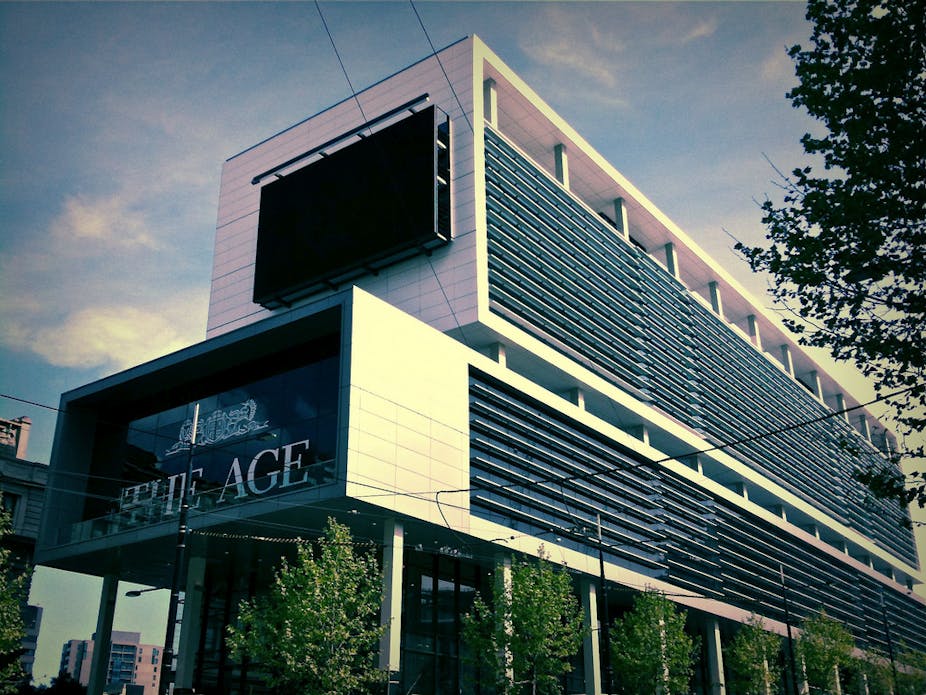
Newspaper revenue is sliding. The economics of supporting large teams of journalists no longer work. The collapse of the print business model will diminish the remaining large private news-gathering organisations in the country. Few websites, radio and television stations, community presses or journalism schools can support the sustained investigative journalism long associated with leading metropolitan newspapers.
Commuters in central Melbourne see the decline every day. Only a few years ago The Age commissioned an impressive new city building, with large glass windows to display the buzz and sophistication of a large newsroom. The windows remain, but many desks are empty. Passers-by gaze into the Mary Celeste, a vision of journalism already in peril as the building opened. The Age city newsroom joins a bespoke printing plant at Tullamarine, architectural monuments to a lost world.
As newspapers diminish so does their role in public debate. The Fairfax media has been much praised for its 1992 charter of editorial independence, a welcome statement that journalism should aspire to standards of fairness and objectivity separate from the commercial aims of the owners.
Yet even if Fairfax editors retain their charter amid a change of ownership, there will be fewer journalists left on the payroll. A depleted newsroom means areas of the Australian polity, once subject to media scrutiny, vanish from public view.
Publicly funded for the public good
What remains is public broadcasting. Only the Australian Broadcasting Corporation (ABC) and the Special Broadcasting Service (SBS) retain the resources and mandate to pursue independent quality journalism on a national scale. It is essential they do so.
In an earlier era, Australian newspaper proprietors lobbied the federal government to prevent the ABC developing an independent news capacity. More recently, in Britain and Australia, the present generation of owners attack public broadcasting. In August 2009, for example, James Murdoch from News Corporation in the United Kingdom criticised a “dominant” BBC as a threat to independent journalism.
As Murdoch told the Edinburgh Television Festival, “the expansion of state-sponsored journalism is a threat to the plurality and independence of news provision.”
Yet the decline of the newspaper business model has proved a more potent threat. Unless new commercial models can sustain large private newsrooms, “state-sponsored journalism” may prove essential to support independent journalism at scale.
This places the ABC, among the largest news gatherers in the nation, and the SBS as a specialised source of international news, in an unprecedented place in Australian political life. Few other media organisations will command similar depth, coverage, or national resources.
Monopolies, criticism and filling the gap
Now centre stage, the ABC and SBS face three new challenges.
First, there is the trial of criticism. As large authoritative sources of news information, public broadcasting faces endless complaint from commercial rivals and unhappy politicians. While the ABC and SBS have always lived with critics, attacks will sharpen in the absence of peer media organisations.
With few other places else to turn, attention will focus as never before on the accuracy and perceived objectivity of public broadcasting.
As Mike Seccombe noted in The Global Mail, commercial media organisations, selling their products behind a paywall, have an incentive to lobby government about free content offered by the ABC. Given both the ABC and SBS rely on public funding, it will need continued editorial courage to speak truth to power.
Second, our public broadcasters are not set up to fill gaps left by newspapers. The ABC and SBS lack the speciality reporters, bureau structure and online material supported by existing publications. The ABC news website, for example, carries only a small percentage of the stories found in newspaper equivalents, and lacks the granularity of local reporting expected from metropolitan newspapers. The SBS news effort is even more modest, reflecting organisational size and mission.
Print newsrooms have a distinct culture around competition for stories and an emphasis on breaking news. While the ABC and SBS may not choose to import all commercial news values, they must decide how far to modify existing newsroom practices.
Governments, in turn, must determine whether to increase public subsidy. The contractions at Fairfax and News mean an aggregate reduction in journalism available to Australians. The ABC and SBS cannot fill the void within their current budgets.
The final challenge, the most conceptually difficult, is the danger of monopoly identified by James Murdoch. It is not the fault of public broadcasting if competition withers away, but democracy is never well served by a dominant media, private or public.
Monopolies become defensive and self-obsessed. They trend toward mediocrity and uniformity.
A broader church
It is not easy to reconcile competition and pluralism with the traditional organisational form of public broadcasting. Efficiency argues for sharing journalism across platforms, with the same information available on the web, in television broadcasts, in local and national radio.
A commendable concern for editorial integrity reinforces the idea of a house style, with demonstrated objectivity essential for the reputation of public broadcasting.
Yet as the ABC and SBS become major sites for public debate, they must become ever more like the nation – diverse, pluralist, argumentative. As with the best newspapers, public broadcasting needs both news and analysis, accurate information and lively, even aggressive, debate.
Speaking just to the converted is not enough. The ABC and SBS work hard to broaden their audience, but broadcasting is a medium with limitations – still often a lecture with an expert out front holding the microphone.
As ABC Managing Director Mark Scott noted in a recent speech at the Centre for Advanced Journalism, the ABC is “not a single masthead…[but] more like a large chain of newspapers or separate editorial products.”
It takes skill and energy to sustain multiplicity within a single organisation. The challenge for the ABC and SBS is to reconcile diversity with limited channels, national reporting with still small newsrooms, depth and specialisation with an aspiration to large audiences.
The decline of traditional newspapers propels public broadcasting into an unfamiliar central role. It will not be alone entirely.
New cable stations will challenge ABC24 and international broadcasts channelled through SBS television. Independent web sites, including The Conversation, attract wider audiences, and Australians turn to the international tradition of newspaper journalism through online editions of papers such as The Guardian and the New York Times.
We must hope for a viable online future for existing local newspapers, so their distinctive voices remain part of the mix available to Australian voters.
Yet few will match the ABC in particular for its national reach across so many platforms. Public broadcasting is already an important tradition in this nation. Now a more central role will be thrust upon organisations until now just one player among many. The boards, editors and journalists of the ABC and SBS no doubt are debating furiously the consequences. For in the words of beat poet Diane Di Prima:
I have just realized that the stakes are myself
I have no other.
Don Aitkin
writer, speaker and teacher
An excellent comment, one that requires only the addition that if the ABC (and SBS, through I concentrate here on the former) is to fulfill the role that Glyn Davis sketches for it, it will need to become more diverse in its world-view. At the moment, at least in my judgment, its news and comment domain expresses the perspective of the well-educated, well-intentioned middle class, anxious about climate change, in favour of gay marriage, warm to boat people, worried about species extinction, in favour…
Read moreIan Milliss
logged in via Facebook
We must be watchng different ABCs. The one I watch has been devastated by political interference during the Howard era where the board was loaded with right wing extremists who employed a former Liberal Party apparatchik as CEO. He then enforced a right wing culture not different to the Murdoch viewpoint. This ABC has been just as engaged in the unrelenting bullying and propaganda against the current minority government as the rest of our decaying mas media. I would love to know where I can find the ABC Don Aitkin is watching, it would be a real relief from the endless right wing propaganda.
MsKatieKatieKay
logged in via Twitter
I agree with Ian - where is the ABC Don is watching?
In all seriousness though - Don, what are the issues you think need addressing that are being ignored by the ABC?
Don Aitkin
writer, speaker and teacher
Ian,
See Roger Crook's comment below. Balance is the key word. It is difficult to pull off, and it doesn't just happen by giving the Leader of the Opposition the same amount of time as the PM. And the trouble with balance is that it offends just about everyone, because we like to have our beliefs and opinions confirmed by the news story and the way it is presented.
If you think the ABC is full of right-wing propaganda you must have clear and unshakeable views about most things. I'm much more uncertain, and I like my uncertainty verified by the way news and news commentary is presented.
Ian Milliss
logged in via Facebook
As it happens my views on many things are uncertain but I don't regard it as "balance" when experts discussing their area of expertise eg climate scientists, are rebutted by someone with no specialist knowledge in the area eg Lord Monckton - or a political scientist. I regard it as propaganda, as are a variety of rhetorical tricks such as attempts to maintain there is "uncertainty" around the issue of AGW or that those who accept the science are somehow inflexible rather than rational. Balance would be two equally qualified and peer reviewed climate scientists debating the issue although they would in all likelihood be in complete agreement about the basic issue and only disagree about some of the details.
Don Aitkin
writer, speaker and teacher
With respect, Ian, I don't think you enough about the field to be so categorical. When I engage in it, which is with care, I am not engaging in propaganda but exercising a researcher's scepticism. Those who believe in AGW may prove to be right in their insistence that the world has warmed over the 20th century, that the warming is unprecedented, that humans are responsible for it, and that the consequences are dire, but none of these claims is strongly based in data, and the arguments are highly conjectural. After more than thirty years in the research-funding and research policy domains, I know enough to know that, which is why I am agnostic about the perils of AGW, and totally sceptical that our carbon tax is of any value.
Ian Milliss
logged in via Facebook
And with respect Don, I doubt that you know anything at all about what I might or might not know so your appeal to your own sense of authority is lacking expertise and an example of the hubris that AGW deniers seem so prone to. So many AGW rebuttals seem to add up to "I know nothing about climate science but don't you know who I am?" Personally, when I'm uncertain I rely on experts and that's why I'd still trust climate scientists more than those - like you - who aren't climate scientists.
Don Aitkin
writer, speaker and teacher
You don't seem to know about the uncertainty in it all, so I guess you'll go on trusting the climate scientists (you might like to define them) you believe in. That is the trouble with this field: too much belief, not enough questioning — especially given that the stakes are said to be so high.
Michael Wilbur-Ham (MWH)
Writer (ex telecommunications engineer)
The climate scientists that it is reasonable to trust are those who have published the peer-reviewed papers on the topic. The overview of all this research is presented in the IPCC reports, and for an Australian perspective in the Garnaut reports.
The big picture science IS settled, and I'm not aware of any university, research organisation (e.g. CSIRO), or academy of science in ANY country which disputes this.
There are still uncertainties, and these are included in both IPCC and Garnaut…
Read moreDon Aitkin
writer, speaker and teacher
Oh dear! So many assertions, so little doubt. Here is Garth Paltridge, former Chief Research Scientist in atmospheric research, and head of the Antarctic CRC:
'The broad theory of man-made global warming is acceptable in the purely qualitative sense. If humans continue to fill the atmosphere with carbon dioxide, there can be little doubt that the average temperature of the world will increase above what it would have been otherwise. The argument about the science is, and always has been, whether…
Read moreMichael Wilbur-Ham (MWH)
Writer (ex telecommunications engineer)
What makes someone a denier is that they read the quote from Paltridge and think "I knew I was right, this proves that climate change is a load of cr*p."
Anyone truly interested in being informed though will ask themselves what the rest of the scientific establishment think about what he has said. So to google ..
Firstly, it seems that this was published as a book so has not undergone any peer review.
Secondly, Wikepedia says "Paltridge believes that anthropogenic global warming is real, but disagrees with mainstream scientific opinion in that he thinks that the warming will probably be too small to be a threat." So why do the mainstream not agree with him? Back to google ..
Thirdly, the foreword is by Lord Christopher Monckton (which tells us immediately which camp Paltridge is in).
And unfortunately I've not yet been able to find a response from the mainstream science side. I'll keep looking.
Gil Hardwick
Anthropologist
More reason to restructure the way the general public are kept informed in this country, Michael, wouldn't you say?
Why continue to have such important public information filtered by news journalists, then complain that the public are ill-informed?
The way this country has been run for far too long is like the ka-ka bird flying up it's own arse.
Claire Struthers
Writer
A sub writes: Please get that hyphen out of the headline: adverbs are never hyphenated. And it's Mary Celeste, not Marie.
Oh, good piece, by the way.
First they came for the subs ...
Don Aitkin
writer, speaker and teacher
As to the name of the ship, it depends on whether you learned about it from Conan Doyle, like me, or through a history source. Both are correct, depending on the source.
Roger Crook
Retired agribusiness manager & farmer
Quite right, Don.
Good isn't it?
Carol-Anne Croker
logged in via Facebook
You are correct Claire,
the problem with both print and electronic media is the eroding of professional distinctions brought by technological advances. If one is considered a technically literate journalist there is an assumtion that the 'hack work of old' (which I call the quality control) of editing, subbing, layout, typestetting and all those very specific and underestimated skills are lost to the coverage. No one person can be cognisant of the overall look, feel and 'brand' or market needs of any one program or publication. The Mary/Mary celeste analogy is a good one... every ship needs both Captain and Navigator as well as crew, plus enough cash flow to keep it seaworthy in the first place.
ManO'Steel(town)
ManO'Steel(town) is a Friend of The Conversation.
logged in via Twitter
Old Aunty has always been a bit of a media patient on a funding drip. The doctor of the day, let's call him Mark Scott, controls the flow of medicine needed to sustain her overall well being in the form of adequate funding - funding that must provide for the whole of the patients needs.
Read moreOld Aunty's role as a gossip, in the form of news and current affairs doesn't always please the people who pay the doctor of the day. But it's fair to say the doctor's employer, i.e. the Board of Management understands…
John Browne
John Browne is a Friend of The Conversation.
Surveyor
Good article, Glyn.
In the end it comes down to: who do you trust to bring you the news (and us television, radio, print and web people sure still need to be fed).
It worries me that there may never be another fearless, investigative journalist of the ilk of say, Alan Ramsay, who will get a gig with a commercial media group.
Carol-Anne Croker
logged in via Facebook
If it wasn't for the few 'doyens/ennes' of investigative journalism remaining on the payroles we would have a dearth of quality indepth reporting and the need for far more Levison-type enquiries.
Thank goodness even the Industry acknowledges quality current affairs and investigative reporting, plus political commentary through cartooning in their media awards ceremonies. We should make more of these winners and their names celebrated more publically.
Mat Hardy
Lecturer in Middle East Studies at Deakin University
Well if we get more journalism out of the ABC, won't that mean we will lose some of the hundreds of hours per week of Midsomer Murders, Poirot, Miss Marple and the umpteen generic "intelligent and independent female forensic pathologist" British crime dramas?
Ian Milliss
logged in via Facebook
"we will lose some of the hundreds of hours per week of repeats of Midsomer Murders, Poirot" etc There FTFY.
Roger Crook
Retired agribusiness manager & farmer
The ABC will fulfill its purpose in life when:
1. It properly defines what is meant by having the responsibility of being the 'National Broadcaster' and then implements it. It could concentrate on the definition of the word 'balance' in its contemplations.
2. They should stop interviewing their own, because by so doing they make their own, the 'experts' which, quite obviously, so often, they are not.
3. Op Ed I believe is the phrase, should be left to those who have the experience and knowledge in a particular field. If there is another side to that opinion it is up to the ABC to give that opinion equal time, and not make judgements based on the beliefs of the programme makers.
MsKatieKatieKay
logged in via Twitter
Good article. I think any concerns about the ABC's ability to get down into the detail of metro reporting are addressed by looking at the ABC's radio offerings - the number of radio stations offered by the ABC is truly astonishing and allows a very local touch. I would like to see more of it available outside real time (ie more podcasts and streaming and making more of the transcripts available for those who want to read rather than listen).
I agree that the ABC should stop interviewing its own…
Read moreRoger Crook
Retired agribusiness manager & farmer
The problem I see with reporting 'truth and accuracy' is the definition of what is 'truth and accuracy? Can we always say and demand people accept 'the science is settled'. I hope not, otherwise science is damned.
Whereas if 'balance' is the objective, the audience can then make up their own mind on the evidence as presented.
Don Aitkin
writer, speaker and teacher
MsKKK:
What 'truth' are you referring to ? What, since you raise it, is the 'truth' about so-called
Read more'climate change' (meaning anthropogenic global warming)? In my judgment, this is an area with a great deal of uncertainty, both as to how much of it is occurring, and whether or not warming would be a net benefit to humanity. But I don't detect any such uncertainty from the ABC in its news broadcasts. I would agree that balance here is difficult, because AGW is the current orthodoxy. But then…
ManO'Steel(town)
ManO'Steel(town) is a Friend of The Conversation.
logged in via Twitter
That "culture" you identify Don is an interesting one. It seems these days as many people criticise the ABC for its Tony Abbott/John Howard, right wing bias as there are those criticising it for its Karl Marx left wing leanings. And on the fringe dance the many lunatics each blowing their own whistle. Would this indicate evidence of balance? Or is it simply an issue of you being unable to hear your own particular tune loudly enough because the others play a different song at the same concert?
Don Aitkin
writer, speaker and teacher
It could be, yes. I guess we are prone to pick up the cues that are relevant to our own interests. I'm not specially interested (any more) in what happens at the next election, but I am interested in the nature of public debate in Australia, so I tend to tune out the ritual about the leaders, and listen to what remains.
Rob Crowther
Architectural Draftsman
This is how I see the audience when it comes to science.
How many of the audience has done anything more than high school algebra? Would it be 15%. Lets double it and say 30%
Then, how many of that 30% has done linear algebra and multivariable calculus. Say half? 15% of the total?
Then how many have differential equations under their belt?
So, something less than 15% of the viewing audience have the mathematical ability and mental gymnastic skills to follow an argument about hard science. That’s follow – not decide.
You obviously see it differently. So I am interested, how do people decide when mathematical treatment is out of the question?
Hugh Sturgess
Student
There's been research in this. It's called "hostile media phenomenon". Researchers had subjects watch media reports of the 1986 Israel-Lebanon War and asked for their opinions of whether the reports were biased or not. Subjects who identified as strongly or somewhat "pro-Israel" felt that the media reports were anti-Israel, held Israel to a higher standard than other nations, etc. Subjects who identified as pro-Palestinian felt that the media reports were pro-Israel, held Israel to a lower standard, etc.
Roger Crook
Retired agribusiness manager & farmer
Don’t know the answer to your question. What I do know it should not be necessary to have an understanding of differential equations before there can be a line of communication and understanding between science and the people. We must all remember it is the people who are the majority and it is the people, whether they have an understanding of differential equations or not, who elect governments.
The problem is that scientists are not trained communicators; they love the ‘jargon’ of their science…
Read moreMichael Wilbur-Ham (MWH)
Writer (ex telecommunications engineer)
Roger.
There are many books and websites aimed at the average person which clearly explain climate science.
What is more, almost everyone who posts against climate change make points to which the correct answer can easily be found with only a few minutes on the internet. I call these people deniers because they post without having done any investigation to the view of the other side, and has been proven with years of discussion on the internet, I've yet to see a denier change their mind…
Read moreRoger Crook
Retired agribusiness manager & farmer
Michael,
You have shown by what you have written, that you don't understand the dynamics that drive public opinion.
I deliberately did not give a personal opinion on the debate, on who is right and who is wrong. If you got that impression, it was not my intention and I regret your conclusion.
I am not playing politics. I do have extensive experience in attitudinal market research and what makes people behave in the way they do.
As for your last sentence I have always used my real name, why wouldn't I? I would hope everyone does otherwise they have something to hide.
Further to your last sentence I believe it was Oscar Wilde who said 'Oh can men be such bitches'.
Very childish of you.
Michael Wilbur-Ham (MWH)
Writer (ex telecommunications engineer)
Roger, Surely you are playing games!
How can anyone read your post and not think that you are lobbying against climate change action?
I do understand the dynamics that drive public opinion, and have to admire the expertise behind the campaign against action for so effectively changing the views expressed in the media and on-line.
I'm certain that some deniers are paid campaigners posting in forums (here, The Drum, Crikey, etc) to seed the denialists spin lines and to give the impression that there is great public doubt. I wonder how many years it will be before we find out the truth.
Anyone who reads other on-line comments will know that it very unusual to use a real-name - hence my comment.
Rob Crowther
Architectural Draftsman
Roger,
It would appear, from your comment, people decide by ‘smelling a rat’ and ‘on gut feeling’.
Is that then prone to the situation where the best arguer wins rather than the best argument?
Don Aitkin
writer, speaker and teacher
Well said, Roger.
And Michael, you make large assertions that make me shake my head: 'almost everyone who posts against climate change make points to which the correct answer can easily be found with only a few minutes on the internet'. The 'correct answer'. Wow! If only it were true. I'm often told that everything has been sorted out at Skeptical Science, as though it were a Bible of climate change. It's nothing of the kind — it presents a point of view. If one wants the opposite point of view…
Read moreRoger Crook
Retired agribusiness manager & farmer
Yes. That is why 'science' needs to learn to communicate effectively or employ professionals communicators to do it for them and not get exasperated, even abusive, when the 'people' don't understand and don't go to the WWW to read what they have written.
You can see it in advertising every day of the week. Advertisers change behaviour. Buy my car not his. Have you noticed recently that all of a sudden it's mum who is driving the family in the SUV? Dad is happy for mum to drive the new car with it full him and their kids. Bet I know who leads the way into the showroom now. The choice may have been, subliminally, made unimportant. This IS a car mum can drive.
You can see it in who makes the news story for a Sunday morning when most in the media are pulling their hair out for a local story instead of searching the wires for something to fill in with. Almost anything local gets up.
Roger Crook
Retired agribusiness manager & farmer
"Anyone who reads other on-line comments will know that it very unusual to use a real-name - hence my comment."
So really it's cowardice? Have to hide behind another name or a silly avatar or both.
It's no wonder the debate has gone off the rails if we don't know who is writing what.
You could be anyone! Good grief! Pleased to meet you Greg.
Michael Wilbur-Ham (MWH)
Writer (ex telecommunications engineer)
I'm new to this forum, so my view of deniers comes from Crikey and occasionally The Drum.
If there is uncertainty about the big picture of climate change can you tell me one university, government run research organisation, or academy of science in ANY country that shares your doubt?
It is a fact that there are a few highly publicised scientist that disagree with climate change, and people such as yourself who dispute it.
But it is also a fact that as far as mainstream science goes there is no dispute.
Where have you published your work? If you have, what has been the response? If not, why are you right and the vast majority of climate scientists wrong?
And if the vast majority of climate change scientists are wrong, is this because they are all stupid? Or because of some vast international conspiracy?
ManO'Steel(town)
ManO'Steel(town) is a Friend of The Conversation.
logged in via Twitter
OMG Roger, are you suggesting we should run the risk of only reflecting on ideas and opinions? Considering your position though, perhaps we should also be compelled to sign our electoral ballot papers, just so someone knows who voted for who and then later, they can ask me why. Me? Well I have to maintain a degree of anonymity because as a mild mannered reporter, my views must remain so, as a cover for my "other life" as the anti-christ. Rupert understands, even if you don't ...
Don Aitkin
writer, speaker and teacher
Michael,
Universities and academies of science are not people. People have doubts, organisations don't. To the best of my knowledge no university in Australia has made a public statement about the accuracy of AGW assertions. Only the executive of the Australian Academy of Science has made such a statement. The Fellows have not been asked. Same with scientists. There has been no meeting of climate scientists at which they have listened to all point of view and then voted on the issue. Science isn…
Read moreRoger Crook
Retired agribusiness manager & farmer
Goodness me! Sorry superman. What do you do now they are taking away public phones? Use an Ap, I suppose.
ManO'Steel(town)
ManO'Steel(town) is a Friend of The Conversation.
logged in via Twitter
It's a tight squeeze, but at least I don't have to worry about accommodating rent-a-crowd...
Michael Wilbur-Ham (MWH)
Writer (ex telecommunications engineer)
Scientific organizations endorsing the consensus:
The following scientific organizations endorse the consensus position that "most of the global warming in recent decades can be attributed to human activities":
American Association for the Advancement of Science
Read moreAmerican Astronomical Society
American Chemical Society
American Geophysical Union
American Institute of Physics
American Meteorological Society
American Physical Society
Australian Meteorological and Oceanographic Society
Australian…
Don Aitkin
writer, speaker and teacher
And in no case were the members of the organisation asked what their view was. This is politics, not science. Don't you understand that?
Michael Wilbur-Ham (MWH)
Writer (ex telecommunications engineer)
Yes, it is politics.
Those campaigning against action on climate change have been so successful (especially in Australia and the USA) that governments have still failed to act to prevent temperatures rising to dangerous levels, and though the science has firmed up the public has become increasingly doubtful.
Climate change is not just an intellectual debate (e.g. evolution vs creationism) but something that has huge economic and environmental consequences.
What more can the scientists do than use their organisations and professional bodies to represent themselves collectively.
It is politics, because the whole point is try and convince people that the mainstream science has reached a consensus. But it is HONEST politics because this is true.
The deniers tend to use DIShonest politics, where the fact that the vast majority of scientists IN EVERY COUNTRY support the consensus is denied or put in doubt.
James Walker
logged in via Facebook
And ever since then, reporters have realised that they can get away with any bias they want, so long as they get someone on their favoured side to complain about them.
Just one of the many reasons journalism has gone to the dogs - and poor quality journalism is why the industry is dying.
Ross McPherson
Editor-in-Chief, Goulburn valley-based McPherson Media Group
Glyn, your thoughtful piece reminds me on an equally apposite quotation, often wrongly ascribed to Charles Darwin, but probably Clarence Darrow or Leon Meggasin:
Read more"It is not the strongest that survives, nor the most intelligent but the one most responsive to change."
One need only look to the Norwegian newsmedia group Schibsted (profits of AUD460m on revenues of AUD2.3bn - 55% of profits come from digital activities) to shed some light on why Australian metropolitans have been too slow to…
Daryl Deal
retired
Josh Fox, the document film maker of "GasLand", sums up the lack of ethics, of all but a tiny handful of corporate mass media journalists, neatly in this one short sentence:- "The sky is pink"..
But then again, if we do apply the standards set by the late Edward R Murrow, in May 1945, as a scale of one to ten. The vast majority of todays corporate media journalists, would reside in, or be well below sub basement level ten, along with Rebekah Brooks, Andrew Bolt and Judith Miller. That is, well below the detectable and measurable limits, for all ethics and standards.
To be a modern journalist, working in the corporate sector, in the twenty first century, one has to sell one's soul, for thirty pieces of silver first.
"Murrow's turnin' over in his grave
Murrow's turnin' over in his grave"
lyrics Fleetwood Mac song Murrow Turning Over in His Grave 2003.
Gil Hardwick
Anthropologist
Why not simply have our universities publish newspapers and whatnot?
Increasingly it is they who train journalists anyway, and the technicians, and they have the infrastructure and substance as well as the research capability (as if that needs to be said). Curtin for example already runs its own FM radio station. UWA alone has its own publishing house, and its own printshop.
Increasingly we would find benefit from far less drivel, far less crap, far less contrived 'public opinion', far less…
Read moreRod Palmer
Doctoral Candidate at Curtin University
"Monopolies, criticism and filling the gap...."
And a key challenge is to halt the shift to the radical right in response to this criticism. I recently saw a list of how often speakers from the Institute of Public Affairs (IPA) have appeared on ABC TV programs or online on The Drum. It was literally hundreds of appearances from 20 or so IPA reps. When was the last time the ABC invited a polemicist from the radical left on to The Drum? (and I don't mean the near permanent fixture of David Marr!).
Remember neo-liberal claptrap my be attractive because he/she can respond to any issue within a radical free-market prism, but that shouldn't necessarily mean they are provided a permanent platform to spruik their fringe persectives. In case we forget - neoliberal think tanks the world over do not believe public broadcasting is legitimate. Maybe now is the time to reconsider the ABC's heavily reliance on these people as always ready 'talent'.