Welcome to the Future of Work, a series from The Conversation that looks at the ongoing evolution of the workplace. Today, London Metropolitan University’s Frances Holliss looks at the growth of home-based work and the implications for urban design.
The home-based workforce is growing rapidly, globally. This is a popular, family-friendly, environmentally-sustainable practice; good for both the city and the economy. But we do not generally design for it at either an urban or a building scale.
This needs to change.
As ubiquitous as the “house”, the building type that combines dwelling and workplace has existed for hundreds – even thousands – of years. Examples can be found worldwide.
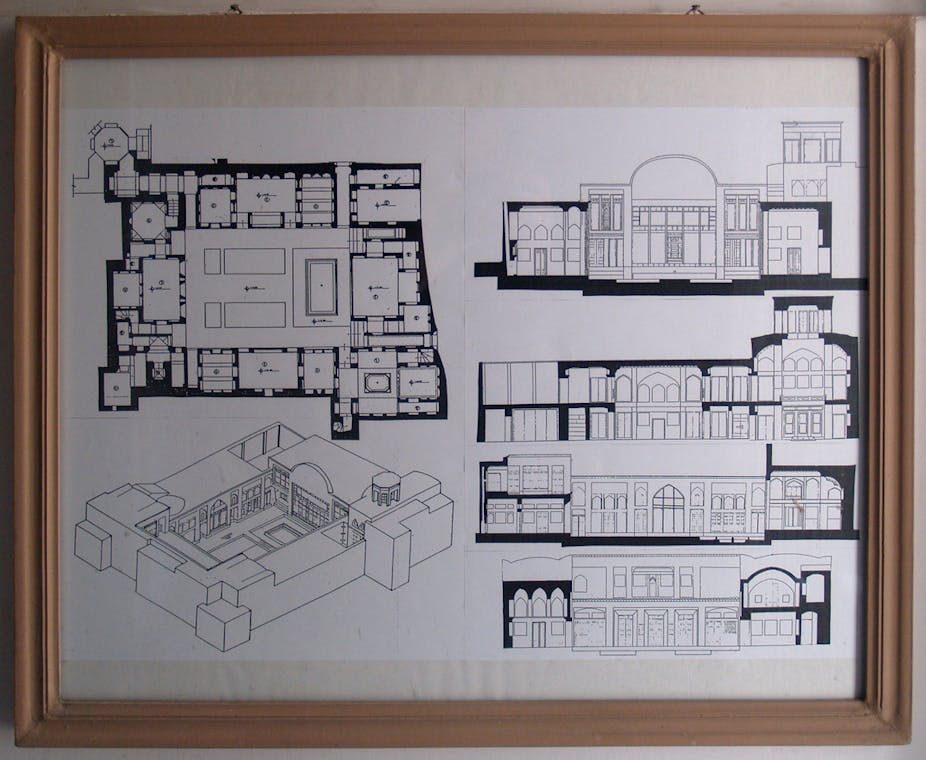
They range from the Japanese machiya to Malaysian shop-house; Iranian courtyard house to Vietnamese tube house; medieval English longhouse to contemporary live/work unit. Taking different forms according to culture and climate, these buildings are often so familiar that we do not notice them.
Their history has not been constructed before. But it can be found – fragmented and often disguised – in publications about houses or workplaces, about individual buildings or architects’ oeuvres, or about particular geographical locations or historical periods of history.
The “workhome”
Carl Linnaeus, the 18th century botanist whose classification system for the biological sciences is still in use today, said: “If you do not know the name of things, the knowledge of them is lost too.”
This may be key to understanding why so little is know about this age-old building type.
Before the industrial revolution, it was called “house”, with sub-sets of bake-house, bath-house, ale-house and so on. But through the 20th century, the term “house” came to refer to a building type in which people cook, eat, bathe, sleep and watch TV, and nothing else. So the building that combines dwelling and workplace lost its name.
In order to be able to gather knowledge about it, this building type needs a name. So I have coined the generic term “workhome” to refer to all buildings that combine dwelling and workplace.
Research process
To establish the existence of the workhome, I excavated its history from medieval times to the present day in England.
Then, building on work carried out by North American architects Penny Gurstein and Thomas Dolan, I set out to identify some (ideally universal) design “truths” for workhomes.
A close scrutiny was made of the lives and premises of 76 contemporary home-based workers in urban, suburban and rural contexts in England. Participants were selected from across the social spectrum, working in a wide range of occupations and inhabiting all sorts of different buildings.
A semi-structured interview was held with each person. Some lasted only twenty minutes while others talked for hours. Many said how much they enjoyed the process and how it affirmed their chosen lifestyle.
Photographs were taken of each building, inside and out, except where these would endanger the inhabitant in some way. And each building was measured so simple plans could be drawn.
Who are these home-based workers?
An analysis of all the home-based workers, first, revealed eight different workhome user-groups.
juggling parents
backbone of the community
professionals
24/7 artists
top-up
craft-worker
live-in
start-up
The analysis highlighted the different spatial and environmental requirements for each group, which hints at the need to revolutionise design for home-based work.
What are these buildings like?
An analysis of the buildings, in terms of their dominant function, found two basic types
home-dominated
work-dominated
Home-based workers either work in their homes or live at their workplaces. A lack of understanding of this basic distinction has led to confusion on both sides of the ocean as local authorities tried to legislate the “live/work” movement.
Three degrees of spatial separation
Most contemporary home-based workers inhabit buildings that have not been designed for the dual use. This often causes frustration, stress and inefficiency. A central issue is the relationship between the “dwelling” and “workplace” elements of the workhome.
Three basic degrees of spatial separation between the two functions were found in the 76 buildings studied. Each is suited to different sorts of home-based worker.
no separation: live-with
some separation: live-adjacent
more separation: live-nearby
The first type combines dwelling and workplace in a single fire compartment with a single entrance. Many different possible models exist, including the “double-height space and mezzanine” and the “workspace in the spare bedroom”.
The second type combines dwelling and workplace in two adjacent fire compartments each with its own entrance. This type is popular in workhomes such as shops, pubs and funeral parlours, where the work involves interactions with members of the public.
The third type separates dwelling and workplace into two buildings a small distance from each other. Each has its own entrance. Common models include the “shed at the bottom of the garden” and the “mews workspace at the bottom of the garden across a courtyard, with a separate access road”.
Design as a tool
Common disadvantages to home-based work include problems with occupational identity and social isolation. The fact that most home-based workers inhabit cities and buildings designed around the dominant spatiality of the industrial revolution, which separated dwelling from workplace, exacerbates this.
Cities and buildings designed around home-based work would inevitably take a different form. It’s time for us to explore this. Recognising the existence of the workhome – and its immense contemporary relevance – is a necessary first step.
Dianna Arthur
Dianna Arthur is a Friend of The Conversation.
Environmentalist
Compare the environment of the open office cubical to the home environment (even one which includes small children) and determine which offers the most flexibility and productive outcomes.
From a personal POV, as a highly motivated, independent worker I prefer to be interrupted by my little niece or nephew than the boss - any time.
Garry Claridge
Systems Analyst
For home-based workers, and those in very small offices, engagement in the "Jelly" concept is worthwhile. We have a Jelly in Maleny every Friday for this purpose :)
Frances Holliss
Architect and academic at London Metropolitan University
what a great concept, thanks for posting this...
George Naumovski
Online Political Activist
It is what people prefer as it could lead to more productivity, also people with a disability who can do office type work would benefit from “work at home” and as many jobs are being outsourced to sub-contractors/one person businesses it could be a better option to work from home.
Hetty Startup
architectural historian
I like the design of this page, Frances. Is the book out already?!
Frances Holliss
Architect and academic at London Metropolitan University
Not 'til next year!
Gavin Moodie
Principal Policy Adviser
I find this study most interesting. I enjoyed the brief history of the workhome to which this piece links, with 1 qualification.
A key process during the industrial revolution and in the transition from workhomes to separate homes and factories was the putting out system in which intermediaries distributed raw materials such as wool to home workers who weaved the wool and returned some time later to collect the material and pay the artisan.
Artisans would work for only as long as they wanted…
Read moreFrances Holliss
Architect and academic at London Metropolitan University
Interesting comment.
I agree control over the worker was a critical factor in the development of factories. There was a phenomenon in England called 'Saint Monday' (often stretched to 'Saint Tuesday'), in which home-based artisans took Mondays, off work if they could afford to. Work/life balance. Factory owners did not permit this, as it meant they lost control of the amount of work their workers did.
And yes, the trend for employers to out-source is an important reason for the contemporary rise of home-based work. High rates of unemployment and an associated rise in micro-enterprises are also a factor.
There are a number of different management approaches that facilitate home-based work. The potential savings in overheads for large corporations means these are likely to be adopted more widely over time. I heard yesterday that the BBC's new premises includes 10 workspaces for every 14 employees...
Doug McIntyre
logged in via Facebook
I worked from home for 18 years so I could bring my kids up. It took discipline, was a juggle but highly rewarding. I wanted to be a hands on Dad and not just see them at nights & on weekends. As an office these days can consist of a laptop or Ipad a lot of space isnt required.
The main issue is liability and the recent court case where Telstra was successfully sued because one of their employees who worked from home hurt themselves at home has set the SOHO movement back incredibly. It means many businesses are not prepared to take the responsibility for the safety of peoples homes.
Frances Holliss
Architect and academic at London Metropolitan University
This is a huge issue, although the Telstra case seems a bit bizarre.
Many people are voting with their feet because home-based work enables the lifestyle they want. And it's good for the economy, at both the micro and the macro scale, as well as the environment. So it seems likely that the law will ultimately evolve in a way that supports this.
British Telecom is the UK corporation with the biggest home-based workforce; they have an entire department that oversees the set-up of home-based working spaces. It is an important issue if home-based work-related injuries are to be avoided. However if too highly regulated, it also has the potential to send this working practice back underground.
Russell T
IT Consultant
Although I am not a 'home worker' as such, I often work from home. If a task requires 'extra effort' out of hours, for a client I almost always do that work at home. For me that is not much of an issue as all I require is the internet and a computer. Most of the the kids have left home so I have grabbed one of the bedrooms, removed the bed and added a desk and couple of bookcases. The room also has a very relaxing view. We live out of town and I believe that I am immediately more productive in this…
Read moreFrances Holliss
Architect and academic at London Metropolitan University
We define the home-based worker as anyone who lives at their workplace or works in their home for a minimum of 8 hours per week, as this is the point at which we consider it becomes spatially significant. Many, like yourself, are able to accommodate their home-based work through under occupation, using a spare bedroom, an under-used dining room or garage, or a shed at the bottom of the garden as workspace. If the house is empty during the day, like yours, then all the better.
Design for home…
Read moreDianna Arthur
Dianna Arthur is a Friend of The Conversation.
Environmentalist
"If your manager doesn't believe that you are working if they can't see you; then working from home is impossible."
The managerial types who only believe their employees are working if they (the managers) are standing right behind the hapless worker and looking over their shoulder.
Having had personal experience of the above is why I will never return to the standard office. I may be living on very little, I may have a chronic illness but I am way happier making my living from the at-home office. I certainly work harder and longer. But it does not feel that way because I am the decision maker, not someone who has not a clue about the technicalities of the work but simply placed into a position of power because they know the CEO's son or something equally inappropriate. Apologies for venting.
Frances Holliss
Architect and academic at London Metropolitan University
Our research has found home-based work to be both common and popular amongst people living with chronic illness and/or disability. This is in part because it removes the commute and means they can organize their work around their physical capabilities, need to rest etc. It can also remove workplace discrimination as, especially if working over the internet, they are judged by the quality of their work alone. As well as maintaining an income, interviewees with chronic illness and disability have told us that this working practice helps to keep them physically and mentally active, and ward off depression.
Dianna Arthur
Dianna Arthur is a Friend of The Conversation.
Environmentalist
I agree with your point about discrimination - a counsellor advised me NOT to admit to chronic illness or depression when applying for jobs. When one appears to be fit and attractive, when there is no obvious disability one must remain silent. People who are in wheelchairs, blind or something obvious are tolerated and in some work places even accepted. But those of us who appear unscathed - we can't speak about it. Don't ask; don't tell. However, bullies can sense people like me instantly.
I didn't choose to work from home - my illness necessitated that. And my income remains sporadic. This does exacerbate my depression at times. I will also be selling my home as I have been paying the mortgage from savings. I can then afford something very small - as long as I can have a garden that will be fine. But I dread the move. I love where I am. But there are people who don't even have the possibility of a home of their own - so I really shouldn't feel so sad.
Russell T
IT Consultant
I believe it leads to great productivity and also provides mental health benefits as well. It is truly nice to not spend your whole life amongst stressed out people. At home the only stress is the deadline, and in the workplace that often is the least of your worries.