
How taxing housing diminishes affordability

A fundamental truism of economics is that if you tax something, you get less of it. Tax is thus a good place to start in seeking to explain why Australia’s housing market is chronically under-supplied, with adverse implications for housing affordability. Many commentators have argued that housing is…

Gzbpzdbx-1334637467
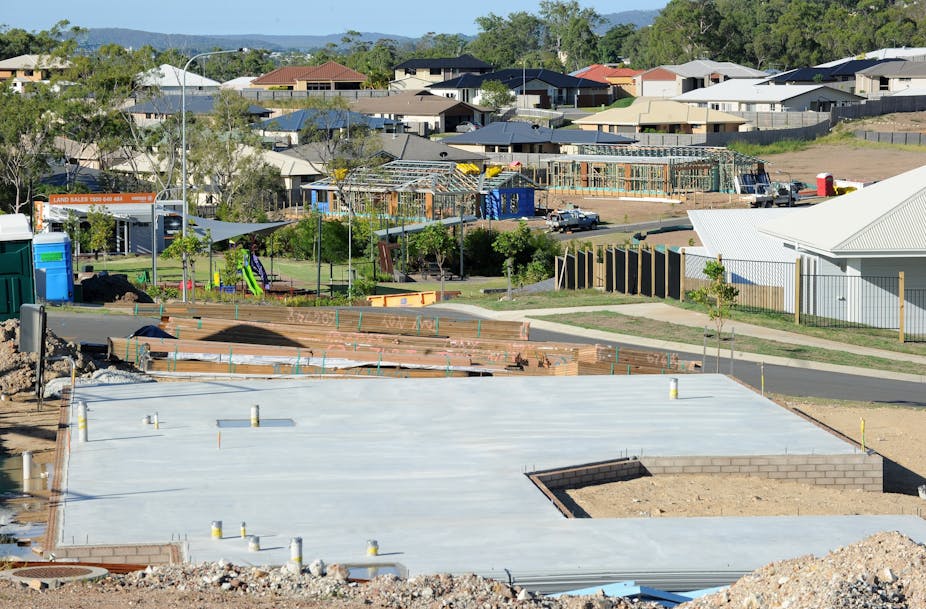
Flat earth approach: the tax burden on housing accounts for much of the financing cost of a new home. AAP

A fundamental truism of economics is that if you tax something, you get less of it. Tax is thus a good place to start in seeking to explain why Australia’s housing market is chronically under-supplied, with adverse implications for housing affordability.

Many commentators have argued that housing is tax advantaged because of the principal residence exemption from capital gains tax. They see the exemption as a source of increased demand for housing and a negative influence on housing affordability rather than a boost to housing supply.

This leads to the incorrect conclusion that housing affordability could somehow be improved by abolishing the principal residence exemption and other tax concessions. For example, journalist George Megalogenis has written that “housing can only become more affordable if prices stop rising… It can only be done by making property less attractive than other investments, such as shares or superannuation… bricks-and-mortar should lose its taxpayer supports.”

The Henry Tax Review was commendable for rejecting the view that saving via owner-occupied housing should be taxed. The Henry Review favoured an expenditure tax benchmark that exempts the returns to saving from tax, including saving via housing. The final report’s recommendation that saving via owner-occupied housing remain tax-exempt was explicitly based on this benchmark. The final report also recommended that the returns to other forms of saving, including capital gains on other assets and net residential income and losses, should enjoy a 40% tax discount.

The Henry tax review made clear that the problem with Australia’s tax system is not that saving via housing is taxed too lightly, but that other forms of saving are taxed too heavily. The principal residence exemption from capital gains tax is in fact model tax policy based on an expenditure tax benchmark.

Henry’s suggested move to a 40% savings income discount is designed, among other things, to remove “the current bias towards negatively geared investment in rental property and shares.” However, this recommendation was made subject to the important proviso that supply-side constraints in the housing market need to be tackled first and that phase-in arrangements should apply to minimise disruption to the housing market.

The final report noted that “changing the taxation of investment properties could have an adverse impact in the short to medium term on the housing market… reducing net rental losses and capital gains tax concessions may in the short-term reduce residential property investment. In a market facing supply constraints, these reforms could place further pressure on the availability of affordable rental accommodation.”

The pre-occupation of many commentators with the principal residence exemption from capital gains tax and negative gearing has diverted attention from the fact that housing in Australia, far from being supported by the tax system, is in fact very heavily taxed. A recent report by private consultancy, the Centre for International Economics (CIE), “Taxation of the Housing Sector in Australia,” prepared for the Housing Industry Association, quantifies the tax burden and its adverse implications for housing affordability.

The tax burden on new housing includes direct taxes such as the goods and services tax, stamp duty, land tax and council rates, as well as a variety of indirect taxes on inputs into housing and hidden taxes that arise from the planning and approvals process. CIE estimate that these taxes account for 44% of the purchase price of a representative new home in Sydney or around $267,879. Most of the burden of these taxes falls on home buyers and not home builders because the demand side of the housing market is less price sensitive than the supply-side.

The tax burden on housing also accounts for much of the financing cost of a new home and thus the burden of mortgage debt and associated interest payments. The cost of financing the tax component of the price of a new house in Sydney is equivalent to 33% of the after-tax income of a young couple aged between 24 and 35 on average wages. The burden is even higher in the first year when stamp duty is paid, accounting for a staggering 72% of after-tax income.

Australia’s under-supplied housing market and housing affordability problem is largely due to the tax burden on housing. Abolishing the principal residence exemption from capital gains tax and negative gearing would only add to this tax burden and further reduce housing supply.

Substantial gains in the efficiency of the tax system and housing affordability could be achieved through the substitution of more efficient taxes such as the goods and services tax for inefficient taxes on residential property. CIE estimate that replacing taxes on housing with a broadening of the GST base could increase GDP by around 2% and increase residential construction by 14%, providing a much needed boost to housing supply.

The main obstacle to a reform of this type is the dependence of state and local governments on residential property taxes, accounting for around 40% of their total revenues. This points to the need for a federal-state compact on tax reform that finances the abolition of inefficient taxes on residential property through changes in the GST rate or base. State and federal governments unwilling to consider such a compact are not serious about addressing housing affordability.

The solution to Australia’s housing affordability problem is to build more and cheaper houses. This can only be achieved by easing the tax burden on housing and not through the abolition of existing tax concessions.

Join the conversation

37 Comments sorted by

  1. Philip Dowling

    IT teacher

    I would certainly agree with this article, In addition, costs are driven up by fees and charges by local and state government on every transaction. Certificates which involve nothing more than printing out an address query from a database are charged over $100, Regulations demand that experts are consulted and paid for pro forma statements, that are the work of clerical assistants.
    While each of these transactions is minor, the overall effect on one's wallet is like throwing away a $100 bill at each set of traffic lights.
    If the end result was high standard buildings with no pronlems then it may be argued that this was justified.
    In reality, people spend more time trying to get around, complying with, and being annoyed by regulations and fees, they have no option but to build inferior housing that is "complying".

    report
    1. Ethno Seeker

      logged in via Facebook

      In reply to Philip Dowling

      Yes I am currently testing costs associated with housing in a build project I have underway, and I can confirm that the issues you refer to well are substantiated by the evidence.

      report
  2. William Bruce

    Artist

    This is THE fact,
    "However, this recommendation was made subject to the important proviso that supply-side constraints in the housing market need to be tackled first..."

    Govt needs to get back to putting in the services like they used to...and/or stop bringing in all these people we don't need.

    ..there is plenty of good housing land in NSW/Oz but Govts force people with a few acres to subdivide to put in Sewerage plants, services, parks...&...?. Every legal restriction too etc...

    We ought consider letting people build whatever they reasonably like in industrial zones and perhaps also in commercial zones is good.

    Lastly, why does this article not refer to how few Australians now own their own home compared to the past?....

    If we REALLY want Oz to go well we need to get more young people "a job & a mortgage" which for too many almost impossible nowadays.

    report
    1. Ethno Seeker

      logged in via Facebook

      In reply to William Bruce

      William, I agree that we cannot be sure we can sort this situation without being able to influence population if required. I am 100% behind you in that.

      One of the suggestions I have seen is for a list of standard house designs pre-approved for development anywhere in Australia [including variations for climate and topography].

      But your thought about extending such a right to commercial and industrial zones cannot be off the table if that is what it takes to sort this matter.

      report
  3. Robert Nelson

    Associate Director Student Experience at Monash University

    Economics is not my field, and so I seek enlightenment on a couple of the points that Dr Kirchner has raised. The first is 'A fundamental truism of economics is that if you tax something, you get less of it.' It may be considered a truism by economists but is it true? Some commodities are notoriously price-insensitive. A tax on petrol, for example, does not noticeably shift patterns of consumption. The price goes up and down by market forces; and as these have little influence on demand…

    Read more
    1. Bruce Tabor

      Research Scientist at CSIRO

      In reply to Robert Nelson

      I think you've hit the nail on the head Robert. You don't need to understand economics to see the intrinsic bias in this article. A simple understanding of logic, especially "non sequitur" will do. While we can all agree that, "The solution to Australia’s housing affordability problem is to build more and cheaper houses", it does not follow that this, "...can only be achieved by easing the tax burden on housing..."

      To paraphrase an old saying, economics exists to make astrology look like a hard science.

      report
    2. Leon Weekes

      Professional Systems Engineer MIE(Aust)

      In reply to Robert Nelson

      Whilst I find your planning arguements compelling and certainly worthy of detailled further investigation, I suspect the real problem is economics. The fundamental problem is debt dynamics and the ability of credit to warp the valuation of assests via speculation in periods of 'good economic sentiment' or what Alan Greenspan would call 'irrational exuberance'. Current 'neoclassical' economics appears to model economies without taking into consideration how banks actually work thus the roles of debt…

      Read more
    3. Ethno Seeker

      logged in via Facebook

      In reply to Leon Weekes

      The economics, Bruce Robert and Leon, are that the diversion of more and more available economic capital [broad money which is principally debt] towards the same capacity to house means that the cost of housing labour, an input into production, grows in real terms, which [alongside the Australian dollar] is making our economy uncompetitive in many many industries.

      Domestic demand is extremely important to an economy, which as you know is one of the debates being had at the moment about the direction from here for the Chinese economy.

      Because housing labour is essential, the escalating costs of doing so [as available debt rolls over to less and less efficient housing] squeezes domestic demand out of the gap between housing yourself and your wage.

      We don't necessarily need debt to contract. We need the capacity of wages to pull debt towards the production of other goods and services other than housing to be restored by a reduced housing price to wages ratio.

      report
    4. Bruce Tabor

      Research Scientist at CSIRO

      In reply to Ethno Seeker

      I basically agree Ethno, but the main component of housing cost in most Australian cities is land, not construction (labour + materials + infrastructure) costs. We live 30 km NW of the Sydney CBD and even out here with a McMansion half the cost was in the purchase of land. Closer in and 80% or more can be the location fee.

      This ridiculous situation is caused by two main factors: lack of new housing supply and poor public transport across the city. It was exacerbated by cuts to marginal tax rates (for the rich), cuts to capital gains taxes (for the rich) and cuts to interests rates since the mid 1990s. This excess money was then mostly poured into existing real estate - essentially dramatically increasing the value of land.

      It would have been far better if it were spent on urban transport infrastructure, new housing and other worthy investments, but it was largely wasted.

      report
    5. Karl Fitzgerald

      Economist

      In reply to Bruce Tabor

      Bruce - great to see the land price is the issue. Yes easy money did pour into land -> unreal estate. If Land Taxes were increased this would deter the speculators as they would no longer be able to hold the market to ransom in pursuit of capital gains. Stamp duties and in particular developer levies in NSW are hurting prices.

      Think about the way McDonald's investigates what a piece of land is worth. They hire surveyors to count cars as they pass the proposed location. They have their $ spend…

      Read more
    6. Not MacroBusiness

      logged in via Twitter

      In reply to Bruce Tabor

      We can solve the dwelling shortage by converting parks to subterranean housing. Build underground and let students reside there. I don't know how good this technology is yet as it doesn't exist and there are technical problems with the scale of what I'm proposing, but this is no fantasy land idea. Look at this debunked report on the so called 'shortage'.....

      http://australianpropertyforum.com/blog/main/3204321

      I say convert all parks, including golf courses, into multistory underground cities…

      Read more
    7. Gavin R. Putland

      logged in via Twitter

      In reply to Not MacroBusiness

      A 51-inch plasma TV can now be had for $400. That's LESS THAN ONE WEEK'S RENT on the median Australian house. And if you need a web connection to find your next casual job so that you can pay the following week's rent, an iPad (or equivalent) is one of the quickest and cheapest ways to get it. The chief mechanism by which hard-earned wealth is "pissed up against the wall" in this country is by pushing up real estate prices for the benefit of established owners.

      report
  4. Rob Crowther

    Architectural Draftsman

    My son did some holiday work mixing mud for plasterers and these ‘trades’ were earning $800 a day and their ‘trade’ took 8 weeks to learn. Eligibility to join the ‘trade’ was to survive being a mud mixer for about a year.

    Conversely, I believe if you get yourself a PhD in science and do field work and have twenty years experience you might, if you are lucky, get to five figures.

    About half of a house’s cost is in the labour.

    I would suggest a mechanism that brings self employed 'trade…

    Read more
    1. Ethno Seeker

      logged in via Facebook

      In reply to Rob Crowther

      It's an issue Rob.

      And having a small group of house designs with rigid [but simple and limited] material component requirements able to be built anywhere in Australia [with variations for climate and topography] would require the practices you refer to as rightly not part of any such building activity.

      One of my first jobs was as a plasterers mate.

      You are right it is disgusting when you think about such an approach.

      report
  5. Chris Booker

    Research scientist

    I wouldn't be to so sure in your conclusions. I'm in New Zealand where there is NO, and never has been, any capital gains tax. Housing is now the safest, easiest way of making large sums of money. Guess what this causes - that's right, an undersupply and heightened demand for housing - the exact problem you have in Australia. Obviously capital gains tax alone can't reconcile these two situations.

    In NZ, the tax-free gains on housing is one of the greatest contributors to increasing socio-economic disparities - those that can afford housing buy into it and make large sums in profit, home ownership rates at the lowest point ever in NZ history (so we are seeing that those that can afford property are increasing the number of properties they own), and there is now a large part of NZ society that will never be able to afford to own their own home. Is this what you want for Australia?

    report
    1. Tobin Richard

      Software Development Manager

      In reply to Chris Booker

      I think that too many people who automatically assume what's good for making money is good for our social fabric.

      report
    2. Ethno Seeker

      logged in via Facebook

      In reply to Tobin Richard

      Chris you are right and look it is a difficult discussion, because it brings into focus the right in addressing the plight of people in other countries, and perceptions of growth [though Tobin I am not quick as you are not to look past the costs of some growth models].

      Even though they are difficult topics as I say, immigration and the right for foreigners to purchase and occupy [or leave vacant] property in another's country where housing is unaffordable are issues that must be faced up to.

      report
  6. Tobin Richard

    Software Development Manager

    What rubbish!

    Negative Gearing and other tax advantages for property have done almost nothing to increase supply. The statistics show that far less than 10% of negatively geared properties are new dwellings. The remaining 90% just compete with owner occupiers, driving up prices without adding anything to supply.

    If you seriously believe that tax incentives will lead to increased supply then limit those incentives to new dwellings.

    report
    1. Ethno Seeker

      logged in via Facebook

      In reply to Tobin Richard

      Where a shortfall in the supply of housing is established, that is where there is a market failure in delivering an adequate supply of a basic need, the government will need to intervene directly through taxation, the purchase of land, and construction.

      And certainly that momentum requires as you say tax incentives only on constructed dwellings.

      report
  7. Gavin R. Putland

    logged in via Twitter

    "A fundamental truism of economics is that if you tax something, you get less of it," says Kirchner. That's true of things produced by the taxpayer. But it isn't true of things produced by nature, because the laws of physics have no respect for the taxman. Neither is it true of things produced by taxpayers other than the one who pays the tax, because only the latter responds to the disincentive.

    So you tax the value of land -- through land tax, or council rates on site values -- you don't get…

    Read more
  8. Michael Romano

    Senior Systems Engineer

    I do know a few people who have 20+ investment properties who complain about paying tax. I don't have any issue with people who have lot's of investment properties, but I do have a problem with them buying up cheaper properties.

    I'd like to see less tax on the first few properties, and much more tax on 4 or more properties. In theory, this will encourage investors who can afford more, to invest in less, higher-value properties, leaving the cheaper investments to the people who are starting out.

    report
    1. Ethno Seeker

      logged in via Facebook

      In reply to Michael Romano

      Yes a law that substantiated compulsory acquisition of investment properties based on means testing to be resold at affordable prices, if not released onto the market within a fixed period of time, may not be unconstitutional.

      That is, the require to acquire property on "just terms" may be met if the purpose of the legislation is to prevent the denial of a man (or woman) having a place to call home, to found himself in a community.

      report
    2. Philip Dowling

      IT teacher

      In reply to Ethno Seeker

      State Governments could free up a lot of money for public housing by selling units with harbour views and houses that are worth over two million dollars, and reinvesting that money in property that is below the average price for the city.

      report
    3. Michael Romano

      Senior Systems Engineer

      In reply to Ethno Seeker

      I should clarify. I meant that it would be better if the more wealthy investors were encouraged to invest in more expensive property as opposed to buying/holding higher quantities of lower priced property.

      report
    4. Ethno Seeker

      logged in via Facebook

      In reply to Philip Dowling

      Yes in appropriate cases in all the circumstances, legislation would provide for such powers.

      report
    5. Philip Dowling

      IT teacher

      In reply to Ethno Seeker

      This is merely an administrative decision.
      A check of cars around some housing commission residences would show that some cars parked there are worth more than half the value of the property.
      Many of the best housing commision properties were allocated to Labor Party faithful and relatives bypassing all normal procedures.
      A block near the Dry Dock hotel in Balmain is classic example of this.

      report
  9. Sarah Toohey

    logged in via Twitter

    Think it's worth pointing out that the CIE report referred to in this article includes a whole range of what they call 'hidden taxes' in their calculations, including infrastructure charges, planning delays and zoning requirements. These account for about 40% or $106k of what they're calling the housing 'tax burden' in Sydney.

    It's fine to have a debate about planning delays and infrastructure charges, but it's a bit disingenuous to call it all 'tax'.

    report
    1. Philip Dowling

      IT teacher

      In reply to Sarah Toohey

      It is a tax in effect. Whether it is paid to the local government, a state government dept or to a bank, as far as the developer/owner is concerned it is money that has been transferred from his pocket. He/she doesn't care where it went to. If academics want to put another name on it, that is their problem. However, it doesn't affect the decision making process of the developer or putative home owner.
      It is such logic as this that frustrates people at every stage.

      report
    2. Ethno Seeker

      logged in via Facebook

      In reply to Philip Dowling

      Philip, I agree the costs of housing production are out of control.

      But that point doesn't need to broaden the definition of the word "tax" to the compulsory contribution to power lines into the district and tar on the road down the corner the new house is next to [without being absolutely specific but you get my point.]

      Sarah is absolutely right.

      report
  10. Paul Sherry

    Engineer

    This article states that 'Australia's housing market is chronically undersupplied'. Says who.I don't see people living on the streets... I would agree its unaffordable, which is about the only thing I agree with in this article. There's certainly something wrong with the skewed investment system in this country when I rent a ~ $900,000 home for $520 pw from which I imagine the owner gets maybe $400/week after expenses whereas taking that same $900,000 and putting it in the bank would yield over a $1000 a week in interest (at 6%). I just wish I could ask my bank not to use my savings to make home loans and thus continue to support this housing market Ponzi scheme.

    report
    1. Ethno Seeker

      logged in via Facebook

      In reply to Paul Sherry

      The approach to rectify this situation will accept there is a risk that undersupply is an issue here, as well as the matters you refer well to Paul.

      report
    2. Philip Dowling

      IT teacher

      In reply to Paul Sherry

      I see people living on the streets even on the North Shore of Sydney. Have you forgotten your optimetrist's appointment for the last few years? Just asking.

      report
  11. Karl Fitzgerald

    Economist

    For an alternative perspective on how the CIE rigged their modelling, pls read http://www.onlineopinion.com.au/view.asp?article=13517

    It is barely surprising that a senior lecturer in economics understands little about the role of economic rents and the pursuit of the free lunch in this age of 'there is no bubble' and 'it's different here'.

    What compounds this is the ignorance of the role the global property bubble played in blowing the world economy apart. The 'solution' to reduce effective taxes on land (as per the CIE paper) and push the regressive GST upon the poor is sweeping the world as per the UK, France, NZ and some US states. This will encourage more speculation, not less. Another boom-bust-bailout is good for whom?

    According to the CIE's ceteris parabus methodology, the estimated $11 trillion cost to US households since the start of the GFC is a positive.

    report
  12. Wei Ling Chua

    Freelance Journalist (night passion) at Self-Employed: Picture Framing/Wholesales

    The issue of housing affordability in Australia is far more complicated than a few taxes. It has got a lot to do with the Reserve Bank interest rate policy and the Australian government attitude towards housing affordability. This article may shed some light on the issue by comparing the two type of attitude (between China and Australia) towards housing affordability: http://outcastjournalist.com/index_files/human_rights_housing_policy_australia_china_compare.htm

    report
  13. Kevin Brown

    Retired Administration Officer

    Housing tax advantages like negative gearing should be limited to new homes to encourage supply and deter property speculation.

    report