
The ABC recently ran the documentary I Can Change Your Mind About … Climate Change, exposing Nick Minchin, former conservative politician, and youth activist Anna Rose, to science and argument in favour of and opposed to climate change and the need to do something about it.
It would surprise no social psychologist that neither Minchin nor Rose changed their minds. Strong minds do not change easily or willingly. As Ecker and Cook eloquently describe, people generally engage in motivated cognition rather than approach information rationally.
The documentary, as well as continuing media coverage of debate in Australia about climate change, creates the impression that national opinion is strongly divided over climate change. Australians’ opinions are actually more aligned than we think. In reality the nation is close to a consensus that climate change is happening.
A national survey by the CSIRO sheds some light on public beliefs about climate change and support for government action. The survey of more than 5,000 people was conducted in July and August 2011, before legislation was put to parliament to introduce a price on carbon. The survey follows a similar survey done in 2010.
Australians’ beliefs about climate change
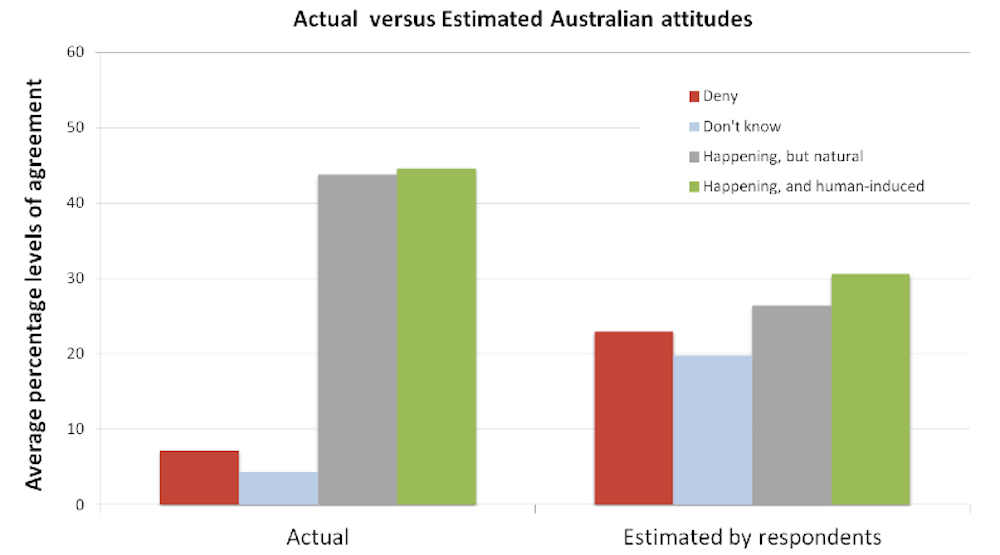
Most Australians – nearly 9 in 10 – accept that the climate is changing. Less than 1 in 10 say they think it isn’t.
This 90% majority is roughly evenly split between those who think climate change is mainly due to human activity and those who think it is a natural phenomenon. The proportion of Australians accepting climate change has altered little in the last year, despite the heated debates that have occupied the country and the mainstream media.
Australians’ beliefs about others’ beliefs
Humans generally are poor judges of how widespread their own and others’ opinions are. When it comes to climate change, the majority view is that climate change is happening. Yet everyone underestimates how common this view is.
Most Australians grossly overestimate the proportion of the population that denies climate change. On average, people figure that about 22% of Australians are “deniers” – more than three times the actual proportion!
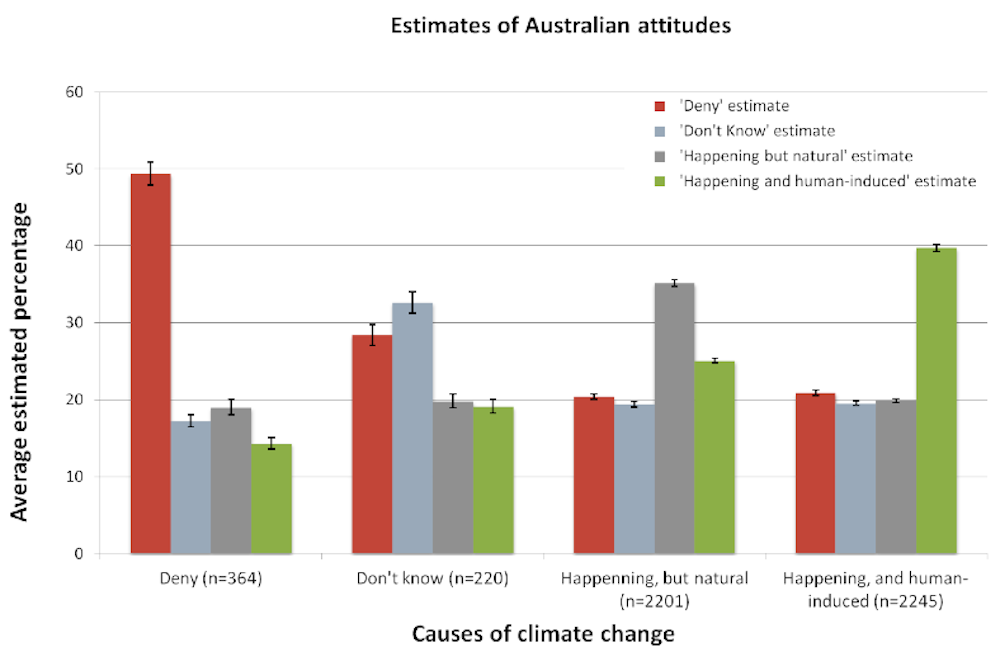
The two minority positions (climate change is not happening; don’t know if climate change is happening) are especially overestimated.
Why do these misperceptions happen?
One possibility is that these misperceptions reflect the airplay and column inches given to those opposed to climate change. When confronted with evidence that a consensus does not exist, it is common for people to think that those that who don’t share their opinion have something wrong with them: a phenomena seen on all sides of the climate change debate.
Whatever the reason, the misperceptions suggest that the real consensus is being ignored; meanwhile, a false consensus is being constructed that a significant proportion of Australians reject climate change.
The CSIRO survey also revealed another important effect in how we think about our own beliefs and others’: people always think that their own belief is the most common belief in the country. This overestimation of the commonality of one’s belief is most evident among disbelievers.
Overestimating how common our beliefs and opinions are is a well-know phenomenon in social psychology. It exists across many different domains. There is nothing unique about climate change that is causing this effect in the CSIRO survey data.
What is unusual in the CSIRO survey data is the gross overestimation of how widespread rare views are.
Perhaps these misperceptions about Australians’ beliefs about climate change are a major reason why debates get heated and polarised, and why it is hard for people to change their minds.
Australians support action on climate change
There seems to be a polarisation of views around support for human-induced climate change, and about the costs and implications of actions such as putting a price on carbon.
In reality, there is much greater public acceptance of human-induced climate change than many would have us believe.
Misperceptions and misinformation about public beliefs about climate change are helping fuel division and dissension in the national debates about climate change.
The climate science is clear. Climate scientists are clear. It appears that the Australian public is also quite clear, but does not yet realise its own clarity.


Byron Smith
PhD candidate in Christian Ethics at University of Edinburgh
Some interesting polling numbers!
"The CSIRO survey also revealed another important effect in how we think about our own beliefs and others’: people always think that their own belief is the most common belief in the country. This overestimation of the commonality of one’s belief is most evident among disbelievers."
Ironically, the one group who *underestimated* their own numbers were the one group who are actually (a) most common in Australia and (b) in alignment with the mainstream scientific understanding. This group still overestimated how many deniers there are by a factor of three, though actual deniers overestimated themselves by a factor of seven.
Byron Smith
PhD candidate in Christian Ethics at University of Edinburgh
Oops - both the first two groups underestimated their own frequency, meaning that 90% of respondents actually underestimated the frequency of their own belief.
Michael Croft
logged in via LinkedIn
Thanks Iain,
Anecdotal evidence that the majority of Australians accept climate change is happening occurred this week when the IPA's Chris Berg said as much in an online piece for the ABC - unfortunately I can't find the link.
It appears the IPA is shifting from disputing the 'facts', to disputing what to do about them. They are now saying in effect that mitigation is impossible, so adaptation is the answer. In short, a business as usual approach that will do nothing to stem CO2e, merely adapt to the changes when required and allow business to profit maximise in the process.
David Arthur
n/a
Gday Michael, Mr Berg's column is "We can't stop climate change - it's time to adapt" (http://www.abc.net.au/unleashed/3997798.html).
Mr Berg is a bit of a breath of fresh air through the IPA. One nevertheless wonders what form "adaptation" might be acceptable to the IPA.
If we were all suffering headaches, the IPA may well call for a round of paracetamol. However, they'd probably also tell us that we have the right to bang our heads against walls.
Peter Best
Computer Programmer
The deniers include those who say it is warming but the warming is mainly due to natural causes. The scientific evidence tells us it's not.
Sean Lamb
Science Denier
That was my reaction also.
If I read the graph correctly it looks about 52% of people are climate change deniers and 44% of people are climate change proponents with 4 % saying they don't know.
It is certainly a very odd way for Dr Walker to present these figures.
Aden Date
Student of Clinical Psychology
Agreed - I think the term "Climate Change denialist," is just a modern contraction of "Anthropogenic Climate Change denialist." Walker distinguishes between those who don't believe the world is warming, and those that do but believe it's due to natural causes, but this is only one of many fine distinctions that can be made to divide those who are against pro-climate policy. I heard it put well once that there are:
Those who believe the world isn't warming (e.g. Richard Muller, until recently)
Those who believe it is, but that it's natural (e.g. Ian Plimer)
Those who believe it's anthropogenic, but not serious (e.g. Richard Lindzen)
Those who believe it is serious, but doesn't warrant market interventionism (e.g. Bjorn Lomborg).
From a policy perspective, the sum of all of these groups is likely to be problematic for pushing for pro-climate policy. That the first of the four groups is particularly small is of no great comfort.
Comment removed by moderator.
John Coochey
Mr
I agree, it is late at night but I think at the very least people should read the original survey and the actual results rather than the rather quaint way they are presented here, but as I intimate elsewhere it looks like the wrong questions were asked
Comment removed by moderator.
Ian Enting
Honorary Senior Associate, Faculty of Science at University of Melbourne
Ian Plimer supports all four views. Consistency is not his strong point.
Comment removed by moderator.
Peter Lang
Retired geologist and engineer
What excellent news. People are rapidly starting to see through the CAGW scaremongering. We are getting rational. Perhaps we may, eventually, return to real science, instead of ideology-driven science.
"The European Parliament has cancelled plans to send a delegation to the UN's Rio+20 summit on sustainable development taking place in June, saying the costs are too prohibitive. “The huge increase in the estimated cost of attending the summit is simply not justifiable, especially at a time when…
Read moreAlistair McDhui
Retired engineer
You clearly haven't a clue. Lovelock: http://blogs.telegraph.co.uk/news/jamesdelingpole/100152774/global-warming-what-global-warming-says-high-priest-of-gaia-religion/
<i>“The problem is we don’t know what the climate is doing. We thought we knew 20 years ago. That led to some alarmist books – mine included – because it looked clear-cut, but it hasn’t happened,” Lovelock said.'</i>
Houghton got the Physics wrong. look carefully at Page 11 of 'The Physics of Atmospheres', 3rd Edition, and he…
Read moreDavid Arthur
n/a
I share Mr Lang's hope that "perhaps we may, eventually, return to real science, instead of ideology-driven science."
The remainder of Mr Lang's contribution pertains to the incompetence of attempts, to date, to devise economic mechanisms to purportedly limit and decrease fossil fuel use (the real effect of economic mechanisms to date has been to deliver barrels of pork to the doors of derivative-trading institutions).
Meanwhile, here's some ideology-free science.
Earth is warmed by absorption…
Read moreJohn Nicol
logged in via Facebook
Dear David,
I am very pleased to see your contribution to the conversation and find myself in agreement with most if not all of what you have posted here.
I realise that discussions of the science here are not going to reach the detail or extent necessary to determine the correctness or otherwise of the assumptions used to drive the modellig, but it nevertheless makes for an interesting exchange and one can enjoy the challenge of trying to put together some plausible arguments based on the…
Read moreDavid Arthur
n/a
Thanks for setting this out Mr Nicol.
The fundamental flaw in what you write is the assumption that non-greenhouse gases cannot cool by radiating energy. Doug Cotton's comments on "The Conversation" pieces a few months ago laboured under the same misunderstanding; my recollection is that Mark Harrigan sought to help Doug out of his confusion.
Another point is that there are three Hadley Cells operating in each hemisphere, with low pressures at Equator and ~60 deg N and S, and high pressures at poles and ~30 deg N and S.
Finally, the presence of water makes a huge difference to earth's climate. For a start, the presence of frozen water at high latitudes increases earth's reflectance relative to the no water case, and hence modifies Tav and Teff.
Given these difficulties, criticism of other climate studies are not well supported by your description.
John Nicol
logged in via Facebook
Thanks David.
I hadn't remembered the earlier exchange between Dioug Cotton and Mark Harrigan and am intersted to know more about the radiation from Oxygen and Nitrogen at the low temperatures of the atmosphere and earth which I guess are always within the range of 200 to 400 K, with corresponding wavelengths of any significant black body radiation between 1 micron and 50 microns (200 and 10,000 cm^1), is that correct?
Since I believe the molecules which can radiate from the air, be they…
Read moreDavid Arthur
n/a
Wavelengths at which O2 and N2 can radiate?
ALL wavelengths, where wavelength is determined by changes in molecular speed (kinetic energy) (see, eg, http://en.wikipedia.org/wiki/Kinetic_theory; googling translational energy levels might also help). It's described by the Maxwell-Boltzmann distribution.
Exchange occurs by collision between molecules, excitation occurs by interaction with radiation. At higher altitudes (lower densities), interactions with radiation make up a larger proportion of events which alter a molecule's energy levels.
Paul Moonie
PhD student, solar energy
A good exchange between John and David, rare in the climate debate between individuals from differing views.
Keep it up Gentlemen!
Tim Scanlon
Author and Scientist
I think some of the perception comes about from active denial campaigns in the media and online. Astroturfing and similar schemes see a lot of activity by a very small group.
John Coochey
Mr
The real and critical "astroturfing' is that collapse of support for Labor and its Carbon Tax
Bob Tronson
Thinker
"Most Australians – nearly 9 in 10 – accept that the climate is changing. Less than 1 in 10 say they think it isn’t.
This 90% majority is roughly evenly split between those who think climate change is mainly due to human activity and those who think it is a natural phenomenon."
--
Is it safe to assume that those who believe the globe is warming due to natural phenomenon (interesting choice of phrase that; natural phenomenon, as opposed to, say, non-human causes) would therefore not support…
Read moreDaryl Deal
retired
The empirical and numerorous other lines of evidence including phenology(study of periodic plant and animal life cycle events), means the peer reviewed science of global warming, is rock solid, since 1896.
Anna Rose, didn't have to change her opinion, as it is and remains concurrent with the real world and the scientific consensus on the subject.
Nick Minchin, who lives in the pink fairy land of total denial, had his posterior nailed to the barn door by Naomi Oreskes.
link: http://www.skepticalscience…
Read moreJohn Nicol
logged in via Facebook
Darryl,
Could you just very briefly show us the evidence using dot points which date back to 1896 as you claim. Please do not include Arrhenius as his specroscopy was too crude at that time to demonstrate the likelihood of the Enhanced Green House Effect, which is the matter under discussion and debate, NOT the classical Green House Effect which Arrhenius and earlier people such as Fourier and Tyndall correctly identified but ignored the role carbon dioxide plays in the radiative cooling of the upper atmosphere. John Nicol jonicol18@bigpond.com Chairman, Climate Advisory Committee ACSC http://www.auscsc.org.au
Kim Peart
Researcher & Writer
Climate change deniers know there is a problem, but they are simply not sold on the solution, because they know in their bones that the solution implies contraction and in all of human history, contraction has been the beginning of decline toward catastrophe.
Is it possible to describe a solution to the carbon crisis that includes expansion?
Anyone with the courage to investigate the matter can appreciate that we were in a position to start building solar power stations in space in the 1970s…
Read moreDon Aitkin
writer, speaker and teacher
As a former survey researcher, I went to the methodology to see what I could learn. Alas, there's not much there. What is the sample? How representative is it? How was it constructed? This is what we get in the 2010 paper:
'The survey was administered online using a representative group of participants sourced from a research-only panel.'
I don't know what that means, but it doesn't fill me with confidence about the data.
There's no questionnaire, and the titles of the tables and figures…
Read moreMichael Shand
Michael Shand is a Friend of The Conversation.
Software Tester
Those that dont accept that it is a result of human activity are still denialists, if it is perfectly natural, beyond our control, then what justification could you have to change behavior or fix the problem?
I would rather deal with the honest deniers than the weazelly accepters, this seems like an attempt to not be called a denier and at the same time not do anythign about it.
Roger Crook
Retired agribusiness manager & farmer
I think it would be helpful if all in this discussion, and those interest in the 'Climate Debate' had a read of:www.abc.net.au/tv/.../webextras/jonova_davidevans_transcript.pdf It's a transcript of the interview Jo Nova and David Evans had with Nick Minchin and Anna Rose. Most if not all of it finished up on the cutting room floor, presumably because it didn't fit with the views of the ABC producers of the programme.
Comment removed by moderator.
Paul Moonie
PhD student, solar energy
Roger, note: the link you provide does not work.
Roger Crook
Retired agribusiness manager & farmer
Paul,
You are right! I have written to the ABC in an attempt to determine why. I have also set about searching for another source and will post as soon as I find one. I find it curious to say the least that it has been taken down.
Obviously, I didn't get a minus eight from people who didn't read it. Its another important part of this ongoing debate, which should, in all fairness, if not only because of science itself, be discussed.
I have a copy which I can send you, my email is tomato#omninet.net.au. just replace the #.
Roger
Roger Crook
Retired agribusiness manager & farmer
Paul,
A friend has just let me know it can be found here as a PDF file : http://www.abc.net.au/tv/changeyourmind/s3456836.htm
Haven't tried it. If it doesn't work revert to above.
Roger
Gil Hardwick
Anthropologist
The only thing of any real relevance that Iain failed to add is that probably better than 90% of the population don't even bother discussing the matter at any length, unless specifically asked. I do not see that as a form of dumb acquiescence merely practical disdain for these 'learned conversations' that go endlessly around in circles.
As I've pointed out previously, we have known about the detrimental human effects on the planet for over 50 years. Detailed knowledge of the effects has grown…
Read moreTim Scanlon
Author and Scientist
Good point Gil.
I saw a point that one of the posters on Bolt's blog made which summed up your point nicely: "we have won because we've stopped action on climate change."
The more we run around in circles the less we get done on actually dealing with the issue at hand. Renewable energies and cutting emissions need to happen now, not when some IPA, Heartland or ACSC have run out of oil money.
John Nicol
logged in via Facebook
There is a very serious problem in the discussion about the ratios of people who believe in Climate Change and those who don't.
Of course 90 % of the population believes that the climate changes because that is what climate has always done from ice age to holocene, from the mediaeval warm period to the Maunder Mininimum and the Little Ice Age. This is simply because you only need an IQ greater than about 60 to understand that the climate always changes.
The problem has arisen because it…
Read moreKim Peart
Researcher & Writer
All these fine arguments built on citadels of strident claims and counter-claims, simply result in the noise of deck chairs being moved around on the Titanic.
If the focus were on ocean acidification, we may wonder what caused that and at what point will growing dead zones and increasingly acidic seas result in algal blooms from dying seas releasing toxic hydrogen sulphide gas that gan kill life on land and harm the ozone layer. We know that can happen.
If we were to consider the geologist…
Read moreJean-Paul Gagnon
Honorary Research Fellow, POLSIS and SMP at University of Queensland
Very interesting article indeed! I only have a very small and marginal bit to contribute. I've found that taking the 'functional' route with skeptics of climate change (i.e. it doesn't matter what you think, going 'green' is good for you and this world for heaps of other non-warming related reasons) to be rather effective. This culminated in a short TEDx talk I gave last year should anyone be interested. The point I made there was that solar power or other renewable technologies could allow us to make our societies better - something beyond the capacity of current energy production systems.
http://www.youtube.com/watch?v=h19z1wG7mew
Philip Dowling
IT teacher
It concerns me that people are so often portrayed in the media and on this site as belonging to one of two completely opposite groups. The believers vs the heretics.
It also concerns me that so often terms used are so imprecise as to be ridiculous, and show basic ignorance. The use of the term carbon pollution is a case in point. Similarly the use of the term climate change to refer to anthropogenic climate change is misleading.
Rather than try to understand and develop even more nuanced ways of trying to get people to change their minds on this single topic, it would surely be more beneficial to evaluate the positives and negatives of each position.
Spain, for example, very progressively invested heavily in solar power generation. However, by spending money on this and other grand schemes, it managed to produce a high unemployment rate, which was even more effective in reducing the amount of electric power needed, and so reduced its carbon dioxide output.