

Improving cyclist safety in regional areas: a case study

Images that promote cycling in regional Victoria are often beautiful and enticing: smiling, happy people ride along scenic bike paths that meander through wide, open farmlands, dense bushland and along the coast. But for people who live and ride in regional communities, the picture is very different…

3mtkm9tw-1358809467
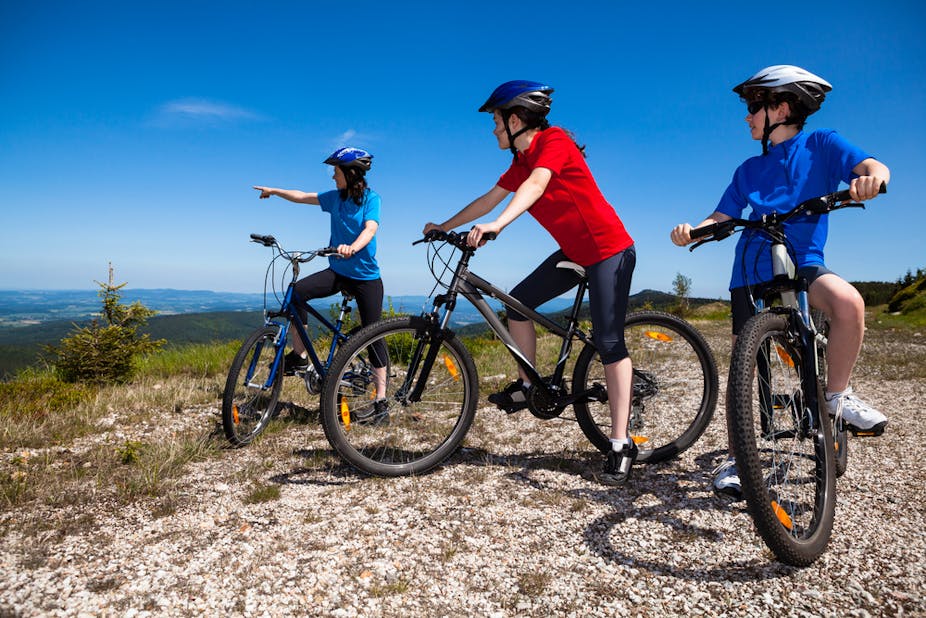
Cycling in regional areas is not quite the paradise you see in tourism brochures. Image from shutterstock.com

Images that promote cycling in regional Victoria are often beautiful and enticing: smiling, happy people ride along scenic bike paths that meander through wide, open farmlands, dense bushland and along the coast.

But for people who live and ride in regional communities, the picture is very different.

A recent Victorian study we undertook for the Baw Baw Shire Council investigated the safety concerns of cyclists and drivers when travelling on the roads in the Baw Baw Shire area.

The study was an online survey of 283 residents in the Baw Baw Shire area, 100km east of Melbourne, the majority of whom had a driver’s licence (98.5%). Around half (47%) of respondents classified themselves as cyclists, though not all rode frequently.

The cyclist’s perspective

Cyclists were most concerned with poor road surfaces which included potholes, broken bitumen, poorly maintained sections of road and the lack of a sealed shoulder.

Poor road surface has a two-pronged impact on cyclist safety: it poses a crash hazard and, when a cyclist swerves suddenly to avoid a pothole, for example, it contributes to drivers’ perception that cyclists are unpredictable.

Cyclists were also concerned about driver attitudes and behaviours. They reported that drivers didn’t allow sufficient distance when overtaking and seemed impatient, particularly when overtaking cyclists on narrow, windy roads with poor sight lines. Cyclists also faced verbal abuse from drivers.

Regional cyclists face a number of safety risks. Warwick Wallon

Cyclists and drivers generally feel more comfortable sharing the road when there are cycling-related line markings on the road. So it’s not surprising that the lack of cycling facilities (such as bike lanes) in the Baw Baw Shire area was a major safety concern for cyclists and drivers. Cyclists were also concerned that bike lanes ended abruptly with no safe option to complete their trip.

Drivers (who were infrequent cyclists or non-cyclists) reported that increased bike lanes would encourage them to ride more often as they currently felt there was no space for them on the road. Some respondents believed that a bike lane legitimised their position on the road.

The driver’s perspective

When driving, the top two concerns for all respondnets were:

  • being able to overtake cyclists safely
  • sharing the road on narrow road sections with no shoulder.

Beyond these two factors, the safety concerns varied considerably depending on the respondents’ road user status (cyclist or driver).

Cyclists were worried about:

  • low visibility and drivers not being able to see them
  • poor road surfaces
  • other cyclists’ behaviour and other drivers behaviour.

Drivers reported being annoyed at bunch-riding groups that sprawled across the road, illegal or arrogant cyclist behaviour and unpredictable cyclists.

Another factor mentioned by all respondents was the issue of speed and the difference between the speed of cyclists and other road vehicles. This is not surprising given many of the roads in the Baw Baw Shire area have high speed limits, often 100km/h.

Trucks were a serious safety concern for many cyclists, particularly on narrow roads where it’s difficult to accommodate large trucks and cyclists without some compromise.

Are cyclists legitimate road users?

While the survey respondents – cyclists and drivers – saw cyclists as legitimate road users, a small percentage (1.5% of cyclists and 13.8% of drivers) didn’t. Four drivers weren’t sure.

Alarmingly, fewer than a third of participants (32.1%) thought that other drivers consider cyclists to be legitimate road users.

Responses to the question: ‘Do you think other drivers consider cyclists to be legitimate road users?’

Council action

This study provided the Baw Baw Shire Council with quantified data about the cycling-safety concerns of residents in the area, which could be actioned.

Baw Baw Shire Council launched a six-part advertising campaign in the local newspaper to address the issue of cyclist legitimacy, driver safety and cyclist behaviour.

Brochures and stickers were also developed to promote sharing the road and these will be distributed at community and cycling events.

Baw Baw guerrilla knitting

Signage has increased in the Baw Baw Shire area to promote cycling facilities and boost cycling legitimacy, including stencils spray painted under bike racks and local artists' guerrilla knitting of bike parking racks.

Roadside signs to increase driver awareness of the presence of cyclists on the road have been purchased and are yet to be installed alongside the main road into Warragul, the largest township in the Baw Baw Shire.

Baw Baw roadside sign

Some 1,000 copies of the Code of Conduct for Training Cyclists have been printed for distribution to bunch riders through cycling clubs and Council.

Findings from the study have already been used to inform the Department of Transport’s Victorian Cycling Strategy of the specific cyclist safety requirements in regional areas. Discussions are continuing with Victoria Police to develop education or enforcement approaches specific to Baw Baw Shire.

The Council still has work to do in identifying routes with high volumes of cyclists along rural roads. It plans to map existing on-road bike lanes to determine whether they meet existing standards and to show the gaps in the connectedness of the current bike network.

While this study was specific to the Baw Baw Shire in Victoria, the findings can be applied to cycling in almost all regional areas of Australia. For many reasons – not least the presence of high-speed traffic, few (if any) bike lanes, poor road surfaces and lack of road shoulders – cycling in regional areas is not quite the paradise you see in tourism brochures.

With the support of local councils, studies of this kind will be the first step down the road of improved cyclist safety in regional areas.

This article was adapted from a conference paper written and presented with Nicolette Davey (Baw Baw Shire Council) this week at the 5th Annual Australian Cycling Conference.

Join the conversation

12 Comments sorted by

  1. Seamus Gardiner

    Citizen

    Thank you for this article. Previous cycling related articles on the conversation have concentrated on inner city melbourne and sydney, which is great if you live there, so it's pleasing to see the circumstances in regional areas.
    It's also interesting to see that the 'copenhagenisation' movement, as laudable as it is for inner city cycling, really has less of a place in regional areas, where distances and infrastructure are quite different. Less stress should be on duplicating cycling paths adjacent…

    Read more
    1. James Steward

      logged in via Facebook

      In reply to Seamus Gardiner

      Copenhagen style bike lanes are a disgusting misfit of road engineering. They encourage motorists not to think of bicyclists as legitimate (get them off the road and out of my way), and put cyclists in danger of hitting pedestrians and being taken out by turning vehicles where they cross side streets.
      I refuse to use these dangerous farcilities, prefering to delay motor vehicle traffic.
      BTW, I've raced through cows on the road with Shepparton CC. Green muck everywhere. I'd prefer to race over that than wet tram tracks ;-)

      report
    2. Seamus Gardiner

      Citizen

      In reply to James Steward

      Hi James,
      I read some research (somewhere) that segregation of cyclists from traffic does lead to less collisions between cyclists and vehicles (what a surprise!). But conversely, more cyclists on the road 'normalises' the activity, makes vehicular drivers more aware of cyclists and reduces collisions as well. What is often forgotten is that cycling paths also lead to cyclist/cyclist collisions (see Bicyclist–Bicyclist Crashes—A Medical and Technical
      Crash Analysis 2013). The 'copenhagen' model…

      Read more
  2. Michael O'Reilly

    Journalist

    Amazing to see that only a third of survey respondents thought motorists see cyclists as legitimate road users. And almost a third weren't sure.
    So much for "share the road".

    report
  3. Julian Del Beato

    logged in via Facebook

    i see my share of illegal cycling behaviour in the city, such as disobeying red lights, but i'm struggling to think what sort of illegal activities cyclists would get up to on rural roads. my experience is that a disturbing number of motorists seem quite certain that being held up by a cyclist must be somehow against the law.

    report
  4. Gary Cassidy

    Potholes seem to be concentrated in the skinny section of road that cyclists use (far left). They are generally very poorly repaired. Not good for non-suspension vehicles such as bikes!

    report
  5. peter mackenzie

    Transport Development and Road Safety Researcher

    Very good article Marilyn and good work by Baw Baw Council in working to address issues.

    Speed differential between motorists and cyclists is a big issue. I have conducted "naturalistic" (observational) studies of road user behaviour over more than forty years. A large number, perhaps the majority of rural drivers travel as close to the speed limit as possible, including around blind curves and over crests, without anticipating meeting slower vehicles, cyclists, agric ultural machinery or even…

    Read more
    1. James Steward

      logged in via Facebook

      In reply to peter mackenzie

      So you're saying;
      a. some drivers should not have a license because they are poorly trained, irresponsible and dangerous.
      b. some cyclists could do with better riding skills.
      c. bike lanes next to parallel parked cars are bad (because they encourage doorings).
      d. authorities are powerless to act unless there is a collision and visible damage, and then the penalties are not geared to the extent of the injury or loss suffered by the victim.

      Ok, I took some liberties with c and d ;-), but basically, I agree.

      report
  6. James Steward

    logged in via Facebook

    Change the minds of the motorists, and bike farcilities (note intentional misspelling) are not required.

    It seems to me the alarming statistic that demands the most immediate attention and forceful action, is that almost half the motorists did _not_ consider bicyclists as legitimate road users.
    How ill informed can they be?
    Bicycles are legally defined as vehicles under the road law.
    A bicycle rider is a legal vehicle operator under the road law.
    You can ride a bicycle _without_ needing a…

    Read more
  7. peter mackenzie

    Transport Development and Road Safety Researcher

    James, if you stlill are following this, I tried to reply yesterday, but computer said No!

    What I was trying to say was that we must have a safety system that stops ignoring risk incidents and instead develops a system to monitor and examine incidents, then take the appropriate steps in education/policing of unsafe behaviour, as well as upgrading infrastructure to safer design. At the moment there is up to 20 and more years lag in upgrading infrastructure, even when it is known to be unsafe, and…

    Read more