Selling Australian uranium is reportedly at the top of Prime Minister Julia Gillard’s priorities as she travels to India this week. Before she decides to do that, there are three facts she may want to consider.
First, despite all the hoopla about India’s nuclear ambitions, nuclear energy is unlikely to contribute more than a few percent of the country’s electricity capacity in the next several decades, if ever.
India’s Department of Atomic Energy (DAE) has always promised much and delivered little. In the early 1970s, for example, DAE projected that by 2000 there would be 43,000 MW of installed nuclear capacity. In 2000, that capacity was actually 2720 MW. Today, nuclear power constitutes barely 2% of the total electricity generation capacity.
There is at least one good technical reason why future targets are unlikely to be met: India is pursuing an unreliable technology. The DAE’s plans involve constructing hundreds of fast breeder reactors. Fast breeder reactors are so-called because they are based on energetic (fast) neutrons and because they produce (breed) more fissile material than they consume.
In the early decades of nuclear power, many countries pursued breeder programs. But practically all of them have given up on breeder reactors as unsafe and uneconomical. Relying on a technology shown to be unreliable makes it likely that nuclear power will never become a major source of electricity in India.
The failure to meet targets is not a result of lack of money. DAE has always been lavishly funded. Its proposed budget for 2011–12 was roughly $A1.7 billion; in comparison, the proposed 2011–12 budget of the Ministry of New and Renewable Energy was $A0.22 billion. It’s testimony to the government’s priorities.
To put that in perspective, the total generating capacity of renewable energy projects was 22,233 MW, whereas the installed capacity of nuclear power was 4780 MW. Though almost all of the growth in modern renewable energy capacity has been over the last two decades, they already generate more electricity (in GWh) than all reactors put together.

Second, there are reasons to be worried about the risk of severe accidents at Indian nuclear facilities. Among all electricity generating technologies, nuclear power alone comes with the possibility of catastrophic accidents, with consequences spreading out across space and time. Despite improvements in reactor technology, the probability of such catastrophic accidents remains stubbornly greater than zero. This poses extreme organisational demands, and these demands have unfortunately not been met.
Most nuclear facilities in the country have experienced small or large accidents. Fortunately, none of these has been catastrophic. Many of these were caused by inattention to recurring problems or other warnings; to the extent that those responsible for safety have tried to fix them, they have not always been successful.
Compounding this state of affairs is the absurd confidence DAE leaders have publicly expressed — and have likely internalised — in the safety of nuclear facilities in the country. This has often taken the form of asserting that the probability of a nuclear accident in India is zero, something that was frequently heard in the aftermath of Fukushima.
Worse, on March 15, 2011, the Chairman of NPCIL reassured the public saying, “there is no nuclear accident or incident in Japan’s Fukushima plants. It is a well planned emergency preparedness programme which the nuclear operators of the Tokyo Electric Power Company are carrying out to contain the residual heat after the plants had an automatic shutdown following a major earthquake.”
Such denial would be laughable, but when the person opining is in charge of India’s power reactor fleet, it ceases to be amusing. It is well worth noting by anyone planning to supply uranium, especially Australia, given that Australian uranium was used as fuel at the Fukushima Daiichi nuclear reactors.
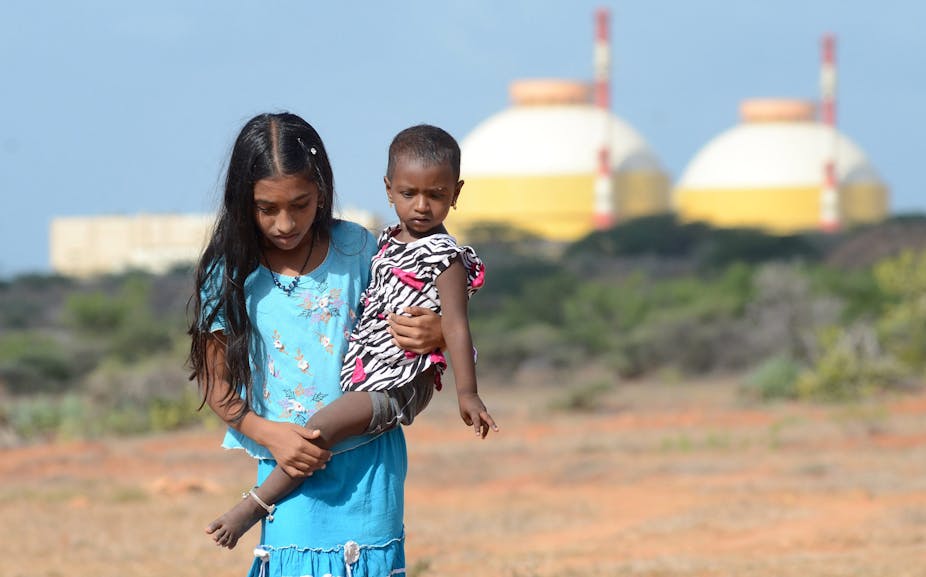
Third, a large majority of the Indian public, particularly those living near proposed nuclear facilities, learned the obvious lesson from Fukushima: nuclear reactors are hazardous, and communities living near nuclear facilities would be the worst affected in the event of an accident. This is why there are ongoing protests at all new sites selected for nuclear plants. The protracted and intense protests over commissioning of the Koodankulam reactors in Tamil Nadu is just the most spectacular of these.
The risk of catastrophic accidents means that the pursuit of nuclear power is justified only if it is done democratically with the informed consent of the potentially affected populations. What the ongoing protests over Koodankulam and other reactor sites tells us is that these populations are not consenting to be subject to this risk.
They deserve to be listened to, including by Prime Minister Gillard.
John Newton
Author Journalist
It seems passing strange for a country one of whose major fuels is burning cow patties to leap into nuclear.
The other issue is that India has enough potential free energy to power the entire sub continent: the sun, the source of all energy.
But there are a couple of things wrong with solar power - and neither of them as to do with baseload which, if anyone cites it, will prove they have not been paying attention to the developments in the technology.
Firstly, because it's free, no one can make squillions selling it
And secondly having nuclear power plants puts you in the Big School.
And what's the bet that none of the issues raised above in this very good article will be raised when our PM meets their PM.
John Newton
Author Journalist
And listen to some of the comments Senator Scott Ludlam makes in this interview:
http://greensmps.org.au/content/audio/scott-ludlam-uranium-senate-doors
Geoff Russell
Computer Programmer, Author
The depopulation and evacuation wasn't caused by the Fukushima reactor
failures. People are living and have been living for millennia in areas of the
planet more radioactive than is currently the case at Fukushima. The reactor
failures raised levels of radioactivity certainly, but not beyond levels that
already occur naturally in some parts of the world ... e.g., Ramsar in Iran. The
evacuation and the deaths and hardships are squarely the fault of anti-nuclear scare mongering.
Consider. Chernobyl caused contamination of large areas of Turkey and the great scare-monger Helen Caldicott tells people not to eat Turkish apricots. What's the (age standardised) rate of cancer in Turkey? About 1/2 that of Australia. That's right, all that contamination has done nothing. Australian beef is a much bigger cancer threat than Australian uranium and we export that to plenty of countries.
Luke Weston
Physicist / electronic engineer
Scott Ludlam probably has more documented, recorded, on-the-record examples of woeful science illiteracy and science denialism to his name, on the subject of nuclear energy, than anybody else in the country.
But I'll let my fellow readers here decide for themselves - from his own words.
http://scott-ludlam.greensmps.org.au/content/media-releases/safeguards-uranium-sales-emirates-entirely-unsafe
"Without nuclear power stations - there can be no nuclear weapons, no possibility of fuels being stolen to build ‘dirty bombs', no possibility of a nuclear power station being hit by a conventional bomb and setting off a nuclear explosion."
Geoff Russell
Computer Programmer, Author
Yes, the author is quite right that the Indian nuclear industry hasn't delivered up to its hype but he doesn't need to deliberately mislead by comparing a nuclear mega watt with a renewable megawatt. So why do it? Typically renewable MWs have to be divided by anything from 4 to 12 (depending on technology and location) before comparing with nuclear MW and even then comparing an intermittent MW with one available 24x7 is still a little dodgy.
There are 7 reactors under construction presently and…
Read moreZvyozdochka
logged in via Twitter
"1/4 million children die annually because of biomass cooking smoke in India."
None of the electricity proposed from those plants will go to people cooking in such a way. It's too expensive.
Mike Hansen
Mr
Geoff Russell claims "Talk of nuclear risks in India shows that the author is a little out of touch..."
From The Age yesterday
"INDIA'S nuclear industry, Australia's newest prospective uranium customer, has been slammed by that country's own auditor as dangerously unsafe, disorganised and, in many cases, completely unregulated"
http://www.theage.com.au/opinion/political-news/india-questions-its-own-nuclear-industry-20121014-27l0a.html
Geoff Russell
Computer Programmer, Author
And the body count for 20 reactors (admittedly small) during the past couple of decades is?
Geoff Russell
Computer Programmer, Author
None? So it will all go to people who already have electricity? So why would they buy it?
Pretty obviously, much of the new electricity will go to people who don't have it ... which may not
be the poorest of the poor, but it isn't only the poorest
of the poor who cook with biomass in India. You could have said the same thing about electricity from coal in
China 20 years back ... why produce it because the poor can't afford it? But it is an essential step in lifting the poor out of poverty.
Zvyozdochka
logged in via Twitter
Investment in baseload power and distribution is a total waste of resources; the poorest won't benefit, they don't want massive power plants. They will never see that power.
If the concern is "lifting the poor", then projects like energyforall.info are most effective.
I urge you to take a look into what they're doing. Solar cookers, solar water pumping purification, solar lighting, solar radios of education. The effectiveness of these programs with massive underfunding is amazing, but the elite want nuclear power funded for the utility company's to profit.
Embedding control of energy to central rent seekers is exactly the mistake the "developed" world has made that is now costing us in quickly dismantling the inefficient and dirty parts of the industry.
Peter Lang
Retired geologist and engineer
And it's still the safest way to generate electricity. Telling isn't it?
Mike Hansen
Mr
Compare the comments from the Indian auditor-general to the comments *after the event* from the Fukushima Nuclear Accident Independent Investigation Commission
"Only by grasping this mindset can one understand how Japan’s nuclear industry managed to avoid absorbing the critical lessons learned from Three Mile Island and Chernobyl; and how it became accepted practice to resist regulatory pressure and cover up small-scale accidents. It was this mindset that led to the disaster at the Fukushima Daiichi Nuclear Plant"
"The regulators should have taken a strong position on behalf of the public, but failed to do so. As they had firmly committed themselves to the idea that nuclear power plants were safe, they were reluctant to actively
create new regulations."
http://www.nirs.org/fukushima/naiic_report.pdf
Geoff Russell
Computer Programmer, Author
I'm still waiting for the body count Mike ... or illness. As far as I can
see ALL of the trauma associated with Fukushima is down to the anti-nuclear
movement with the exception of 3 workers who got mild radiation burns.
Nuclear reactors are like aeroplanes, safety is important and when people make mistakes, their are lots of serious sounding sentences in reports ... as there should be. But at the end of the day a successful crash landing is one where nobody dies. We all know this and understand that planes safer than cars, despite the obvious scariness of being a long way up. You are judging nuclear power as dangerous despite a tiny body count ... zero at Three Mile Island and Fukushima and less than a single aircraft crash at Chernobyl.
Olav Muurlink
Research Fellow, Griffith Business School at Griffith University
Zero at Three Mile Island and Fukushima and less than a single aircraft crash at Chernobyl... Geoff, when aircraft crash, you can count the bodies, one by one, and there isn't much dispute about the count. With nuclear power, unfortunately, the deaths are generally very delayed and can only be indicated (and never 'proven') statistically, much as the anti-nuclear movement might want it to be. However, the fact that there are government-imposed exclusion zones in both Fukushima and Chernobyl indicates that even though you, Geoff, don't believe that 'small' doses of radiation causes cancer, the Russian and Japanese government do. If the best science were not indicating that small doses cause cancer, why do you think Russia and Japan would be sacrificing billions, if not trillions of dollars of good agricultural land and future output?
Ben Heard
Director, ThinkClimate Consulting
"Solar cookers, solar water pumping purification, solar lighting, solar radios of education. "
There is also a lot of wind. Not baseload as we all know, but not village scale either. Over 14,000 MW installed at present (India Energy Statistics 2012).
Does your argument force you to take the same position against furthering investment in this type of energy generation? I can't see it helping the customers of energyforall.info much. It will not be cheap power. It needs connection. Last I looked wind companies are not what you would call "start-ups."
Ben Heard
Director, ThinkClimate Consulting
Olav, that's a great question and I know Geoff will provide a great answer. But to be clear, it's not Geoff making the assertion, it's WHO http://www.bbc.co.uk/news/world-asia-18181224 and you can find plenty of other reports from expert bodies saying the same thing. Even when someone used the most extreme form of modelling to come up with a future death toll, authors with well-known anti-nuclear sentiments, the result was pretty pathetic http://www.marklynas.org/2012/07/fukushima-death-tolls-junk-science/
To be clear: the radiation levels are super low, the health risks virtually non-existent in all but probably some discrete patches. It's not a matter of opinion, it has been measured.
Geoff Russell
Computer Programmer, Author
Hi Olav, I don't deny that small amounts of radiation can cause cancer. So can wood dust, leather dust, bacon, diesel fumes and sunshine ... among many. The issue is one of matching the degree of concern with the actual risk. Consider the atomic bombings at Hiroshima and Nagasaki. Generally the survivors are lumped into groups depending on how much radiation they received. Usually the maximum group is > 2 Sv. That's huge. The LD50 is about 5 Sv. Here's just such a study
http://www.rerf.jp/radefx…
Read moreMike Hansen
Mr
It never ceases to amaze me that nuclear advocates believe that the "Black Knight" defence works.
http://en.wikipedia.org/wiki/Black_Knight_(Monty_Python)
Ben - which of the following statements would concern you
"INDIA'S chemical industry has been slammed by that country's own auditor as dangerously unsafe, disorganised and, in many cases, completely unregulated" (see Ashok's comment above)
"INDIA'S airline industry has been slammed by that country's own auditor as dangerously unsafe, disorganised and, in many cases, completely unregulated"
"INDIA'S nuclear industry, Australia's newest prospective uranium customer, has been slammed by that country's own auditor as dangerously unsafe, disorganised and, in many cases, completely unregulated"
http://www.theage.com.au/opinion/political-news/india-questions-its-own-nuclear-industry-20121014-27l0a.html
Lisa Hodgson
Director
And what causes abnormal thyroid growth in 36% of children Geoff?
http://fukushima-diary.com/2012/10/business-insider-confirmed-36-percent-of-fukushima-kids-have-abnormal-thyroid-growths-and-doctors-are-in-the-dark/
Geoff Russell
Computer Programmer, Author
Do you know what the normal rate of thyroid lumps in Australia is Lisa?
Ben Heard has dealt with this cherry picking ...
http://forum.onlineopinion.com.au/thread.asp?article=13925
Consider Chernobyl. There have been 14 million cases of cancer in the 3 affected countries during the past 25 years. About 6,000 of those are thyroid
cancers due to Chernobyl, with very few deaths. If those three countries
had had Australian cancer rates, how many cancers would they have had? More than 14 million, or less? [Answer: about 20 million] There are big causes of cancer and little ones. Radiation is a little tiny microscopic one. If you have children and let them eat red or processed meat, then that's a BIG cause of cancer. Think about it.
Yoron Hamber
Thinking
Ben, don't think that the International Atomic Energy Agency (IAEA) have done their risk assessments good enough. And what really counts is the radioactive dust that drifting with winds and ocean currents have no end really as they can be carried all over the world through ingesting. I expect both Chernobyl and Fukushima to be there in twenty years, still dangerous. Russia which have the highest amount of 'hot spots' in the world, official and unofficial, do have some remarkable statistics which…
Read moreGeoff Russell
Computer Programmer, Author
Fancy statistics is what you use to find tiny signals in lots of noise. The key word here is "tiny".
Yoron Hamber
Thinking
And you're the expert on this Geoff? Statistics are to my knowledge one of the best tools we have, if not the best, for predicting things to come. But it need to be gathered, not ignored.
Geoff Russell
Computer Programmer, Author
As it happens I do have a maths degree with more statistics than many researchers ... but not as much as a specialist statistician. Nobody is ignoring the data. All the cancer registries around the world are gathered into Globocan and you can google it and check out national cancer rates. These will tell you if anything really big is happening. The cancer rates in Chernobyl polluted Ukraine, Belarus and Russia are about 2/3 of those in Australia. It's always easy to find little pockets where cancer…
Read moreBen Heard
Director, ThinkClimate Consulting
I'm defending nothing. I read the actual auditor report and posted a link to it from my site, it is not a good report card. But I'm very comfortable in pointing out the actual track record of deaths and injuries from the Indian nuclear industry, and the global nuclear industry, compared to every other energy source and system. I am consequently comfortable in querying the benefit to us in holding nuclear to a standard far above other energy sources. If we do that, we lose.
Can you even imagine what such a review would turn up for the Indian coal industry? But we would not even bother. We all know it kills people in vast numbers, we have just decided not to care and accept it.
I happen to think all risk matters, not just that with a radiological association.
Ben Heard
Director, ThinkClimate Consulting
I just love that someone marked me down for that comment. Why, exactly? It's fair play to explore the consistency of each other's arguments, it's a logical train of thought, and it includes referenced data.
Oh well.
Ben Heard
Director, ThinkClimate Consulting
For the interest of all, I have linked the original report from the auditor at this page.
http://decarbonisesa.com/2012/10/15/nuclear-india-guest-radio-spot-on-triple-js-hack/
Interesting to note the recommendations. Such a plain speaking report does not, I repeat, does not recommend halting, constraining, reversing or undoing developments of nuclear power in India.
Luke Weston
Physicist / electronic engineer
Avoid absorbing the critical lessons learned from Chernobyl?
I'm pretty damn sure nobody in Japan ever built and operated a water-cooled graphite-moderated reactor with a positive void coefficient, much less put people who weren't nuclear engineers, with absolutely no understanding of void reactivity coefficients, temperature reactivity coefficients, xenon-135 neutronics, etc. etc. in charge of operating a power reactor.
Mike Hansen
Mr
You could always read the report that I linked to Luke.
"Much was learned from the Chernobyl accident about low dose radiation exposure, including the risk of thyroid cancer among children. Although the positive effects of administering stable iodine and the proper timing were fully known, the government’s nuclear emergency response headquarters and the prefectural government failed to give proper instructions to the public."
Perhaps the main advice from the report was to not let your country…
Read moremark mc dougall
educator
geoff, you seen recent deformed births in fallujah? Like the idea of twoheads?
lungs outside the body?,??Your grandchildren?
seen anyone missing a digit? sawmiller, or child of irradiated heritage?
talking cancers, Ever realise that maralinga,....had a dust cloud,....which blew all over australias food bowl,..? that maralinga itself still has hot spots?..
statistics anyone?or prefer white noise!
Geoff Russell
Computer Programmer, Author
Did you bother to read anything at all about birth defects before making that contribution? After the Hiroshima/Nagasaki bombings, there were huge studies involving over 76,000 births to women who had been irradiated and this was compared with a similar sized control group. They looked at doses received by both mother and father. The birth defect rate was the same.
http://www.rerf.jp/radefx/genetics_e/birthdef.html
It is possible to produce all manner of birth defects with radiation in experimental animals, but the doses are massive, far higher than even an atomic bomb survivor would get.
As far as I know, nobody knows the cause of the Fallujah problems, but they are far too serious to be due to any conceivable local radiation dose and not even remotely likely to be due to depleted uranium. Somebody has just made up this story about it being due to depleted uranium and people who don't bother to check anything at all just lap it up.
mark mc dougall
educator
try second generation studies!
radiation external, and radiation internal are different.the first a one off, the second,ingested,is a continuing,... like asbestos, continuing antagonist...repeated malevolence... you know the demeanour??
Geoff Russell
Computer Programmer, Author
Internal radiation? Everybody needs internal radiation. Without
it you are dead. Try living with a zero potassium intake.
Do you have any evidence for your slogans? So far, that's
no. What do you teach? Slogans 101?
Mike Hansen
Mr
"Somebody has just made up this story about it being due to depleted uranium and people who don't bother to check anything at all just lap it up."
You are quite the radiation crank Geoff. You need to read beyond the nuclear cult sites.
"In aggregate the human epidemiological evidence is consistent with increased risk of birth defects in offspring of persons exposed to DU."
http://www.ncbi.nlm.nih.gov/pubmed/16124873
"This brings us to the point where we are currently at, where the potential…
Read moreYoron Hamber
Thinking
Didn't come to discuss Globocan Geoff, it seems a worthwhile and ambitious project to me, just point out that western statistics isn't what it should be when it comes to former USSR. We can make this into how big an issue we want and gather at each side of the fence but that's not very smart.
I could point out that their 'charter' states that 'Mortality statistics are collected and made available by the WHO .Their advantages are national coverage and long-term availability, although not all datasets…
Read moremark mc dougall
educator
Dear geoff, it would be thoroughly unproffesional for me to elucidate cases and experiences on this public forum. If you cannot imagine any of the above mentioned scenarios maybe "life" will have to arrange a meeting?,...those that dont learn from past mistakes seem destined to repeat them...
"slogans"?? "Every body needs internal radiation"???
Yes we all need to die, but the question and importance is when and how and what should we have achieved before we die. The main question remains, How deformed do we wish our inheritors to be (when we are gone)?
Geoff Russell
Computer Programmer, Author
What any of this has to do with Indian nuclear power is beyond me. It's all rather like suggesting a ban on swimming pools because they use chemicals found in mustard gas.
But, lets continue anyway. The original suggestion seemed to be that the normal thyroid lumps are somehow relevant to Indians building nuclear power because of birth defects in Fallujah. Yes? And the whole can of worms tumbles out.
Mike, the studies you cite are all excellent reasons why I'd be extremely certain that the…
Read moreZvyozdochka
logged in via Twitter
There you go, plus'd it up for you.
Mike Hansen
Mr
I agree that it is not directly related to the topic at hand. I was responding to your claim "Somebody has just made up this story about it being due to depleted uranium and people who don't bother to check anything at all just lap it up."
Well clearly that is bull shite. It was not made up. You can disagree with the studies but you cannot claim that they do not exist.
"In aggregate the human epidemiological evidence is consistent with increased risk of birth defects in offspring of persons…
Read moreBen Heard
Director, ThinkClimate Consulting
Balance is restored!
Geoff Russell
Computer Programmer, Author
Mike, there's a big difference between a certain impact being consistent with a postulated impact of DU (and a million other things) and the claim that a massive impact was caused by DU. Someone made up the latter.
I don't claim that uncertainty implies no impact, but it almost always implies a small impact. Diesel fumes can cause cancer, as can sunshine, as can ionising radiation, I've never disputed this. What I do say is that the carcinogenic impact of diesel fumes doesn't warrant mass panic…
Read moreBen Heard
Director, ThinkClimate Consulting
Mike, the report is a relevant link, thanks (saved it for future reference)
Some relevant findings, absolutely.
But the stubborn lack of fatality from acute radiation, the extraordinarily low dose exposures to the public, and the measured findings that most of the exclusion zone would be perfectly safe to live in, do serve to rebalance things. There is a difference between bad practices that should not have occurred and contributed to the event happening, and the subsequent consequences…
Read moreBen Heard
Director, ThinkClimate Consulting
Mike,
You know something that really sh!ts me in places like this? It's when people cherry pick a sentence from an abstract of a paper to support their POV. This is what happened in that Fukushima thyroid nonsense. Think I might cherry pick a few myself...
"Animal studies firmly support the possibility that DU is a teratogen."
Ok. We know what happens to animals in animal studies. Massive doses.
"While the detailed pathways by which environmental DU can be internalized and reach reproductive…
Read moreMike Hansen
Mr
Ben. As well as keeping the report, you like Luke should try reading it. Note also that this is the "Executive summary". Read the quote re Chernobyl in my reply to Luke. They are not comparing reactors but the reaction after the accident. Here it is again
"Much was learned from the Chernobyl accident about low dose radiation exposure, including the risk of hyroid cancer among children. Although the positive effects of administering stable iodine and the proper timing were fully known, the government…
Read moreMike Hansen
Mr
Here is the Ramsar, Iran link.
http://en.wikipedia.org/wiki/Ramsar,_Mazandaran#Radioactivity
This is a village of 1800 people. If you get this example served up, you know you are being had.
"Some areas around Ramsar have the highest level of natural radioactivity in the world, due to the presence of radioactive hot springs. In the high-background radiation districts of Ramsar, the average dose of radiation received by a person for one year is about 10 mSv, and can reach levels in excess of 260 mSv."
Geoff Russell
Computer Programmer, Author
"unless there are bodies, there is no harm done" ... nobody believes this Mike, but we know the consequences of panic and hurried mass evacuations; people die, frequently the elderly and infirm die before their time. And animals were left to starve. You support killing people to avoid 133 mSv per year?
In a single dose, 100 mSv is regarded as detectable using normal epidemiology, but 133 mSv over a year? Find me an epidemiologist who thinks this will kick up cancer rates by an amount even close to the death and trauma rate of the evacuation.
Mike Hansen
Mr
Did I read it. Look at what I linked above!
"This lack of fundamental information makes extrapolation from animal data to humans a strictly academic exercise. The few human studies that are out there are limited to military service personnel who have different exposure profile than we would expect for civilians, or the studies are limited in usefulness by their design and sample type "
Your point is?
My point is that Geoff claimed "Somebody has just made up this story about it being due to depleted uranium and people who don't bother to check anything at all just lap it up."
Well someone did not make it up. There have been studies that indicate reason for concern. The fact that there is conflicting and some inconclusive research is not the same as claiming it was made up. For obvious reasons epidemiological studies in Iraq are problematic. For Geoff to dismiss it out of hand is consistent with his dismissal of risks from nuclear radiation.
Lisa Hodgson
Director
October 16, 2012
http://thewatchers.adorraeli.com/2012/10/16/ground-fukushima-unit-4-sinking-structure-verge-complete-collapse/
Anyone concerned about the consequences of this?
I suppose this will be completely safe, with only minor exposure?
No need for further evacuation hey?
Geoff Russell
Computer Programmer, Author
Are you worried about the reactor vessel or the spent fuel rods?
If the pool with the rods collapsed, then there's a bunch of rods on the ground containing fuel pellets. Annoying and expensive ... but dangerous? No more than a fire ... just stay away unless you have the right gear. I guess if you were to turn up with a mortar and pestle and remove all the pellets and grind them up and then put a bomb under it, then that would be a problem. But that's like imagining all the fuel tanks in Australia magically just blowing up. Why aren't you worried about that? It's just as likely.
Ben Heard
Director, ThinkClimate Consulting
I did read it. You know, those quotes and stuff? Plus I acknowledged where it is strong and where I make no argument with their conclusions. I fundamentally disagree with how you are choosing to apply it to the suitability of nuclear power at large, along with your inability to acknowledge the very clear weaknesses, biases, lack of completion and misunderstanding of radiological harm that the report also contains in a couple of important issues.
But everything else you describe in the report remains…
Read moreGeoff Russell
Computer Programmer, Author
Yes, well said Ben.
Mike, bluffing with citations that don't support your claims works quite well in the anti-nuclear movement, and I have to confess, that I spent plenty of years just accepting references without actually checking. But climate change forced me to spend time checking my biases on issues like nuclear power that I had taken for granted for decades. It took me months of digging to realise the whole Caldicott charade is just built on sand. So now I'm angry. Mainly at myself for being so damned gullible.
I've also got a mother in a nursing home so the evacuation issue is pretty raw. The idea of putting her through such a trauma over 133 mSv/yr (or probably less) is totally unconscionable, but that's the state of unjustified panic that the anti-nuclear movement has produced.
Lisa Hodgson
Director
OK. According to the Secretary of former Japanese Prime Minister Naoto Kan “If Unit 4 collapses, the worse case scenario will be a meltdown, and a resultant fire in the atmosphere. That will be the most unprecedented crisis that man has ever experienced. Nobody will be able to approach the plants … as all will have melted down and caused a big fire,” said Murata during the interview. “Many scientists say if Unit 4 collapses, not only will Japan lie in ruin, but the entire world will also face serious damages.”
But Geoff assures us that it's all good; best worry about imaginary fuel tank explosions then.
Mike Hansen
Mr
You really have some cheek accusing me of cherry picking the details of background radiation in Ramsar. It was quoted as an example by Russell and by Lynas but I am the one who provided a link where the information could be checked.
Here it is again.
"Some areas around Ramsar have the highest level of natural radioactivity in the world, due to the presence of radioactive hot springs. In the high-background radiation districts of Ramsar, the average dose of radiation received by a person for one year is about 10 mSv, and can reach levels in excess of 260 mSv."
http://en.wikipedia.org/wiki/Ramsar,_Mazandaran#Radioactivity
Lisa Hodgson
Director
Apologies, I quoted the wrong guy should have read Mitsuhei Murata, the former Japanese Ambassador to both Switzerland and Senegal.
Mike Hansen
Mr
"You support killing people to avoid 133 mSv per year?"
What a truly pathetic argument. You really have been wacked with the nuclear magic wizzle stick. Are there any depths below which you will not sink?
This is from the NAIIC report. "The operator (TEPCO), the regulatory bodies (NISA and NSC) and the government body promoting the nuclear power industry (METI), all failed to correctly develop the most basic safety requirements—such as assessing the probability of damage, preparing for containing…
Read moremark mc dougall
educator
http://tv.globalresearch.ca/2012/10/iraqi-birth-defects-surge-us-depleted-uranium-ammo
yes, a side issue.
Luke Weston
Physicist / electronic engineer
Could we try a health physicist instead of a politician?
Geoff Russell
Computer Programmer, Author
As early as June in 2011, there were indications that some of the people
responsible for standards were beginning to realise that various of the
official standards are doing more harm than good:
http://spectator.org/archives/2011/12/06/let-the-people-of-fukushima-go
There have been too many decades of pandering to a politically powerful anti-nuclear movement and Fukushima demonstrates that this needs to change. Lives shouldn't be put at risk to avoid a dose of 133 mSv/yr.
If the anti-nuclear movement hadn't stalled the nuclear rollout of the 1970s, our climate change problem would be much smaller. France has been generating ~6.4 tonnes CO2/cap/yr (not total GHG, just CO2) for decades while the countries who abandoned their nuclear roll outs rose ... Germany ~10 tonnes CO2/cap/yr. The anti-nuclear movement has cost us decades and their legacy to the planet may end up being 6 degrees.
Caldicott's legacy to the planet may end up being 6 degrees.
Geoff Russell
Computer Programmer, Author
P.S. I noticed Mike that you didn't answer the question. It's clear that the IAEA has standards which result in deaths to avoid small levels of radiation. But I asked you what you think. Should people be killed to avoid 133 mSv/yr? Do you support these lethal IAEA standards or not? ... that's the bottom line because that's what actually happened. People and animals suffered enormously to avoid tiny risks. That's just plain cruel.
mark mc dougall
educator
cruelty,? compassion?
http://tv.globalresearch.ca/2012/10/iraqi-birth-defects-surge-us-depleted-uranium-ammo
maybe? maybe not?
Caldicotts legacy to the planet may be our continuing human lives on this living earth, and may be 6 million (or six billion) deformities saved ?
life in abundance ? or deformed depletion?
being decided even now,...
Mike Hansen
Mr
On the other hand, readers here can check my posts and discover that any claim I make is backed up with a link.
They can then check your posts and discover that you make extraordinary claims without any evidence or links.
Mike Hansen
Mr
Helen Caldicott and Geoff Russell are flip sides of the same coin.
They both claim that the nuclear industry is incapable of operating within current radiation safety standards.
Calidcott wants to abolish the nuclear industry, Russell wants to abolish the safety standards.
Mike Hansen
Mr
Yes. I support the IAEA standards. As does the Japanese Government. The idea that the Japanese could dispense with IAEA advice and not evacuate because a crank in Australia thinks the standards are wrong is your fantasy - I am sure it gives you great solace.
Geoff Russell
Computer Programmer, Author
When safety standards increase suffering, then they need to be changed. It's been clear to a variety of experts with far greater knowledge than me, since at least June 2011 (see e.g., http://bit.ly/skjiuZ ) that the evacuation has done far more harm than leaving people where they were. I would hope that there is activity behind the scenes to learn from this and fix evacuation guidelines to that they do good instead of harm.
Yoron Hamber
Thinking
Geoff?
"When safety standards increase suffering, then they need to be changed."
You forgot to define for whom, those living there, or the Yakuza closely involved in the planning and building of nuclear plants, or the Japanese Government?
What the ordinary people wants is simple, to be safe. And if you think that the government changing 'safety levels' from one day to the other makes people believe themselves safer you're deluding yourself..
IAEA stand for pushing nuclear 'safe' technology, not for monitoring and protecting, although that has become one of their priorities nowadays. In a way you can say that it all goes into one another of course, but the real question is if mankind really is best served by nuclear technology. And looking at Russia, Japan etc?
Zvyozdochka
logged in via Twitter
(My comment was lost somehow).
Nuclear power implies a baseload distribution which would be a massive investment in wasted infrastructure. Of course it's a lock-in to utility company operated power.
I've worked on community energy projects in India in the poorest areas. The greatest benefit to the greatest number of people of cheap energy would be more of the same, not massively distribution of power these people can't afford.
Olav Muurlink
Research Fellow, Griffith Business School at Griffith University
"Despite improvements in reactor technology, the probability of such catastrophic accidents remains stubbornly greater than zero." That's the nub of the question. However, I think even IF reactor technology were to be perfected, we'd still be left with humans who will continue to have a probability of stuffing up, deliberately or accidently, stubbornly greater than zero. That wouldn't really matter if nuclear power posed the same risk as coal fired power stations--that is, dramatically raising the temperature of the earth, killing a few dozen million people...it matters because nuclear has the potential to make the entire planet unlivable for all higher mammals. We need to remember that THAT is the reason nuclear power came into being--to kill on a grand scale. We may be trying to retrofit power generation onto the technology, but....
Ben Heard
Director, ThinkClimate Consulting
"nuclear has the potential to make the entire planet unlivable for all higher mammals." Extraordinary claims require extraordinary evidence Olav, and I am not seeing any.
"the same risk as coal fired power stations--that is, dramatically raising the temperature of the earth, killing a few dozen million people..." Erm... are you about to publish? You seem pretty confident in your finding in an area that very smart people work very hard in. Once again, no evidence provided, but for the record I'm placing "a few dozen million people" in the basket marked "significant"
As far as probabilities that remain stubbornly greater than zero, I do wonder how you, and MV Ramana, get out of bed in the morning...
Ashok Kaniyal
logged in via Facebook
It's curious that we hardly ever speak of moratoria on the construction or shut down of chemical production facilities in India or elsewhere, in the same volumes as Nuclear? In the constant discussion of the perils of nuclear, people seem to forget the daily struggles of the people of Bhopal relative to that accident's contemporary in Chernobyl.
The Chernobyl accident led to 64 direct deaths and up to 4000 indirect deaths (from the UNCEAR report). It's also interesting to note compare the deaths of over ten thousand from the Tōhoku earthquake but the enduring name from those events is Fukushima. The Fukushima earthquake led to four deaths, but the accident, zero.
Peter Lang
Retired geologist and engineer
MV Romana,
Do you really think you would know more about India's electricity needs than the Indians?
Do you really think Australia should be telling India we wont sell them energy because we know better than they do what sort of electricity generation they should use?
Do you really think Australia should deny the Indians the opportunity to more quickly lift themselves out of poverty?
Do you really think Australia should deny the Indians the opportunity to save many tens of thousands…
Read moreZvyozdochka
logged in via Twitter
Do you really believe that the poorest people in India want nuclear power that they already can't afford?
If more massive centralised power projects are pursued in India, it will only benefit the upper middle class city minority.
gary hudson
retired engineer
Nuclear power has been the popular option for many, particularly in the "developed" countries. The reason for this is that the world is running short of the low cost end of fossil fuels. The global population is exploding and hence resources are becoming scarcer and more expensive.
Read moreIn theory, nucleare power is attractive. It delays the consequences of the near-term problems (above) it is CO2 "clean" . Disposing of the waste is a matter of discarding it to outer space and this troubles few people…
Ben Heard
Director, ThinkClimate Consulting
[declaring that these are cut from my posting at Climate Spectator]
I think the authors is a little confused about a couple of things.
Success in the devleopment of fast breeder technology, which has already been achieved in the United States with the IFR, would essentially kill demand for Australian uranium for new reactors. Newly mined uranium would barely be required, as fast breeders extract energy from 100% of the U instead of around 0.7% in currently commerical reactors. This new reactor…
Read moreBen Heard
Director, ThinkClimate Consulting
[as above, previously posted at CS]
Read moreThe nuclear expansion should come as welcome news. In a country where 290 million people have no electricity, 830 million people cook with solid fuel and half a million women and children die every year from indoor air pollution (Indian Council of Medical Research 2001) they need all the clean modern energy we can get. Instead, yet another commentator sees fit to speak in grave terms about the hazards of nuclear power and continue the ridiculous tradition of…
Ben Heard
Director, ThinkClimate Consulting
In a novel experience I will agree, in part, with Zvyozdochka.
The 2012 Energy Statistics for India reveal a significant contribution from off-grid renewable, and that makes a lot of sense for a country like India. A role of these off grid, micro-scale renewables, scaled-up as much as possible? You bet, there will be plenty of places where that is the most sensible, cost effective and rapid next step in development as opposed to connecting to a grid. Such efforts deserve support, even with the…
Read moreZvyozdochka
logged in via Twitter
Please take a look at the World Bank and Asia Development Bank initiative over at energyforall.info
Those 800m you mention are mostly in rural or non-metro areas where investing in the necessary distribution network required to go with massive baseload (of any type - but particularly nuclear) will deprive needed funds into community energy projects that will never be affordably connected to such a grid.
It's the massive energy companies (build, operate and fuel supply multinationals) promoting nuclear power - not the people. Dabhol is a text-book example of why baseload is wrong for India, nuclear or otherwise. http://en.wikipedia.org/wiki/Dabhol_Power_Station The people can't afford the power!
Ben Heard
Director, ThinkClimate Consulting
I took a look, and a bit of a browse. I think it looks sensational, and will do heaps of good. Makes great sense in the Indian setting. I have no trouble believing there is the capacity for more good to be achieve than is currently funded.
But nothing there is an argument against nuclear power. Your position seems to be forming into an argument against any form of grid with centralisation of generation.
India's population is about 30% urban. That is projected to grow to 50% urban by 2044…
Read moreLisa Hodgson
Director
Hi Ben,
that's twice I've read from you that nuclear power is "zero carbon". This is a complete fallacy. Uranium mining is a high carbon activity, transport of uranium from mines to enrichment to reactor is high carbon. Building said mines, enrichment facilities and reactors is high carbon. We haven't even produced any electricity yet. Next is dealing with the waste!
Nuclear power would have to be the most stupid, idiotic, dangerous, expensive, NOT zero carbon way to boil water that *man ever created.
Geoff Russell
Computer Programmer, Author
Lisa, can you make a solar thermal power station or a wind farm without concrete and steel? Please go and check how much concrete and steel it takes for these compared to a nuclear power station, and remember that modern reactors are designed to run for 60 to 80 years, during which time you'll have to rebuild your wind and solar installations 3, 4 or even 5 times.
The waste isn't a problem, its a fuel. In fast reactors, there is enough waste and depleted uranium to power the entire planet ... and close ALL coal mines, ALL gas fracking, ALL oil well, and yes, even ALL uranium mines. Fast reactors have been operated for decades and will be part of the Chinese nuclear future.
[Answer: a thermosolar plant requires about 13 times more concrete and 70 times more steel. and remember you have to build them multiple times.]
John Newton
Author Journalist
Geoff - could you give me a source for those stee and concrete figures? they do seem quite alarming when you consider the skin required for a nuclear plant compared to the skin for a solar thermal plant
Geoff Russell
Computer Programmer, Author
Here's some data:
http://bravenewclimate.com/2009/10/18/tcase4/
Keep in mind that if you want to build these things out in the desert, then you need to transport the materials and the workers and their supplies also. The Moree solar plant called for 7,200 B-Double truckloads of stuff to be moved to the site. Building something to replace Loy Yang A would need 345,600 B-Double truckloads of material + moving workers and food ... just multiply it up.
We have plenty of room here so nobody thinks about these things, but in Japan, for example. If you were to use solar thermal to replace the Fukushima reactors, you'd need an area about the size of the 20 km exclusion zone ... level it and start laying in the rows of panels. Now that's what I call depopulation ... forever.
John Newton
Author Journalist
And similar figures for nuclear
Geoff Russell
Computer Programmer, Author
Not at all. Whether a temporary, partial, voluntary evacuation was ever advisable is debatable, but there is
no rational reason why the area is now empty. It would be more rational to evacuate Tokyo because of air pollution.
John Newton
Author Journalist
I understand that Dr Barry Brook, one of the proponents of the site you led me to above, once claimed - before the event - that a meltdown at Fukushima was impossible.
Should his figures be believed?
And where are the figures for steel and concrete to build a nuclear site?
Ben Heard
Director, ThinkClimate Consulting
Hi Lisa,
As simple short-hand, I use "zero carbon" for anything doing less than 100g/kWh. That includes nuclear and most renewables.
Your best bet for a source would be the report by Beyond Zero Emissions were they try to run Australia on renewables. Those guys are anti-nuclear but they cannot fudge this issue: nuclear is "zero carbon" to the exact same extent as wind and solar (actually, it's notably a bit better than solar). They are all miles better than fossil fuels. It has been studied to death.
It's short hand. I get tired of saying "taking into account emissions across the full life cycle".
Ben Heard
Director, ThinkClimate Consulting
John, it's pretty straightforward. They all require materials in significant volumes. Per unit of energy output solar and wind required more than nuclear, and that's very evident when you see the size of the facilities in question. In terms of embodied emissions, they then make up some ground because the fuel is sunlight and wind, nuclear loses some ground from the uranium fuel cycle. Across the full lifecycle they come about the same. This is all documented in detail in this 2006 study from the University of Sydney. It is one of those issues that should just be put to bed, there is very little in it. http://www.isa.org.usyd.edu.au/publications/documents/ISA_Nuclear_Report.pdf
I will be publishing my own work that includes this issue at the end of the year, get in touch if you would like to be sent a copy.
Luke Weston
Physicist / electronic engineer
John, could you please provide evidence that that supposed claim from Barry Brook that you mention ever factually existed?
Zvyozdochka
logged in via Twitter
I wouldn't get too bogged down in these sorts of comparisons John.
The key metric is the net energy return period. That is the time it takes to return the energy cost of embedded in materials.
For example; depending on technology, you can find claims for solar PV as rapid as 2 years or as bad as 5. For wind, operating and manufacturer experience seems to be settling around 2 years. Depending on technology again, concentrating solar should be quite rapid as well.
The thing that sites like Brave New Climate and their resident nuclear boosters never wish to concede are two problems in their absolutist argument on renewable materials;
1) It's extremely likely that investment in site preparation (foundations and other infrastucture) is reusable for another cycle of wind turbines or concentrating solar.
2) Unlike nuclear, the materials used in renewable equipment are highly recycleable at much lower embedded energy cost.
George Naumovski
Online Political Activist
Basically, if Australia does not sell uranium to India or whatever other country wants it, they will go buy it from someone else. How India wants to run its energy generating system is their choice, not Australia’s and so we as a country can supply the resources they need.
Luke Weston
Physicist / electronic engineer
"There is at least one good technical reason why future targets are unlikely to be met: India is pursuing an unreliable technology. The DAE’s plans involve constructing hundreds of fast breeder reactors. Fast breeder reactors are so-called because they are based on energetic (fast) neutrons and because they produce (breed) more fissile material than they consume.
In the early decades of nuclear power, many countries pursued breeder programs. But practically all of them have given up on breeder…
Read moreLuke Weston
Physicist / electronic engineer
"the probability of such catastrophic accidents remains stubbornly greater than zero."
Well, how about that!? The probability that something (anything!) happens in some (any!) system stubbornly insists on remaining greater than zero!
If you actually literally demand a probability of zero, for any particular condition of any particular system, you're accomplishing nothing more than making yourself a laughing stock.