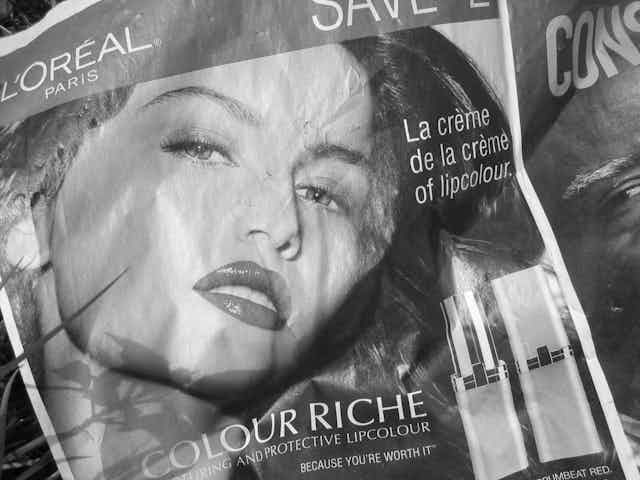

Each year, L’Oreal’s Australian and international women in science programs contribute significant sums of money to support research and encourage girls to enter careers in science, technology and engineering.
The catch for researchers is that nothing comes for free.
In exchange for support, individual scientists and research institutions become aligned with a unique and sophisticated public relations strategy, aimed specifically at embedding this manufacturer of beauty products within the world of reputable scientific research and notions of empowered and successful young women.
So, with applications opening on March 18 for L'Oreal’s annual Australian Women in Science Fellowships, is the cosmetics giant merely paying lip service?
Background colour
Women remain underrepresented at senior levels of all scientific and technological fields in Australia. This is in part due to the typical structure of research careers that make it difficult to maintain funding and momentum during periods when women begin families.
This problem is compounded by funding models that favour strong track records and make it difficult for young researchers to gain a foothold on the ladder to success and stability, and by the overall fierce competitiveness for very limited funding resources.
In 2012, just over 20% of National Health and Medical Research Council project grant applications were successful, despite over half being deemed worthy of funding.
Enter L'Oreal
L’Oreal first began its support of female scientists in 1998 when it introduced the L’Oreal UNESCO For Women in Science Awards: annual prizes of US$100,000 to women around the world, to use towards furthering their own research.
Since then, the program has expanded to include the annual L’Oreal International Fellowships of up to US$40,000 to support young women in life science research, multiple programs aimed at encouraging an interest in science and technology careers among girls and, in 2007, the first annual Australia and New Zealand Women in Science Fellowships, which award A$25,000 to women in the early stages of their research careers.

The money is welcome, of course. But what are the consequences for academic science when it aligns itself with an industry known for its use of questionable scientific claims to sell make-up, face creams and hair care products? And what kind of message does it send to young women aspiring to build successful careers in research?
Like many cosmetics companies, L’Oreal aims to position its beauty products as the outcome of advanced scientific research. Whether the product is “enriched with peptides”, is “clinically proven” to create skin that “glows with a new luminosity”, or with “exclusive liquid light technology […] infuses skin with a ray of light”, hyperbolic language peppered with non-specific scientific and technical terms is sure to abound.
Walking the line
The fine line between credible science and product promotion has been a problem for L’Oreal in the past. In many cases, if cosmetic products really did what they claimed to do they would have to be classified as drugs, which need demonstrated proof of their safety and efficacy to be sold.

Indeed, in September 2012, Lancome (owned by L’Oreal) received an official warning from the US Food and Drug Administration about advertising that its anti-wrinkle creams had the drug-like qualities of being able to “stimulate cell regeneration” or “boost the activity of genes”.
L’Oreal has also faced criticism from the UK Advertising Standards Authority, which in 2011 banned a series of print advertisements for anti-wrinkle products involving airbrushing that the Authority ruled were misleading to consumers.
L’Oreal’s funding of scientific research needs to be viewed through the lens of a company with a credibility problem when it comes to its own scientific credentials. Aligning itself with academic science may be good PR for L'Oreal, but at what cost does this come to a field that relies, by its very nature, on public trust and respect?
The body beautiful
Just as L'Oreal has an image problem when it comes to its science, as part of the cosmetics industry it also gets a bad wrap when it comes to issues of body image. By associating itself with dedicated young women in science, L'Oreal gains an opportunity to transform its public dialogue with women and speak in terms of empowerment, independence and professional success.
At a recent L’Oreal Girls in Science Forum, high school students had the opportunity to rub shoulders with some of the best and brightest medical researchers in Australia, with the aim of sparking a passion for science. They were then sent home with a gift bag containing an assortment of L’Oreal products.
The focus on the body that the cosmetics industry brings is not just potentially damaging because it perpetuates, at least in part, the notion that a woman’s value resides in how others judge her appearance; it also obscures the deeper structural and cultural issues that discourage women from embarking on and continuing in careers in science.
The problem of how to market careers in maths, science and technology to girls in a respectful and rounded way without resorting to reductionist stereotypes is potentially fraught, as the European Commission recently learned following its heavily criticised Science, It’s A Girl Thing! campaign. It is a problem, however, that arguably demands a better response than the beauty industry can offer.
Show me the money
At the end of the day, does it really matter where the money comes from? As scientists we may be uncomfortable with publicly associating ourselves with an industry that hijacks and misuses the language of our profession for profit.
And when it comes to feminism, the debate surrounding the role of the cosmetics industry in society could fill volumes.
But when careers in research are being promoted to young women, and when the fellowships are being used to find solutions to climate change, or to find cures for devastating diseases such as malaria and blood cancer, especially when funding is so hard to come by, maybe it’s time to take a pragmatic approach.
That said, integrity is hard to come by and easy to lose. Somehow one can’t help asking: aren’t we, as women and as scientists, worth more?
Craig Minns
Self-employed
What a confused article.
I did like the final sentence though, it encapsulates the sense of entitlement that feminism has engendered very well and perhaps explains a great deal about why fields in which personal performance is the benchmark (such as science and engineering) are so bereft of women.
Jac Hancox
BSc. Agriculture - Biotech undergraduate
Wow, what an offensive statement to make. I can tell you that performance has little to do with it in my case. I have a stellar GPA and am constantly being told that I need to pursue a PhD and a research career due to the scientific acumen and performance I have shown so far. Why won't I be going into a career in science after I graduate? Because I have three children and the field of science is set up for men who do not have primary caring responsibilities for children. As a woman who is a primary…
Read moreCraig Minns
Self-employed
The sense of entitlement oozes from the screen, Jac. You chose your field of study, you chose to have children. Perhaps you should have chosen a less demanding field, rather than expecting others to reduce their expectations of what constitutes good performance? That would have had the additional benefit of freeing up a place for a student who is committed to the field.
I recommend a read of Olivia Carter's column here on TC for an example of someone who is a genuine high achiever in science and is confronting the consequences of her choice to have a child.
No excuses from her.
Niall Byrne
Creative Director, Science in Public
Science is not bereft of women.
More women are taking life science degrees than men, more women are completing PhDs.
They are doing remarkable research. But we lose many of them in the transition to independent scientist.
The system forces them to choose between family and career. It's just too hard to stay competitive with the constraints of the current system.
For example Carola Vineusa at ANU had three Nature papers and two children in five years. She has said in public that the only thing that kept her in science through this period was the $50,000 she received from her Prime Minister's Prize for Science and spent on child care.
To quote an old West Wing episode, "I get that it should be hard, but it shouldn't be this hard."
We spend a lot of money developing terrific young scientists then, for want of a few tens of thousands of dollars we lose them mid career.
This is an economic waste.
Olivia Hibbitt
Medical Writer
Good grief Craig, what a confused and insulting comment. You might want to wander down the corridors of a research institute to see how completely, utterly incorrect your statement is!
The fact is people are realising that the current system does not work for families and that science is losing many promising graduates because of it (male and female). This is not some sort of 'entitled feminist rant' it is fact. Luckily there are more enlightened individuals than you out there trying to recitify this!
Sean Lamb
Science Denier
" She has said in public that the only thing that kept her in science through this period was the $50,000"
Weird, because plenty of women manage to struggle on in science without any special assistance from the Prime Minister.
I expect the main problem is there is a gigantic mismatch between the number of people we train in science and the number of science jobs out there. This is likely to impact women the most as they are more likely to want a career break.
A few tens of thousands of dollars in special fellowships or gender targeted programs is just kicking the can down the road - once that few tens of thousands of dollars is spent they are going to need another few tens of thousands of dollars and so on until they retire.
Cut off the head of the snake and reduce the number of PhDs being injected into the job market each year.
Jac Hancox
BSc. Agriculture - Biotech undergraduate
Not so much a sense of entitlement as disappointment Mr. Minns. And I also think you are equating the concept of 'performance' with 'hours worked'. This is not what my personal definition of performance would be; I tend to think of it as the quality of what you contribute in the time you are putting in, whether that be on a full time or a part time basis.
I do not need to explain my personal circumstances to you suffice to say that I've been studying and raising my children since my youngest was…
Read moreCraig Minns
Self-employed
No Niall, biology forces the choice.
The simple fact is that it makes more sense to fund males in the fields where individual commitment is important, both economically and from the POV of a utilitarian division of labour.
Women have to be "special" to compete and few women are "special" enough to justify the added cost burden or the loss of potential males to the field through lost opportunity to study it in the first place because females have taken some of the available places.
Instead of spending money developing scientists who are likely to leave the field, like Jac, we would be better served developing those who are committed.
Jac Hancox
BSc. Agriculture - Biotech undergraduate
The big question from my perspective would be: How can meaningful work be structured in such a way that takes into account that the care of children is also a real and meaningful commitment that many people choose to make and how can we all (men and women) work together to create amazing workplaces that achieve great things that do not rely on us negating our children? It's about maximising productivity and economic returns, keeping people who care as much about their kids as they do their work is a no-brainer in this regard. Smart people will still chose to become parents, why not do all we can to try to include everyone who wants to contribute? Everyone has a unique set of personal circumstances and challenges they face, adopting the flexibility to include these people would make the most of our human capital.
Jac Hancox
BSc. Agriculture - Biotech undergraduate
FYI Mr. Minns. I am "special" enough to justify my place. I have outperformed the males in my area of study so far. Your opinion comes from a very antiquated world view. Most families don't and can't live and work like in the "old days". To imply I am not "committed" is insulting - I'd like to see you achieve what I have under my circumstances thus far. Come back to me when you have full time care of 3 children under 5 years old and a 6.75 GPA, 1 scholarship prize, another academic prize and multiple years awarded a place on the Deans List. No? Didn't think so, so please don't dare to presume to make assumptions about what it means to be "committed".
Comment removed by moderator.
Raine S Ferdinands
Retired
Jac, what some people fail to understand is the simple but profound truth that professional women who choose to have babies are serving the nation in immeasurable ways. It is nation building! What the heck shall we do with all the fabulous research, or education or all the money in the world if we, as a nation, cease to propagate and nature children? Children are the product of mums and dads. If only women could conceive via the 'holy sprit' can we attribute to women as ‘having their choice' to have…
Read moreJac Hancox
BSc. Agriculture - Biotech undergraduate
Thank you for your response Raine. It's a complex conundrum but I know that in the big picture, I will be of more use to the economy and to my field of study if I could contribute what I am able to at the moment, rather than the all-or-nothing approach that says "You either fit your life around our requirements or we're not interested". I would love to be able to do what I could part-time until my children are old enough that I can expand the hours in paid work. I want to do great work, but I also want to raise great human beings that will also make a positive contribution to society. That is why I don't have a problem with things like this L'Oreal sponsorship of women in science - ANYTHING that can help is a good thing and as noted in other comments, it's not like they're expecting recipients to spruik their product in return.
Olivia Hibbitt
Medical Writer
Hi Craig, the 1950s called, they want their opinions back!
Thanks for the schooling though, who knew that my Oxford Education and multiple prizes and considerable research funding over the years was just an added cost burden. I shall write to the appropriate authorities to let them know their dreadful mistake!
Craig Minns
Self-employed
Ooh, Aren't you a clever little thing? Shame all that education doesn't seem to have equipped ypu to produce a comment that's either original,witty or relevant.
Olivia Hibbitt
Medical Writer
Well, I can tell that you aren't actually here to contribute something of substance to the conversation.
I just wonder what has made you this bitter about women being in the sciences. Do you not like the idea that a female is able to attend higher education? Do you not like the idea that females may progress in their careers? Perhaps you don't like the fact that the world is changing to allow all sectors of the community access to education and career opportunities.
I find it really sad that…
Read moreCraig Minns
Self-employed
Oh dear, here we go again: I must be "bitter" or somehow defective for offering a critique of a claim of special pleading by women.
Doesn't it embarrass you to present such shallow, rationally empty responses? With such an expensive education, I'd have expected a genunely intelligent argument, not a predictable and tedious excuse for failing to think.
Olivia Hibbitt
Medical Writer
OK Craig, whatever you think. But, while you are here do you think you can point me to which one of your comments offered a well reasoned critique?
My poor female brain is unable to identify where you have offered a cogent argument about why there should not be processes in place to allow skilled, talented individuals of either gender the opportunity to pusue both career and family.
Craig Minns
Self-employed
I have no problem at all with processes that are designed to assist everyone,but this srticle is about assisting women and ends with a claim for special treatment of women.
You can't have it both ways: either women are capable of holding their own, or they need special treatment.
Which is it?
Do try to respond to what is said this time, your imagination isn't very intetesting.
Olivia Hibbitt
Medical Writer
OK, so let me get this straight in my head.
You think that any process to help people enjoy both a career and family needs to include ALL people?
So your argument is, that because this is only open to women, it's not actually valid as it's just helping some poor performing women carry on in a career that they are basically doomed in anyway because they are not men?
I think I understand, and really Craig, I am trying to actually argue your point here rather than resorting to name calling…
Read moreStephen John Ralph
carer
Hi Olivia
leave it alone...we've all been there.
Its the highway to hell.
Olivia Hibbitt
Medical Writer
It's like when you have a bad ulcer in your mouth, you can't help but rub your tongue over it!
What's the internet equivalent of dousing an ulcer in savacol?
Craig Minns
Self-employed
so after all that expensive education paid for by the public, you left the field, just like Jac plans to and most other female graduates.
Now you're saying that you want even more money thrown at you, having demonstrated a lack of commitment already.
Princess syndrome.
Craig Minns
Self-employed
Another effort to shut down the discussion. Funny how there seem to be so much of that from certain quarters, especially when it's not going the way they'd prefer...
Check the name of the site, stephen. If you've nothing to add and it's London to a brick that you don't, you'd do better to simply pull your head in.
Craig Minns
Self-employed
Here's another well-qualified woman who has chosen not to pursue a career in science, but to become a "science communicator" (tour guide) for children.
http://www.theage.com.au/technology/technology-news/when-brendan-proposed-to-christie-at-sydney-uni---with-a-physics-paper-20130227-2f59r.html
Her partner, on the other hand, is more committed to doing science.
"McMonigal is now doing his PhD on "galactic haloes" in the gravitational astrophysics group at the University of Sydney, while Nelan works as a science communicator in the Questacon Science Squad."
No doubt it's all because nobody gave her the special treatment she deserves as a woman...
Craig Minns
Self-employed
As I have been saying for some time, the whole drive to push women into work and even more, train them preferentially (nearly 2:1 women to men at tertiary level study) is badly flawed.
As well as the obvious issues of them choosing to prioritise family commitments over the pursuit of a career in the field they are trained in, there is the simple fact that there are huge demands on a parent's time.
http://www.news.com.au/business/worklife/strung-out-working-parents-costing-workforce-5bn-a-year…
Read moreStephen Wade
logged in via Facebook
I am not sure what you mean when you say that "(she) wants even more money thrown at (her)"?
Or even why throwing money at people has to be a bad thing?
Craig Minns
Self-employed
Read the thread, Stephen, Her whole thesis, between the juvenile efforts to put words in my mouth is that she would not have left science if she had not had to compete for grant funding. I think it's a shame, because she's obviously a capable researcher, but there are lots of competent researchers who don't demand special treatment.
It doesn't HAVE to be a bad thing to throw money around (why do so many people demand absolutes?), but when it is selectively thrown at particular groups that have a history of producing the least output and requiring the most support to do so, it is simply a waste.
The simple fact is that in general women will choose to be mothers and they will then choose not to prioritise their career. If the education had been provided to a man instead, the conflict doesn't arise and the return on investment is greater.
Megan Quinn
Polyglot
Unfortunately unlike ulcers, trolls will not go away if you pay attention to them....
Trying to reason with certain individuals really is like playing chess with pigeons.
And trying to explain the irony of someone who has been gifted since birth with all of the special privileges produced by centuries of institutionalised patriarchy complaining about women receiving special treatment will fall on ears deafened by self-righteous misogyny.
Some people don't want to actually learn or debate anything, they're just looking for a fix of easy validation by provoking a reaction from people who make them feel insecure.
Sean Lamb
Science Denier
" As scientists we may be uncomfortable with publicly associating ourselves with an industry that hijacks and misuses the language of our profession for profit."
I knew a couple of people who took Oreal fellowships, one used it for a post-doc at Cambridge the other as an accuse to spend some months in Brittany.
I have always admired their ability to mask their discomfort with associating themselves with the cosmetic industry. If I didn't know better I would have assumed they couldn't have cared less where the money came from.
Its good training for the basic rule of academia - never stand between an academic and a bucket of money.
Stephen John Ralph
carer
Hi Sean
agree............through a friend of a friend (always dubious?), I have learnt that the world of research at universities is a money-go-round, with the bottom line being performance or perish.
Universities have awards for the "top" money earner, when you would have thought it would be academic excellence.
And when research reaches fruition, who do universities turn to for the next step - companies with the dollars to market products.
McDonalds in primary schools, Coles & Woolies too..........its the way of the future - isnt it?
And I always thought it was never stand between a politician and a bucket of money.
Stephen McCormick
Ph.D. Candidate in Mathematics
If you do some research (aka Goolging) you will discover that the best way for an academic to make a bucket of money, is to quit academia. This website (http://www.cs.ucla.edu/~palsberg/azuma.html) has a graph showing one comparison of academic salaries vs. industry salaries; this in particular is for computer science, but it is well known that academics make far less money than they would if they moved to industry.
When I started my PhD, we were welcomed with "So, I presume nobody is doing this for the money" (or something to that effect) - the whole room laughed.
Craig Minns
Self-employed
What do you think is the reason for that, Stephen? For example, do people in industry enjoy the same entitlements to things like holidays, flexibility of working hours, travel to conferences, freedom of research choice, even opportunity to do research at all? In my own experience in industry (in engineering labs, not science) the time demands are very high and output is the principle measure. the demands of the job come well ahead of personal considerations.
Stephen McCormick
Ph.D. Candidate in Mathematics
It's because we always want to learn more, and as such enjoy an academic job. Most academics put in more hours than they would in any industry job that I've come across, but it's not too bad because we enjoy it. But that's not the point here - the only point I'm making is that people seem to think scientists are researching for the money, instead of simply because that's what they love. I'll grant you that there are a small group on unscrupulous scientists out there looking to make an easy buck, but they are few and far between.
Also the demands on your personal life are far higher for somebody trying to make it in academia than in industry; this is discussed in the article above.
Craig Minns
Self-employed
it's more than just the learning, Stephen, isn't it? Academics get to enjoy the benefits of having a large group of like-minded people around them and the conditions are excellent. The work is interesting, where in industry it's often repetitive drudgery.Those at the top generally aren't too concerned if you don't show up before lunchtime as long as they get to put their name on the paper that you eventually produce. The need to constantly, on a daily basis, work to strict deadlines is generally absent and interactions with commercial clients are rare. There is also greater prestige, generally, in being associated with an academic institution than an industrial lab, especially here in Australia.
Stephen McCormick
Ph.D. Candidate in Mathematics
The only comparison to industry that I was making, is that of income; I was responding to the comment "Its good training for the basic rule of academia - never stand between an academic and a bucket of money".
I'd much rather be in academia than industry, but it certainly has nothing to do with a bucket of money. If that's what motivated me, I'd have been out the door a long time ago.
Craig Minns
Self-employed
I realise that. I was simply making the point that there are trade-offs for the money.
There ain't no such thing as a free lunch.
Ingrid Suter
PhD Candidate at University of Queensland
This article seems pretty easy to understand to me. While L’Oreal may have been generous with the truth when it comes to their advertising & products claims (and which company isn’t guilty of this from time to time), so long as there is no conflict of interest with scientific research and award recipients, where’s the problem? Previous L’Oreal award winners have enhanced cancer research, global food security and solar energy research, not taken jobs at the Pantene Institute for Hair. It’s exactly the same as sports clubs with pokies supporting Little Athletics, junk-food outlets funding CleanUp Australia Day or mining multinationals supporting Greening Australia. It’s a little grubby perhaps, but that’s life. With women being the predominant consumers of L’Oreal products, it makes sense that their awards are geared towards women. I can’t see what the big deal is.
Jac Hancox
BSc. Agriculture - Biotech undergraduate
Agreed. While scientists have to fight so hard for funding, should we be surprised that private enterprise is stepping in? As you said, it's not like we're seeing prize winners in a lab coat spruiking the wonders of Pantene shampoo on TV ads.
Niall Byrne
Creative Director, Science in Public
This article misrepresents the L’Oreal/UNESCO Women in Science programs.
Elizabeth makes important points about the challenges women face in building a career in science. But she draws a long bow in claiming that science is being captured by a unique and sophisticated public relations strategy. I’ve not seen that in seven years of helping L’Oreal manage the Australian program.
These are my personal views. I don’t speak for L’Oreal.
Read moreL’Oreal is of course a massive global cosmetics company…
Jennifer Seberry
Professor of Computer Security at University of Wollongong
I went to a L'Oreal sponsored conference in Korea a few years ago.
They asked us to cheer when our continent was mentioned:
North America, South America, Asia, Europe, Africa (that's it folks
there are five continents).
The good point was that I got to meet some high profile women from overseas.
I have never seen a call for funding sponsorship from L'Oreal.
Tracy Ainsworth
Research Fellow
I have funding from L'Oreal Women in Science. The funds have supported research that I didn't otherwise have funds to undertake, the research has been successful, enjoyable and productive, it has helped support students, and made an advance in my area of research. I am very grateful to have had these funds, as research funding is hard to come by. I have had other grants from funding agencies and research foundations, and there has been no difference in the grant administration between the L'Oreal fellowship and the other sources of funding.
These grants make a very big difference to early career researchers and fill a gap by providing support that enables young researchers to move into bigger funding areas. Science needs more not less of these initiatives, regardless of what areas they choose to support, and they can support many.
Ilana Feain
Research Scientist
I was one of the four winners of the inaugural L'Oreal Australia For Women in Science Fellowships back in 2007 and agree with Niall's point that there was never any kind of campaign or PR aimed at linking my science with L'Oreal cosmetic "research/PR/marketing". Whether or not this is the high level intention unbeknownst to us is another question altogether, but during my interactions with L'Oreal I never once felt exploited or used. I used the money to fund my research and some outreach projects…
Read moreCraig Minns
Self-employed
A talented person who works hard will perform better - produce more output - than an equivalently talented person who doesn't.
Pretending that there is no correlation is simply silly.
Angela Moles
Associate Professor at University of New South Wales
Of course this is a form of ad and a brand placement strategy - but If L'Oreal gets associated with "reputable scientific research and notions of empowered and successful young women" by funding reputable scientific research and empowering and contributing to the success of young women, then I say good for them.
I got one of the L'Oreal awards in 2008, and it was extremely helpful to me - for the funding for research, for the recognition, for the great media training course they put winners through, and for the confidence boost. All of these things have helped my career. I am not at all comfortable in make-up (I think I have now worn cosmetics 5 times) - but there was never any uncomfortable association with the L'Oreal brand.
I think we would do a lot more good by working on getting more companies to do this sort of thing than by complaining about this one.
Comment removed by moderator.
David Semmens
logged in via Twitter
"Never should a modern woman become so filled with self-importance they forget there are men in the world."
I hope there comes a time when women forget that there were ever men like you in the world.
Dale Bloom
Analyst
Yes, it probably was one of those “it’s about women, so we don’t have to include men ” type of articles.
The L'Oreal award doesn’t surprise me.
About 50% of the world’s scientists are involved in the military, and many scientists are well prepared to sell their soul for money.
Catherine Pohlman
Lecturer
What annoys me about the L'Oreal fellowships is that L'Oreal gets out of it so very cheaply. US$100k per year is barely even "pocket change" to a company of this size. If L'Oreal wants buy scientific credibility, they should at least be willing to pay substantially more for it. $25k doesn't go very far in many fields of science (granted, it goes a lot further than $0) - but the awards ought to be far larger than they are (to cover the ACTUAL costs of doing science, rather than the researcher-subsidised…
Read moreCatherine Pohlman
Lecturer
Further note: Most early career women scientists I know are employed on "soft money" and are always having to chase funding to cover their salaries as well as their research expenses. If L'Oreal wanted to make a genuine difference, they'd include the funds to cover salary as well as research expenses (I don't know how many early career women scientists L'Oreal imagines are out there with a salary but no research funding). What's the use of having $25k in research funding if you don't also have the means to pay the rent?
Tamara Davis
Astrophysicist at the School of Mathematics and Physics. at University of Queensland
I'm a L'Oréal Women in Science Fellow, and I have only good things to say about the experience. Fantastic things, in fact. With the prize funding I hosted an international workshop on the subject of a project that I was developing, leveraging the L'Oréal money to get as much again from other sources, which also allowed me to run a follow-up conference the following year. We gathered top researchers from U.S., U.K., Canada, China, Denmark France, Germany, Italy, Israel, Poland, Turkey, Korea, India…
Read moreDaniel Cotton
Physicist/Astronomer
"The focus on the body that the cosmetics industry brings is not just potentially damaging because it perpetuates, at least in part, the notion that a woman’s value resides in how others judge her appearance; it also obscures the deeper structural and cultural issues that discourage women from embarking on and continuing in careers in science."
This is the problem for me. I recently attended the Women in Physics session of the the AIP Congress; it was sponsored by L'Oreal, and for that reason…
Read moreStephen John Ralph
carer
Hi daniel
I do agree with many points in your comment.
Can I suggest another example that may have correlations (but may not too i guess) to the L'Oreal argument.
If we assume that men like cars, - to a greater or lesser degree than women I don't know - but why is there the need to buy a new car when the car already owned is more than adequate.
Is the need to trade up a sign of a deflated ego, or keeping up with the joneses, or something else.
And why if a holden will get you from A-B in the same time (given the speed limit), do people want to buy a mercedes benz. Is it because it looks better - is the COSMETIC value an inherent incentive to buy.
I'm sure there are other examples too - mobile phones, tvs, etc.
Craig Minns
Self-employed
At least one other example, Stephen - the NBN as a FTTP network...