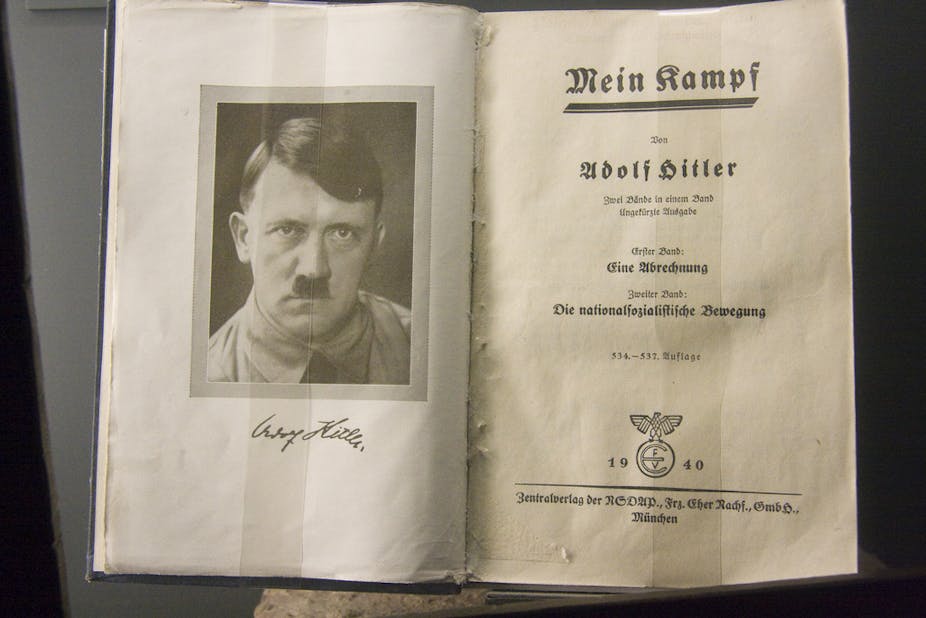
Is Mein Kampf still too dangerous?

Almost 70 years ago, Adolf Hitler committed suicide in the bunker of the Reich Chancellery, marking the downfall of one of the most murderous regimes the world has ever seen. Decades later, there is still a fierce debate over whether Hitler’s Mein Kampf, the autobiography he dictated to his secretary…

Z7fchjzp-1336615300
After 70 years, Mein Kampf is to be re-printed. Michael Dawes

Almost 70 years ago, Adolf Hitler committed suicide in the bunker of the Reich Chancellery, marking the downfall of one of the most murderous regimes the world has ever seen.

Decades later, there is still a fierce debate over whether Hitler’s Mein Kampf, the autobiography he dictated to his secretary during his spell in Landsberg prison in 1924, should be re-released in Germany.

Since Hitler was officially domiciled in Munich, his estate, including the copyright to Mein Kampf, fell to the German federal state of Bavaria. Until now, the Bavarian state has claimed the text is dangerous, and any attempt to republish this inflammatory book – a detailed, if tortuous, account of Hitler’s anti-Semitic ideology and his plans for world domination – has been blocked.

This decision is absurd. The text is freely available on the internet in many languages, including English (the first English editions appeared in the 1930s). And several million (mostly unread) copies of Mein Kampf sold in Nazi Germany were often handed down to family members after the war, and are still around.

New edition

In 2015, the Bavarian state’s control over the copyright will expire, and everyone will be allowed to reprint and publish Mein Kampf. In anticipation, the Bavarian authorities have commissioned an academic edition of the text, annotated by leading historians to put Hitler’s inflammatory statements into their proper context. This edition has been widely welcomed.

The Bavarian state’s suppression of Mein Kampf has always been contentious among historians, who have pointed to the inconsistency of this decision, as Hitler’s other writings have been available in Germany since the 1950s. These include Zweites Buch (Second Book), the sequel to Mein Kampf published posthumously in 1961, and a multi-volume edition of Hitler’s pre-1933 speeches and writing.

Behind the official suppression of German editions of Mein Kampf lies the unfounded suspicion that the text would reinforce neo-Nazism and remains too dangerous for public consumption. The Bavarian state’s attitude is based on the very simplistic assumption that Mein Kampf served as the blueprint for what Hitler and the Nazis did during the Third Reich.

This view fundamentally exaggerates the significance of the book and has been dismissed over decades of historical research that highlight the extremely complex decision-making processes of the Nazi regime.

Still, Mein Kampf is important as it shows that Hitler had a more or less coherent world view, the essentials of which were a vicious anti-Semitism and the plan for conquering “living space” (Lebensraum) for the Germans in Eastern Europe.

Too dangerous?

English-speaking newspapers and journals, always keen for sensationalist Nazi-related headlines, have recently reinforced the claim that Mein Kampf is too dangerous for Germans who are still susceptible to Nazi ideology. Nothing could be further from the mark.

For many decades now, an extremely critical view of the Nazi past has emerged as a firm part of German national identity, illustrated most clearly perhaps by the Berlin memorial for the millions of European Jews murdered during the Holocaust.
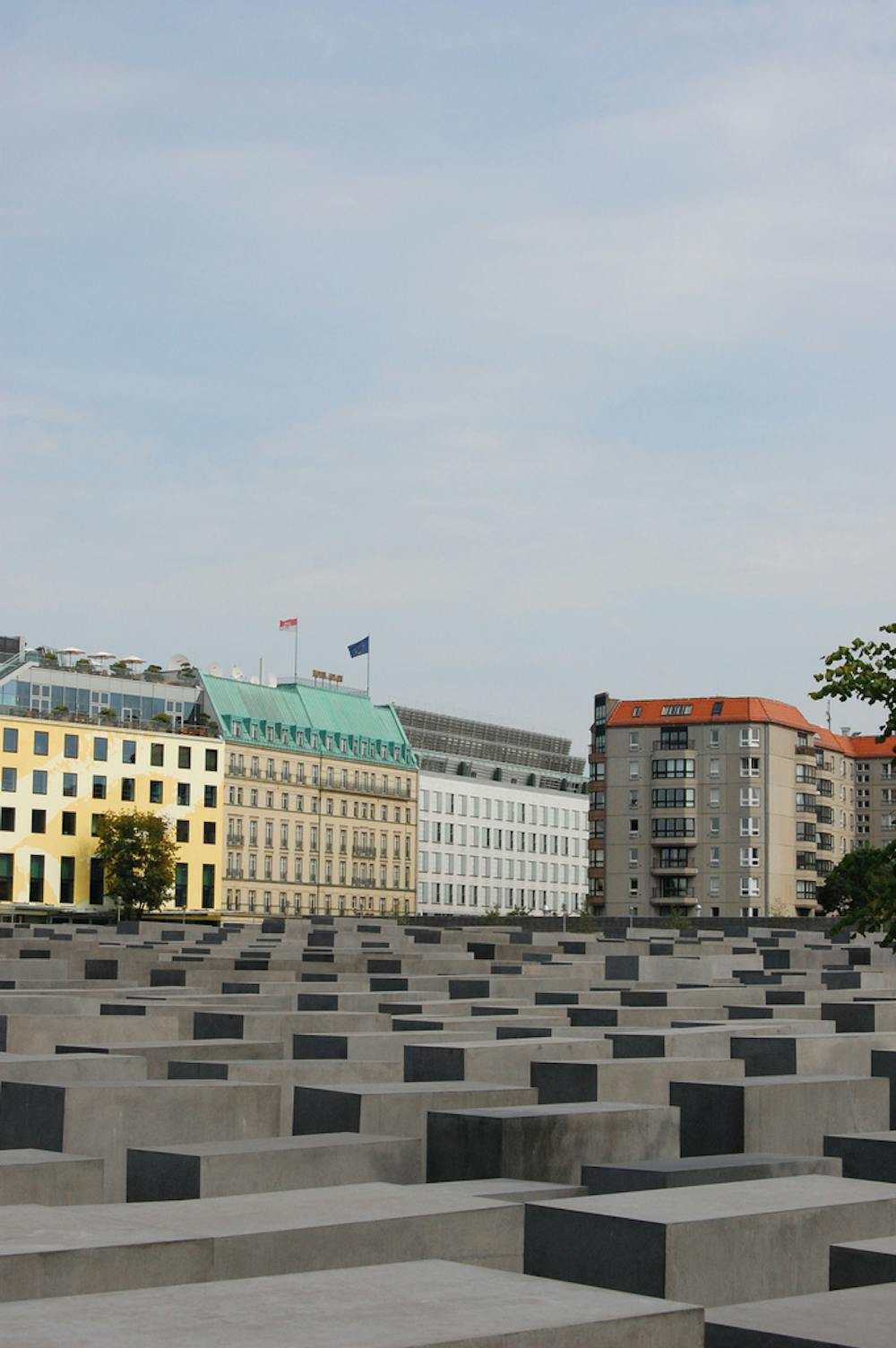
The holocaust memorial in Berlin. Paul Graham Raven

Still, there is a dangerous potential for anti-Semitism, neo-Nazism and far-right extremism in Germany, as the recently uncovered series of murders perpetrated by a neo-Nazi terror cell reveals.

But neo-Nazism and far-right extremism are probably not more widespread in Germany than in other European countries. Because of Germany’s Nazi past, though, the world media are quite understandably more likely to diagnose such alarming phenomena in Germany than elsewhere.

The recent electoral gains of the far right in the French presidential elections and the 2011 mass murder committed by the Norwegian right-wing extremist, Anders Breivik, suggest a very dangerous rise of far-right extremism throughout Europe in the context of the worst economic crisis since the Great Depression.

Demystifying the text

The long overdue publication of a scholarly, annotated edition of Mein Kampf in Germany will allow Germans to access this controversial, but historically important text that gives an insight into the worldview of one of the 20th century’s most brutal characters.

Whether or not people will read a new edition of Mein Kampf is another question. If more people had read Mein Kampf in the 1930s, perhaps they would have taken Hitler’s ideology more seriously.

Sign in to Favourite

Want to follow The Conversation?

Sign up to our free newsletter to get the day's top stories in your inbox each morning, with a special wrap on Saturday.

Spinner
Donate and become a friend of The Conversation

Join the conversation

10 Comments sorted by

  1. A Ahmed

    Student

    what what does the Author make of the Quran then? given that Geert Wilder has been acquited in a court of law for make the association between Mein Kampf and the Quran as being the same?

    http://www.geertwilders.nl/index.php/in-english-mainmenu-98/in-the-press-mainmenu-101/77-in-the-press/1752-final-remarks-of-geert-wilders-at-his-trial-in-amsterdam-june-1-2011

    I (Geert Wilder) am here because of what I have said. I am here for having spoken. I have spoken, I speak and I shall continue to…

    Read more
  2. Grant Phillips

    project officer

    I don't think any written material should ever be banned, regardless of how offensive it is.

    report
  3. Mat Hardy

    Lecturer in Middle East Studies at Deakin University

    Maybe the Bavarian government should organise mass rallies and have the books burned in the street, along with any other reactionary and decadent texts.

    The last line of the article is important. Mein Kampf is sometimes referred to as the most unread book of Nazi Germany. Everybody had a copy, but few could make their way through the prose.

    report
  4. Melissa Joanna

    logged in via Facebook

    @ A Ahmed, I don't understand your question to the Author- are you insinuating that you believe the Qu'uran should be banned?

    I'm all for publishing it, as pointed out in the article, in this day and age, anyone who seriously wanted to read it would have obtained a copy somehow. I don't think anyone will be "inspired" to subscribe to Nazi ideology simply from reading it- they would already have extremist tendencies/ prejudices in order to seek the book out and interpret it in that way...

    Having it re published will simply aid access to an important political historical document...

    report
    1. A Ahmed

      Student

      In reply to Melissa Joanna

      @Melissa,

      just pointing out the connection and hence asking what conclusions can be drawn..

      the author makes reference to dangers of Nazi ideology and so should the same conclusions and hence warnings be applied to islam which seems to be a political movement which preaches Islamic supremacy.. as we know there are many examples of jihadist in many countries around the world and surely there is a similar link to an ideology.. Look at Geert’s own experience where His life is under constant threat because He has dared criticize Islam..
      Banning the texts is not the answer. Better to have open discussion to discuss and discover what attracts people to these ideologies and also uncover the reason(s) why it is just not acceptable.. This I believe is a natural part of our evolution so that our societies can evolve into even better future.
      .

      report
    2. David Boxall

      logged in via Facebook

      In reply to A Ahmed

      Better the wound be open, than left to fester in the dark.

      report
    3. James Walker

      logged in via Facebook

      In reply to A Ahmed

      The threat of Islam - is most accurately described out by people who have *read* the Koran and hadiths.

      Having these texts available - especially online! - allows the defenders of each belief system to disprove slanders while attackers point out flaws and embarrassing facts that would otherwise escape notice: everyone wins.

      report
  5. Monika Merkes

    Honorary Associate, Australian Institute for Primary Care & Ageing at La Trobe University

    What about Leni Riefenstahl's films "Triumph des Willens" and "Olympia" - are they still too dangerous, too? Fascinating films, if one disregards the propaganda (as much as it's possible to do that). When I lived in Germany, it was impossible to (legally) watch these films. But that was before YouTube.

    report
  6. Gerard Dean

    Managing Director

    A refreshing read. It was a little ironic that post war Germany banned Mein Kampf. Having said that, the war and it's story are hyper-sensitive issues in Germany to this day. In their defence and after working in German factories many times, I never met anyone who openly said they wanted a return to Nazi ideals. Perhaps at home they may say differently.

    Compare this with my experience in Japan where the people I spoke to had no idea of the excesses of the Japanese armed forces as they carved…

    Read more
  7. Tina Radermacher

    teacher

    From my German point of view I'd like to point out that the decision of the Bavarian state is anything but absurd as it certainly keeps people aware of the severity & meaning of its horrifying content despite the access to it anywhere else in the world and to other books similar style – the latter, however, certainly never got the attention Mein Kampf got. So EVERYONE should feel responsible for keeping this severity aware.

    This, however, should include our neighbouring and non-neighbouring countries…

    Read more