


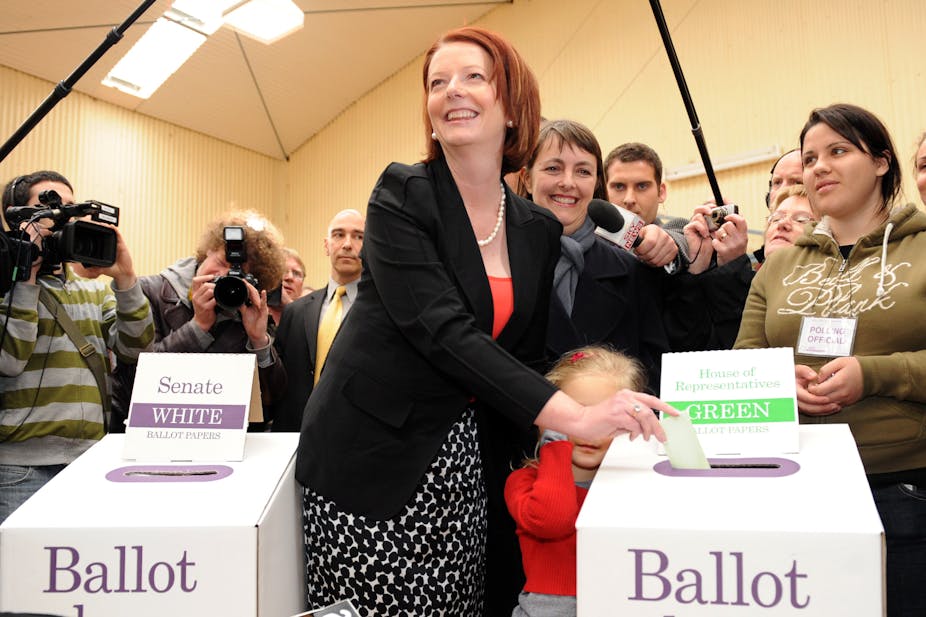
When prime minister Julia Gillard announced last month the nation would go to the polls on September 14, she made political history and caught the nation off guard. She also sparked renewed debate about whether the Australian federal government should move to fixed terms.
This is an issue that the Australian electorate need seriously consider, and one that former Victorian premier Steve Bracks has long supported. He introduced a fixed term to Victorian parliament in 2006, and says it should be extended to at the federal level.
“I support fixed four year terms for both state and federal governments around Australia,” Bracks told The Conversation.
“It is fair to all, provides certainty and enables governments to better able deliver on the program and policies they were elected to deliver.”
But is it that simple? And what would fixed terms actually look like? Let’s begin with the basics.
The situation as it stands
For reasons of history and political stability, members of the House of Representatives and the Senate each are elected using different systems of voting and for different lengths of time. Members of the house are elected for a maximum period of three years. This period, however, is flexible and the prime minister has the power to call an election at any time.

Life in the Senate is different. Senators are elected for terms of six years, fixed from the date that they assume their seat, regardless of whether an early election is called.
Nationally, the Commonwealth is in the minority in retaining this structure. Although Tasmania and Queensland still have fully flexible lower house terms, each of the remaining states and territories have adopted fixed terms in upper and lower houses.
The international story is similar. The majority of Canadian provinces have fixed term electoral cycles. In Britain and New Zealand, political debate has so coloured perceptions, prime ministers in both countries have recently set election dates far in advance of what was required.
Out of whack
Back in Australia, a general election is typically held around every three years. Each election sees half of the Senate and the entire House of Representatives up for re-election, a system that keeps Senate and House elections roughly in sync.
But what happens after a number of early elections? Or in the case of a mid-term double dissolution election in which every seat in both houses is up for grabs? Clearly, the result would be a desynchronisation of the electoral cycles between the houses.
In this situation a government has two options: to hold a separate half senate election; or to hold an early general election. Typically governments are politically averse to the first and so the second is more likely.
Early polls
Why would a government risk a loss by heading to an early poll? There are at least three reasons, each revolving around the idea of electoral advantage.
First, a government travelling well in the polls may decide it’s better to risk its position when there is a good chance of being returned. In the process it earns itself another three years. This is what happened in 1998 when John Howard went to an election in October despite his term in office not expiring until March the next year.
Second, a government without control of the Senate may find it difficult to pass key aspects of its legislative agenda. In this instance it may call a double dissolution election.
However, governments are normally reluctant to take this path as it is seen as politically risky. In 2009, for example, Kevin Rudd decided not to hold a double dissolution election when emissions trading legislation failed to pass the Senate. By contrast, in 1987 Hawke utilised a double dissolution to exploit opposition disunity, winning his government a third term in office.
Finally, a government may call an election to bring Senate and House elections back into alignment. This may be done to avoid having to hold two federal elections in a single calendar year. This was part of Hawke’s rationale when, despite his government being barely 18 months old, he called an election for December 1984.
What all this means is that the Australian population head to the polls much more often than the nominal three years our system leads us to expect. In fact, since Federation, Australians have voted in a Commonwealth election on average about every 30 months. In the 25 years before the turn of the century, this had come down to a little over every 27 months.
The advantage of fixed terms
The first, and most obvious, advantage of a fixed term is that it removes the problem of short governments causing the desynchronisation of electoral cycles between the House and the Senate. Fixed terms do not, however, address the problem if this occurrence is due to calling of a double dissolution election.
Another advantage would be the significant reduction in electoral costs associated with the falling number of elections. Governments in fixed systems are much more likely to run full term. We can therefore expect to see the number of elections held per year to fall significantly.
A last, and particularly significant benefit, is removing the ability at a time of his or her choosing to call an election from the sitting prime minister. This prerogative is a substantial advantage of incumbency and allows a government to manipulate election dates for partisan ends. Its removal would be a significant win for the electorate.
Cross-party reform
Achieving this will not be easy. As Steve Bracks has noted, it will come down to bipartisanship.
“At a federal level a change to fixed four year terms requires a Constitutional change,” he said.
“To achieve this change through a majority vote and a majority of States, support of both major political parties is required.”
In the current political climate, this is unlikely, but not impossible.
On this evidence, there is strong case for thinking about the structure and length of our electoral cycle. Now that the Prime Minister has opened the debate, we as a nation would be foolish not to make sure it continues.