Learning for the western world? The Indigenous education dilemma

Last week the Western Australian Indigenous Labor MP, Ben Wyatt, told a conference in Perth that Aboriginal children in remote communities need a “full Western education”. Wyatt went on to say that the State had delivered “a palliative education system” to remote Indigenous communities and had endorsed…

R4vp8mbz-1355370104
An Indigenous MP in Western Australia has highlighted the tensions in Indigenous education around culture and. Indigenous image from www.shutterstock.com

Last week the Western Australian Indigenous Labor MP, Ben Wyatt, told a conference in Perth that Aboriginal children in remote communities need a “full Western education”.

Wyatt went on to say that the State had delivered “a palliative education system” to remote Indigenous communities and had endorsed low expectations of Aboriginal children.

I agree with him that Indigenous children need the best possible education. But, he went on to issue a challenge to Aboriginal people saying “Aboriginal people cannot be empowered if they are not willing to prioritise the one key to empowerment, education.” He also suggested that parents must compromise on “cultural life” for the sake of their children’s economic futures. And herein lies the problem.

If it is to be successful a “full western education” as Wyatt puts it, must also value who the students are, the culture they come from and respect their identity.

A history of disadvantage

The history of Indigenous education provision throughout Australia’s remote areas is replete with instances of neglect, infrastructure shortfalls and systemic underfunding. Every Aboriginal child deserves the best education possible and this has patently not been the case in the past.

Indeed many Aboriginal children in Australia’s remote north are still unable to attend secondary school in their own communities and children living in very remote outstation communities are still receiving only the most rudimentary of education services.

Aboriginal people in remote Australia face a great and deep dilemma in engaging with the current education system. On the one hand, as Wyatt implies, education can be a pathway to social mobility, it can offer great economic returns and education can be the key to alleviating social disadvantage.

However, education that does not allow for learning in your own language and that is not inclusive of your social, cultural and economic values is not empowering. It is disempowering.

At its worst, education can be a tool of acculturation and assimilation for remote Aboriginal people. Education can usurp local social structures, cause deep intergenerational divisions and education that is not connected to the reality of a student’s daily life in remote community can seem utterly pointless, leading to disengagement.

A national test

Tackling this dilemma is one of Australia’s great challenges. On the face of things, our inability to deliver a good education to such a small percentage of the population defies belief.

Of course, there are deep complexities.

There are 168,803 Indigenous students in Australia characterised by an array of geographic, socio-economic and cultural diversity. Collectively, these students come together with educators, parents, policy-makers and politicians to form something referred to broadly as ‘Indigenous education’.

Given this diversity of stakeholders, it is perhaps not surprising that Indigenous education in Australia is a highly politicised field of endeavour, and that its form has long been contested. Also, as I have previously noted, the causal relationships between systemic neglect, socio-economic disadvantage, geographic isolation and poor health are structural determinants of educational achievement well-noted in research throughout the world.

In the last decade, though, contemporary policy has paid less attention to these structural, historical and social determinants of educational achievement. Instead, policy is focused on the roles and responsibilities of parents and schools, coupled with a reliance on “carrot and stick” programs such as the recent Improving School Enrolment and Attendance through Welfare Reform Measure (SEAM) and formulaic literacy and numeracy testing regimes, best evidenced in NAPLAN.

Unfortunately, after over 10 years of these approaches, the constants in Indigenous education continue to be poor levels of attendance, low retention rates, and literacy and numeracy outcomes well below those of other groups within Australian society.

For example, the table below shows the percentage of very remote Indigenous students in Wyatt’s home state of Western Australia that are meeting minimum standards on NAPLAN tests in comparison to their non-Indigenous peers in the rest of the country.
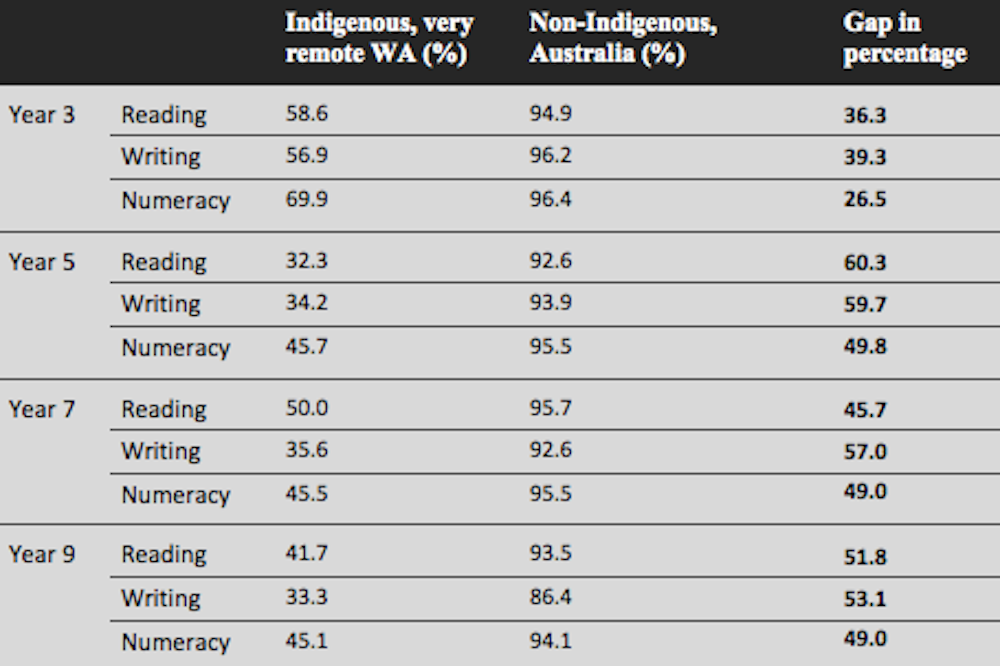
Achievement of benchmarks by students, by Indigenous status & geo-location, as assessed by NAPLAN 2011. Original data: ACARA 2012

What’s needed

Despite the well-documented shortcomings of NAPLAN as a pre-eminent form of educational measurement, this data certainly demonstrates a clear and large “gap” between these cohorts.

Wyatt is right to say this gap is unacceptable. However, nothing in the research base suggests that a pathway to improvement is to be found in advocating for Aboriginal people to jettison cultural practice, nor is it productive to blame communities and parents. We already know what works.

First, you need to make learning content engaging, accessible and culturally responsive with a school culture that supports this and builds on high expectations for all students. Second, you need to empower, support and engage Aboriginal and Torres Strait Islander students to enhance their own learning capacity, while also building and sustaining teacher capacity. Third, you need coherent and localised approaches to evidence-based literacy and numeracy teaching. And finally a profound understanding of the importance of school-community partnerships.

None of these observations are new, yet current policy approaches seem consistently unable to support such creative collaborations. These are the areas that local schools and communities need to be supported in through good policy at both a state and a national level and I’m sure that Mr Wyatt’s considerable influence and help would be most welcome.

Articles also by This Author

Sign in to Favourite

Want to follow The Conversation?

Sign up to our free newsletter to get the day's top stories in your inbox each morning, with a special wrap on Saturday.

Spinner
Become a friend of The Conversation and donate

Join the conversation

40 Comments sorted by

  1. James Jenkin

    EFL Teacher Trainer

    Bill suggests education for indigenous children 'must also value who the students are, the culture they come from and respect their identity'. No-one could disagree with that.

    However, does any other group of children - Chinese, Sudanese, Indian - feel their culture and identity is being compromised by attending mainstream schools?

    Here's a thought - why don't we ask indigenous parents what sort of education they want for their children? Rather than experts in 'indigenous service provision' deciding for them.

    report
    1. Shaun King

      Designer

      In reply to James Jenkin

      James, that idea could work for us anglo's and immigrants as well.

      But instead of just asking the parents, how about asking the children.

      In fact, how about the grading and classification of children be reversed and put on the teacher. Each Friday, the kids "grade" the teacher as to how interesting the week had been, how fun, how truly educational, how constructive, how friendly, how empathetic the teacher has been.

      NAPLAN for the teacher, judged by the students.

      report
  2. Michael Mihajlovic

    Retired

    Whilst culture is important it is not important in the early years. It should come in later years as history, ancient and modern.
    The Germans used to live in trees, but, the education system only refers to that as a historical phenomenon in the evolution of their socieety.
    What the aboriginal children need first and foremost, as the statistics above show is "Reading, Writing and Arithmetic" skills and most importantly a development in their learning skills. As German Academics would say in the formative years the children need to develop their reasoning skills.

    report
  3. Mark King

    Senior Lecturer, Psychology and Counselling and Researcher, CARRSQ at Queensland University of Technology

    This speaks to the paradox faced by policy makers dealing with other cultures. If our yardsticks for success remain firmly embedded in our own culture, then they are assimilationist, yet the rhetoric is about recognition and respect for culture. An Indigenous Australian in a remote community who speaks his or her language and observes Indigenous cultural practices is a success in terms of culture being valued and maintained, but may well be regarded as a failure in terms of Australian education…

    Read more
  4. Maria Hitchcock

    retired teacher author environmentalist at Education Environment

    The problem faced here is the traditional view of education - that is, put a whole lot of children in a room with a teacher in charge. With indigenous communities I believe that we need a completely different approach. With western education we presume that the parents themselves are educated even if only at a basic level. This is often not the case in remote communities. Children with illiterate parents face a huge disadvantage. For this reason I believe that we need to educate the mothers along…

    Read more
  5. Inge Kral

    Researcher

    Aboriginal education is a contested field that engenders divergent, often volatile, responses from a range of commentators. What is clear is that everybody wants the best for the next generation of Indigenous young people. Wyatt and Fogarty agree on this fundamental point. What is also clear is that the education ‘system’ that has been in place for a number of generations in the many different Indigenous domains (urban, regional and remote) has not always yielded the expected results. One has to…

    Read more
  6. Frank Baarda

    Geologist

    "...education provision throughout Australia’s remote areas is replete with instances of neglect, infrastructure shortfalls and systemic underfunding....." Bill Fogarty ommits another factor, the bureaucratic sabotage of bi-lingual programs through ignorance and/or malice.
    When the head of the NT Education Department in the Northern Territory can in an interview with 4 Corners a few years ago come out with "English is the language of learning, it is the language of living...." one despairs.
    Many…

    Read more
  7. Jonathan Marshall

    Founder

    Firstly I must confess I am not expert in the education space and cannot begin to imagine the impact of disadvantage many/most remote indigenous children face.

    But do question statements such as:

    "education that does not allow for learning in your own language and that is not inclusive of your social, cultural and economic values is not empowering. It is disempowering"

    I work with one individual whose family where illieterate substitence farmers in Vietnam and they arrived here with nothing…

    Read more
    1. Tim Scanlon

      Debunker

      In reply to Jonathan Marshall

      Clearly, teaching kids in a language that virtually no-one uses will stand kids in good stead in the wider community.

      report
  8. Frank Baarda

    Geologist

    An excerpt : Wednesday, 4 April 2012 (Alice Springs) House of Representatives Page 37
    ABORIGINAL AND TORRES STRAIT ISLANDER AFFAIRS COMMITTEE
    Language learning in Indigenous communities-
    Mr Rice: "I grew up in Yuendumu, learning both in Walpiri and English. I work in the language centre in Yuendumu, and my main work is translating and recording stories for new books. I have brought some of them here for you to maybe check out later. They are in language. When I was growing up, since I was in preschool…

    Read more
  9. Maria Hitchcock

    retired teacher author environmentalist at Education Environment

    I also came to this country as a young child and had to learn English at school. However, I have observed a marked difference between migrant cultures and Indigenous culture. Migrants expect to be given jobs without discrimination and they encourage their children to get the best possible education so that they can join the trades or professional class. Years of discrimination against Aborigines in Australia have left an indelible stain on relationships particularly in country areas. Few remote area…

    Read more
    1. Jonathan Marshall

      Founder

      In reply to Maria Hitchcock

      This is a complex area and it is easy to fall into giving glib responses - but my schooling experience was that there was extensive discrimination against anybody who did not look "anglo:.

      Although of mixed heritage I look very Greek or Maltese and was teased incestantly at school - there was certainly in your face discrimination. My parents came to Australia because there were no jobs and no prospects where they were living. It was not a question of where their cultural homeland was it was a…

      Read more
  10. Derek McKinnon

    Manager

    I don't understand the focus on maintaining "culture". My ancestors (on both sides) arrived in Australia in the 1850's. My culture is completely different from theirs, and is moving further away at an increasing rate. Culture changes. The only reason to trap people into an existing culture is because you enjoy viewing it, the same way you might enjoy a museum. This is not the way to treat human beings. We have to give people the education and opportunities that everyone else also gets, and then leave it to them to decide what sort of life they want.

    report
    1. Jonathan Marshall

      Founder

      In reply to Derek McKinnon

      Agreed - after just finishing JM Roberts "History of the World" the one thing that resonates is that no successful culture is stuck in time - it is one big melting pot of ideas and values and they are constantly changing and moving forward.

      report
    2. Derek McKinnon

      Manager

      In reply to Derek McKinnon

      Agreed, apart from the last word "forward". It implies an assumption that changes are always good (in some way). There are enough examples of this not being the case that I don't need to argue this.

      report
    3. Derek McKinnon

      Manager

      In reply to Derek McKinnon

      I have read Matt Ridley's book, and I agree with it. However I believe that applies to economic wellbeing, which leads to benefits in many ways. When I think about culture, I think about things like societies strength.

      eg. Russia during communist rule. From 1918 to 1990 the culture of Russia changed significantly. Economically it did advance (which is often forgotten). However everything I have read about the culture indicates a significant amount of damage. eg Civility significantly reduced. This may start to change back now, but it will be a very slow process.

      report
  11. Frank Baarda

    Geologist

    “Cultural survival is not about preservation, sequestering indigenous peoples in enclaves like some sort of zoological specimens. Change itself does note destroy a culture. All societies are constantly evolving. Indeed a culture survives when it has enough confidence in its past and enough say in its future to maintain its spirit and essence through all the changes it will inevitably undergo. ”
    ― Wade Davis, The Wayfinders
    To those that are prepared to "walk in another's shoes" I highly recomment The Wayfinders.

    Paul Henderson (the former Chief Minister of the NT) said he wanted remote Aboriginal children to have the same education opportunities that his children had had.
    In my own sardonic way I interpreted that to mean that he wanted children to be taught in their mother tongue (as had his). Unfortunately I don't think that is what Paul Henderson meant.
    Maybe we'll have more luck with the new Chief Minister (Terry Mills) that has made some pro-bilingual noises.

    report
  12. Ellie Isobelle Knapp

    logged in via Facebook

    I live in Kambalda WA, 700km from Perth. Our town of 2,000 isn't small, nor is it very isolated. Despite all of this we have a medical clinic with no doctors. I know this is slightly off topic but I just don’t understand how the government can let communities go without basic necessities that they should provide to everyone.

    report
  13. Dave Phillips

    logged in via Facebook

    One can only imagine the soul crushing circumstances of young people in remote communities, with generational poverty and dysfunction their only examples of what is in store for them. To break free and succeed in that "western" (read modern) world, they have to over come some truly monumental obstacles, that to us, are no more bother than what shoes we will wear to work tomorrow. I know policies in the past have ranged from full blown intervention, to isolating them from the rest of us by deeming…

    Read more
  14. Michael Dodson

    Director ANU National Centre for Indigenous Studies

    It is informative that a measured article based on research results about how to provide the best education for Indigenous children degenerates so quickly into a debate framed around somehow ‘unwarranted’ benefit being provided to Indigenous children. This is a worrying and continuing discourse about Aboriginal and Torres Strait Islander peoples today which undermines our capacity as a nation to sensibly tackle important problems like the one this article seeks to address.

    Like Jonathan I confess…

    Read more
    1. Linus Bowden

      management consultant

      In reply to Michael Dodson

      Perhaps, Michael, you could pepper your point with your own experiences growing up in an "indigenous" culture, as opposed to a mere "immigrant" culture?

      report
    2. Linus Bowden

      management consultant

      In reply to Michael Dodson

      Michael, you claim:

      "Immigrants know they are coming to a euro cultural centric country born of European colonisation. Also they know the education system is a product of that colonisation and may not cater for their cultural needs. However, in many wonderful schools this does happen, and this enriches our society. Why is it that these schools never have to defend their position in the same way as those which provide education to Indigenous students whose first language (or even second or third) is not English?"

      Could you please provide examples of these immigrants' schools?

      report
  15. Frank Baarda

    Geologist

    "In Australia, our ways have mostly produced disaster for the Aboriginal people. I suspect that only when their right to be distinctive is accepted, will policy become creative"… Kim Beazley Sr.

    Kim Beazley Sr. also said that to deny people an education in their own language is to treat them as a conquered people. I guess that is what they are, a conquered people.

    I've lived on a remote Aboriginal community for almost 40 years. In my opinion the best way to go is to bring back self-determination…

    Read more
    1. Linus Bowden

      management consultant

      In reply to Frank Baarda

      Kim Beazley Snr. also said:

      "when I joined the Labor Party it contained the cream of the working class; now it contains the dregs of the middle class"

      report
  16. Tim Scanlon

    Debunker

    I would like to see the breakdown of figures of Indigenous remote and non-indigenous remote vs. city-indigenous and city non-indigenous. I'm guessing the biggest issue is one of remoteness and probably "poverty", rather than ethnicity.

    The next point I would make is one that was brought to my attention by some rural teachers. Apparently the base starting point for indigenous vs. non-indigenous was completely different, as quite often kids were arriving at school never having seen a book before, let alone someone reading. Thus, the entire idea of reading, writing and by extension maths and science, was a completely foreign concept. It also shows that those kids are not going to have the support from family to learn.

    Essentially, I think we have a cycle of poverty that has been developed at the base of our society. This poverty is driven by education standards. Until this cycle is broken by having parents and kids involved in education together, standards will continue to be low.

    report
    1. Frank Baarda

      Geologist

      In reply to Tim Scanlon

      All valid points and questions Tim. Of course there are many more factors at play.
      You should see the dexterity with which many kids here have taken up texting on their mobile phones and there are many Warlpiri people that have developed the ability to make extremely fast calculations when it comes to playing certain card games despite not necessarily having ever attended school.
      Measuring education standars by NAPLAN testing (in a to a Warlpiri child foreign language and a foreign social context…

      Read more
    2. Tim Scanlon

      Debunker

      In reply to Tim Scanlon

      If bilingual is what it takes to get the parents involved, then have at it, I say.

      report
    3. Matt Stevens

      Senior Research Fellow/Statistician/PhD

      In reply to Tim Scanlon

      The elephant in the room is culture. Good points Tim

      report
  17. Tim Pitman

    Tim Pitman is a Friend of The Conversation.

    Researcher in higher education policy at University of Western Australia

    Like you, Bill, I am concerned that Indigenous people access education not only to get ahead in the world, but also to decide what that world should look like and value – hence the importance of the maintenance of culture through education (note to Derek and Jonathan: being a dynamic culture and maintaining and strengthening cultural links are not mutually exclusive concepts). So at first read, Ben Wyatt’s comments might raise alarms.

    However, his speech needs to be contextualised as what it…

    Read more
  18. Joanne Gamage

    Home Carer

    Why compare "year 3" results across the states, when remote kids enter school and move to year 3 with very different experiences, in many areas advanced of our city kids. When I taught in an indigenous school, teachers faced a completely new set of students in their class by mid-year. Parents valued schooling when families were present in town but also valued culture when families relocated to outstations. By year 3 the indigenous kids may have experienced a year of western schooling as opposed…

    Read more
  19. Frank Baarda

    Geologist

    A bit off topic but here goes:
    "Clearly, teaching kids in a language that virtually no-one uses will stand kids in good stead in the wider community."
    It will be a sad day for humanity when a language's "worth" is judged only by how many people use it.
    Should that be the dominant criterion we will all eventually end up speaking only English, Mandarin or Hindi.
    No more Malayalam, Swahili, Guarani or Warlpiri.

    T.G.H Strelow,in 1958 said it so much better than I can:
    “Above all, let us permit…

    Read more
    1. Tim Scanlon

      Debunker

      In reply to Frank Baarda

      Language is for communication, if you aren't learning to communicate with the people in your own country, what chance have you got of doing anything?

      Of course, we could go back to learning ancient Sumarian.

      report
  20. Linus Bowden

    management consultant

    Michael Dodson

    Oh, and a heads-up. There is no such thing as "Aboriginal & Torres Strait Islander culture"

    report
  21. Graham Phelps

    Manager

    The recommendations of this articles and many of the comments are very sound. An engaging curriculum, involved community, excellent teachers and bilingual education for kids from a ESL background, etc are all important. But no-one seems to have tackled the more fundamental question about why would kids and their parents bother to engage in education if it will have (or appears that it will have) no impact on the lives of the kids.

    It is possible to find similar poor educational outcomes in non…

    Read more
  22. Frank Baarda

    Geologist

    Being pro-bilingual somehow is seen by far too many people as being against English. I'm not aware of any pro-bilingual education Warlpiri person that doesn't want their children to learn English,
    Similarly when Ben Wyatt stated that remote Aboriginal children "need a 'full Western education', many assdumed that that meant he was against Aboriginal languages and culture.
    A bit like when many of us didn't believe in the existense of WMDs this meant that we were pro Saddam Hussein. These are known…

    Read more
  23. Shaun King

    Designer

    I think we're all missing the point. We're debating why our educational system doesn't cater for, or doesn't benefit our indigenous population.

    This debate has raged for what, 20, 30, 40 or 50 years? And we're no further advanced. And that's because our educational system is still based on a model created 50-100 years ago.

    Our current system doesn't even cater for white anglo saxon children, let alone any other.

    Ask any anglo/immigrant child, from age 6 through 18; "Do you enjoy school…

    Read more
  24. Maria Hitchcock

    retired teacher author environmentalist at Education Environment

    Well said, Shaun King. As a former secondary teacher I was appalled at the lack of actual learning that took place each day. No wonder we have discipline problems. I say indigenous children attend school for a maximum of 10 days in the year and still be promoted to the next grade. Bizarre!
    I would add the ability to reason as a fourth major skill required to function in our society.

    report
  25. Tracy Heiss

    logged in via Facebook

    In very remote locations, what is the desired outcome of the inhabitants? Do they wish their children to become adept at both (Aboriginal and 'western')cultural educational outcomes, which may result in a mass exodus from their remote communities?

    In rural farming communities of western nations, the educated young flock to cities, or overseas, and don't choose to continue with the traditional way of life. This in turn has contributed to the decline of these communities. What would happen to the remote indigenous communities if all of the children left? Or, are they expected to get an education in health and education in order to 'come home' and help in those fields? If so, isn't that a contradicition of the purpose of education, in that it empowers individuals to pursue what ever career path or life direction they may be interested in?

    I hope there is far more research undertaken in what the people in remote communities want for themselves.

    report