
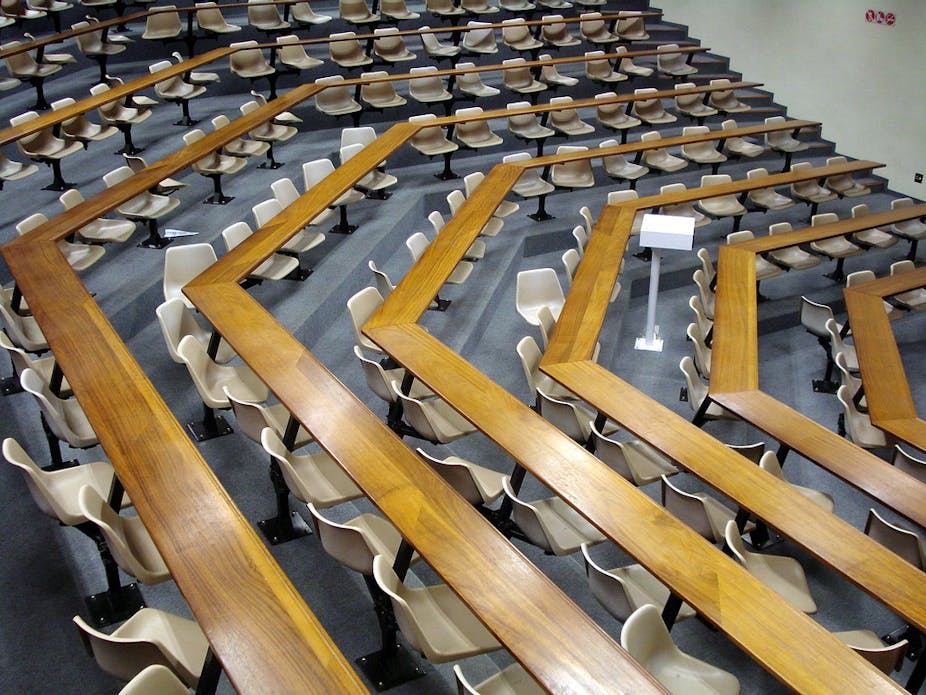
Large lecture theatres are disappearing and will soon be gone from university campuses say Australian vice-chancellors.
The trend is evidenced by the major campus upgrade being undertaken by the University of Technology Sydney, which will favour more interactive learning environments over lecture theatres.
“At UTS we’re in the middle of spending a billion dollars on our campus and as part of that we’ve got two new buildings going up … there’s a not a single traditional lecture theatre in either of those new buildings,” UTS deputy vice-chancellor Shirley Alexander told the audience at a conference on high-speed broadband and education.
Australian National University vice-chancellor Ian Young said undergraduate students are increasingly voting with their feet and not turning up at lectures.
“On-campus education is going to change. The large lecture theatre, if not dead now, is disappearing.”
Professor Young said universities that saw their role as providing on-campus education would need to demonstrate they were providing some sort of value-add.
“Why in the world would a student come along and sit in a passive lecture with 300 other students when they can access the material online themselves?”
He added that this should be seen by universities as an opportunity rather than a threat.
“The transmission of content into an online environment gives us an opportunity with an on-campus environment to give a richer environment in small groups and tutorials – the thing that education perhaps was once in the past.”
University of New England vice-chancellor Jim Barber said with very few exceptions just about anything students could once do on campus would soon be available anywhere via the NBN.
“In place of the traditional campus, then, we will see nodes of activity connected over the internet such as UNE’s ‘Future Campus’ which is to be a very high technology enabled, informal learning space.”
Professor Young said despite the trend towards the delivery of content online, campuses would remain important, particularly for young students who needed the physical discipline of turning up to learn every day.
“To interact with your social peers for short periods of time online is one thing, to do the hard slog of a whole course and have the discipline to do that is another.”
Callum Doorhinge
logged in via Twitter
Argh! Why are VCs so narrow-minded!? I have completed an undergraduate degree in the last year, and have now started my second.
Read moreThe reason lecture attendances are declining is not because the material in lectures is available elsewhere - it has been available elsewhere since the invention of the printing press.
Lectures are the best way I learn. I am an aural learner - I learn from someone with knowledge, who takes me through an argument for why a topic is interesting and relevant.
Lectures…
Andrew McNicol
PhD candidate (Media) at University of New South Wales
While I agree with you that terrible powerpoint lectures are an important factor in turning away audiences, I don't believe it's the main one.
I've sit in on courses where the presentations overall, including any powerpoint slides, were clear, engaging, and actually quite enjoyable to watch. (Of course, this is partly because my own bias primes me to be interested in the content.) However, many students still attend these rarely, even if they're expected to discuss the content in the following…
Read moreMeg Thornton
Dilletante
Another current undergrad here (my fourth attempt at completing a degree) and I have to agree - lecture attendance may well be declining, but it's not just "because the students are lazy".
The university I'm attending provides podcasts and video streams of the majority of the lectures for most subjects. I still prefer to actually attend the lecture theatre in person (despite a growing tendency toward agoraphobia). And yes, there is a reason for this. In my case, it's because I have a minor…
Read moreRobert Tony Brklje
Robert Tony Brklje is a Friend of The Conversation.
retired
The lecture theatre is simply a cost saving exercise. The means by which one qualified person is used to present materials to much greater than the ideal of ten students, in fact upwards of a hundred students.
Read moreSo learning cut back to a focus on tutorials or direct student teacher educational interaction and lecture type material altered to become higher production value audio visual presentations.
Those audio visual presentations can incorporate questions and answers for review of material but…
Amanda Peters
Amanda Peters is a Friend of The Conversation.
Sociology student
Before Universities move too far down the path of eliminating face to face lectures I wish they would take the time to understand the reasons why students don't attend lectures.
Read moreI know popular reasoning is that the online revolution has led to a desire for lectures on-demand but I believe it may not be the only reason. The following is purely anecdotal evidence based on my own experience but I have found that students increasingly want a peared-down, essentials-only learning experience. For example…
Dennis Alexander
logged in via LinkedIn
Sorry Amanda, I disagree, students are students, not customers. The best analogy, and it is still left wanting, is the gym: pay your fees but that gets you membership which is about access, if you don't go or you don't train correctly, the gym is not liable for your lack of results - even personal trainers run an effort disclaimer. Students are members of the university or other institutional community. Unlike gym members, most university's rules provide for a student's membership to be revoked…
Read moreTim Comber
logged in via Facebook
Another possible reason for the decline in lecture attendance is that many students are working part-time as well as attending uni. If the lecture time clashes with the job then they cannot afford to attend the lecture.
Dennis Alexander
logged in via LinkedIn
On the learning style issue: http://psychology.about.com/od/educationalpsychology/a/vark-learning-styles.htm. Basically no correlation between preference and outcome.
Whether or not lectures are useful depends on many things. Whether or not a flipped classroom is useful depends on many things. There is a lot of research out there about teaching and learning, including one little gem that someone on this site put me onto by Eric Sotto, but none of it is an exclusive one-size-fits-all prescription…
Read morePhilip Dowling
IT teacher
I find it puzzling that the presentation of ideas is considered in an either ..or fashion.
There is also a singular lack of consideration of university attendance as a social activity, which involves enculturation into a discipline. In addition, there is a whole additional peer support aspect, which is enhanced by group activity as simple as attending lectures year to year.In addition, it is clear that social networking was very important at Sydney university thirty-five years ago.
Perhaps it is time that universities identify all the various functions that different activities perform.
To see themselves as credentialling factories will see surely see a race to the bottom to find the cheapest means of doing so.
Debra Joan Smith
Account Executive
As a life long learner, I want to echo Callum's comments above and express the hope that this trend against lecture halls is not some theory of the day impulse. I learned well in lectures and I see one of the main reasons for the decline in their perceived effectiveness as the decline in manners in the lecture hall among the audience. When I was a young woman, you could hear a pin drop when the prof was lecturing. The rustle of paper was the loudest thing we contended with but now, here in North America at least, I have had to ask my fellow learners to take their chat somewhere else. It is as though some students start to talk when the prof does and think that they have the floor-to everyone elses' detriment.