
Limiting Australia’s ballooning coal exports is good for the economy

Last week, Greenpeace released a report calling for a halt to Australia’s burgeoning coal exports and pointing to the catastrophic climate impacts they would cause. In response, Mitch Hooke, chief executive of the Minerals Council of Australia, took a standard industry line: “the proposal to stop Australian…

Cn473qr8-1359520803
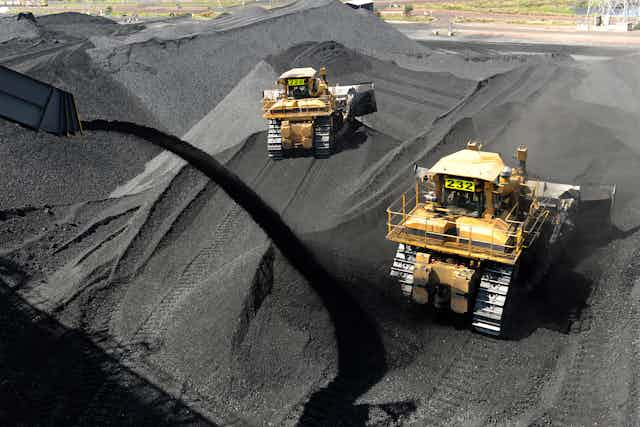
Coal mining is crowding out industries that could bring more benefits to more Australians. AAP Image/Dave Hunt

Last week, Greenpeace released a report calling for a halt to Australia’s burgeoning coal exports and pointing to the catastrophic climate impacts they would cause. In response, Mitch Hooke, chief executive of the Minerals Council of Australia, took a standard industry line: “the proposal to stop Australian coal exports won’t stop global coal use – it will just send Australian jobs offshore and deprive state and federal governments of billions in revenue”.

Arguments that the strength of the Australian economy is heavily dependent on digging up and shipping out as much coal as possible, as quickly as possible, are common. Of course, they also imply that economic arguments trump any concerns about contributions to climate change.

But leaving that aside, how true is it? Would slowing or halting Australia’s coal exports really deprive Australians? What would it mean for Australian jobs?

Research by The Australia Institute suggests that slowing down the pace of coal exports would actually result in enormous benefits to the Australian economy. It would allow our other key export industries – including manufacturing, tourism, education and agriculture – to expand, employing more people and paying more tax.

Because these industries are all far more labour intensive than mining, less subsidised and mostly better taxpayers than mining, it would lead to more jobs and increasing state and federal revenue in the long run.

It’s no accident that the unprecedented expansion of mining in Australia has been accompanied by a sharp decline in many of our most important long-term export industries.

The relentless stream of manufacturing job losses, decline in tourist arrivals and overseas students, and declining agricultural exports are the collateral damage of allowing a breakneck mining expansion without regard to its impact on the rest of the economy.

The problem is that the more mining you have, the less you have of everything else.

For two decades from the early 1980s, exports from Australia’s non-mining industries were steadily increasing as a percentage of our GDP. This was a sign of an increasingly healthy diversified economy, better able to pay its way in the world. Then in the early 2000s, with the onset of the mining boom, something changed, and these industries have been heading south ever since.
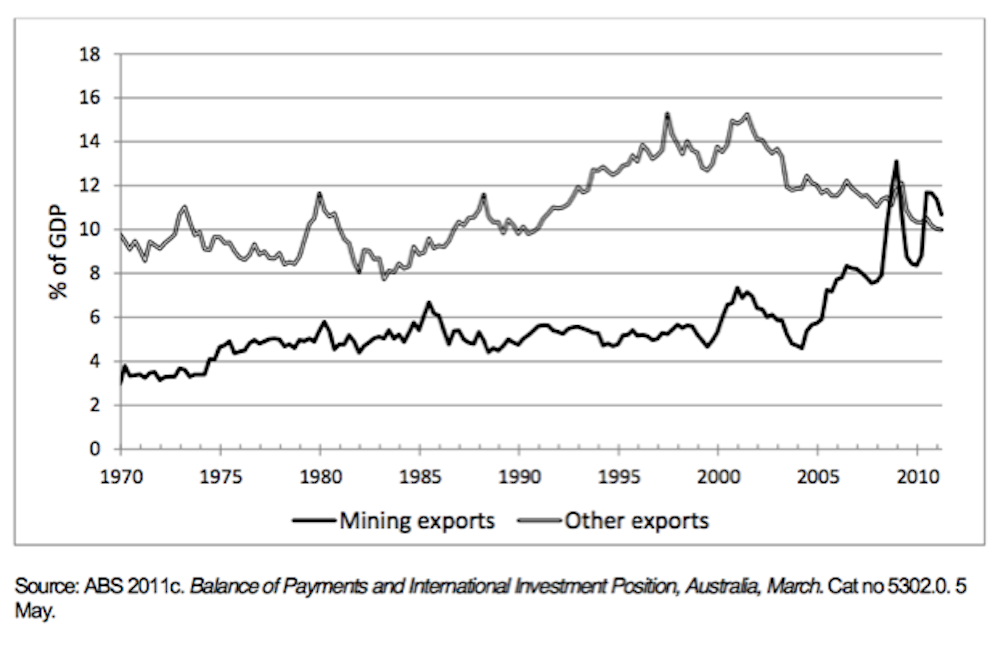
The reason is that mining “crowds out” other exporting industries, which flows onto the rest of the economy, creating what we call the “two-speed economy”.

It has done this primarily through driving up the exchange rate, and creating an acute skills shortage.

The unprecedented rise in the Australian dollar is primarily driven by increasing commodity prices, and the massive $260 billion influx of foreign capital to fund the construction of mines and gas fields.

A further cause is that Australia has high interest rates relative to other developed countries, which means it attracts more overseas investment and further drives up the dollar. The Reserve Bank has cited the mining boom as a reason for every interest rate rise since 2005.

This has had a devastating impact on our non-mining exporters. Manufacturers who were receiving $100 for a product sold into the American market a few years ago now receive less than $70 for the equivalent item. The dollar has also appreciated by a similar amount relative to most of our other markets. Hotel rooms, meals and tours and university courses are similarly more expensive for those thinking of visiting Australia.

Australian tourism visitors have dropped by around 250,000 over the last decade, as more Australians holiday overseas, and overseas tourists go elsewhere. This is during a 20% boom in global tourism over the last decade.

Since the beginning of the mining boom, Australia’s rural sector has lost $43.5 billion in export income. This includes $14.9 billion in 2010-11 alone. These losses have occurred because the mining boom has forced the Australian dollar to historic highs. The beef industry took a $2 billion dollar hit last year alone.

Manufacturing job losses are announced with depressing regularity, with well over 120,000 manufacturing jobs disappearing since the GFC.

Adding fuel to the fire, the mining boom has created an acute skills shortage. This is simple supply and demand. If you plan to build $260 billion dollars’ worth of mining projects at once, it will create enormous demand for a narrow set of skills that are also important to other industries. This makes it much harder for other businesses to recruit and retain employees.

These businesses will also have to compete with the inflated wages being offered by the miners. The economic consultants for Clive Palmer’s China First mine acknowledged this impact alone would cost around 3000 jobs in manufacturing and tourism, and that’s just one mine!

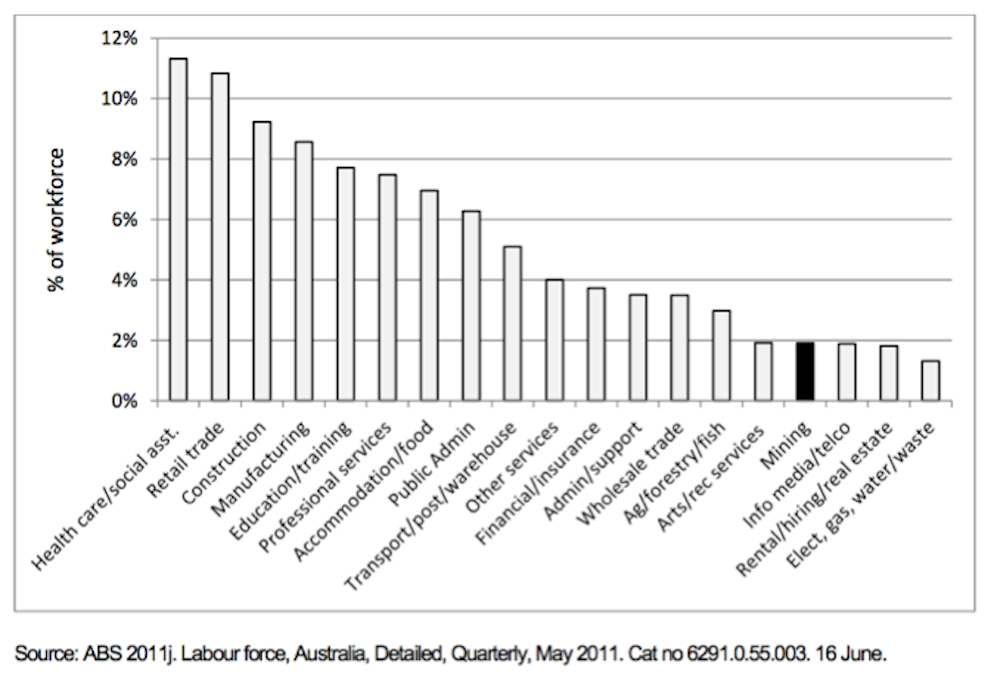
Hooke’s concern about Australian jobs is especially interesting when you consider that the coal mining industry is highly capital intensive, and a very small employer. It employs around 38,000 people nationally, less than a third of one percent of the workforce, compared to around one million in manufacturing, half a million in tourism and 327,000 in agriculture.

With a capital-intensive industry crowding out labour-intensive industries, it seems likely that the net effect of the expansion of the coal industry will be job losses for Australia as a whole.
Screen Shot at AM

Crowding out of these industries also means a loss of tax that these industries would have been paying. The mining industry pays an effective corporate tax rate of around 13.9%, compared to the industry average of 21%.

To take the latest year available, 2009-10, mining companies paid $6.8 billion in company tax, amounting to just 2.2% of government receipts.

The coal industry also pays around $4 billion dollars a year in royalties to the states. Although royalties are technically considered taxes, the minerals are the raw materials of mining in the same way that wheat is for a baker, or bricks to a builder. Bakers and builders pay market prices for their raw materials, and the costs are not considered as a tax.

The difference is that the Australian people own those minerals, and the state government sells the minerals to mining companies on our behalf. It is hard to imagine that if the minerals were owned by a private company, like bricks or wheat, they would be sold for around 7% of their market value. This special treatment of the mining industry could be seen as a huge subsidy in itself.

As it stands mining is highly subsidised, to the tune of at least $5 billion dollars a year, which makes subsidies to manufacturing look modest.

Mitch Hooke’s claim that “the proposal to stop Australian coal exports won’t stop global coal use” is true, as far as it goes. But no one would seriously suggest that it would. Other countries will continue to export coal.

What it will do is drive up the coal price considerably, because Australia is the world’s largest coal exporter. In fact, Australia has a larger share of the world’s coal exports than Saudi Arabia does of oil, and no one would doubt the effect on global oil prices of Saudi Arabia reducing its oil exports.

This will have the effect of our customer countries – primarily Japan, Taiwan and India – reconsidering investing in coal for their energy infrastructure.

Luckily they already are. India has had to scrap huge coal power plants due to coal price fluctuations and difficulties in securing enough coal that have led to massive blackouts. This has led to rapid ramping up of solar targets to 10GW by 2017.

This shift to renewable energy is gaining pace around the globe with renewable energy investment exceeding fossil fuel in 2011. This is an unstoppable trend, and is great for the developing nations who will be able to avoid dependence on volatile and ever increasing fossil fuel prices, and the myriad of health and pollution problems associated with burning coal.

This article was co-authored by Mark Ogge. Mark is the Public Engagement Officer at Canberra-based think tank, The Australia Institute. His work involves communication of key research findings about the impacts of the mining industry on other crucial sectors of the Australian economy, especially manufacturing, tourism, education and agriculture.

Join the conversation

26 Comments sorted by

  1. Dale Bloom

    Analyst

    When the mines import nearly every piece of equipment, and then start importing labour, it appears Australia is not getting much from it.

    Tourism is closely associated with the real estate industry, and tourists can have a huge ecological footprint. The tourist industry can also have 100% social impact on an area, because all the locals leave. Tourist resorts quite often they pay their employees backpacker rates, and there is 0 job security with a large staff turnover.

    I would think the education…

    Read more
    1. Bernie Masters

      environmental consultant at FIA Technology Pty Ltd, B K Masters and Associates

      In reply to Dale Bloom

      Dale, most mining projects use 60 to 80% locally sourced materials. Most mining projects have a profit margin of just 5 to 15%, and while some companies export most of their profits overseas, that still leaves 85 to 95% of the value of mineral exports remaining in Australia as wages, salaries, service and material purchases, etc.
      It's very easy to blame the mining industry for every ill in the world but the truth is more difficult for many people to accept, namely, that mining is mostly a responsible corporate citizen that needs to be taxed and regulated like all other industries.

      report
  2. John Newlands

    tree changer

    I don't go much on either the exchange rate argument or that renewables will save us. What I don't like is futility and hypocrisy. It beggars belief that we can have a domestic carbon tax which is a factor in struggling families having their electricity disconnected. Meanwhile larger amounts of emissions from the very same coal get off scot free.

    So far China and India are not our biggest coal buyers but that could change as their domestic sources run out. Consider the Galilee Basin Qld as…

    Read more
    1. Henry Verberne

      Former IT Professional

      In reply to John Newlands

      It surprises me that there is not more pressure from other sectors (eg manufacturing) to "rein in" mining, given its acknowledged impact of a high dollar. Or are they too cowed by the clout of the miners to mount some sort of campaign?

      I hope you are correct that "profitable coal will be used up in 20 years" but do you have some figures to base that on?

      report
  3. George Takacs

    Physicist

    Richard and Mark,

    Thanks for this piece, and in particular for getting the numbers out there. So mining returns around $12 billion to government coffers, minus $5 billion in subsidies, netting $7 billion, whilst vacuuming up investment capital, skilled workers, and resources which could be deployed elsewhere. Didn't Donald Horne write about the stupidity of this half a century ago?

    report
  4. David Jones

    Engineer

    I am unconvinced about the price elasticity.

    The analogy with Suadi Arabia is particularly poor. Internationally traded coal represents only a small part of total coal consumed while internationally traded oil is a large part of all oil consumed. Saudi Arabia has a much much greater relative proportion of total oil production than Australia does coal production.

    Coal is also relatively easilly substituted by other fuels wheras it is very difficult to substitute oil with alternatives.

    report
    1. George Takacs

      Physicist

      In reply to David Jones

      David,

      I don't know what current volumes are, but coking coal for use in steelmaking used to be around half our export volumes. For this part of our exports fuel substitution is not an issue, at least at present.

      report
  5. Robert McDougall

    Small Business Owner

    mm.. so for every job made in mining, there is a multiple of jobs lost in other sectors of the economy.

    mm.. so mining companies pay 1/3rd less tax than someone working at hungry jacks.

    mm.. so mining forces up interest rates and exchange rates, making it harder for the 98% thereabouts who arent working in mining to cover costs of living.

    mm.. so in order for mining to expand, the rest of the economy has to contract.

    mm.. so mining, being a multi billion profitable exercise, also enjoy…

    Read more
  6. Pat Moore

    gardener

    A clearly argued case against the great travesty that is subsidised coal mining....we pay them to rob us & to poison our global atmosphere by huge Chinese/Indian carbon pumps.

    And a great post thanks Robert McDougall.

    Another giant black dirty vampire sucking the life blood out of environment, country & people to feed the 1%.

    report
  7. Mike Jubow

    forestry nurseryman

    At last! Someone has exposed the dollar value to coal mining in Australia. For a long time I have seen the economy of our nation being dragged into the depths and our primary rural industries and rural communities being devestated by the coal giant with little benefit to the nation. It doesn't take much intelligence to see that the reason a lot of Aussie manufacturers are going off-shore is because of the lack of opportunity to employ reasonably paid tradesmen. The bastardisation of our rural land doesn't seem to even be given much consideration along with the ruination of rural communities.

    What I am thankful for is, that now someone has put a dollar value on it all.

    report
  8. Neville Mattick

    Grazier: Biodiversity is the key.

    As a sustainable food producer I feel the impact of an inflated Australian Dollar in trying to market livestock that will be part of an export program.

    Reading recently of the over forty billion dollars lost to Australian Agriculture is enough // http://bit.ly/YZtP4T in the last decade.

    Thank you Richard and Mark for this important article.

    report
  9. Garry Baker

    resarcher

    Australia’s burgeoning coal exports"" ... er, look around and see who owns the vast majority of these mining companies - Australians certainly don't.

    More to the point, we are nothing more than a mining destination for others to colonise the action - and to boot, they bring their own shovels. Added to this, their core expertise is not sourced from Australia, whereas their vast profits are. Indeed, repatriated to head office back in the mother country, then fanned out as dividends to its owners…

    Read more
    1. Mike Jubow

      forestry nurseryman

      In reply to Garry Baker

      Garry, thank you for the support. Your statement," More to the point, we are nothing more than a mining destination for others to colonise the action - and to boot, they bring their own shovels. Added to this, their core expertise is not sourced from Australia, whereas their vast profits are. Indeed, repatriated to head office back in the mother country, then fanned out as dividends to its owners", is quite pertinant in todays economy.

      For the last 5 years, I have posited that Australia cannot…

      Read more
  10. John Newton

    Author Journalist

    The brilliant foreign minister Bush Shirt Bob Carr was being interviewed on Radio National over the summer season, and was fulminating, as he is wont to do, about the crisis of climate change and how we must all do our bit to reduce fossil fuel use.

    The interviewer asked him how he could reconcile that with our enormous coal industry. His answer was along the lines of, well, ours is very high quality coal.

    Boggled.

    report
  11. Jon Brodie

    Research scientist

    George Takacs got one important point absolutely correct. Over 60% of Queensland coal exports are coking coal. This is not used for power generation and is not replaceable by any alternative except other carbon based materials (e.g. natural gas) and certainly not by 'renewables'. Unless we are prepared to give up most of our steel and aluminum use we need large amounts of coking coal. So certainly one suggestion for climate change mitigation with less effect on export earnings is for Australia to reduce our exports of thermal coal but retain our exports of coking coal.

    report
    1. Derek Bolton

      Retired s/w engineer

      In reply to Jon Brodie

      Coking coal for aluminium? AFAIK, alumina refinement uses coal for thermal processing, while the final product requires electricity. Neither appear to need a carbon source specifically.

      report
    2. Jon Brodie

      Research scientist

      In reply to Derek Bolton

      Normal Hall Heroult process still has to use coke to remove the oxygen from the aluminium oxide (alumina) just as in steel and many other metal manufacturing. In this case the coke is in the anodes used and is consumed producing carbon dioxide. I don't think there are any non-carbon alternatives.

      report
    3. Jonathan Maddox

      Software Engineer

      In reply to Jon Brodie

      Carbon is indeed a necessary element in most metallurgical chemistry, but there is no requirement that it be sourced from fossil fuels or that carbon dioxide gas need be released to the environment.

      Vast quantities of pig iron are produced in Brazil using charcoal from forests. This is technically renewable, though of course it is devastating to the forests in question and to the many labourers forcibly employed in charcoal production. More genuinely sustainable renewable carbon-based fuels are available in modest quantities, and in the longer run synthetic regeneration of carbon-bearing fuels from CO2 using renewable electric or heat energy is technically possible.

      report
  12. Graham Smith

    Project Manager

    Richard, a very interesting atricle. The links to the Australia Institute reseach that are in the article do not relate specifically to the research that they have conducted - can you refresh the links or provide the link via the comments please.

    report
  13. Bernie Masters

    environmental consultant at FIA Technology Pty Ltd, B K Masters and Associates

    and mining is responsible for climate change, the extinction of the thylacine and Collingwood losing the AFL grand final, I suppose. Give me a break! The author says: "The reason is that mining “crowds out” other exporting industries...(and) It has done this primarily through driving up the exchange rate, and creating an acute skills shortage." The high value of the Australian dollar is due to the good financial management of the Howard government, good regulation of the banks by successive governments, possibly by Kevin Rudd's responses to the GFC and mostly by Australia's stable democratic government and high interest rates. The mining industry is a small albeit important part of this country-wide picture but it is patently wrong to blame the industry for all of our national woes.

    report
  14. Chris O'Neill

    Telecommunications Engineer

    "This has led to rapid ramping up of solar targets to 10GW by 2017."

    10GW of always-available power is enough for about 10 million people in Australia. India's population is about one billion.

    This is only going to work if India remains a third world country.

    report
    1. Jonathan Maddox

      Software Engineer

      In reply to Chris O'Neill

      I don't think anyone's projections suggest India will be a first-world country quite so soon as 2017.

      report
  15. awexfwex

    logged in via Twitter

    Looks like all of the links to the Australia Institute are broken. Can you set up some perma-links, then fix them in the article, please?

    report
  16. jean wilson

    retired

    I'm also wondering just how much we're losing by hosting and supporting a largely foreign mining frenzy. It will be interesting to see how much (if any) MRRT tax has been collected in the last six months. 15 Feb is when the Greens' senate motion to reveal this figure will be actioned.

    It distresses me to know about some of the extreme damage this industry is causing our environment, plus the pollution. Guess who will be paying to repair/clean this, if such a thing is possible?

    report