

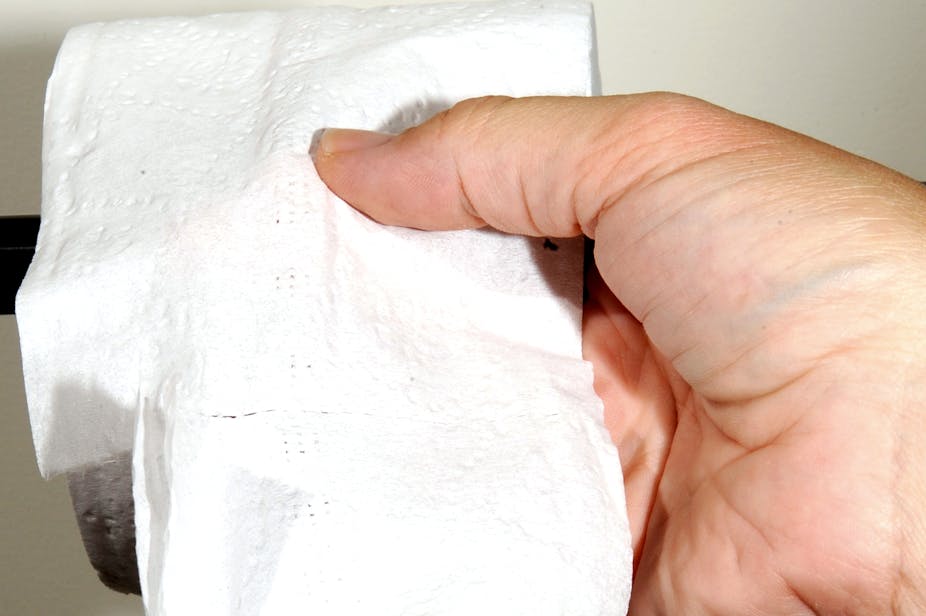
Loosen up, it’s time to talk about toilets

Bodily waste can be an embarrassing subject, but one that most of us can avoid thanks to efficient toilets and sewers. Nevertheless, this embarrassment may be holding back improvements in sanitation where they’re needed most. Over the course of your life you might spend three years in the bathroom and…

Syz6sd3g-1351484960
Is our distaste for toilet talk halting sanitation improvements in the developing world? Alan Porritt/AAP

Bodily waste can be an embarrassing subject, but one that most of us can avoid thanks to efficient toilets and sewers. Nevertheless, this embarrassment may be holding back improvements in sanitation where they’re needed most.

Over the course of your life you might spend three years in the bathroom and a considerable proportion of that time on the toilet. Yet, here is an activity widely regarded as so distasteful that, unless you’re a parent of a potty-training child or involved in a caring profession, your conversations on the subject are likely to be short and rare.

When we in “developed” nations do talk about bodily functions, we often do so through euphemism and metaphor. Consider the commercials in which a canine protagonist is draped in lengths of toilet tissue to illustrate the twin pillars of softness and strength.

Perhaps this is only natural. After all, a more literal representation of toilet paper in use would be less appealing than the symbolic alternative offered by an ever-young Labrador.

There’s nothing exactly natural about our aversion to talking about bodily waste however. Indeed, the historical sociologist Norbert Elias found that our relationship with bodily functions has become increasingly layered with distaste since the late Middle Ages.

Elias also noted that the shame around bodily functions, and the subsequent desire for privacy in the toilet, predated the emergence of scientific and political concerns over hygiene.

I don’t deny that the discoveries of bacteriologists and the rise of hygiene as a social ideal boosted the case to construct sewers and toilets. Nonetheless, sanitary concerns of waste removal don’t explain why we design buildings and rooms to separate toilets from all other architectural purposes; draping a veil of secrecy over our bodily functions.

Neither do concerns over personal cleanliness explain our anxiety when privacy in the toilet is disrupted. Consider what makes you nervous or embarrassed in these contexts: Is the presence of someone in the next cubicle distracting? Have you ever put down a layer of toilet paper to silence things just a little?

If the answer is no, then good for you: you’re free from centuries of emotional conditioning. Make no mistake though; the phenomenon is of enough concern that products exist to cover up our, erm, noisy movements.

If the presence of someone in a cubicle next to you slows you down, you’re not alone. VeRoNiK@GR

Toilets and the treatment of bodily waste are important psychological and cultural concerns. Slavoj Žižek goes so far as to clarify the different features displayed in German, French and Anglo-American toilet conduct before illustrating how these compare with national character and philosophy.

In line with the anthropologist Mary Douglas – who argued that excreta can symbolically defile cultural space – serviceable cubicles, toilets, drains and sewers all uphold personal experiences of social and spiritual order. They are widely considered to be markers of civilised society.

Equally, however, by separating us from one another while we make a deposit, and by effectively sucking away the offending materials, toilets reproduce our embedded thresholds of embarrassment and shame. The “civilised” citizen is conditioned to flush and forget that which is unwanted.

Herein lies a serious problem.

Beyond the borders of wealthy nations, four in every ten people have no access to a toilet or latrine, and instead they must defecate in public spaces, exposed to contaminates left by those who went before them. As a result, more children under the age of 14 die from diseases associated with poor sanitation than AIDS, malaria or tuberculosis combined.

While movements such as Sulabh and the World Toilet Organisation seek to raise money to build public toilets for people with little or no access to functional sanitation, they often find it difficult to attract public support because of a general lack of willingness to converse on the subject of bodily waste.

What can we do to redress this concern? Well, for starters, perhaps we should just stop being so embarrassed, and think more clearly about waste and its disposal.

If you consider it for a moment, squatting at the head of thousands of miles of sewerage systems before emptying the food that your body has processed is a minor miracle.

Why not bring this up in conversation with your loved ones over dinner tonight? No? Well at least spare a thought for those who don’t have the privilege of forgetting the subject.

Join the conversation

15 Comments sorted by

  1. Judith Olney

    Ms

    Its interesting that we find it difficult to talk about human waste, and yet there is no problem talking about animal waste, and using animal waste on our gardens, although there seems to be a hierarchy of waste. I know people who will use copious amounts of animal manure on their gardens, as long as it comes from herbivores, but they refuse to use waste that comes from animals that eat meat.

    When I tell them that dog poo is great for growing tomatoes, buried beneath the seedlings it is a great…

    Read more
    1. Monika Merkes

      Honorary Associate, Australian Institute for Primary Care & Ageing at La Trobe University

      In reply to Judith Olney

      Judith, I found advice from the University of Wisconsin that concludes "The health hazards associated with cat and dog manure are greater than the potential benefit from its fertilizer value. Cat and dog manure should be disposed of by flushing down the toilet, burying deep in the soil (six inches or more) or by placement in tight plastic bags for garbage collection". http://www.extension.umn.edu/yardandgarden/ygbriefs/h238manure-dog-cat.html

      report
    2. Judith Olney

      Ms

      In reply to Judith Olney

      Hi Monika Merkes, sorry I cannot reply directly to your post, this seems to be something that the TC have not, or do not, want to fix.

      The dog poo I use is buried in the garden, under the seedlings.I also know exactly what my dogs are eating, they are wormed regularly, checked regularly by the vet, and are not diseased. I do not use cat poo.

      I think there would be more potential hazards flushing the dog poo down the toilet, than burying it in the backyard. I do not believe in using plastic…

      Read more
    3. Peter Gerard

      Retired medical practitioner

      In reply to Judith Olney

      I suppose the main reason we don't use dog or human faecal matter in our garden is the smell. The waste of herbivores is perfume to the nose compared to the waste of carnivores.

      report
  2. Colin MacGillivray

    Retired architect

    With very efficient vacuum systems well tested on ships and planes, is it time to use the same technology in the suburbs? If urine was directed elsewhere (as suggested in a Conversation post recently) and water in the vacuum pipes was minimized it might be possible to collect the feces at processing stations, dry it and bag it and make it available for use as manure- all by machine in one place. A small unobtrusive building at, say 1 kilometer intervals might do.
    Than the Council could close down sewerage treatment plants serving suburbs. This idea doesn't work for industrial or commercial waste of course-too much unknown stuff in the waste stream.
    Has this been done yet?

    report
  3. Kate Neely

    Research Student

    Toilets and latrines are incredibly important to the health of the majority of people on this planet. I think that it is important to note though that the issues are not just about infrastructure - there is a swathe of cultural and behavioral learning about defecation that we almost never discuss - eg the size of ones poo can be seen as a status indicator among men in some areas, where more poo equates more food in the family. Women may go to the toilet together for protection and social reasons. How the infrastructure fits with existing understandings of defecation as a social and cultural phenomena is important too.

    report
  4. Monika Merkes

    Honorary Associate, Australian Institute for Primary Care & Ageing at La Trobe University

    Hi Judith
    I cannot comment to you directly either. Not sure whether this is meant to be or a hiccup with the Conversation's new commenting system.
    I very much respect your approach to this issue. As they say at the German Shepherd Club, 'my dog, my responsibility'.
    A few years ago I attended a workshop on worm farming. When I asked the facilitator whether dog faeces could be used in worm farms, the answer was yes, but a) the faeces should be exposed to the sun for a few days to kill bacteria, and b) I should feed the worms only dog faeces and not a mix of faeces and other organic matter, because then the worms would only eat the other stuff. I've never tried it. Drying the dog poo in the sun didn't sound appealing in my circumstances (small backyard), and in particular I didn't want to send the smell over the fence to my neighbours.

    report
    1. Judith Olney

      Ms

      In reply to Monika Merkes

      Hi Monika, I've also seen a mini septic tank system used for getting rid of dog poo, its a closed anaerobic system that uses bacteria to break down the poo. It is very effective, and you can even make your own small scale version if you only have one or two dogs. The resulting compost can be used directly on the garden as fertilizer as the system kills any nasties that may be in the poo. With this system there is no smell at all.

      There are systems that you can buy off the shelf, but its quite…

      Read more
  5. Jonny Crane

    Cautious Optimist

    Dear Robin, Judith and Monika,
    no discussion of the future of toilets should be complete without mention of Joseph Jenkins seminal work "The Humanure Handbook".

    Available in its entirety online and for free it describes a very inexpensive system for the safe composting of human manure, dog manure or any other manure you might care to think of: http://www.weblife.org/humanure/

    Jenkins' later work in post-earthquake Haiti even indicates that public latrines may have been a big part of the health…

    Read more
    1. Monika Merkes

      Honorary Associate, Australian Institute for Primary Care & Ageing at La Trobe University

      In reply to Jonny Crane

      thank you for the links, Jonny. I watched Nick Ritar's talk. Food for thought.... I'm not quite ready yet to follow his recommendations in my inner city suburban backyard. In the meantime, I'll keep my two more traditional compost bins going.

      report
  6. Jonny Crane

    Cautious Optimist

    Hi Monika,
    yes people in our city weren't quite ready to have a go at composting toilets either until we suffered a 10 year drought and severe bush fires threatened our sewerage treatment plant.
    http://en.wikipedia.org/wiki/Lower_Molonglo_Water_Quality_Control_Centre
    (see "Risks to Canberra" section)

    If we are courageous enough to start experimenting now with alternative methods of distributed (as opposed to centralised) recycling we may be able to help our cities become more resilient to…

    Read more
  7. Arthur James Egleton Robey

    Industrial Electrician

    What was the down-side to Vermitech? They used beds of worms to process our waste into a splendid product for growing "tomatoes".
    The most effective way of extending your life is the flushing toilet. Anything that extends life is bad. There are 9 Billion of us with a doubling time of 35 years and the doubling time is decreasing. The consequences of the exponential function inevitably are bad. Ask yeast in a bottle. "Are humans smarter than yeast?"
    We have hit Peak Phosphorus. Why is that important? Because of ATP,which is the only molecule that will feed the living cell. Without ATP life is not possible. That "P" in ATP is Phosphorus. (Phosphate)
    Worm casts retain the phosphorus. Wastewater treatments do not.
    Is this important? That depends on whether you value life.

    report
  8. Molly Galea

    logged in via Facebook

    We had a wonderful indoor composting toilet at our last, rural property. The commercial ones are very different aesthetically to the home-built ones described in "humanure", but the principle is the same. I'd have one in a flash in our suburban house if I could. It seems such a profligate waste of drinking water every time we flush! I have taken some small consolation in building a small composting toilet for the dog poo. I'll use the composted poo on fruit trees, not the general veggie beds, although you probably could.

    report
  9. Peter Hindrup

    consultant

    Anybody else notice that this conversation rapidly moved decisively from human waste to doggy do?

    I have a feeling that I posted this on some earlier discussion, but anyway.

    I grew up for a time with a 'dunny', that was a can in which disinfectant was left, much liquid, stank to high heaven.

    Roadside composting toilets stink. I was totally convinced that it was sewage or a septic tank. Then I visited an 'alternative' friend, who had a cant to be emptied dunny INSIDE!!!

    I quietly freaked…

    Read more