
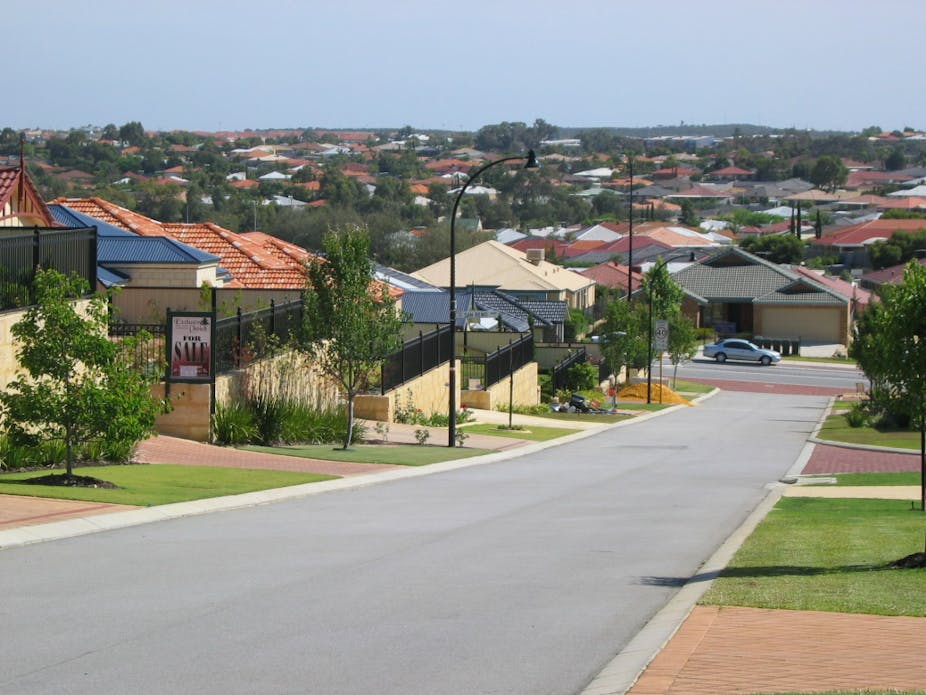
Next time you drive through a suburban street or any country town shut your eyes for a moment and try to imagine the dreams of the people who built that house. Houses are envelopes for our desires and hopes and change with every generation.
Every time I read a story about the horrible waste of space and resources consumed by the ever-expanding Australian house on the large suburban block we should remember our past. Have people forgotten that the single-family dwelling, separate from the neighbours, was established as the basis of white, middle-class living before World War I?
The loan schemes that enabled the purchase of homes in all Australian states by the 1920s have their roots in the Workers’ Housing Acts enacted in most states before the Great War. In 1913 the ideal home was projected by architects and taste-makers as a modest but charming one, on a freestanding lot, with a garden ready for planting.

The bungalow was presented as the ideal housing type, something that suited Australian lifestyle and leisure, climate and conditions. Many Australians could not afford such modern and detached dwellings at this time; most people lived in homes of earlier building stock, much of which was constructed in the boom of the 1860s to 1880s, including the small and poorly built speculative terraces of Sydney and Melbourne. They wanted to get out of them as fast as possible.
Flats were virulently opposed by state politics and the building industry in the formative years of Australia after Federation in 1901. Florence Taylor, owner of Building magazine and the first registered woman architect in NSW, was a vocal opponent to such flats. She wrote in 1915: “the flat is the enemy of home life”. White middle-class Australians were expected to have something better – race was often invoked in the argument.
John Fitzgerald, first chair of the NSW Housing Trust, noted in 1912 that “human nature is in favour of the freehold”. Flat-living was not considered socially useful as a long-term ideal. We must remember today that flats were always rented in 1913 and that the residents moved on, for many workers, either to further precarity, but for others, to possible home-ownership if they qualified for the new loan schemes.
The style in which a house is built goes much deeper than surface style. In a country with historically one of the highest levels of home ownership in the world, the appearance and design of individual dwellings meant a great deal.
Was the appearance of homes about various “isms” or simply a matter of aspiration? What can we expect the home of the future to resemble? Will we ever learn to add value by employing architects, or will we remain a country of developer-led homes that nonetheless seem to embody Australian democratic ideals?
Australia has long exhibited a high level of home ownership; by 1890 almost half of the population were home-owners. By the 1920s all states had loan schemes in place actively encouraging Australians to mortgage themselves and purchase a home.
Home-owners cared less about styles or isms imported from abroad than they did about appearances. A Mediterranean villa suited the harbour in Sydney, so long as it had good plumbing. The mock-Tudor with mass-produced half timbering popped up everywhere.
Although all of these inter-war homes appear very different, they were considered very new in terms of internal planning, the size of windows and management of light. The famous 1920s house “Greenway” which still stands in Vaucluse was famous for being sited on the plot to face the view, and not the street, no gum trees were destroyed, and the house had open sleeping porches for hot summer nights.
Such homes were meant to rationalise domestic labour, reduce household clutter and apply soothing effects of colour to the domestic environment. Built-ins only became really common in Bauhaus-inspired dwellings and were not at all common until the 1950s. They were considered both modern and hygienic.
The fitted kitchen was one of the novelties of that era and promised the housewife large unbroken surfaces on which to wave her magic culinary skills. The notion we see today of white goods as marking our status and distinction is hardly new. What has changed is that a 1950s housewife wished her fridge to stand out like a masterpiece; many now desire minimal cabinetry in which everything seems to miraculously disappear.
The DIY culture of post World War II life in which thrifty family men spruced up the environment connected people very closely to their homes, parts of which they often had made themselves. Home meant everything.

The modern flat, the subject of considerable energy from the international avant-garde, gained increasing attention in Australia between the wars, but it was always controversial. Sydney, unlike Melbourne, had experienced an explosion of flat-building in inner-city areas following the depression of 1929, due to relaxation of zoning laws.
Despite opposition to such housing from political parties on the grounds of social disruption and familial breakdown, over 500 blocks were built in Sydney annually between 1935-41. From 6.8% of Sydney’s building stock in 1921, they rose to become 12.8% in 1933. Flats did not cater for most workers due to the relatively high rents, and there was little discussion of economical working-class interior design until the 1939 Erskineville Rehousing Scheme.
Acres of identical and cheaply built flats, the type that former Premier Bob Carr attacked in NSW, spread everywhere after the Second World War. Although often very ugly, they are frequently very well planned and practical inside, and permit enormous light and ventilation. Many a home renovator has learned this of late.
The more space the better. The idea of being a good modern citizen living in a society of inevitable progress was employed to fuel consumer desire and spending. The consumer today is quite different, as consumption is linked to the idea of self-fashioning; we are what we spend.
So what will make the 21st century home?
The first issue is what the great architect-writer Robin Boyd called featurism, which he detested. When we pretend we live in Bali or the south of France, are we really engaging with where we live and how we live? Life style shows encourage these thematic gestures because they make people feel exotic and different and they are easy to understand.
If we are going to be a mature nation of home-owners we should reflect more on how we live and also where we live. There are now regional schools such as the Brisbane sub tropical style, which produce wonderful indoor-outdoor hybrid dwellings that if they are well handled, do not fall into kitsch.
Apart from warehouse conversions and architect-designed homes, many Australian dwellings are McMansions that do not relate to the scale of the houses around them or have anything to do with their environment. It is possible that as in North America, we are retreating into our homes more and more, meeting lovers online, watching our video on home entertainment systems, cooking on industrial quality ovens and holding parties with enormous BBQs that would once have provided a catering company. Perhaps we need to think a bit more about whether we are part of communities and networks or if we are heading towards an atomized existence? Or are such homes now firmly ensconced in the Australian psyche?
Aden Date
Manager of the Guild Volunteer Hub at University of Western Australia
I was doing some door-knocking in the lead up to the WA State Election last week in one of our more affluent suburbs. It strikes you the mix of old and new housing stock, with retirees and their unexpected million dollar homes sitting right next to middle-aged professionals with young families in McMansions.
The "atomised existence" (Australian spelling, please!) is no better juxtaposed than in these suburbs. Small homes on large blocks, naturally cooled by almost tropical gardens, with inviting…
Read moreBruce Tabor
Research Scientist at CSIRO
While I agree that "many Australian dwellings are McMansions that do not relate to the scale of the houses around them or have anything to do with their environment", McMansions work when set in master-planned estates with other McMansions. Developments in Stanhope Gardens and The Ponds in NW Sydney are examples. And the incongruity is not restricted to McMansions. Few things make an urban environment uglier than misplaced 1930s red block flats or modern high rise apartment buildings.
No matter what the age, architects and planners always seem to have a chip on their shoulder regarding the latest popular housing trend. Very few people can afford architect designed homes, or the latest in environmentally friendly design.
Lorraine Hunter
Retired
Generally there are covenants, particularly in new subdivisions, in place to keep uniformity of building design, but this would go out the door when an owner/builder buys up an ageing home and replaces it with a modern home in suburbia.
Having had an unhealthy disregard for architects for most of my life,I was pleasantly surprised and thankful for a designer who planned our acreage home which fits into the environment and which we would never have envisioned without his help. Excellent airflow…
Read moreSimon Doring
logged in via LinkedIn
No disrespect intended but I find it distressing that a scientist can state that "Very few people can afford architect designed homes, or the latest in environmentally friendly design."
It's simply not true that good design, whether produced by a person trained in architecture or best practice building design or what's called environmentally sustainable design is by default un-affordable design. Actually, that's a very unscientific statement since re climate change, the whole world can't afford…
Read moreLorraine Hunter
Retired
I'm with Simon on the points he raised and this is from a mere home owner who has observed our own and others mistakes over the years and quite happy to admit to it. The proliferation of project homes has created an easy/fun approach to building the dream home but with unseen costs by the unwary that would more than pay for an architect or designer!! We are thankful for the generosity of time and advice we received and have a home that well and truly surpasses environmental needs as well as profitability on sale that has occurred. Weather it's a carpet or car, you get what you pay for.
We had reason to speak only last week to an old 'Sculpturer' who is finding life hard. He said 'people don't see quality. They will pay $60K or $80K for a car but won't pay $10K for something like this." He's so right and we are too into factory processed houses/clothes/artwork. We've lost the art of recognising quality in the quest for cheap reproductions. I'm done!
Graham Walker
IT Architect
Unfortunately many of the benefits of a well designed, environmentally sound home are things that are realised over the life of the building with payment for these things required up front. I don't think there is enough recognition of these benefits in the evaluation of the cost of a house. For instance, I put solar panels and solar hot water on my last house reducing my electricity bill by 2/3, however when it came time to sell 99% of the purchasers couldn't care less about that sort of thing. They…
Read moreBruce Tabor
Research Scientist at CSIRO
Simon, no disrespect taken. I have to confess to a degree of frustration to what is almost a reflex rejection of so-called McMansions by those with the good fortune to be able to afford inner city housing, architects, or the latest eco-friendly features.. To me it's akin to looking down on "Bogans" or "Westies". I'm not entirely sure what a McMansion is, but it seems to be any 2 story house with more than 3 bedrooms plus lounge, dining & kitchen.
And there is no inconsistency. Why should the financial…
Read moreSimon Doring
logged in via LinkedIn
$300,000 for a house with as many sustainable features listed in the brochure is cheap and competitively priced.
Peter Ormonde
Peter Ormonde is a Friend of The Conversation.
Farmer
That's true Simon - good design should not - need not - be expensive. But it is a moot point regarding sustainability if the house is on the fringes of a city and imposes an enormous transport burden on the residents - 2 cars minimum and long commutes really blow sensible sustainabile design out of the drink.
But these are largers scale design issues - like rail lines and stations and the infrastructure (such as shops and commercial services) required for modern life. I'm not holding my breath.
Dale Bloom
Analyst
Fundamentally, I would question why there has to be more and more houses.
“In 2006, there were a total of 7.8 million households in Australia. By 2031, the number of households is projected to grow to between 11.4 and 11.8 million.”
http://www.abs.gov.au/AUSSTATS/abs@.nsf/Lookup/4102.0Main+Features20Dec+2010
Research by Curtin University estimates that an average new house now costs $684,000 in longer term infrastructure costs, or about $263,000 per person.
http://sustainability.curtin.edu.au/local/docs/Curtin_Sustainability_Paper_0209.pdf
Most of these infrastructure costs have to be paid in long term rates, which may be a reason why so many councils are now on the verge of bankruptcy.
As well, there is the destruction of environment with each new housing subdivision, and also resource depletion as each new house is built, (with very little that can be recycled from a new house built on a slab).
Steven Liaros
PolisPlan - town planning and eco-village consultants
I agree with you Dale.
No mention here of the public costs of the separate detached houses or the resource wastage or environmental damage.
No mention here either that it is precisely the distance between the separate detached houses that separates us from any sense of community, that causes us to "retreat more and more into our homes..."
No mention of the unaffordability of housing especially for the younger generation nor of the enormous level of household debt across the community (caused…
Read moreCarol-Anne Croker
logged in via Facebook
Unfortunately, where I live housing is also changing from functional seaside to atomised existence for holiday makers who bring from their city abodes the same visual barriers to community and actual engagement with the locals ( people, flora and fuana). These holiday houses serve one main function aesthetically, to brand your economic and social representation of character.
I too use the term McMansion disparagingly but thus is another form of cultural elitism. Am I jealous of the outdoor kitchens…
Read moreDale Bloom
Analyst
I would agree that affordable housing, destruction of environment and declining quality of life are becoming the most important issues now facing Australia, but totally ignored by politicians with a desire for continuous growth.
If any destruction of environment has occurred over the past 200 years due to housing, that destruction will increase by about 50% over the next 20 years, judging by ABS data.
Affordable and sustainable housing may actually be something similar to this.
http://www.panoramio.com/photo/71625951
There have been gardens in Papua New Guinea estimated at over 10,000 years old, which would make the village sustainable enough.
The villages were also surrounded by huge areas of undisturbed natural bushland.
Unfortunately, I think Australians are now too used to something else.
Michel Stasse
logged in via LinkedIn
I disagree that "it is precisely the distance between the separate detached houses that separates us from any sense of community". I've lived in Brisbane for decades, and had nothing to do with my close neighbours, often driving right across town to see friends. I have twice lived in the country where houses are sufficiently far apart that you don't even know if the neighbours are home, and yet the feeling of community is far stronger here. Maybe it's the commitment shown when neighbours have to walk 200m to share a coffee and a chat!
Lorraine Hunter
Retired
"Fundamentally, I would question why there has to be more and more houses."
Read moreDale, where do you suggest we house a growing population? The Baby Boomer era has created an enormous challenge which politically hasn't been addressed in more ways than one. The era saw unprecedented wealth, larger homes and massive spending. It's a done deal and cannot be undone. This will now result in a larger number of single person dwellings in the next fifteen years as those Australians reach retirement and the statistics…
Michel Stasse
logged in via LinkedIn
According to the Bureau of Statistics, at the time of the last census there were some 830,000 empty houses in Australia........
Rachel van Someren
logged in via Facebook
Can't quite agree with you about detached houses causing a separation from any sense of community - but in the style of detached house. McMansions with their lack of yard and face closed to the world certainly do, but living in a post-war in Brisbane, with it's open windows, yard to play & work in &, most importantly, low see-through fences that invite interaction & conversation, this style of detached house actually contributes to our sense of community with our neighbours.
Craig Steel
Miner
Agreed. Where I live now I can walk around town and run into people I know who live in town or on surrounding properties, even in the next town over. In Sydney I lived next door to people for decades - literally - who wouldn't even acknowledge your presence, so you give up trying.
Stephen John Ralph
carer
Hi Peter
more often than not these days, the people who "build" the houses are Metricon, Simmonds, Henley etc.
These firms build whole suburbs of houses.
The very openness of the living spaces doesn't allow for a teev to be on in one room, and a cd on in another. or allowing someone quiet time in a study or reading room.
And of course when you visit the display homes they look faaaaabulous.
I guess it must be nice living in these homes, but to me they are characterless and don't seem…
Read moreDianna Arthur
Dianna Arthur is a Friend of The Conversation.
Environmentalist
You stole my thunder, Stephen. I simply cannot understand why anyone would want to live in a free-standing house sans room to play outside, devoid of of shade either trees or eaves (eaves actually do more than just provide shelter from the rain while scrabbling for keys; they help to protect the house).
No place for pets, not even room to grow a few tomatoes - even in pots one requires a sunny area to place them.
And the cleaning of these enormous homes - not all occupants can afford cleaners, surely?
If people don't want to relate to the environment why not just live in a well appointed flat?
Dianna Arthur
Dianna Arthur is a Friend of The Conversation.
Environmentalist
And the final insult many of these houses are built on what used to be arable farmland.
McMansions: insult to injury!
Carol-Anne Croker
logged in via Facebook
Ah economics ans notions of taste...the elephant in the room. Your functional issues cash be regulated through government mandated standards, such as water tanks in all new homes, etc. The biggest need is forcing developers to develop with public space in mind allowing for necessary infrastructure without pricing average home buyers out of the market as the become American-style gated communities of sameness.
Carol-Anne Croker
logged in via Facebook
The loss of agricultural land and green wedges in outer suburban Melbourne is at crisis point but State Govt of either persuasion don't see this as important vote betters, let alone important issues. Of environmental sustainability.
John Kerr
IT Education
I've often wondered why arable farmland has such appeal. You can build houses on poor quality farmland, hillsides unsuitable for farming and many places that suit homes but don't suit farming but always the best farmland goes to build sprawling housing. I don't think that many councils have farmers on them who can advise them about this. So, we build houses further and further from where people work, we destroy the farmland that feeds them meaning we have to cart food from further and further away, all the time denying that resources and fuel are drying up.
Michel Stasse
logged in via LinkedIn
In my not so humble opinion, 99% of housing is a disaster. And "boring as" to boot! So disenchanted was I when we decided to build our own home, I did it all myself - design and build - and won an award for the trouble.
There is absolutely no thought put into the current housing stock regarding the environmental impact of these builds. It is now a given that all houses will be airconditioned. Yet it doesn't have to be so.
Our place, built in Sub Tropical Qld needs no heating (even though temperatures can drop below zero in Winter) and no cooling in Summer when 30 to 40 degrees occurs regularly.
The proof's in the pudding, with some assistance from a small solar power system installed well before it became the rage, we have NEVER had a power bill.....
http://damnthematrix.wordpress.com/2011/09/04/the-power-of-energy-efficiency/
http://damnthematrix.wordpress.com/2011/11/01/mon-abri/
Michel Stasse
logged in via LinkedIn
We built our place on arable farmland....... but we farm it! Sort of..... on our 6,700m2 block, we grow most of our food and even raise goats for milk and dairy products. It's all done organically using permaculture principles.
I don't know how anyone can live without a garden.......
http://damnthematrix.wordpress.com/2009/07/22/finally-zone-1-under-control/
Jan Burgess
Retired
"I simply cannot understand why anyone would want to live in a free-standing house sans room to play outside,...If people don't want to relate to the environment why not just live in a well appointed flat? "
Whilst not disagreeing with your opinion of large houses on tiny blocks, I would point out that a flat comes with a corporate body. I think you will find that anybody who has had the dubious pleasure of dealing with a corporate body would jump at the chance of a freehold house. Being free to make your own decisions and not have to pay the inflated rates charged for corporate body work is very attractive. If you haven't owned a strata titled property, you probably grossly underestimate the disadvantages and sheer frustrations.
John Phillip
John Phillip is a Friend of The Conversation.
Grumpy Old Man
Michel, my wife and I want to build on our 5acre block in Stanthorpe and disconnect totally from the grid. Thank you for the link to such a terrific website. Cheers :)
John Kerr
IT Education
I was amazed to find that Russian Society has tended to head in a different direction entirely to us. The development of productive small cottage farms has been enormous to the extent where they are providing a large slice of produce. "In 1999, 35 million small family plots produced 90% of Russia’s potatoes, 77% of vegetables, 87% of fruits, 59% of meat, 49% of milk . . . And since 1999, it seems things have only gotten better when it comes to small-scale agriculture in Russia." The government even provides small plots for families to grow produce in this cottage industry manner. Seems to be solving problems rather than creating them like our society is doing.
Craig Steel
Miner
Agree with both of your statements here. Which is why I bought 40 acres of land on the side of a hill and am in the process of building a small strawbale, lime rendered house for wifey and myself. A small area will be cleared for the house, sheds and a 'food forest' but the rest will remain unspoiled.
Robert Nelson
Associate Director Student Experience at Monash University
Thanks, Peter, a very interesting article and fun to read!
You and I approach the house from different roads but seem nevertheless to come to the same door. You recognize the atomized existence promoted by the contemporary free-standing house, which I would argue was incipient in premodern times and belongs inherently to the bungalow archetype, which became an epidemic with the growth of cars. In The space wasters: the architecture of Australian misanthropy (http://www.planning.org.au/documents…
Read moreGavin Moodie
logged in via LinkedIn
I hope readers don't follow the author's advice to shut their eyes next time they drive thru a suburban street or country town.
It is precisely because people understand the aspirations represented by various domestic building styles that some are so deprecated. People criticise the 'white picket fence' not because they have anything against white picket fences per se, but because they represent the White Australia policy and other forms of insularity.
Stephen John Ralph
carer
Hi gavin
gee that was a long bow to draw.......my take on picket fences would be that it represented conformity -
in the same way as Pete Seeger's song "Little Boxes.
btw re fences - I am bemused when I see a big and expensive fence, and behind a very ordinary often less than loved home.
Graham Walker
IT Architect
We just moved up to the Gold Coast from Sydney and the suburb that we have been renting in has, to me, a very interesting phenomenon - garage sitters.
Read moreThe suburb, Pacific Pines is one of those huge, multi stage, developer estates with project homes on 99% of the blocks. Since coming up here I have been amazed at how many people seem to spend their evening and weekend time with their garage doors open sitting in the garage. I have come to the conclusion that it is some sort of, probably to a large…
Marie Bosworth
Administration
On gardens: In some cities, a garden is not terribly practical when you take into account the water it uses, and how short on water we are. You can argue that we could plant native plants, but they often look sparse, are expensive, and are surprisingly difficult to keep alive. I work full time so I just don't have enough time to care for fussy plants. Then there are Japanese style stone gardens, but on a 40 degree day is that really what you want?!
I dream of a small cottage garden with lawn and…
Read moreCarol-Anne Croker
logged in via Facebook
Will be watching out for garage sitting around me...mostly our visible owners are balcony sitters with their view down to us unimpeded but our view of them, a type of glass enclosed fenced display zone for the gastronomic worship of the outdoor cooking appliances and heaters. We are here and want to be seen here but don't want to engage with neighbours just our select group....whilst dominating streets cape with visiting cars as the houses so large on blocks...available parking taken by two 'resident' cars and boat. Fascinating area for research across so many disciplines.
Carol-Anne Croker
logged in via Facebook
I love the idea of vertical gardens in the city, especially on bare walls, the water tends to be collected, recycled etc...but would be very expensive to install and maintain. Would love every city rooftop to have a green communal space for workers and residents.
Tim Traynor
Rocket Surgeon
Interesting. In Melbourne, you can tell the home owners are Greek or Italian if they're sitting in their garage.
Stephen John Ralph
carer
Hi Time
this is the second time this "phenomena" has been mentioned.
I think it is a great idea to use the space as an almost al fresco sitting area.
Its reminiscent of the front porch days.
Its been suggested that one reason for the rise in crime on urban streets is that the days are gone when people lived more of their lives "on the street".
I can imagine walking the streets of a suburb or town and connecting with the garage dwellers - a wave at first, then a talk about the weather, and then viola - communication.
Perhaps the next step might be a seating area on the front perimeter of the property.
I remember when I was in Greece a while ago and being pleasantly struck by citizens mingling in the town plaza. Men walking arm in arm deep in conversation. Women and men involved in conversation, and kids doing what they always do.....laughing and playing.
An idyllic scene...but one that was genuine and heartwarming.
Peter Gringinger
logged in via email @iinet.net.au
Even though this article gives some historic insight into the development of Australian housing, but it misses the important factor the reliance of planning the endless burbs had on cheap fuel and cars, something which still continues today. In a time of peak oil, resource scarcity and climate change it is complete lunacy to continue this way, but eventually the burbs will become millstones around our necks but will have to live with them for a while and try to adopt them to the new realities of cars becoming a luxury, food having to be produced locally as many other basic products. Eventually they may become salvage yards of materials used for real communities built according to real human needs and within the carrying capacity of the planet. But if and how we get there, that is the big question. See David Korten, Agenda for a New Economy or The Great Turning for more details.
Michel Stasse
logged in via LinkedIn
It was BECAUSE of the looming Peak Oil crisis that we moved out of town and onto sudivided dairy farmland. We now produce most of our own food, using nothing but rainwater and the fertiliser that comes out the rear end of our goats, chooks, and ducks!
John Kerr
IT Education
Wow, there are so many aspects to this article. One that springs to mind is that we seem to have not taken any notice of some of the previous designs of houses. I was visiting a friend recently in what is quite a warm climate and he said that he hadn't used the air conditioner because he doesn't have to. It is an old house, off the ground, wide eaves, shade and huge verandahs. The design of the house was for the area and protects the inhabitants against heat. Unfortunately, you don't see any…
Read moreMichel Stasse
logged in via LinkedIn
Houses built on slabs are usually much cooler than ones raised on stumps. To keep a house cool in Summer and warm in Winter, you need INTERNAL thermal mass..... which is where McMansions have it all wrong with all their bricks on the outside. They don't build ovens out of bricks for nothing.
To build a low carbon footprint house requires a whole chain of events to occur: siting, shape, glazing size, eaves, etc etc... http://damnthematrix.wordpress.com/2011/11/01/mon-abri/
If you don't want your house to flood........ don't build on a flood plain!!
Graham Walker
IT Architect
I came across the idea of reverse brick veneer the other day and it sounds like a very sensible, thermal mass concept for Australia.
Jan Burgess
Retired
"One of the sad things I see in modern housing is the older couple who keep their family home long after the family is gone."
This really makes me angry. Why on earth do people think it is acceptable to group all "old people" into one size fits all, small units. Just because you don't have young children, you're not supposed to want some space and privacy around you. You're "selfish" for wanting to stay in the house you and your partner have spent decades making into a home. You're not expected…
Read moreJohn Kerr
IT Education
Jan, what I was referring to was the old couple who can no longer take care of the family house, the garden is overgrown and maintenance obviously needs to be done. I was not putting old people into the 'one size fits all' either. We have been researching living for an older relative who has the big family house that is well beyond them. What we found was rather refreshing - some retirement villages with separate one, two, three and four bedroom homes. All low maintenance. With or without gardens…
Read morePaul Felix
Builder
Sadly I must admit to building a mcmansion, though I do think the owners were duped by the army of useless experts helping them to create their dream home.
Read moreI also built a house for my daughter who insisted to her architects that the house was to be moderate and the garden extensive. She went through 3 before she designed a beautiful, functional home that cost her $180000.
The point I want to make is that not only do these places remove play areas, the effect of having no space is that most activity…
elizabeth williams
elizabeth williams is a Friend of The Conversation.
Registered nurse
Interesting history but all buildings and environmental designs seem to completely miss the need to provide for the population as it ages. Working in this field, many older people have to leave their long term environment due to minor physical /cognitive issues purely due to suburbs designed for cars making it dangerous for people with reduced vision, hearing, cognition to live with cars moving down the streets and across footpaths. Even some retirement villages follow the same layout. If houses faced car free walking/common areas with cars entering the rear of houses on service roads, older persons with physical/cognitive deficits could safety remain a lot longer in their own homes and parents may be more inclined to allow their children out to play without the risk of abduction by car.
Graham Walker
IT Architect
I really love the idea of Village Towns (http://villagetowns.net/en/) and would participate in the creation of one if it ever happened. Unfortunately I think that getting the required momentum for such a development is unlikely to happen and so have to a large extent given up on it becoming a reality.
The books on building a Village Town are really interesting and paint a fantastic picture of what we could do if we built without having to plan everything around cars as the central focal point of our existence.
Paul Richards
strategic foresight
Peter McNeil wrote: "It is possible that as in North America, we are retreating into our homes ... ? Faith Popcorn wrote about the Global trend toward 'cocooning' in the 1990s; "Cocooning has been in our bank for thirty years. That's how early we discovered cocooning, and cocooning is about staying home, ..... how many days can I work at home? That's cocooning."
Peter McNeil wrote: "Or are such homes now firmly ensconced in the Australian psyche?" Going on futurist observations like Faith Popcorn's and yours, yes they are firmly ensconced. However there is a growing trend toward form based architecture in the US, modeled on the best humanised European cites. The interesting issue is the motor vehicle plays a secondary role. The issue of cocooning inside a motor vehicle as well as our homes will need addressing if we want sustainable cites.
Judith Olney
Ms
I wonder if the reason many of us like our homes to be places to get away from other people, is because for many of us who work in jobs where we deal with "the public" on a daily basis, for many hours of the day, it nice to not have to deal with people outside of work. I view my home as my sanctuary away from the demands and view of other people, where I can spend time alone, or in the company of those I choose.
It seems that in this country we like our privacy, if all the super-six and colourbond…
Read moreJohn Kerr
IT Education
I was looking at some interesting designs from overseas and the housing developments seem much better planned. Houses in a huge circle with open space in the middle to allow for car-free playing and activities. Houses face inwards and access by car is from the road at the rear. Seemed to be a much more friendly atmosphere than our street on street developments. Several of these circular developments were placed near sporting and activity areas/buildings as well as a small shopping centre and services.
Judith Olney
Ms
The type of development you are describing John, would be wonderful. I would love to see the focus shift from cars to people, we have moved very far from having liveable suburbs.
I wonder if our housing developments will be redesigned when we no longer have access to cheap fuel and cheap cars?
Graham Walker
IT Architect
Hi Judith,
I reckon you'd find the concept of Village Towns (http://villagetowns.net/en/) to be very interesting. Have a look through the website. I've read all the books but have decided that actually finding/building such a place is unlikely to happen. That said, if such a development was to actually go ahead in Australia, I'd seriously consider being part of it.
Judith Olney
Ms
Thank you for the link Graham, the concept looks like something I would definitely support. I'm going to have a look at the website in a lot more detail to get more of an idea of what this is about.
I feel that as a society we will have to change the way we do things as resources become more scarce, which is inevitable as most resources being used to support our current systems, are finite.
The return to a village type system, that is sustainable in the long term, and far more human friendly, is the way to go for the future IMHO. It will take people wanting to make the change in the short term, but long term it may be a change that is forced on people, as our current system is simply not sustainable, or healthy for many people.
Dan Fashaw
Brain Surgeon
People want their own house on their own block of land, Australia certainly has the space, and the money, and the desire. If people want to live in flats then by all means they should, but I disagree when people say it's important to stop the urban sprawl because of unsuitability, lack of community, transportation issues and environmental harm etc.
Australians have a choice between flats and more compact living vs. suburban more spacious living and that choice is important to maintain. One of the great things about Australia is the ability for someone to have their own space on their own land. I don't think the majority of Australians want to see that go.
Stephen John Ralph
carer
Hi Judith
in a perfect world this would have already happening. Particularly in the enlightened 21st century.
Unfortunately its too easy to opt for the quick buck, and not really think too much about the concept of architecture vis a vis human interaction and practicality.
As we lost the corner shop, so people now have to drive a ways to the supermarket. Although I suppose we can order online and have stuff delivered. But then that just perpetrates the isolation that has been commented upon herein.
It seems to me utterly unfathomable that architects, builders, state and local planners etc could not in this day and age come up with a better solution to modern living than the urban sprawls we see everywhere.
And now here in Victoria there is talk that the Minister for Planning & Environment (an oxymoron I believe) is willing to sacrifice green wedge land around Melbourne to the altar of development.
Judith Olney
Ms
Hi Stephen, I almost missed your reply, please use the reply button at the bottom of the posts, this means that I will get an alert when you reply. Your posts are always informative and interesting, and I would hate to miss them :)
The points you raised baffle me also. Perhaps we need more imaginative planners, and less greedy developers, and a complete rethink about how we want to live. We, as the buyers of housing, seem to just accept what we are given to buy, without really questioning how…
Read moreStephen John Ralph
carer
Hi Judith
Living in Torquay as I do, I have already mentioned in this forum the Sands Resort development.
When I was a kid I used to ride my bike out towards Barwon Heads. The population of Torquay was about 1,200 (now just over 15,000).
Anyway on these rides I would pass an area that was a wetland and home to birds such as pelicans etc. That area is now The Sands development.
And again I say that in Victoria we have little solace that our planning minister will offer inspiration
and leadership in the area o fsustainable development and architecture.
Also between Geelong and Torquay there has already started a development under the umbrella name of Armstrong Creek. 30,00 - 40,000 homes are planned over the coming years. If you allow 4 people per house thats well over 1000,000.
I know people have to live somewhere and it always easy to criticise from the comfort of our keyboard.....BUT.
Judith Olney
Ms
Hi Stephen, I know the area your talking about quite well, as I have relatives in Point Lonsdale. I can't believe the changes that have happened to the area. I remember when Geelong seemed such a long way from Melbourne, but it seems as though it is wall to wall housing developments now. We are creating urban deserts.
The same thing is happening along the South West Coast of Western Australia, so many environmental issues, loss of habitat for native animals being just one. There is a monumental disaster with canal developments, that are affecting the fisheries as well as destroying the land based ecosystems.
All to serve the mighty dollar. Very sad.
Stephen John Ralph
carer
Now I can't stop commenting - I'll blame you Judith.
Another curious thing is the way people build on food plains and can't understand why their houses go under.
Even more curiouser (!) is the fact that builders are allowed to develop these areas, and sell to unsuspecting buyers. Something is amiss somewhere.
It is only natural that as cities develop further into the hinterland, there will be any number of old river beds, creeks, wetland areas and flood plains. But the urban sprawls dont seem to take these features into account. Thus heartbreak for many families - particularly if the y have no insurance.
Dianna Arthur
Dianna Arthur is a Friend of The Conversation.
Environmentalist
Judith and Stephen
Just a quick note to tell you how much I am enjoying your comments and (being Victorian) know only too well of the areas of which you speak.
Neo-libertarians will argue that people are simply using their 'right to choose' as if there exists a plethora of choice.
Not all of us can afford to engage an architect as much as we would like. Nor are we all educated in ideal positioning of a home on its site, let alone environmentally necessary design that includes eaves, verandahs, shade plants, collection of rainwater {not only into tanks but which can also be directed to water gardens - love ag-pipes - a good garden designer or landscape architect can plan for a garden that can self-sustain) and planning that excludes building on flood plains, vital farmland but includes which supportive infrastructure.
Stephen John Ralph
carer
Hi Dianna
thanks.
As a teenager i would draw house plans in the back of my school exercise books.
I would loved to have been an architect, but I was lousy at maths - probably because I was too busy drawing my dream houses.
Dianna Arthur
Dianna Arthur is a Friend of The Conversation.
Environmentalist
I studied Landscape Architecture. Although I admit we students had to cope with trigonometry for Surveying, our teachers gave all the help anyone could need.
Students (and this included straight out architects) were selected for far more than just mathematical ability - we used to joke that Landscape Architects were the jacks of all trades. A shame that you deselected a natural talent simply because you thought you were bad at maths. I was always in the top 5 at maths until I got a teacher who…
Read moreMichel Stasse
logged in via LinkedIn
I wouldn't hire an architect in a fit...... you'd probably get the wrong advice!
The internet is full of good advice you know...... Google is your friend. I designed (and built) a very successful passive solar house that needs no heating cooling.
Google "passive solar" and permaculture. That should keep you occupied for WEEKS......!
http://damnthematrix.wordpress.com/2011/11/01/mon-abri/
Judith Olney
Ms
Hi Dianna, Not all of us can afford to engage an architect, that's for sure, but we can make informed decisions by educating ourselves.
I have recently bought an ex-housing commission house, in a suburb where there is still a human feel, as I described in one of my posts above.
One of the things that convinced me to purchase this house, rather than build new, was the design was very energy efficient. The house is tiny compared to what is built today, but far more practical, particularly as…
Read moreDianna Arthur
Dianna Arthur is a Friend of The Conversation.
Environmentalist
That's excellent. There is so much we can do with existing homes rather than wasteful tearing down.
You have clearly put a lot of thought into your home.
When selecting mine I had certain criteria, hence I ended up with my "tree-house" - a small 3 bedroom home of western red cedar on block of sloping land much larger than the home. My home began life as single room shack with a brick chimney, the chimney was subsequently built around and added to, resulting in the thermal quality of a central…
Read moreJudith Olney
Ms
Sounds absolutely wonderful Dianna, there is nothing as good as being close to nature. I get a taste of this in my little home and beautiful garden.
Living in among the trees would be lovely, but not very practical in my very hot dry area, the fire risk is too high. We have already had 2 bush fires this year that have burnt very close to where I live, and we have been asked to evacuate once, so although it sounds idyllic, it wouldn't be something I would be willing to do.
You are very lucky indeed :)
Peter Ormonde
Peter Ormonde is a Friend of The Conversation.
Farmer
Most interesting article.
I'd hope we get a lot more contributions on urban design and archicture in the Conversation. Most folks have little real choice in the sort of housing they accept - little basis for making choices if they were available - the decision being financial rather than aesthetic or even practical.
PS Can we establish a register of Architecture Crime ... where the children of appalling architects must spend their lives demolishing and refurbishing the sins of their parents.
Paul Richards
strategic foresight
Peter Ormonde wrote: "... hope we get a lot more contributions on urban design and archicture.." Could not agree more, all with at least one of the keywords; humanise, new urbanism, form based architecture, Jan Gehl cites.
Here is a link to in the meantime. The development is close to us and the kids seen playing regularly are always very happy.
http://architectureau.com/articles/2012-national-architecture-awards-residential/
Jim Wright
Retired Civil/Structural Engineer, IT Consultant/Contractor
The wide variety of house and suburb design reflects changing demographics over time, so that a McMansion built to serve a substantial family can, as pointed out in an earlier comment, later house only the empty-nester parents, who perhaps would like to move to a more modest home, but cannot afford to do so because the current generation of families cannot afford the inflated price they would need to ask to pay off a mortgage or extract pension support . There are some huge inefficiencies in the…
Read moreLorraine Hunter
Retired
Are these problems any different to the housing in the 'old days'. I have an elderly uncle still living in a large house (McMansion) that was occupied by my grandparents and ten children. Many very large and smallish 70's highset Brisbane homes are very adaptable (many with underneath garages turned into teenagers self contained bedrooms) and are already taking advantage of options (rent out one room or unit underneath), but elderly people choose to stay (and this is their right) in these houses…
Read moreShani Walker
Teacher
My home was built in the 1890's in a small country town. It is still in great condition and we have opened it up a bit, added another needed bedroom and a pool. We have room for pets, including chooks, vege gardens and fruit trees. They built them to last back them. Newer homes in town are already looking dated and badly built, while mine is a classic and just keeps on going. I'm truly fortunate to own my home.