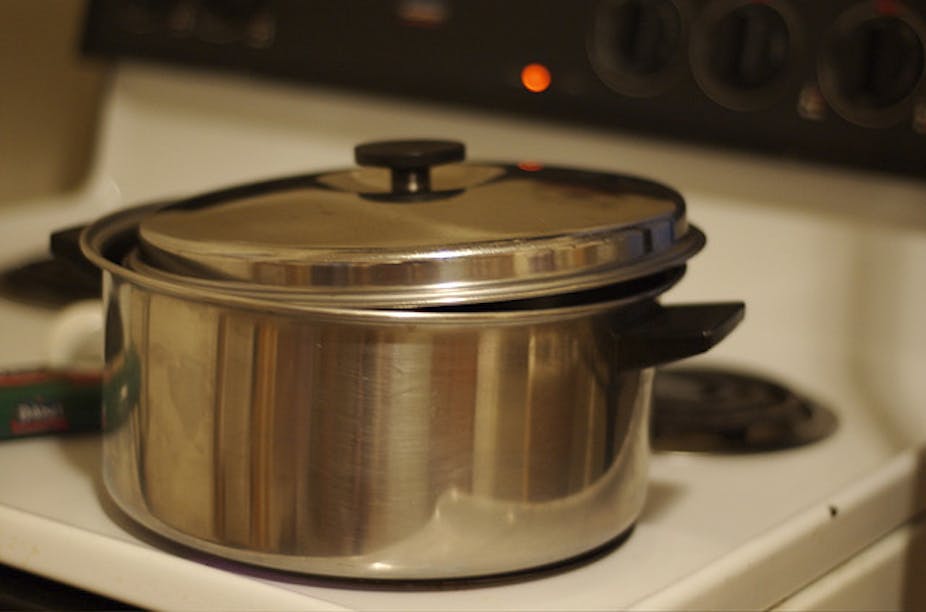
Food poisoning doesn’t just come from dodgy kebabs, under-cooked chicken and restaurants with poor hygiene practices – it can also occur in the home. And anyone who has suffered a bout of food poisoning knows it’s not pretty.
The specific symptoms, and the time it takes until you get sick, vary depending on the pathogen and include nausea, stomach cramps, fever, vomiting and diarrhoea. People who have compromised immune function are particularly susceptible to food-borne illness, including babies, young children, pregnant women and the elderly.
Australia’s surveillance system for food-borne illness is monitored by OzFoodNet. In 2009 alone, more than 2,600 Australians became ill from food poisoning; of those, 342 required hospitalisation and eight people died. OzFoodNet reported restaurants were the most common setting for food contamination.
But many mild cases of food poisoning from home-prepared foods never get reported.
Temperature danger zone
Foods that are cooked then reheated are more likely to be a risk for food poisoning. The greatest potential hazards are meats, casseroles, curries, lasagna, pizza, sauces, custards, patties, pasta, rice, beans, nuts and foods containing eggs, such as quiche.
As cooked food drops to 60°C or below, bacteria that have survived the cooking will start to multiply until the food cools down to five degrees. The longer the food is left to cool, the longer the bacteria – which causes food poisoning – has to multiply.

Food Standards Australian and New Zealand (FSANZ) provides a guide to managing potentially hazardous foods in the risky temperature zone: food should take no more than two hours to cool from 60°C to 21°C, and no more than four hours to cool from 21°C to 5°C. If you want to check this at home, invest in a good quality food probe thermometer (and follow the manufacturer’s instructions).
Try to eat food promptly once it’s cooked. Or, if you intend to store cooked foods to eat later, you can cool it on a bench as long as the temperature doesn’t drop below 60°C. This is roughly when the steam stops rising. You can keep cooked meals safely in the fridge for a few days, but if you want to keep it for longer, put it straight into the freezer.
In the fridge, make sure you store cooked foods on the top shelves and raw foods on the bottom shelves to avoid any contamination from condensation on the raw food that falls onto cooked food.
And finally, when defrosting food, put it in the fridge and keep it below five degrees Celsius. Never leave it to defrost on a bench at room temperature because this places in right into the food hazard temperature zone.
When it comes to food safety, a little common sense goes a long way. Always wash your hands before handling food and use separate utensils and chopping boards for raw and cooked food. If you’re in doubt about the risk of something you find lurking in your fridge or freezer, throw it out.
Further reading:
NSW Food Authority – for information about food poisoning
Better Health Channel – for more on food safety
Grendelus Malleolus
Senior Nerd
Fantastic article - however this does not solve the issue of my hot pot of curry raising the temperature of the items around it in the fridge to a rather upleasant level - and if other people have a smaller fridge as I do, then the space is at a premium already. This was the reason I was always given for avoiding putting overly hot items in the fridge.
If I know I am going to be making a lot of food in big pots I generally try to get a bag of ice to make an ice bath in the sink to sit my pot in.
Sreejith sv
logged in via LinkedIn
If it is curry items then it would be better to stir them occasionally so that the food will cool down much easily. Also using shallow pans will also cool the food quickly.
Grendelus Malleolus
Senior Nerd
Good point! I have also used shallow baking trays to cool mine.
Sue Ieraci
Public hospital clinician
Grendels - perhaps you could invite us all over when there is excess curry - thereby negating the risk of storing left-overs. I would volunteer to help.
Sue Ieraci
Public hospital clinician
I'm always skeptical when people who get food poisoning are asked whether they ate at one of the large multi-national fast food chains. Ironically, while this food is probably not nutritionally good, I imagine that they have standardised practices which are actually quite good. The outbreaks of food poisoning I have seen have been from small take-away food traders - and not necessarily "junk food". Domestic re-heating is the other danger area, as are parties where the fridge is too full and things are left out on the bench-top.
Michael Tam
Lecturer in Primary Care and General Practitioner at University of New South Wales
That has been my experience too Sue - small take away stores (especially if it was bought during shopping and then not consumed for a few hours before reaching home) and (finger-food?) at children's birthday parties!
Nick Melchior
Senior Publishing Editor
So what is the best way to store food for leftovers? Leave to cool before until stops steaming and then put it in the fridge? Or can I just stick it in the fridge while hot?
Jonathan Bruck
Mr
The reason there is confusion is because there are two competing factors. You don't want your hot food heating up your fridge (potentially risking your whole fridge), but you don't want your hot food to cool so slowly that you get food poisoning.
That said, as it says in the article if you have a piping hot dish. Leave it to cool for a short while on the bench and then put it on the top shelf of your fridge. Modern fridges have multiple cold air outlets, and there is almost always one at the…
Read moreJonathan Bruck
Mr
Leave it on the bench till it reaches 60C (nothing will grow above this temp anyway). Then put it on the top shelf of your fridge. - This is the main point of my much longer comment above.
Karl Schaffarczyk
Law Student at University of Canberra
A simple trick is to place your pot of hot food on to a kitchen sink so the sink can act as a heatsink - the metal conducts the heat away.
A secondary option may be to place the pot on the floor in a laundry or bathroom - again the tiles can quickly conduct the heat away.
Donncha Redmond
Software Developer
Will re-heating the food not kill off any bacteria anyway? Microwaving?
Sreejith sv
logged in via LinkedIn
if the food is not cooled properly after cooked then there are chances that some bacteria produces toxins in food. Some of these toxins cannot be destroyed even after reheating. So if you have cooled the food safely after cooking, reheating helps to destroy the vegetative cells.
John Hartshorn
retired - financial analyst
Water is not a problem where I live in the US so I've gotten the habit of putting the hot container in the sink with cold water after a meal and moving it to the 'fridge after about an hour. In cooler weather just leave it out on the porch. But set the timer of you may wake to frozen leftovers the next day.