Monday’s medical myth: stress can turn hair grey overnight

The belief that nervous shock can cause you to go grey overnight (medically termed canities subita) is one of those tales which could nearly be true. There are certainly cases in medical literature of rapid greying over quite short periods of time. And reported cases go back to antiquity including such…

Wx9yw4cr-1361414395
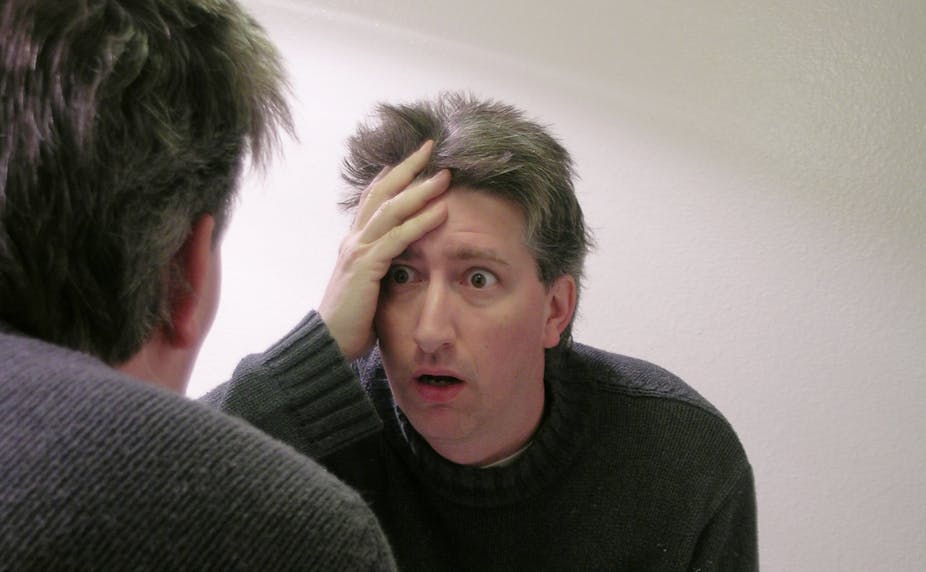
You may achieve your pigmentary potential a little ahead of schedule, but you can’t go grey overnight. Image from shutterstock.com

The belief that nervous shock can cause you to go grey overnight (medically termed canities subita) is one of those tales which could nearly be true. There are certainly cases in medical literature of rapid greying over quite short periods of time. And reported cases go back to antiquity including such legendary figures as Thomas More and Marie Antoinette.

The biology of the phenomenon suggests that a mixture of hormones and cognitive bias is responsible for the myth.

There is little doubt that plausible biological mechanisms exist to account for emotional stress potentially affecting hair growth. What’s fascinating to me, as a pain specialist, is that several of the signalling proteins involved (such as nerve growth factor and substance P) are the very same ones that operate in other nerves to create and regulate pain signals.

Human hair cycles between a growth phase (anagen), a resting phase (catagen) and a dormant phase (telogen). Pigment is produced by the hair follicle to colour the hair during the anagen phase while it is growing.

Marie Antoinette’s hair may have turned grey, but it didn’t happen overnight. Joseph Ducreux

The length of the anagen phase varies according to your genes and certain hormonal levels. It can be anything between two years and eight years. When the follicle receives orders to end the anagen phase, it stops producing more hair and begins to prepare for telogen. Telogen phase lasts for between six and eighteen months at a time before heading back into anagen.

After ten or so of these cycles the follicle runs out of pigment and produces a hair with no colour at all. Despite its white colour, we insist on referring to these as “grey hairs” for some obscure linguistic reason.

Intense stress can cause large numbers of your follicles to hit telogen at around the same time, producing simultaneous loss of a large percentage of coloured hair. This phenomenon is known as telogen effluvium.

Telogen effluvium is often caused by drugs which affect the hormonal control of the hair cycle, including chemotherapy drugs and anti-Parkinson’s drugs.

Interestingly, these hormonal signals have a less potent effect on non-coloured hair, so a person could conceivably lose large amounts of coloured hair, leaving behind mostly white hair. This could also happen at a stressful time, such as the night before your execution. It can also happen due to auto-immunity (alopecia areata) where the feral antibodies target pigment-producing follicles ahead of non-pigmented ones.

Blame pigmentary potential, not the stress of being the leader of the Free World. U.S. Air Force

The problem for the myth is that none of this can happen as suddenly as overnight.

There are also plenty of good alternative explanations for these reports. In the case of Marie Antoinette, she was seen little in public in the couple of weeks before her execution, and would also have been deprived of her wigs and servants to dye her hair, if indeed that was one of her guilty secrets.

People such as President Obama, who go visibly greyer during a period of extreme stress over months or years, are usually at an age where many of their unfortunate follicles are on their last pigment cycle.

What a difference four years can make. The White House

Confirmation bias means we remember those stressed people who look much greyer, but don’t remember those who go through such periods without visible greying.

We also tend to ignore those who grey early and don’t seem particularly stressed. That gets put down to genetics rather than stress.

So no matter how stressful your life may become, it might help to know that although you may achieve your pigmentary potential a little ahead of schedule, you can’t go grey overnight.

Join the conversation

11 Comments sorted by

  1. Sue Ieraci

    Public hospital clinician

    Thanks for a succinct review, Mike.

    We know that the only "live" bit of hair production is the follicle - the hair shaft that exits is inert. The shaft can no more change colour than become "revitalised" by any of those expensive shampoos and conditioners.

    report
  2. Craig Minns

    Self-employed

    My beard went white over a period of just a couple of years, from a very vivid ginger. There was a brief period of "pepper and salt" lasting only a few months, then it was over. Some portion of the hair on my arms, especially at the extremities, did the same, but by no means all.

    My scalp hair doesn't seem to have been affected, but I have experienced male pattern baldness.

    I was under very considerable stress for some time preceding the change and I've wondered about the mechanism. Thanks for the article.

    report
    1. Garry Claridge

      Systems Analyst

      In reply to Craig Minns

      Craig,
      I have a very similar story to yours. And, am also interested if stress was an accelerator.

      report
    2. Deirdre Ryan

      Medically Retired

      In reply to Garry Claridge

      Mr Vagg, Why does hair deepen into another colour again (usually a lighter shade of black) when taking certain nutritional supplements, and stops the silver/white from continuing its all over affect? Nutritional meds that are necessary for chronic illness? this happens to varying ages of persons and of blond, honey blond, light brown hair colouring prior to meds. Your reply would be appreciated as this has puzzled me for a long time.

      report
    3. Michael Vagg

      Clinical Senior Lecturer at Deakin University School of Medicine & Pain Specialist at Barwon Health

      In reply to Deirdre Ryan

      Thanks Deirdre, that's an interesting question.

      As far as we know, when a hair runs out of pigment it can't start producing it again, ie once a hair follicle starts producing white hairs it can't go back. I think I read a paper while researching this which claimed they had found a potential molecular trigger to reverse the pigment loss, but this certainly isn't the mainstream view at this point.

      A little-known function of hair is to provide a way of detoxifying the body of certain compounds, especially heavy metals like lead, arsenic and copper. What you may be seeing is some deposition of metabolic byproducts in the hair, which might conceivably cause a colour change.

      report
    4. Michael Vagg

      Clinical Senior Lecturer at Deakin University School of Medicine & Pain Specialist at Barwon Health

      In reply to Garry Claridge

      Would be interesting if they could find a substance that was non-toxic and deposited in hair so you could match your existing colour!

      report
    5. Deirdre Ryan

      Medically Retired

      In reply to Michael Vagg

      Michael, One week ago had very thorough blood tests with metals etc & others added into the standard full range/mix at my request. All within the parameters as much as "reference ranges" can be relied upon Never felt better than now! Am extremlely wary of lead etc as my sons and I had lead poisoning tthru ignorance 30+ years ago when I sanded 100year old house - even the Siamese cat had convulsions - which diagnosed the 2-legged household inhabitants.

      We are all taking NUTRITIONAL supplements…

      Read more
  3. David Maddern

    logged in via Facebook

    Hi,

    It seems you discount greyness. I heard a researcher say that when a melanocyte runs out of folic acid it appears to irreversibly stop colouring hair.
    I have been taking 500mgm folic acid with 50 mgm B12 as the CSIRO in Australia found (by following blood neutrophils and their dumbbell shapes) that such a dosing regime allows DNA repair mechanisms to work leading to a better state of repair in the body. My own opinion is that broken DNA is the precursor to cancer as it is accepted in radiation but not chemical breakage. They still say 'a mutation here, a mutation there' is the cause of cancer.

    I know one does not make a significant sample size, but I still have a full coloured head of hair and turn 60 this year.

    Cheers

    David

    report
  4. Brooke Berry

    logged in via Facebook

    According to this my father is a medical miracle. He went to Sydney for a very stressful meeting and came back a week later with parts of his hair gray. The hair grew back normal colour. There was certainly no "dyeing". He didn't go gray again until about 20 years later, and this time it was permanent.

    report
    1. Michael Vagg

      Clinical Senior Lecturer at Deakin University School of Medicine & Pain Specialist at Barwon Health

      In reply to Brooke Berry

      Yep, that's an interesting anecdote Brooke!

      Changing the ratio of white to normal colours makes the white ones stand out much more noticeably. Sounds like most of his hairs reached their pigmentary limits much later on. Another possibility is that there was a temporary pause in pigmentation which switched on again after the stressful period was over.

      I would certainly say he's a rare case!

      report