
Mug punters: the people and their relationship with politics and the media

We live in an era of expanded media and accelerated news cycles, in which citizens have access to more information, and more opportunities to participate in the public sphere, than ever before in human history. Yet pessimism reigns about the negative impact of political media on the democratic process…

2j8mng87-1363049764
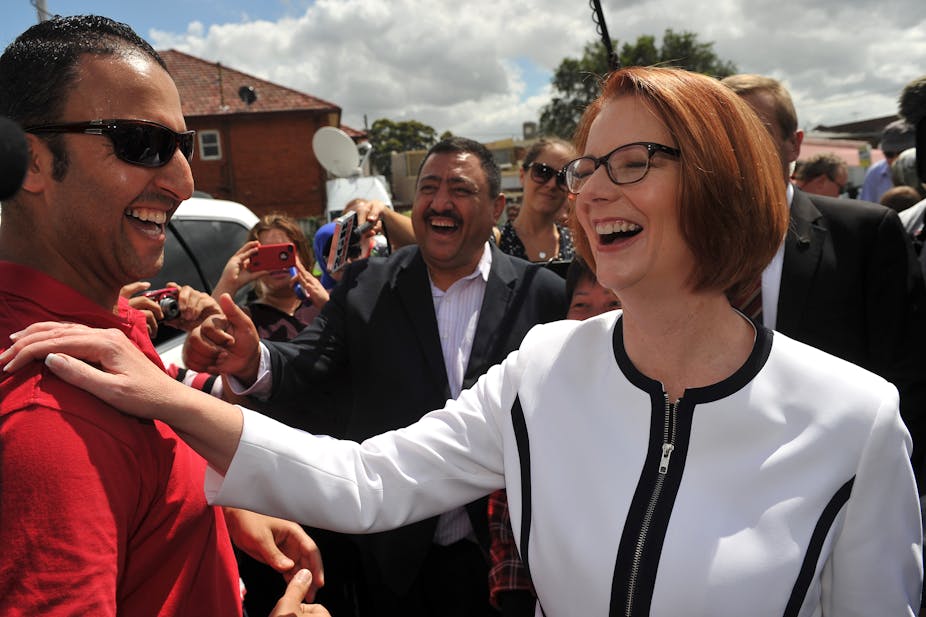
Julia Gillard’s tour of the western suburbs of Sydney is a shining example of politics and media merging into “stunt”. AAP/Paul Miller

We live in an era of expanded media and accelerated news cycles, in which citizens have access to more information, and more opportunities to participate in the public sphere, than ever before in human history. Yet pessimism reigns about the negative impact of political media on the democratic process.

Citizens are said to be disillusioned about politics and politicians, turned off by a dysfunctional media. The period running up to the 2010 federal election, and since, has seen regular debate and commentary not just on policy matters such as the carbon tax and immigration, but on the presentation of these by the parties and their spin machines.

Although Australia has a compulsory voting system which, to a degree, masks public dissatisfaction and disengagement, there is a widespread perception that citizens are fed up with the political process, in large part because of the way in which it is represented in the media.

Former ALP cabinet minister Lindsay Tanner’s 2011 book, Sideshow, argues that Australian media coverage of politics undermines effective democratic governance by focusing on the trivial and ephemeral – we recall the brief, if intense media frenzy which followed Tony Abbott’s saying “shit happens” to Australian soldiers in Afghanistan in February 2011. Should he have said “shit”? Does it matter? Do we care? It became the lead news story across the media that day and into the next.

Former Liberal leader Malcolm Fraser, quoted on the cover of Tanner’s book, asserts that “the relationship between politicians and the media degrades public life and diminishes our future”. Media commentators and scholars – in Australia and internationally – have been critical of trends in the media-politics interaction since at least the 1990s, when Jay Blumler identified “a crisis of public communication” in the liberal democracies.

Critics have referred to a process of “dumbing down” of political journalism, of a rise of “infotainment” and the crowding out of hard or “serious” news and commentary in the public sphere by fluff and trivia, such as the style of Julia’s glasses, or Abbott’s swimwear.

There has been one thing largely missing from this debate, however – the views of the public itself; the great mass of ordinary citizens who vote in elections, and who are in the end what it’s all supposed to be about (politics, that is).

What do they think of the way politics is covered, represented, spoken and written about, in the myriad media forms and platforms which take that job on? Beyond the occasional opinion poll indicating that levels of trust in politicians are lower than journalists, or higher than bankers, or roughly equivalent to what we feel for used car dealers, we don’t really know.

Where are the views of “ordinary Australians” in the way our media reports on and engages with politics? AAP/Lukas Coch

At QUT we’ve embarked on an ARC-funded research project which we hope will shed light on these questions. We’re calling the project: Politics, Media and Democracy in Australia: public and producer perceptions of the political public sphere.

It will assist the makers of political media, we hope, to do a better job of engaging citizens in the democratic process.

We’ll be constructing a “map” of all the media outlets and formats in which politics is reported, analysed and discussed in Australia, exploring their interactions, and how they each contribute to the broader goal of an informed, active citizenry.

We’ll be asking political media practitioners – the pundits, the producers, the editors, the writers – what they believe their role to be in Australian public life, and how that role is reflected in their work. Then, we’ll ask ordinary Australians in cities and towns across the country to tell us their perceptions of how effective the twenty first century public sphere is in providing them with the information they need to make rational choices in elections.

We’ll be exploring the role of public participation media formats such as Q&A, and talkback radio, where the public are physically present in the political debate and able to make a contribution. One response of media organisations to the perception that they – and the politicians – are too remote from the ordinary people has been to introduce more interactive, participatory styles of coverage; to engage their audiences more proactively. Q&A is the best example of this trend, and we’ll ask – does it work? Do Australian viewers feel that this kind of live participation, augmented now by social media (see the stream of tweets which crosses the screen throughout a broadcast of Q&A), addresses their issues and concerns more effectively than traditional journalism, in which a presumed expert tells us what it all means?

We’ll explore public perceptions of another trend in political media – the attempt to humanise our politicians. Now, there are those who believe that the “dumbing down” of politics is seen nowhere more than in the rise of light, insubstantial, human interest journalism about political style and personality – the sideshow condemned by Lindsay Tanner. But it might also be argued that, for better or worse, twenty first century citizens want to see their leaders, actual and aspiring, in ordinary, non-professional contexts – to judge them as “real people”, rather than only as members of an exalted elite. ABC’s Kitchen Cabinet, in which Annabel Crabb breaks bread with a well-known pollie is an example of how media organisations are trying to address that desire.

We’ll also ask about the role of political satire in forming the public’s perceptions. We enter this project with a firm belief in what someone once called the “revolutionary power of laughter”. Revolution may not be on the cards, but politicians in a modern democracy should expect critical scrutiny of their efforts to include the kind of joshing they receive on Shaun Micallef’s Mad As Hell. The Project also has that satirical quality, as has The Chaser at its best.

Such programs are not quite what Jurgen Habermas meant when he rather somberly defined the public sphere in the late 1960s, but in 2013 perhaps they can play a positive role in engaging the disengaged with a different kind of political knowledge.

Join the conversation

21 Comments sorted by

  1. ricphillips

    logged in via Twitter

    Well I, for one, wish you well on the project.

    It would be nice to see if the cliches of the twenty-four-hour-news-cycle hold up or not.

    I am one of those 'turned off' citizens. Literally. I have turned off The Insiders, and the editorial pages of The Age and The Australians. I have stopped reading The Drum, and I no longer listen to any talkback radio.

    I am completely over the reduction of commentary to 'the game' and the rejection of policy debates in favour of process and politics reporting…

    Read more
  2. Felix MacNeill

    Environmental Manager

    I too wish you well.

    I wonder if you'll be attempting some kind of assessment of the actual knowledge levels of surveyed participants (I mean simply their awareness of basic facts - I recall seeing some fascinating work done a year or so ago in the US that actually demonstrated that Fox viewers knew significantly less than other Americans - though the causality versus the correlation may not have been fully clarified) - I also remember a conversation with a colleague once who felt comfortable…

    Read more
  3. Marilyn Shepherd

    pensioner

    The book about the arrest and persecution of Dr Haneef shows how our media operate - they all bleat the same rubbish day in and day out without fact checking.

    What the criminal gangsters in the Murdoch media today are saying is that crimes don''t matter so long as we can say whatever we want about anyone we don't like.

    Any old lie will do so long as we tell it often enough.

    Like the beat up and abuse of Peter Slipper over many years that resulted in a silly charge of $900 cabcharge use over 24 years in parliament being passed off as a crime of the century when the real crime was the way the media allowed James Ashby and the lieberal party use and abuse a man to bring down a government.

    The abuse of Craig Thomson has now come down to bogus claims that he bought icecreams on his duly issued union credit card.

    report
    1. John Phillip

      John Phillip is a Friend of The Conversation.

      Grumpy Old Man

      In reply to Marilyn Shepherd

      You seem to be doing pretty well on that front yourself, Marilin. I shudder to think what a media governed by the likes of your paranoid and biased perspective would operate like. All accusation and invective and no fact. Your little spray could reasonably be considered the political flipside of the slavering dribble found in the telegraph.

      report
    2. John Phillip

      John Phillip is a Friend of The Conversation.

      Grumpy Old Man

      In reply to Michael Shand

      It was a thoughtful comment, Michael, The ad hom with the reference to the brevity of my remaining life shows that you have a fair bit of maturity to go yet. I guess in your 'unbiased' eyes, all those who oppose your view should be 'silenced'. I guess that would be the final solution, wouldnt it?

      report
    3. Michael Shand

      Michael Shand is a Friend of The Conversation.

      Software Tester

      In reply to John Phillip

      "Marilyn's emotion laden outpouring of exaggeration and unsubstantiated claim and the crap that's in the tabloids, you're not being terribly honest, are you?"

      Its interesting that you talk about maturity and honesty and at the same time call people Nazi's with reference to final solutions

      Sorry, what were you saying about honesty and maturity - I got distracted by you calling me hitler

      report
    4. John Phillip

      John Phillip is a Friend of The Conversation.

      Grumpy Old Man

      In reply to Michael Shand

      Interesting that you've made THAT leap. I certainly didnt call you hitler. Remember, you are the one making comments about people's age and their proximity to death.
      Unfortunately, you failed to respond to the content of my comment re the similarity of Ms Shepherd's response and those she is deriding.

      report
  4. Ronald Ostrowski

    logged in via Facebook

    The media went balistic about the allegations involving the PM in the AWA slush fund matter. Abbott promised a judicial inquiry. Meanwhile the MSM refuses to examine Abbott's crimes which wrongly put Hanson in jail. There is now a former One Nation politician taking Abbott to court for a seven figure sum. The MSM are ignoring this story thus far. Here is a link to the press release. http://www.independentaustralia.net/Wordpress/wp-content/uploads/2013/03/TONY-ABBOTT-MEDIA-RELEASE.pdf

    report
  5. Michael Shand

    Michael Shand is a Friend of The Conversation.

    Software Tester

    Great Read, I cant wait to see the outcome of this.

    You should be hardlined on media outlets like The Conversation who claim to have academic rigor and be above the rest but constantly let vested interests and mis-information be published without recourse

    I mean with Hearld Sun - we know what to expect, with sites like this there is still an un-easy amount of propaghanda that comes through

    report
  6. David Doe

    Videogame Producer

    "there is a widespread perception that citizens are fed up with the political process, in large part because of the way in which it is represented in the media."

    Been reading the comments in Michelle Grattan's articles, eh?

    An interesting project, and one that I hope bears serious fruit. Good luck.

    report
  7. Meg Thornton

    Dilletante

    I'm another of the "turned off". I started comparatively early, weaning myself off the mainstream women's magazines back in the late 1980s and 1990s, and winding up cutting off my relationship with television in about 1999 - 2000. The main catalysts for the latter were firstly, moving to Canbrrra from Perth (and the subsequent lack of ability to get a decent signal in the rental properties we were occupying) and secondly, moving more and more onto the internet as my main form of information medium…

    Read more
    1. Dianna Arthur

      Dianna Arthur is a Friend of The Conversation.

      Environmentalist

      In reply to Meg Thornton

      I too weaned off so-called women's magazines many years ago for the reason they just didn't hold any relevance for me.

      And have finally completed severing my last link with print media last week. I now have an Ipad as well as my home PC.

      I enjoy finding reliable information in order to make up my mind about everything from politics to animal care (somehow that goes together).

      Best of luck with project, Brian. I posit that your findings will differ from the daily polls to which we are subjected, telling us what we are supposedly thinking - polls are too easily manipulated both by the style of questions and then the manipulation of the data itself.

      report
  8. Martin Hirst

    Associate Professor Journalism & Media at Deakin University

    Good luck with the project Brian. Are you going to ask why the MSM seems to gather around only one or two poles of attraction in relation to political news?
    This refers to what Daniel Hallin has called the "spheres of consensus" and "limited controversy". Anything outside is "deviance".
    I like this thesis because it helps to explain the pack behaviour of the news media but also why it does not challenge basic and false assumptions about the supposed benefits of the "free" market or that government…

    Read more
    1. Metta Bhavana

      logged in via Facebook

      In reply to Martin Hirst

      It is interesting to see in recent reactions the media players suddenly twitch and reveal the true motivation and agenda behind their benign friendly faces. It is one of those moments, like in the Truman Show when we, as the dupe of the big illusion makers and manufacturers of consensus, become Truman, noticing things that betray a greater reality, just outside our grasp.

      report
  9. Metta Bhavana

    logged in via Facebook

    The critical analysis of Habermas, dropped nonchalantly into the last paragraph, seems little understood, even by academics. The public sphere was by definition inclusive, but entry depended on one's education and qualification as a property owner. The idea of a neutral social space for critical debate among private persons is a wonderful ideal, but it is not as it seems, or as routinely presented, anywhere available. To test this, try avoiding marketing, or any publicity via advertising, for even…

    Read more
  10. wilma western

    logged in via email @bigpond.com

    This sounds interesting but I agree with commentators who suggest some method of testing political knowledge of respondents from the public. I assume there would also be knowledge of voting behaviour required .

    It would be interesting to find out if the level of "disengagement" has increased or decreased . How is "engagement" measured? My hunch is that hostility to the present government is far greater than dissatisfaction with Howard but how could you validly measure that , as retrospective…

    Read more
  11. wilma western

    logged in via email @bigpond.com

    However ,it is intriguing that Fairfax writers not involved in political "analysis" and political news, such as Ross Gittins have consistently examined tax and economics issues in a far more balanced way. Rather like the professional economists . But the louder voices of party spokespeople and political reporters seem to dominate.

    A good recent example was also Tim Colebatch's examination of the 457 visa figures.

    report