

National container deposit scheme crushed by Australian Senate

For the past 30 years, South Australians have lived in a state with a “container deposit scheme”. This means on small bottles or cans of water, soft drink, juice or alcohol, consumers pay a 10c deposit which is then refunded when they return the empty container. The Northern Territory introduced a similar…

Nc8wjdxh-1348011542
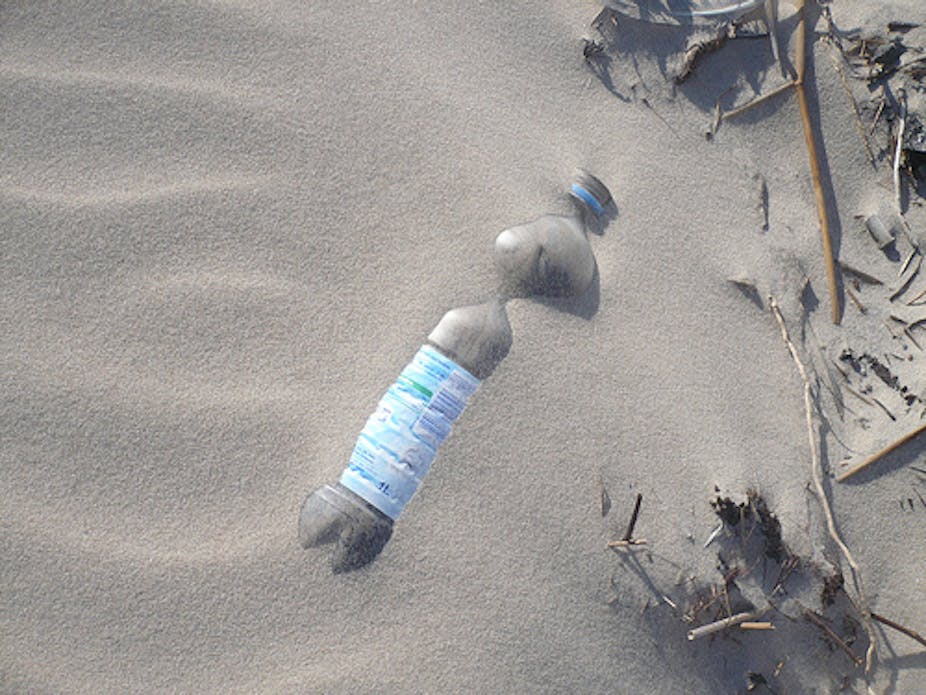
Plastic bottles often end up on the beach where the plastic can remain for decades, harming sea life and the fish we eat. senderweb/Flickr

For the past 30 years, South Australians have lived in a state with a “container deposit scheme”. This means on small bottles or cans of water, soft drink, juice or alcohol, consumers pay a 10c deposit which is then refunded when they return the empty container. The Northern Territory introduced a similar scheme at the beginning of this year. However, last week, a bill which proposed rolling out a national scheme was quietly crushed in the Australian Senate.

Only the Herald Sun reported its demise, repeated in Business Spectator. The latest article in the Sydney Morning Herald for “container deposit” is from last month saying “councils in NSW could save $62 million a year on recycling and rubbish collection if a ‘cash for cans’ scheme was introduced”, whilst food and beverage organisations argue it would be costly and ineffective.

Senator Xenophon reflects in his address to the Senate that the scheme has “98% support in South Australia” and a national scheme would have prevented 600,000 tonnes of waste going to landfill each year. Given that each Australian sends nearly one tonne of waste to landfill each year – two to three kilograms per day adding to almost 1000 kg every year for each person in Australia – this would equate to avoiding the total waste to landfill from all of Tasmania.

The bill was introduced by the Australian Greens and defeated by Labor siding with the Coalition. Labor’s Senator Urquhart says the intent of the bill has merit. However, she goes on to say: “This bill proposes a [national] government-run scheme that would be a different mechanism over and above the two existing arrangements [in SA and NT]. Logically, this only leads to increased regulatory complexity as well as costs to industry and the community.” She says that it would “undo good work done at the COAG table”.

Whilst household recycling rates of beverage containers from kerbside collections are good, the costs fall to ratepayers instead of big drinkers. It’s not a new concern. One of us (Stuart White) at the Institute for Sustainable Futures, UTS was commissioned over a decade ago in NSW to undertake an independent review of Container Deposit Legislation. More recently, Boomerang Alliance have researched the topic extensively and shown the potential benefits for recycling other goods that could occur by setting up drop-off machines across cities.

The UTS review showed that recovery rates of used containers can double with a deposit and refund scheme, mainly due to collection of the containers consumed away from home. Of course this represents an additional cost, just as council ratepayers bear a significant cost already as a result of kerbside recycling. However, there are offsetting benefits, principally from the reduced environmental cost of producing new containers from raw materials rather than recycling used materials.

The beverage and packaging industry was very happy to support the findings of the Independent Assessment of Kerbside Recycling in Australia which concluded that, despite the financial subsidy from local Councils, kerbside recycling provided a net economic benefit due to this reduced environmental cost. What is good for the kerbside goose, according to the industry lobbyists, is not good for the container deposit gander.

A container deposit scheme also reduces litter and street bin collection costs as people collect and return unwanted empty containers. And it’s not just our streets which benefit. A recent program on ABC’s Catalyst showed a CSIRO study on the amount of plastics washed up on Australian beaches. Plastic drink bottles thrown away onto a street get washed out to the ocean in the rain and the plastic persists for decades. It then either directly harms sea life or breaks into tiny pieces which concentrate toxins in the fish which we then eat. The lowest count for plastics of beaches surveyed so far was in South Australia. Is this a result of its geographical position or the community’s support for a container deposit scheme?

Usefully, Australia has a National Waste Policy: Less Waste, More Resources. In principle, this recognises that in the decades ahead, learning how to do more with less resources will become second nature. Critically, it’s lacking data for good evidence-based policy on waste and political will as shown in the Senate. Linked to the National Waste policy, Product Stewardship legislation has been introduced (and passed) to ensure computers and TVs are recycled. If this isn’t too hard to do nationally, how can it be that legislation to recycle cans and bottles escapes our abilities?

Join the conversation

32 Comments sorted by

  1. Zvyozdochka

    logged in via Twitter

    I think the authors have no business writing an article with such a tone of surprise.

    Respectfully.

    report
  2. Daryl Adair

    Associate Professor of Sport Management at University of Technology, Sydney

    As someone who grew up in Adelaide but now lives in Sydney, can I say that this was a big opportunity wasted. The container deposit scheme is a "no brainer" and has worked a treat in SA for many years. The rest of the country - you've missed out!

    report
    1. Tracy Heiss

      logged in via Facebook

      In reply to Daryl Adair

      Yep...I don't get it!! Apart from recycling etc, it's a great way for kids to earn extra money, and I've known pensioners to be pretty happy to collect the containers too...excercise, a sense of doing something for the environment, and extra money.

      report
  3. Mark Amey

    logged in via Facebook

    I seem to remember a similar scheme existed in NSW way back in the 60s, when I was a lad. We kids converted rubbish into lollies very effectively.

    As Daryl has already said, 'a no brainer'!

    report
  4. Colin MacGillivray

    Retired architect

    If a bottle was really worth 10c then (outside of SA & NT) commercial enterprises would be collecting them and making a profit from them. In fact there is an excess of used bottles, or there was in Auckland 5 years ago when I suggested to the Council imitating Adelaide.
    The fact then was that clear glass was piled up in mountains, clearly with no economic value.
    It feels good to recycle hence it appears to be a no brainer- it isn't.

    report
    1. Daryl Adair

      Associate Professor of Sport Management at University of Technology, Sydney

      In reply to Colin MacGillivray

      Colin, I'm not sure what you are arguing. The retail value of glass or plastic is not the carrot that makes people collect containers and hand them in; rather it's the deposit associated with that (10 cents in SA). So kids who collect 10 bottles lying in the street and hand them in earn a dollar. Whether they feel environmentally good in addition to that would be a bonus. That process should be a no brainer.

      However, on a second reading perhaps your point is that the collection is a waste of time because the containers themselves are not being recycled for production. Well, if that's the case we should forget about recycling ANY drink containers - whether or not there is a deposit scheme.

      If you could clarify for me I'd be grateful. I may have completely misunderstood your points. Thanks.

      report
    2. Rick Fleckner

      Student

      In reply to Colin MacGillivray

      Obviously it's not worth any money to the industry. The value is the deposit itself as an incentive to recycle. However, Industry at large is not concerned with re-using containers if there is a significant cost involved. The bottom line is what matters, exclusively. All areas of Australia had recycling of glass bottles, instigated by industry, until the production costs of new packaging reduced hugely with technology advances. The sad thing here is that the packaging industry and many industries that rely on packaging, made up of people, choose to do nothing about the waste they create, preferring to rely on 'don't litter' campaigns, seemingly without a thought for environmental consequences of overstretched landfill resources. Someone needs to invent an organic package that disintegrates on demand.

      report
    3. Michael Glass

      Teacher

      In reply to Colin MacGillivray

      I can't understand why the Labor party would vote against this obviously sensible piece of legislation. The report in the Herald Sun http://www.heraldsun.com.au/news/breaking-news/senate-rejects-container-deposit-scheme/story-e6frf7kf-1226473376252 says:

      'Labor senator Anne Urquhart earlier said the plan did not respect the cooperative work done by governments and industry to reduce packaging waste and litter.

      '"It is a heavy-handed national approach that seeks to undo the good work done at the COAG (Council of Australian Governments) table," she said.

      'Liberal senator Ian Macdonald said environment ministers from federal, state and territory governments had met as recently as August 24 at COAG where they agreed to undertake a more detailed analysis including regional and distributional impacts.'

      It appears that the major parties don't take kindly to the Greens' attempt to stop them dragging their feet on this issue.

      report
    4. Colin MacGillivray

      Retired architect

      In reply to Daryl Adair

      Daryl
      My point is that it's the ratepayers who are paying the kids and deros the 10c not the intrinsic value of the glass as an item to be recycled.
      I live in Kuching Sarawak, Malaysia. A guy collects my old newspapers and pays me about AUD5c a kilo. (I actually don't take the cash). At a central depot, aluminium cans fetch a larger amount per kilo. They aren't doing it because they like recycling! Plastic is not collected here so I guess it has no "value".
      Glass is processed sand so putting it in the ground can't be environmentally unsound. Putting it in heaps above ground looks ugly.
      Perhaps there is research into the environmental effects of producing a new bottle versus collecting, sorting, cleaning, moving and finally using an old one for something worthwhile.
      (I expect another 8 red marks.)

      report
    5. Phil Dolan

      Viticulturist

      In reply to Colin MacGillivray

      'My point is that it's the ratepayers who are paying the kids and deros the 10c not the intrinsic value of the glass as an item to be recycled. '

      Well yes, that is the point. But if we must suffer the philosophy of the market sorting out all problems in the world, how much would it cost per bottle if council workers spent their time picking them up. Or how much would the value of your house drop if the neighbourhood looked like a tip. Or if we just let all the plastic go out to sea so we end up with no sea life. 10c per bottle would give us a better place to live. And as I sell wine, my share of it would be more, but that's life. A better life.

      report
    6. John Delong

      Engineer

      In reply to Michael Glass

      "I can't understand why the Labor party would vote against this obviously sensible piece of legislation."
      Three words should help you understand: Coca Cola Amatil

      report
    7. Francis Lee

      Student

      In reply to Michael Glass

      Because still lots of companies are lobbying to the government because they don't want to get bothered to collect, wash and reuse them. For them, it's easier to order new bottles from China.

      report
  5. Will Hardy

    logged in via Twitter

    Living in Germany, I think it's astounding that Australia still uses single-use containers. Recycling is nice if the alternative is throwing everything in a hole. But simply washing and reusing the containers is waaay better, and if you're going to collect them anyway, you pretty much have the infrastructure you need. Maybe this is the long term plan anyway, it's very easy to implement when you already have a deposit scheme (just give single-use containers a much higher deposit and the producers will automatically switch to multiple-use containers).

    The inefficiency and waste is pretty incredible to witness when you've gotten used to it being done right.

    report
    1. Peter Hindrup

      consultant

      In reply to Will Hardy

      This was the system way back in the 1940's! A penny for beer bottles, but only the local brewery, and threepence for soft drink bottles -- again locally brewed!

      Coke? That was what some people burnt on the fire.

      A penny then bought a big bag of broken biscuits, a real treat, or an ice cream.

      report
  6. Phil Dolan

    Viticulturist

    Labor joined with Liberal to keep us pissing in the well.
    I had no idea this was up for a vote and would love to see some of the excuses for such an outrageous dereliction of duty.

    report
  7. Jonathan Sobels

    Lecturer, Human Geography at University of South Australia

    Anecdotally, the further impact of a container deposit can be seen in Adelaide in the apparently improved lives of people one would think of as 'living rough'. Every day in the CBD there is a procession of men and women, most with recycled bicycles, multiple bulk bags (those red white and blue ones) bbq tongs, gloves, reasonably clothed and shod, picking out and crushing the cans and cartons from rubbish bins. One might conclude that the container deposit provides an income that improves the health of these otherwise maginalised people. And if their health is improved through their own efforts, the broader impact could be reduced costs to the community.

    report
  8. Rob Kelman

    logged in via LinkedIn

    CD nationally is not yet dead, despite the Senate vote.

    Environment Ministers will continue a process of analysis and are expected to make a final decision (based on a 'decision RIS') around April 2013.

    Though it is also true that the dying embers of beverage industry opposition (primarily Coke and Lion - Tooheys, James Squire et al) will flare up again and attempt to frame the deposit scheme as a new 'container tax'.

    report
  9. Peter McLean

    Chief Executive Officer - KAB

    The problem with CDL is that it doesn't address all types of recycling and litter. Keep Australia Beautiful want to see a scheme that addresses not just bottles, but all litter, and one that doesn't increase the cost of living. We want to see a scheme that changes people's behaviour in a positive way to recycle more.

    A much more practical method of controlling waste is to reduce or avoid items that are difficult to dispose of or recycle and to continue our focus on strong educational campaigns. Our approach is also based on sound behaviour change methodology which had been successfully used to rapidly reduce drink driving and smoking, and is an extension of Keep Australia Beautiful’s previous mass awareness campaigns and advertisements in 1970’s and early 1980’s.

    Just look at what the government is doing in Victoria for example. It has good recovery and less litter.

    report
    1. Daryl Adair

      Associate Professor of Sport Management at University of Technology, Sydney

      In reply to Peter McLean

      Peter, with respect, you haven't articulated that CDL is a "problem" at all. Your point should be that it is only one of a raft of solutions. Changing people's behaviour is important: CDL provides incentives for that. Again, it is only ONE part of the equation. Putting all your behavioural eggs in one basket, rather than providing nuanced solutions, seems risky to me. There are numerous respondents to the above column that have lived, or still do, in SA where CDL has been a roaring success for three decades. I find it extraordinary that you can dismiss this. Did CDL originate separately from the KAB campaigns? In short, what is KAB's relationship (or otherwise) with SA's CDL programs?

      report
    2. Will Hardy

      logged in via Twitter

      In reply to Peter McLean

      I don't see how CDL is in competition with other approaches. Why wouldn't a container deposit scheme complement a broader behaviour change campaign?

      report
    3. Will Hardy

      logged in via Twitter

      In reply to Will Hardy

      Ahhhh now I understand: http://www.ausfoodnews.com.au/2012/06/07/recyclers-commit-initial-660000-to-keep-australia-beautiful-alternative-to-a-container-deposit-national-scheme.html and http://www.abc.net.au/4corners/content/2003/transcripts/s941450.htm

      So Keep Australia Beautiful is funded by the beverage industry (BIEC) on the condition that it does not support a container deposit scheme.

      That's a little sad. The saddest part is that it looks as though the larger campaign is to get the broader community to believe that it's their responsibility to deal with the packaging problem. It's not; if you produce it, dealing with the waste is your moral responsibility.

      report
    4. Jonathan Sobels

      Lecturer, Human Geography at University of South Australia

      In reply to Will Hardy

      With respect to the increased cost of living argument (Peter McLean), I siuggest that most spending on cans and cartons (milk excepted) is discretionary so the impact is unlikely to be large. In terms of 'responsibility' by consumers, if you explore some of the lierature on 'sustainability', the responsibility also lies with producers to become much more aware of the energy and material flows in the life cycle of their product.There is no reason why packaging couldn't be a 'lease and return' system…

      Read more
    5. Peter McLean

      Chief Executive Officer - KAB

      In reply to Daryl Adair

      Keep Australia Beautiful (KAB) is Australia’s leading grassroots environment organisation, with more than 40 years’ experience in changing behaviour around litter and recycling through community engagement and partnerships. KAB is well credentialed to contribute to the deliberations of the COAG Standing Council on Environment and Water on potential national measures to increase packaging recovery and decrease packaging litter. Advocating effective policy is an integral part of our mission to lead…

      Read more
    6. Daryl Adair

      Associate Professor of Sport Management at University of Technology, Sydney

      In reply to Peter McLean

      Peter, thanks for your detailed response. I don't have any expertise in this area, but I still have a question. Would you like to see the end of the CDL system in South Australia? The inference from your figures above is that it has been very costly and of minimal value in terms of recycling. Surely, on the basis of your argument, it is counterproductive?

      I googled Industry Packaging Stewardship and discovered that it relies on "voluntary industry recycling, litter reduction and education programs". I don't mind voluntarism at all, but I sure know that economic incentives (or disincentives) also fundamentally shape behaviour. That's why CDL seems so logical to many of the SA folk who have blogged in response to the above article.

      However, what you seem to be saying is the voluntarism trumps incentives, and CDL is way more expensive than Industry Packaging Stewardship. Do I have that correct? Thanks.

      report
    7. Peter McLean

      Chief Executive Officer - KAB

      In reply to Daryl Adair

      Hi Daryl,

      South Australia have had this sort of infrastructure for a very long time. Rolling it out now in other states around Australia like NSW, QLD and VIC we feel, isn't going to address the problem of recycling, and litter, and yes, it will be extremely costly to implement. Much more than Industry Packaging Stewardship. This material (which only makes up 20% of the recycling stream) is already being collected at home. If people start thinking they can litter their bottles on the street because the Scouts will pick it up, then what stops them from the same behaviour with their newspapers, and coffee cups, as an example.

      report
    8. Daryl Adair

      Associate Professor of Sport Management at University of Technology, Sydney

      In reply to Peter McLean

      Hi Peter, I'm relieved to hear that you don't seem to be advocating the closure of CDL in South Australia. I can happily assure you that people in SA do not litter bottles in the street on the assumption that Scouts will pick them up. Why would they when the containers actually have a monetary value for return? Here in Sydney, if people purchase a soft drink they are likely to throw the container in a bin. No recycling there. However, if the container had a monetary value (as in SA) consideration…

      Read more
  10. Lorna Jarrett

    PhD candidate, science education; Physics teacher

    I'm appalled. As if we needed more evidence that politicians are acting directly against the interests of the citizens who employ them, pay them - and whom they're supposed to represent.

    Seeing as they're firmly in the pockets of big business, surely they don't need our money anymore? Then we could spend the savings on service providers to do all the jobs our Governments are shirking.

    report
  11. John Harland

    bicycle technician

    This one will affect how I vote.

    I appears to be a vote against sound policy purely on the grounds of who raised it.

    report
  12. Janine Keating

    Anti-Litter Advocate

    Back in 2003, I struggled so much with litter in my town, I took to carrying gloves, plastic bags and litter collection bags in my car boot. When visiting a local park, I came to expect that I would have to clean it up before I could enjoy it. Handwash and paper towel from my glovebox was then used to clean myself up. After this little activity, I could get on with enjoying the great outdoors. The lucky country, hey?
    As drink containers were the most numerous items collected, I have long been…

    Read more
    1. Phil Dolan

      Viticulturist

      In reply to Janine Keating

      It's good to see this back on the agenda.
      I've decided to write to all standing at the next election in my seat and ask what their stance is and vote accordingly.

      report