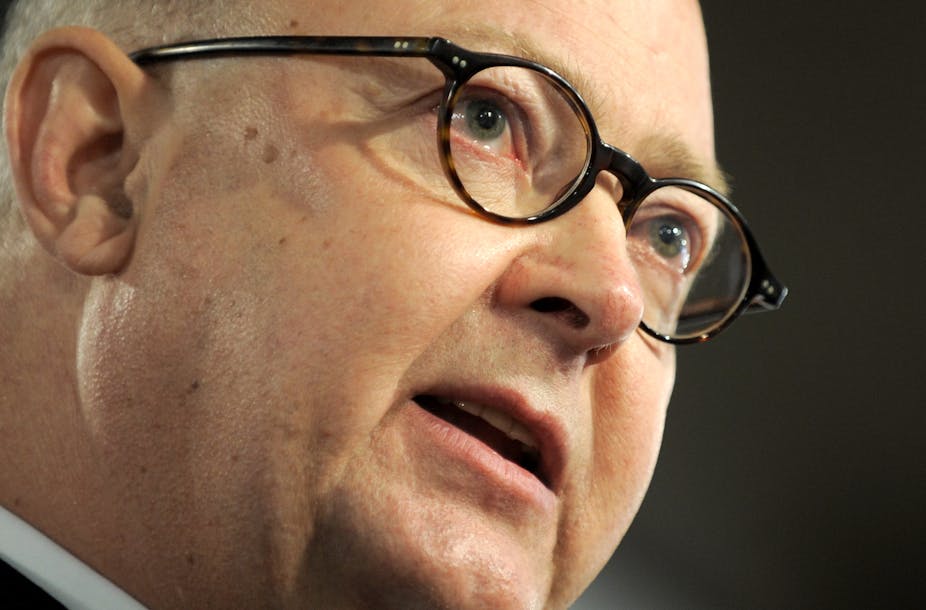
Earlier this week, Kim Williams, CEO of News Limited, spoke at the Australian International Movie Convention on the Gold Coast and called for new copyright laws to better protect digital property rights.
Back in February, my colleague and friend Bruce Arnold opined a similar view, stating that in “the age of the internet and multinational business models, many of the existing laws are under strain, their suitability and ultimate purpose called into question”.
Williams complained the NBN would make illegal file-sharing and downloads worse and called upon the NBN to be included in any future code and be obligated to take reasonable steps to stop piracy. Additionally, he requested ISPs to take stronger action against unlawful activity on their networks.
But what can be done and are new laws really the solution? ISPs, as the focal point of the pipe which delivers content, certainly play a major role in many issues of online trust and safety.
In this instance we need to look at whether ISPs have either contributory or vicarious liability. This could be based on if an ISP knows or has reason to know of copyright infringement and induces, causes or materially contributes to the infringing conduct of another. But just as ISPs could do more to stop malicious software, so too they could contribute to and could assist in the reduction of copyright theft. Recent legal precedence is illuminating.
After three years of legal argument, the Roadshow v iiNet case ended with the High Court unanimously deciding iiNet never supported or encouraged unauthorised sharing or file downloading by its users. The Court held that an ISP “is not to be taken to have authorised primary infringement of a cinematograph film merely because it has provided facilities for making it available online to a user who is the primary infringer”.
Many content rights holders have lobbied for strategies to address online copyright infringement, including the implementation of a graduated response scheme designed to compel ISPs to forward notices and apply sanctions against users the rights holders allege are engaging in copyright infringement, for example, via peer-to-peer file sharing.
The ability for a rights holder to be able to send a copyright infringement notice to a relevant ISP for forwarding on to their subscriber is a good idea.
But in the iiNet case, the High Court determined “[i]t was not unreasonable for iiNet to take the view that it need not act upon the incomplete allegations of primary infringements in the AFACT Notices without further investigation which it should not be required itself to undertake, at its peril of committing secondary infringement”.
The next biggest players after ISPs are search engines. Search engines trawl content on the web and reproduce text, images and sound recordings. Copyright law raises a number of challenging legal issues for search engines as they do not own content, but instead organise, rank and display vast amounts of material that is posted on, or to websites. Other copyright issues for search engines include caching of copyright material, the extent to which fair use applies, authorisation liability and the impact of safe harbour provisions.
But what about other industries? The recent Finkelstein Report discussed charging for online content and found highly-differentiated online content would normally command a scarcity premium.
“For such content, charging for access could work provided that the producer can retain control over the related property right. But it may not be an easy proposition given the current level of piracy and unauthorised use of content on the internet.”
Online media companies are also similar to search engines and generate revenue by selling advertising.
So what does the government think? Principle 8 of the Australian Government Convergence Review Interim Report states “Australians should have access to the broadest possible range of content across platforms, services and devices”. There is no mention though of copyright protection or the role of ISPs and search engines.
And the NBN – well, that will transform the way we live and operate in the online environment – but we can hardly blame it for copyright infringement. NBN Co are an important stakeholder, but do not hold the answer.
Clearly, there is a problem. Williams raises some valid concerns. We need industry to collaborate with government to assist content rights holders to be able to enforce their copyright and change the behaviour of those who engage in online copyright infringement.
New laws are not the answer. Rather, we need to look at education, technical mechanisms, licensing solutions and responsibility of ISPs and search engines to find a workable balance between the right to own and creative content and the ability of users (and intermediaries) to access and reuse such content.
elbatxeb
logged in via Twitter
Good article.
I wonder if/when the 'old guard' of media companies will move with the times.. The cat is out of the bag!
Surely they would do better to look at what the other revenue-raising options are than trying to get laws changed / going after individuals etc?
shuningbian
logged in via Twitter
In addition to "education, technical mechanisms, licensing solutions and responsibility of ISPs and search engines", how about some new business models? How about not charging Australians stupid amounts of money for digital content sold cheaply elsewhere? How about not treating all customers like potential thieves? How about making digital content purchasing EASY?
As it stands, if I buy a movie on DVD I will be treated to around a minute of un-skippable warnings about copyright infringement, and…
Read morePeter Reefman
Project Manager
Shunningbian,
The article, and your comment, remind me of this Radio National Big Ideas program that I listened to (Podcast) the other day:
http://www.abc.net.au/radionational/programs/bigideas/copyright-doctorow/4135238
Which indicates that we seem to have shifted from the media companies controlling things to having the distributors (esp Apple's iTunes) with the actual content producers STILL being left with a raw deal.
It seems that any time you try to "interfere" with monied vested interests we end up with either the same or some other monied vested interests ending up keeping most of the pie. And the artists?? Maybe they don't matter. We don't seem to do much to look after them, so they must be expendable??
Meg Thornton
Dilletante
Actually, what you'll find on a DVD depends, I think, on the distributor. I recently purchased 5 new DVDs. 4 of these were from Paramount, and didn't have the five-minute scolding from the copyright protection people at the front (or possibly they did - but Paramount had the bright idea of basically being able to skip straight to the main menu and have done with it).
The fifth was from Village Roadshow, an Australian distributor. Not only did it have the unskippable scolding from the copyright…
Read moreDavid Boxall
logged in via Facebook
Cory Doctorow (http://craphound.com/) says his problem isn't piracy; it's obscurity, so he gives his work away and asks people to buy a hardcopy for their local library. He seems to be doing OK.
I recently went looking for a specific book. I found that I could get a paperback delivered for less than $8. Several retailers offered the book, at different prices. To me, that indicates effective competition. The eBook would have cost me more than $11. The eBook's price was the same at all retailers…
Read moreMark Harrigan
Dr
It would appear the media barons and content owners have learned nothing.
More than a decade ago on-line sharing and copy right infringement of music via downloads was rife. Why? Because for years the music publishers and record companies had gouged the public for the right to purchase hard copy. Suddenly the internet made it possible to change that. Did the right's owners embrace this technology as a new medium of distribution? No, they sought to protect their monopoly revenues and tried…
Read moreAntonio DeBono
Freelance Social Media Consultant
When content providers can make it so difficult and needlessly expensve to purchase content in Australia, it's little wonder that some consumers turn to piracy.
I recently heard an album on Spotify (a free, legal way to consume music, and an absolute revelation - more on this later), and I wanted to purchase said album for my ever growing CD collection. The album was released in Europe, so I thought that it would be simple enough for me to source the CD and buy it from somewhere like Amazon.de…
Read moreDavid Harrison
Company Director
I certainly agree that new laws are not the answer, but I'm wondering if reverting copyright laws back to something that more closely reflects their original implementation was considered here - basically rolling back to a much shorter copyright term?
The current laws - with their extremely long terms brought about by lobbying by copyright owners - do not seem to capture the original spirit or intent of the original copyright laws.
John Bloomfield
Retired Engineer
I have never understood how the various Internet service providers have escaped some responsibility for the marketing of massive download/upload capacities (multi hundred Gigabytes) to all and sundry.
What do they think that private citizens are using such high capacities for?
Photographs, emails, bloggs, personal documents etc require only a tiny part of that large capacity. Even heavy users of YouTube, Iview or other video streaming resources use no more that 2-3 Gb per day ( equivalent to…
Read moreMister Anderson
Student
Here's an idea. How about we legislate against Australia being a 'premium market', so we don't get charged though the nose for all forms of media?
Better yet, let's cut out all the studios and middle men that extort money form artists. As a musician I can either sell CDs via a record label and make around .1c each. Or I can offer it up for free on my web page and allow people to pay if they like. So far, my band has made far more money offering our music this way than we ever would on a 'professional' label. The same goes for all multimedia. Louie CK proved through a kickstarter fund that artists are getting ripped off by labels and studios that they do not need.
Illegal downloads only matter to mega-corporations who extort artists and the paying public. Independent game, music and film makers are all making far more money per unit by cutting out studios all together.
Danny Kingsley
Executive Officer for the Australian Open Access Support Group at Australian National University
This article made me think of the highly amusing TED talk about 'Copyright Math' which beautifully qualifies the numbers behind the claims of huge losses to the economy as a result of copyright piracy. Check it out - it is only 5 minutes long - http://blog.ted.com/2012/03/20/the-numbers-behind-the-copyright-math/