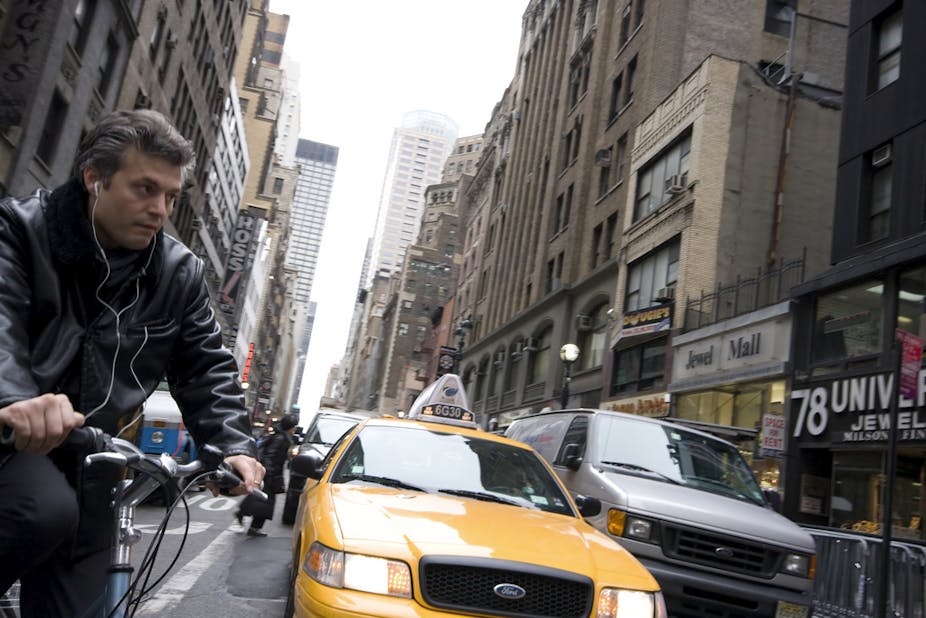
Are you addicted to speed? Has a “hurry virus” taken over your life?
Building faster roads or buying a fast car or a second car may seem appealing solutions to time pressure. Yet our obsession with speed, and our reliance on cars as a supposedly fast mode of transport, may be an underlying cause of our lack of time. The more we rely on “time-saving” machines such as cars, the more time we lose. The following anecdote helps resolve this paradox.
Imagine living in a village, where your job each day is to collect a bucket of water from the river. This takes an hour each day. To “save time” you build a machine to fetch the water. However, to make the machine work, you need to spend two hours each day winding up a spring.
In modern cities, the equivalent of “winding up the spring” is the time spent at work earning the money to pay for all our transport costs. For pedestrians, this time is virtually nil. For cyclists it is minimal. For car drivers, the time spent earning the money to pay for all the costs of cars is usually much greater than the time spent driving.
Motorists may think they are saving time with their cars when it takes 20 minutes to drive to work, compared to 30 or 40 minutes on a bicycle. However, motorists might be spending one or two hours per day (or more) earning the money to cover the cost of their cars, while cyclists spend only a few minutes per day earning the money to pay for their bicycles.
The concept of “effective speed” takes into account all the time costs of any mode of transport, not just the time spent travelling.
When the various costs of cars are taken into account, their effective speeds are surprisingly low. Estimates of effective speed show how slow cyclists can travel and still be effectively faster than a car.
Cyclists in Melbourne or Sydney who can average around 15km/h would be effectively faster than a motorist on an average income in the “fastest” new car (that is, the one with lowest operating costs). In New York, cyclists would need to cycle at only 9 km/h to be effectively faster than a car. In London, 7 km/h would place cyclists ahead of the fastest new car.
The higher trip speeds of cars do not save time; instead they encourage longer travel distances as the city spreads out and local shops, schools and services close. In cities dominated by cars people spend more time travelling by motorised transport than in cities where public transport and cycling are the main modes.
As the speed of cars increases, so does the cost. When motorists drive faster to save time, the few seconds they may save will cost much more than that in the time needed to pay for the extra fuel, wear and tear on the car, and stress. Paradoxically, switching from the car to the bicycle will reduce the total time we spend on travel, as well as boosting our health directly through increased physical activity.
Unlike drivers, increases in trip speed for cyclists could result in a substantial increase in their effective speed. This is because the main time component for cycling is the time spent on the bicycle. Increases in trip speeds for cyclists could be achieved with minimal cost.
If governments understand the concept of effective speed they will also appreciate the futility of trying to save time by trying to increase the average trip speeds of private motor vehicles. Cities that invest most effectively in cycling infrastructure will have more time and money to devote to things other than transport, including health promotion.
Improving urban health might be as simple as valuing the time of cyclists more than the time of motorists.
Seamus Gardiner
Citizen
The impediments to cycling for commuting are various I imagine. Chief amongst them are infrastructure and safety issues such as dedicated bicycle paths, hostile traffic, showering facilities, lockers etc.
I think culturally there is insufficient numbers also to role model the activity as an accepted or desirable method of transport. I now live in the country and i think I am one of 3 cycle commuters on my campus, in a rural city with very good cycle commuting infrastructure. Compare that with melbourne, with an amazing quantity of commuters on busy streets (albeit with bike lanes).
Before this discussion gets taken over by cranky anti-helmet activists it should be noted that the greatest impediments to cycle commuting is infrastructure not helmets or 'fear generated by helmets'. Nevertheless, as helmets have only demonstrated around a 10-20% reduction in ED presentations I believe there is scope to rescind Mandatory helmet laws (MHLs) for adults.
Dan Smith
Network Engineer
10-20% reduction in ED presentations sounds like an excellent reason to keep them in my opinion, particularly if the actual numbers are high. You mustn't be as risk averse as I am!
Jason Brown
logged in via Facebook
It would be great, but the usually-cited downside is that participation in cycling drops precipitously after the introduction of MHL.
So there's a trade-off. Do you want XX% of people to quite cycling, thereby exacerbating long-term public health issues and road congestion, or do you want to deal with XX% more head injuries. The actual figures seem to vary by source, but cited values are as much as 50% of the cycling population versus an extra 10% in head injuries (not separating minor and serious, obviously)
Lastly, if MHL were repealed, helmets would not suddenly be banned. If you're risk-averse, keep wearing.
However, this is somewhat off-topic
Jason Brown
logged in via Facebook
*quit not quite. Odd typo.
Derek Williamson
logged in via Facebook
Jason this recent piece citing recent data questions your view that MHL have caused a plummeting in cycling numbers. and other complaints that they don't actually help etc.
http://www.med.unsw.edu.au/medweb.nsf/page/shownewsstory?OpenDocument&LinkID=920022F16B
Jason Brown
logged in via Facebook
Except that's not *exactly* what it says.
First, it quotes no numbers to refute the decline whatsoever, then it clearly cites increased spending on infrastructure, which would tend to exert a counterpressure to any observed decline. It then quotes a decline in real numbers of head injuries, and claims victory for helmets without actually parsing the figures in any way to see how much of a decline was really due to helmet use and how much was due to other factors. Frankly, I'd expect to see a decline…
Read moreSimon Arthur
Reader
I don't think this is off-topic as helmets are a cost too, along with public health spending. Looking into the NZ study you referenced a bit deeper:
"Traumatic brain injuries were most common in crashes involving a collision with a motor vehicle whereas upper extremity fractures were most common in other crashes."
ref: http://www.biomedcentral.com/1471-2458/10/655
This would suggest that helmets should be mandatory for on-road riding, and most people will be riding on-road to get to and from a cycle path. But the real solution's obvious - get people out of cars and you'll reduce the amount of motor vehicle collisions!
Jason Brown
logged in via Facebook
Well, ideally, as you say, getting more people out of cars and onto bikes would certainly have an effect. Infrastructure is oft-quoted as the panacea, and I have to say it would go a hell of a long way...
If, that is, they can work out the bugs, such as frustratingly long wait times for cycle control lights, road sensors that fail to detect bikes approaching at all, cycle lanes that are too narrow to accommodate overtaking, hipsters using bike lanes as shopping trolley parking, drunk clowns in suits who step out in front of bikes without looking, police sting operations at key cycle lane junctions, dog walkers who refuse to keep poochy on a lead on SUP infrastructure and all the rest.
Then: Utopia!
(just kidding)
Jason Brown
logged in via Facebook
Couple of apropos-of-not-much items
My expenditure on cycling this year has been pretty high - I've invested in two new bikes (well, one, which I snapped, leading me to upgrade the warranty replacement), clothing specifically for riding, parts, maintenance etc. I use my car twice, maybe three times a week now, and usually one of those journeys is to get me and my bike out to the Mountains, so could be counted under both columns
My overall expenditure is probably still less than my car, but…
Read moreDennis Alexander
logged in via LinkedIn
Agree about incidental costs. Then there is the time cost of changing: one gets in their car and drives, gets out and goes straight to work; so do some cyclists but I try not to sit near them; me, I sweat at the drop of a hat (even in a Canberra winter) so a change and shower is needed at the end of both trips.
Jason Brown
logged in via Facebook
Ten minutes, fifteen if feeling like a longer shower. Some days when I drive I spend that long trying to find a park.
And as you get fitter from riding more, you'll sweat less. Then you'll find there are of days where you don't really need a shower. But by then you'll also be faster, so you can have one anyway. WIN WIN
Daniel Kinsman
logged in via Twitter
When you drive, do you go to work in your pyjamas without showering?
Dennis Alexander
logged in via LinkedIn
Unfortunately Jason, I'm one of those people for whom sweating does not correlate with fitness. And the shower time is still travel time in the terms of this article.
Jason Brown
logged in via Facebook
Sounds far fetched to me. Have you got a doctor's certificate?
And as Daniel says, do you regularly drive to work still in your pyjamas without showering? Move the morning shower from "before the drive" to "after the ride".
It's a pretty trivial thing to be moaning about, though, Dennis. And you moan about it A LOT.
Seamus Gardiner
Citizen
Shower time is not contained within travel time.... Unless you regularly would not shower when driving to work.
Jon Holbrook
logged in via LinkedIn
In defence of Dennis, as a fellow extreme sweater, it is a pain in the bikeseat. Having said that, it's not that hard to get in the habit of riding, and it's one extra quick shower a day. I'd rather do that than sit in the queue of cars exiting the car park.
Seamus Gardiner
Citizen
Yeah, but his point was that post ride showering was additive to commuting time. My point is that most people shower before going to work so whether you shower before commuting by car or after commuting by bike is immaterial.
I am an extreme sweater and my biggest problem is that if I go for a training ride before work in summer I have to sit around for 20 minutes to cool down before having a shower... A small price today though, as I don't have to find extra time in my day to go to the gym or whatever, which would be the consequences of not cycling.
Robert Moore
Street Sweeper
Could just jump in the shower straight away!
My experience is you don't sweat that much when riding, or at least it mostly evaporates if you have non-cotton clothing, hence the popularity of "proper" cycling gear. The trouble arises when you stop cycling, when suddenly you lose the cooling effect of the breeze. Body reacts by copious sweating. This is fresh, so doesnt smell, but is potentially embarrassing. can just wipe down, rather than shower. Handy to have a big fan on your desk or nearby where you can hover for a few minutes. People who drive cars or catch the train get to work sweaty too, and it is likely to be not so fresh.
Robert Moore
Street Sweeper
These sort of articles give me a headache! Need to put it into mathematics and physics before I understand it, in terms of entropy of the system always increasing unless you supply a lot of energy, ie have to run fast to stand still.
If we all cycled to work, would the boss be justified in paying us less, because we don't need to spend so much on cars?
Or would we just choose to work less because we wouldn't need the money?
Or would demand for houses close to work drive up prices so we would have to work longer?
Daniel Kinsman
logged in via Twitter
The "effective speed" measure is a little obtuse and unintuitive. As the old saying goes "time is money" but a lot of permanent workers with set hours don't feel like they can reverse that transaction. But they can.
One way of expressing it simply, cycling will save you money, and saving more money means you can retire earlier. Or you can do what I have done, just ask your boss if you can work part time. I was surprised how easy and straightforward it was to organise.
Peter Sheldon
Forestry Student, Germany
I think you're right Daniel. Work is not flexible enough to allow it to become the decision-making factor - ie we can't set our watch for the number of hours we need to work to pay for our lifestyle then just 'clock-off' when we've hit our target.
Also, in a highly affluent society such as Australia money is unlikely to be the deciding factor ahead of convenience (infrastructure set up for cars ahead of bikes) and discomfort (getting up 20 minutes earlier/cold/rain/sweat etc).
I always cycle, and cost is part of the equation, being a student. I also get to work earlier, can park in the office and, best of all, enjoy the commute.
Susan McCosker
Former school teacher
We are getting organised to sell and buy in a more 'convenient' area - where we can walk, ride, and catch buses more to the places we go. Financially, the costs of selling and moving compared to the cost of us buying and owning a second car work out even after about five years, plus there are time and health advantages.
Mark Amey
logged in via Facebook
Good on you Susan. My wife and I have lived three, and now, two kms from work, so walk as often as possible. We both work a rotating roster, so I tend to walk at all times, whilst she takes the car for night shifts. We've only just bought a second car after 18 years, as our son is learning to drive.
Of course there many benefits, including fresh air, exercise and losing the frustration of driving around like a fool looking for a parking spot!
Trevor S
Jack of all Trades
I come to this article late, trying to catch up with my reading :)
We moved to a rural area, I retired early (43 now 47) and my partner works part-time 3 days a week, to which she mostly rides. if it is raining (dirt road so it's muddy) she maybe passes one car so no stuck in traffic blues if we didn't have a dirt road we would get an electric ute if they were available and put solar panels on the roof of the garage to charge it) . We go to shop (50km round trip) once a fortnight. We could…
Read moreJennifer Kent
Research Assistant and PhD Candidate in Planning at University of New South Wales
I hate to bring it up, however what if speed and the ability to cover distance are not the real reasons we drive? It is possible that in our harried modern world cars are increasingly beneficial as objects of comfort, privacy and predictability. And that the autonomous mobility they provide is more about being free to go where we want, when we want - sometimes with little real consideration of or care for how long it takes us. Barriers to the use of alternative transport need to be understood in the context of all the benefits we gain from driving a car. And these benefits are increasingly conceptualised as potentially unrelated to utilitarian notions of speed.
Jason Brown
logged in via Facebook
What if you're relying on those benefits at times when they don't really exist? A drive may start out with the desire to head to work in your comfortable, insular metal bubble, safe from the cares of the world, but by the time you get there you may be harrassed, stressed and frazzled.
Driving, at that point, has become a harmful habit in the same way a social drink or two after work to wind down becomes a too-regular liver-pummelling.
Robert Moore
Street Sweeper
Commuting by car in Sydney hardly qualifies as comfortable, private or predictable in many cases, so I think this idea needs a little more work! Maybe it is just so we can avoid the usual "stare into space " awkwardness on public transport. Those seats on trains that face backward have a lot to answer for.
Jason Brown
logged in via Facebook
"Maybe it is just so we can avoid the usual "stare into space " awkwardness on public transport"
Protip: iPad. Or, to be more retro, the morning cryptic
;-)
David Bennett
Architect
Jennifer, don't 'hate to bring it up' you are RIGHT on the money. Us humans are very good at making decisions, but not always rationally. Aside from the other comments regarding certain inflexibilities in being able to trade ones earnings for time, the issue here is in perceived comfort, privacy, predictability and control.
(I say perceived, because - as we have all experienced - cars are sometimes the antithesis of these things.)
So how do we make decisions? Have a look at how cars are marketed. Individual climate control. Electric sun-roof. The great outback adventure. Go anywhere. Freedom. Blue skies, clean air, fresh mountain water. Often its really an expression of a desire for independence.
I'm an avid bike rider and PT user, but is it fair to say that there is a powerlessness in waiting for a bus? or pulling up beside a big car at traffic lights?
Simon Batterbury
Associate Professor at University of Melbourne
I don't have the research, but with advancing age myself I am sure the choice of a car over a bike is partially a matter of laziness (or more politely, avoidance of physical exercise). I live in the ideal place to test this hypothesis - 4km from the Melbourne CBD and the Uni, one of the highest cycle commuter percentages in Australia (well over the 11% for the northern suburbs) and 1km from big shops. So far it is pretty much all done by bike, but the tendency to just pop in by car is ever-present…
Read moreSimon Batterbury
Associate Professor at University of Melbourne
Aussies just haven't experienced the Tube or the Tokyo subway experience enough, and the culture of ignoring what is in front of you. Part of London culture is the packed morning train commute. It is amazing what you can avoid seeing when it is staring you in the face about 20cm away.
Donald Rennie
property manger/retired/disabled
Humans are only good at decision making, when we have ALL of the relevant data. But we are also really good at deceiving each other, and withholding information. (they don't even count bicyclists enough to calculate fatalities per kilometer traveled) We also tend to be very stubborn and resort to denial to avoid change.
What I think Jennifer was hinting at (that Jason and David missed), is that transportation choices, like clothing, are affected by fashion. It just isn't cool to ride a bicycle…
Read moreRobert Moore
Street Sweeper
Well known epithet on cycling web sites- "Work to eat, eat to live, live to ride, ride to work" - attributed to Cheryl.
It is National Ride to Work Day on Wednesday too. There is a website at
http://www.bicyclenetwork.com.au/general/ride2work/
Fred Pribac
logged in via email @internode.on.net
Interesting way to look at it but it neglects inconvenience which is worth paying extra to avoid. In particular it breaks down for folks who have age related or degenerative health issues that simply make safe cycling impossible. So how does public transport rate in this regard for folks who can't go all the way to a cycle led personal economic savings? Also I'm guessing that factoring in the cost of environmental degradation probably makes all these differences even more stark.
Jason Brown
logged in via Facebook
"it neglects inconvenience which is worth paying extra to avoid"
Define "inconvenience". Is it actually more convenient to drive, or is that mere ingrained perception? I've been asking myself that for the last few months, and I'm coming up with the answer "often, it's far from convenient".
For example, it's more convenient for me to drive to my weekly shop - because of the carrying capacity of the car. But it's not convenient for me to spend 30 mins fuming in traffic on the way to the office…
Read moreRobert Moore
Street Sweeper
Electric bikes are great for those with knee or hip problems and could well revolutionize mobility for those with some disability.
On relatively level ground riding a bike is easier on the body than walking anyway, witness many elderly people still cycling in The Netherlands.
A combination of bicycle and public transport can get many cars of the road, so long as there is space on the trains. Huge car parks at stations are really a very inefficient way of using land.
Fred Pribac
logged in via email @internode.on.net
"Define "inconvenience"."
Well ... for me it's not being able to tote my double bass and amp to a gig or to get both that work task done to deadline "and" be back on time to transport kids to and from childcare or to the swimming pool.
Or how about having to wrangle 5 or 6 heavy grocery bags some twenty kilometres.
Or, as was recently brought home to me, heart disease could make a bicycle trip pretty darn inconvenient.
Don't get me wrong - I spent many years using a bicycle as my primary…
Read moreJason Brown
logged in via Facebook
I'm certainly not failing to recognise the needs of "the elderly, the infirm and the chronically busy" (and actually I slightly resent the implication).
My partner, as I've mentioned, is disabled. I need my car to get her around. Does that mean I also need to use my car for a commute, on my own, in rush hour, a grand total of 11km? I also play bass (electric). I'd rather not lug that onto public transport, for sure
The real problem in Sydney is not elderly and infirm people clogging up the roads every day - that, to me, is a red herring here. It's people who have better options and either don't realise it or - more importantly - don't care.
Btw, I'm concerned that you drive 20km to do your grocery shopping. Where the hell do you live??
Fred Pribac
logged in via email @internode.on.net
Please accept my apology. I was making a general observation relating to a number of threads I've seen in the past where there are often unspoken assumptions about bicycle users and usage and a high moral tone. I was not directing my comments at you nor at your partners specific situation.
As to why I have to travel 20 km to do my grocery shopping it's because many people, including myself, live twenty kilometres or more from the nearest shopping centre.
Donald Rennie
property manger/retired/disabled
It really bugs me when anyone (bicycle advocates even!) live in some fantastic motor-utopia where private motor vehicles are not killing a million people every year and trying hard to cook the whole planet!
20 kms for groceries! Wow. It is only some countries where 90% of the population is urban, so I guess that isn't too uncommon.
But in any case, in my bicycle utopia, private motor vehicles would only be phased out. That is banned only where adequate alternatives existed. The 'where' being…
Read moreAlan Davies
logged in via email @bigpond.net.au
The average cost of running a car is high compared to the most obvious alternative, public transport. So people must feel they're getting something from car-ownership e.g.:
On-demand convenience
Direct travel - no deviations
Point to point – no waiting
All-weather travel
Carry passengers and objects
High degree of personal safety esp at night
Privacy
Access to distant destinations
Status
Cars also offer speed in non-congested conditions, which is why many of us train to work but drive to the shops or kids footy. Work trips only make up around a quarter of all trips.
Not sure "effective speed" offers any more explanatory value than income. Hours worked to pay the mortgage is "effective what"?
David Bennett
Architect
Yep. No doubt people feel like they're "getting something from car-ownership". what is interesting for this discussion is the perception of what they are getting as opposed to what they are really getting.
Alan, your list of things they are getting is unarguably right. And I'd like to think that most people are aware of what they are buying into when buy into a car-dependent lifestyle location to live. (and no doubt many DONT have a choice) but i suggest that most dont really understand the reality…
Read moreAndreas Jacques
Manager
Hi Paul - you mention that effective time involves "the time spent at work earning the money to pay for all our transport costs" and that "For car drivers, the time spent earning the money to pay for all the costs of cars is usually much greater than the time spent driving."
The problem is that even if most of us rode to work, we would still need to own a car for many other tasks of daily life. The costs of driving to work should therefore only take into account the marginal costs associated with driving to work ie petrol and wear and tear for those trips. It shouldn't include fixed costs such as purchase repayments, rego, insurance etc. My hunch would be that if you only took into account the marginal costs relating to work, the 'effective speed' results would be significantly less discrepant.
Susan McCosker
Former school teacher
It might not make a lot of difference to the individual, but for a household who can share a car if they use alternative modes to travel to and from work, it does make a significant difference.
Simon Arthur
Reader
@Andreas, you're right on car ownership, those fixed costs of owning a car are not offset for many commuter cyclists. Still, I find the savings on fuel and resale value are still quite considerable, in the range of $2200/year on fuel and 9600km off the odometer. Yes I have an SUV, it's thirsty, but it also gives me load-carrying capability which is very useful with a young family.
Then you also need to consider the infrastructure costs which have come about because of congestion in our major…
Read moreCraig Henderson
Horticultural Scientist
Paul, is there a magpie (substitute any other territorial bird) harassment function in your model? Probably has at least two components: disincentive to get on the bike in the first place, however increased speed at certain points on the ride as an avoidance tactic.
As indicated above, I sense that the argument is around the requirement for the actual car - once you've committed to the fixed costs of ownership, the marginal per km additional costs are probably less obviously in the bike's favour, particularly outside major cities, e.g. with longer regional commutes.
Simon Arthur
Reader
Magpies should be THE reason for mandatory helmet laws, maybe even for mandatory cable-ties on the helmet :)
Or we could just bulldoze their habitat and build more freeways ... a bit more costly but no doubt effective.
Jason Brown
logged in via Facebook
And suddenly I realise what the cable-tie-on-helmet thing is all about.
Screw magpies (demon chickens the lot of them) but I am NOT riding around with cable ties poking out at all angles. Jeez.
Seamus Gardiner
Citizen
Take the hits.
In 20 years I've only known one particularly homicidal magpie to draw blood from me ( and very effective she was too, hovering some inches from behind me pecking my ear). The rest just swoop and make a bit of noise, with the occasional one softly colliding with my back, like being struck with an aggressive feather duster.
Peter Hewson
Citizen
About a year ago I moved home and now walk to work. I still own a car that gets very little use. Ignoring the comments above related to cycling (that wasn't the rational of the article as I see it) I'm now considering the practical aspects of car ownership: having the car sitting in a garage leaking depreciation and inerest and consuming standing costs. Yes, it's convenient for getting the groceries and the ocasional weekend trip but at a standing cost of about $120 per week (min: I've done the sums) each km I do in it is no longer measured in a few cents. And, yes, I've considered that I am working those hours to feed the (now) recreational vehicle. At the moment ego rules but maybe not for long.
Seamus Gardiner
Citizen
Sell it. I lived in manly for two years without a car, just hired one for weekend trips and walked to the supermarket... You won't miss it. Buy a good raincoat though.
Michael Dodd
logged in via Facebook
Anyone with half a clue that wants to be time efficient won't drive if they don't actually need too.
Every unnecessary moment an individual spends behind the wheel is a waste of time.
When you walk or ride you get exercise and when you catch public transport you have an opportunity to read. Exercise and education is an important aspect of life that isn't achievable while behind the wheel.
Jason Brown
logged in via Facebook
You might be surprised at the number of drivers I see in slow or stationary traffic *reading the paper*. I see it so often it's becoming a Sydney cliche.
They're expanding their minds while paying no attention whatsoever to the road. A shining example of Australian thirst for knowledge.
David Leigh
logged in via Facebook
I think the question that should be asked is... Do we have to travel to work? In the case of a bricklayer or carpenter, we do. Designers, architects and IT people should not need to travel, but mostly do. Anyone who can work online, should. I work from home and live in a country area, where transport is essential. I do not however, go anywhere unless it is vital. I grow my food (mostly) and only make necessary journeys. I do so in a small (1.5 Lt) hatchback and use E10 where I can. It is sometimes slow on hills and annoys the hell out of fast car drivers but I get there for a fraction of the cost and it only takes a few minutes more. I ask of those drivers, what do they do with the time they save?
Robert Moore
Street Sweeper
Recent study by the NSW Transport Statistics Bureau showed home workers made as many if not more car trips as office workers, just at different times, ie between 9 am and 4 pm. They went out to shop, bank, do business, etc. A lot of shift workers would also get the opportunity to drive during the day, when it is much more pleasurable and convenient. I guess it helps to reduce peak hour congestion, but pity more of these trips by home workers couldn't be made by bicycle or walking etc.
http://www.bts.nsw.gov.au/ArticleDocuments/82/cp2012-4_travel_sydneys_home_workforce.pdf.aspx
william hollingsworth
student flinders university
Again we have this narrow argument of car versus the push bike. Why are motorbikes and scooters constantly ignored? It is to the detriment of city transport that the motorcyclist is discriminated against as motorbikes use less fuel,space and resources .It is totally obscene that a 2000kg car is used to transport one person. For our efforts the motorcyclist pays more in government taxes, more for parking per square metre and is seen as a social outcast .Most journeys are taken by one person per vehicle. Rego for motorbikes should be free, as should parking .Without such an incentive our roads will clog up even more and every road will become a toll road. Begin the motorbike revolution now.
Fiona Telford-Sharp
logged in via email @internode.on.net
If you have children that need to be picked up before and after you go to work, then cycling to work and adding additional time to your commute means extra cost for before and after school care. Recently I worked out that it would cost me an extra $65 a week in before and after school care costs if I were to cycle to work (that is taking into account the amount it would save in petrol, although not including fixed costs like rego because I have to pay those anyway). Plus it would mean less precious…
Read moreRobert Moore
Street Sweeper
Plus setting a good example to your children and other parents.
Comes a time I guess when children are old enough to get to school themselves, or there are walking groups or car sharing arrangements.
You seem half way convinced, so that is a good start, and why not do it a couple of days a week if you can?
Re the clothes issue, the usual suggestion is to drive in to work on the weekend or on the days you don't cycle with a weeks worth of clothes and leave them in a locker. Works better for males I suppose but can be done, as many bicycle commuters seem to manage. There are suit satchels too, purpose designed to carry suits on a bike.
Fiona Telford-Sharp
logged in via email @internode.on.net
I'm sure you don't mean to, but you know you sound terribly condescending talking about 'a good start'. I didn't comment to be convinced. I commented to illustrate that some of us make decisions based on other factors then cycling as number one priority. As a full time working parent my time with my children is worth more than trying to cycle every day. I'm not interested in solving the problem of ferrying my professional attire to work by buying a satchel or making trips on the weekend, I get it…
Read moreRobert Moore
Street Sweeper
Sorry if I was condescending, I was trying to be encouraging, as you said you were thinking of riding to work, and it sounded like it can't be that far, but of course it might be quite a distance. Anyway, if your children are walking or cycling to school with you before you set off to work that is enough Brownie points in my book.
Simon Batterbury
Associate Professor at University of Melbourne
I was able to choose a place with minimal commuting when moving to Melbourne and our son was 1. An article about what we did about kids cycling since arriving is published here. https://docs.google.com/file/d/0B6fL-AXTMskgMGY2MjVkMzYtNTk3Yi00OTY1LWFkNGEtYzU1NGNjNmUzN2Nj/edit?hl=en_US&pli=1
or via
https://sites.google.com/site/judylongbottom1/home
The fact that our son did 7km a day on a bike with us (for an outlay of $5!) by the age of 4 has drawn some comment among incredulous parents but…
Read moreMiranda Buck
logged in via Facebook
When pregnant with my first child it was commented that I would now 'have' to learn to drive. Again with my second child, the commentary on the necessity of cars. I still feel no need for a car. I suspect most people vastly underestimate how much cars cost. We read books on the train, observe the city as we cycle, meet people in our neighbourhood, support our local shops, and spend the cash we save in cafes.
Donald Rennie
property manger/retired/disabled
Nice! Thanks for resisting all that pressure.
You can obviously also more easily save for your children's future or a house or ...
And you are right. Like all bad habits we aren't very good at being honest with ourselves as to their true costs.
Donald Rennie
property manger/retired/disabled
Thank you Paul!
Finally someone is doing the math. Kudos, but more like that is needed. I suspect bicycling is still 50 times safer than motoring, per kilometer traveled. But it would be nice if bicycle kilometers were counted, so we could do full cost (time and health-care expense) comparisons. Would be even nicer if governments would pay attention.
Aussie Car
Australian Vehicle Wholesale at aussie car wholesalers
This blog reminds me of the second law of thermodynamics. It says that “the more order the things are the more disorder it becomes.” Perhaps we want to have cars so that we can save more time in going to work (making things in order), but we really don’t realize that we spend more time working so that we can pay for the maintenance and fuels for are cars (things are becoming more disorder).Well, the concept of “effective speed” is common but most of us don’t mind this at all. It is true that effective…
Read more