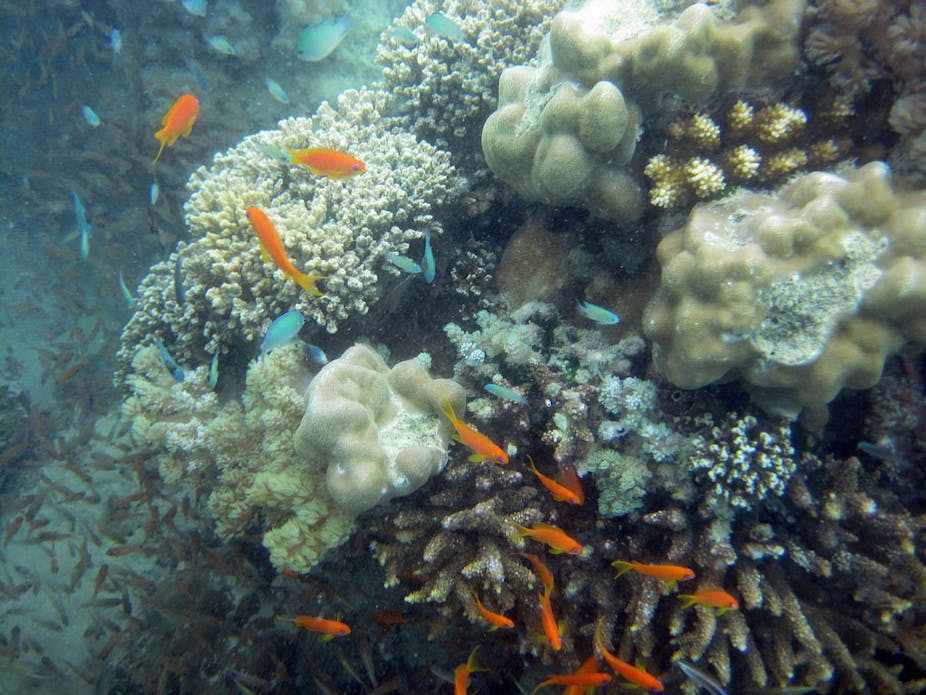
Coral reefs off part of Western Australia’s coastline have flourished over the past 110 years, despite the rise of carbon dioxide levels in the world’s oceans, new research has found.
But the growth has largely taken place in the coolest, most southerly waters, where global warming has made the ocean more habitable for the tiny marine animals. The finding suggests that rising water temperatures aid growth in the underwater colonies initially – before other factors, such as acidification and coral bleaching, take effect.
Samples taken from long-lived corals in reefs at six points across a 1000km stretch of the Indian Ocean show that in some cases calcification (or growth) has increased substantially, a team from the Australian Institute of Marine Sciences found.
At the most southerly collection point, off the Houtman Abrolhos Islands, calcification rates increased by 23.7% between 1900 and 2010.
The research is published in the journal Science today.
It comes amid efforts to stem the ongoing decline of the Great Barrier Reef, off the country’s north-east coast, and despite predictions by some that rising carbon dioxide levels in the oceans would cripple the marine colonies worldwide.
The research team, lead by Dr Tim Cooper, found that calcification rates in the Indian Ocean were greatest across reefs furthest from the equator, where the water was originally cooler and warming had been greater.
“In the southeast Indian Ocean, marginal reefs have taken advantage of warmer conditions,” the team writes.
Dr Cooper said that rising sea surface temperatures appeared to increase calcification rates up to a point. But beyond that point, bleaching and acidification – caused by increased carbon dioxide levels – slow their growth rates.
In coral in the most northerly sites, where sea temperatures had been higher and warming less marked, there had been no change in calcification.
Professor Maria Byrne, the director of One Tree Island Research Station, the University of Sydney’s research station on the Great Barrier Reef, said the findings made it clear that global warming was “definitely happening – particularly at higher latitudes. And it’s having an obvious effect on the physiological processes of these animals.
“Corals can’t cope with cold waters. They never could. But now you’re getting those tropical waters moving south, making it easier for corals to spread at higher latitudes. The water is up to 19C in winter at those latitudes now – anything below that corals don’t like.”
The elevated temperatures would be good for corals in those areas up to a certain level. “But then all of a sudden it hits the wall and becomes too hot,” she said.
Increased ocean temperatures caused mass coral bleaching across the Great Barrier Reef in the summers of 1998, 2002 and 2006, the Great Barrier Reef Marine Park Authority said.
Marc Hendrickx
Geologist
So where is that coral grave yard Ove?
Peter Lang
Retired geologist and engineer
What were the Great Barrier Reef and the WA coral reef like during the last glacial period?
Was there areal extent less than today/
Did they flourish in colder water as they do in warmer water?
What is the trend in these coral reefs from the cold period to the warm period?
I understood the GBR contracted and struggled to survive during the glacial periods but flourishes in warmer water.
It would seem to me, very simplistically, that the waremer the water, the better the coral reefs flourish.
This seems to be supported by the massive coral reefs that can bee seen in the geological record during warm times.
Does this lend support to the view of some that life thrives when the planet is warmer and struggles when colder?
Is this an example of what IPCC AR$ WG1, Chapter 6 means where it says that there was more carbon tioied up in the biosphere when the planet is warmer and less when colder?
David Arthur
n/a
Gday Peter Lang, you rightly allude to the fact that corals have persisted through a great deal of climate variability; that is, while it is entirely plausible that many existing corals will die as climate changes, corals may well flourish elsewhere.
You then ruin it all with the rhetorical "Does this lend support to the view of some that life thrives when the planet is warmer and struggles when colder?"
What you still resolutely refuse to comprehend is that a warmer world will not be good for species that have evolved in the Pleistocene. That's us. Wake up to your self.
Trevor Ellice
Geologist
Umm David,
Homo Sapiens Sapiens is a warm adapted species. Homo Sapiens Neanderthalus was a cold adapted species (subspecies?). They are extinct, we won and will be just fine on a warmer planet thankyou very much.
Peter Lang
Retired geologist and engineer
Not only that, if we plot population density versus average annual temperature, we find that people prefer to live in warmer than cooler climates. In fact it is an exponential distribution towards warmer.
(This is derived from a plot of population density versus latitiude, and then convert latitude to average annual temperature at sea level.)
We find, unsurprisingly, people prefer to live near the equator than near the poles.
I guess people really do prefer warmer to colder. How surprising :).
Is that why more people travel to warmer climates for their annual vacation than choose to rent beach houses along the shores of Antarctica?
David Arthur
n/a
Trevor, your argument fails because H. sapiens supplanted H. neanderthalensis well before the end of the last glacial period within the latter group's home range.
What you also need to remember is that the planet will be even warmer than H. Sapiens has ever experienced, that is, warmer than the world to which we are, by your argument, adapted.
On a warmer planet, sea levels will be metres higher than at present. Doubtless our heirs and successors will deal with climate change very well, but the large-scale loss of so much built capital will set them well back.
You also neglect the large-scale disruption of most of our agricultural systems.
In summary, there is no doubt that H.Sapiens will survive, and ultimately prosper. The issue for us is whether we are consigning the majority of the world's population to economic loss, and death through famines this century.
You don't have children, do you?
Dave Hudson
Environmental Scientist
I think people need to pay attention to the last two paragraphs, which states that warming is good for corals, but only up to a certain limit at which point the heat starts to become problematic.
I fully expect to see this story being spread around by AGW pseudo-sceptics as being evidence that global warming is good for the world and that ALL coral reefs will benefit greatly from the extra heat, despite the cautious tone of the article and the presence of 'howevers', 'buts' and other clarifiers.
Peter Lang
Retired geologist and engineer
Dave Hudson.
This silliness "AGW pseudo-sceptics" is the sort of name calling that has so seriously damaged the credibility of the "Catastrophic Global Warming" Alarmists. It never ceases. Almost every post by Alarmists, seems to have to include this nonsense, instead of addressing the questions.
Because many of the alarmists have become advocates for a cause - including scientists like James Hansen, Phil Jones, Michael Mann, Will Steffen, Andrew Glikson, and many others - the so called…
Read moreDavid Arthur
n/a
Gday Peter Lang, I've explained several times over how Anthropogenic Global Warming is a problem for life as we have come to know it.
As you rightly point out, belief in an ideology is not science.
Andrew Glikson
Earth and paleo-climate scientist at Australian National University
The serious nature of climate change ought to discourage kindergarten-like language terms such as "warmists", "skeptics", "alarmist" or "denialists" - what is essential is the evidence in nature, not name calling.
As shown by the geological record, corals, like other life forms, can adpapt to changing ocean and atmosphere climate conditions over periods of thousands of years and longer.
It is a different proposition when tempratures rise at a rate of ~0.3 Celsius per decade and CO2 at 2.6 ppm/year since, when environmental changes occur at such a rate, many species can not adapt.
Precisely what occurred during the great mas extinction of species.http://www.skepticalscience.com/Earths-five-mass-extinction-events.html
Peter Lang
Retired geologist and engineer
Andrew, so why don't you practice what you preach? You frequently screech "deniers" and give long diatribes about "deniers" when you don't want to answer the questions. This approach discredits all climate scientists, because it is a common tactic. When scientists becoma advocates for a cause, as you have done, all objectivity ceases.
Andrew Glikson
Earth and paleo-climate scientist at Australian National University
Regarding the proposition as if life thrives during warm periods - whereas some genera and species do, other genera and species do not. On the whole the rise of 12C/13C as the Earth cools reflects increased biological activity under lower tempratures, which involve greater solubility of oxygen and carbon in the oceans, enhancing life (see Figure 1 in Zachos et al., 2001)
http://www.sciencemag.org/content/292/5517/686.abstract
Peter Lang
Retired geologist and engineer
Andrew,
Thank you for that reply. However, I am not convinced. It does not seem to fit with what AR4, WG1, Chapter 6 says. For example:
1. more carbon tied up in the biosphere when the planet is warmer and less when colder
2. area of deserts is reduced when warmer and increases when colder.
The latter seems to be supported by evidence such as
- more dust concentration in the Antarctic ice cores in cold times and less in warm times
- Pleistocene sand dunes around canberra from the last ice age - all grass covered now
- Much of the Dahara was grassland during the warmest period of the Holocene (after the end of the last ice age)
- GBR nearly dies out during the last ice age, and flourished as the seas warmed
- massive coraline limestone depostis from warmer times in the past
- rich sea lfe during the warmest times when the oil was deposited.
Comments?
Timothy Curtin
Economic adviser
As always here, the warmists like Andrew Glikson tend to be parsimonious with real data (except in his case for millions of years ago)..
To fill the gap, here are some trends for the Coral Sea/GBR:
GBR Lat 10-15 at surface:
Linear y = 0.0052x + 25.784 (i.e. 0.05 per decade, and 0.5oC per century)
R² = 0.0704 (very bad fit)
Polynomial #5 y = 7E-08x^5 - 1E-05x^4 + 0.0006x^3 - 0.0162x^2 + 0.174x + 25.318
R² = 0.1592 (much better fit than the linear)
Note that 2010 was mainly an El Nino…
Read moreTrevor Ellice
Geologist
'Dr Cooper said that rising sea surface temperatures appeared to increase calcification rates up to a point. But beyond that point, bleaching and acidification – caused by increased carbon dioxide levels – slow their growth rates'
Now, how did Dr Cooper measure this? or does he just know.
I can see how is warming can cause bleaching but how is it linked to acidification?
Oh CO2 right - yeah got it. But see how the logic in the sentence is flawed. Warming and acidification are linked but really they are separate processes - accordign to current dogma anyways.
Ocean acidification c'mon really guys. Anyways what about the bicarbonate ion fertilising the little beasties and helping them grow their skeletons. And does anybody consider the buffering effected caused by the trillions of tonnes of limestone outcropping along the WA coast. Which, if you look closely, is constantly dissolving.