One man’s freedom fighter… can we ever define terrorism?

Terrorism defies definition. We all know one man’s terrorist is another man’s freedom fighter; or in some cases, one man’s terrorist is another’s recipient of the Nobel Peace Prize. The use of the word “terrorist” by both sides of the current conflict between Hamas and Israel underline its ambiguity…

64g7nz56-1357527347
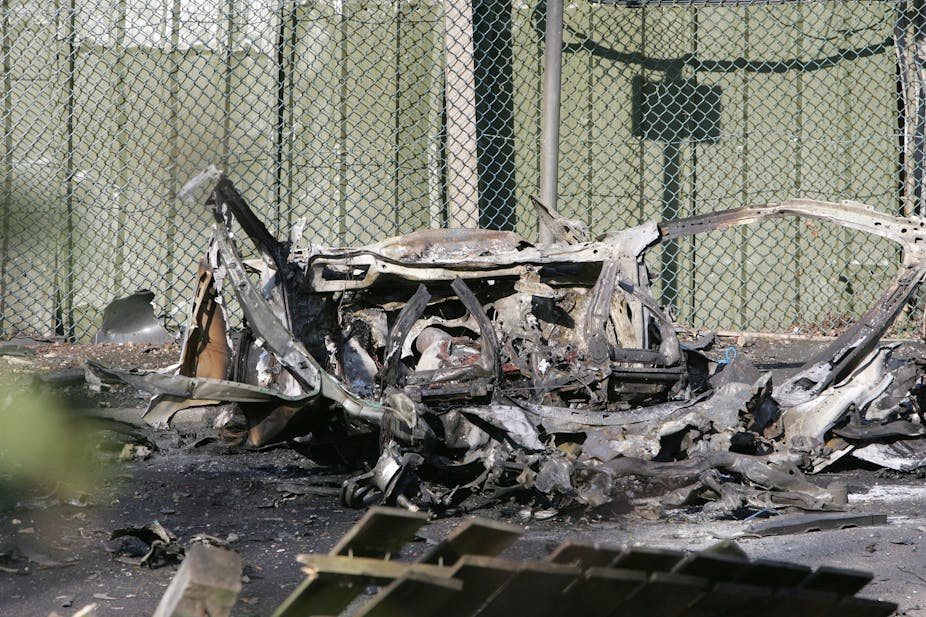
The remains of a Real IRA car bomb after an attack on a British Army base in 2010. Terrorists or ‘freedom fighters’? EPA/Paul McErlene

Terrorism defies definition. We all know one man’s terrorist is another man’s freedom fighter; or in some cases, one man’s terrorist is another’s recipient of the Nobel Peace Prize. The use of the word “terrorist” by both sides of the current conflict between Hamas and Israel underline its ambiguity.

Indeed the perception that terrorism is too contentious to define has resulted in leading scholars, like Walter Laqueur, declaring:

Disputes about a detailed, comprehensive definition of terrorism will continue for a long time and will make no noticeable contribution towards the understanding of terrorism.

Laqueur and others point to the failure of bodies such as the UN to define terrorism. The UN has been debating the meaning of terrorism in various committees since 1963. This matters – and not just because it makes terrorism research more difficult. In the aftermath of the terrorist attacks of 11 September 2001, the United Nations Security Council issued Resolution 1373 calling on member states to take co-operative legislative action against terrorism. Unhelpfully, Resolution 1373 left “terrorism” undefined.

However, the apparent confusion about what “terrorism” is may have been overstated. It is possible that while the word “terrorism” is politically divisive there is a commonly understood meaning of terrorism. After all if it looks like an elephant, sounds like an elephant and smells like an elephant it is unlikely to be a kangaroo.

Nelson Mandela is beloved worldwide, but was also once considered a terrorist. EPA/Str South Africa Out

A group of UNSW law scholars – of which I am part – are working as part of an Australian Research Council project on Anti-Terror Laws and the Democratic Challenge. In collaboration with a colleague in the UK we have identified a surprising amount of agreement in an area usually characterised by discord.

In 1988 two European scholars Alex Schmid and Albert Jongman produced one of the more robust definitions of terrorism. They did this by surveying 200 leading academics in the field of terrorism studies. The research asked each expert to define terrorism.

Schmid and Jongman received 109 responses. They identified 22 words or phrases which reoccurred across the definitions. They noted that on average the academic definitions included at least eight of these words or phrases.

This hinted at the possibility that a core understanding of terrorism might exist.

In our research we applied the same approach to seven legislative definitions of terrorism from six countries. We were expecting that the legislatures – each of whom defined terrorism after 11 September 2001 – would have produced wildly different definitions from the academics. We thought we might discern some commonality across the legislatures themselves but we did not anticipate that they would correlate well with Schmid and Jongman. We were surprised.

In our work we discovered that the legislative definitions triggered on average eight of the 22 words or phrases, the same level of correlation that the academics achieved. It is also important to say that the legislatures did not trigger the same 22 words – it couldn’t be that easy. Still, we were able to extract the following modest proposal:

Terrorism is some form of purposive and planned violence that has a political, religious, or ideological motivation. It is intended to coerce or intimidate and is targeted at civilians or government. Legislation prohibiting terrorism ought to have extra-territorial effect.

Support for our definitions came from an unexpected quarter. Another colleague was recently giving a lecture in UNSW to a group of 14 and 15 year-old school kids. She asked them to define terrorism. They concluded that it was blowing stuff up; that it was aimed at terrorising the community; and that it was political.

It is difficult to argue that a bomb attack on a girl’s school like this recent attack in Pakistan is anything but terrorism – however the attackers would justify it otherwise. EPA/Wali Khan Shinwari

If academics, legislatures and Aussie school kids are all capable of defining terrorism with a fair degree of coherence and agreement why do international organisations struggle? Why does the Rome Statute, which established the International Criminal Court leave the crime of aggression undefined and the crime of terrorism unmentioned? The answer is politics.

The political power of a phrase such as terrorism stems from the fact that groups employ it to denigrate and undermine their opponents: the Irish Republican Army (IRA) frequently referred to the terrorism of the British government without hint of irony or self-awareness; both sides of the Arab- Israeli conflict throw it around; and the President of Iran, Mahmoud Ahmadinejad, is particularly fond of deploying the t-word.

States maintain this ambiguity because it enables them to utilise the phrase “terrorism” without having to clarify what it means. Simultaneously it allows states to avoid condemning behaviour which conforms to the definition of terrorism.

Agreeing on a definition of terrorism would restrain its use. It does not suit the purposes of many states to have terrorism defined: either because they do not want some actions to be defined as “terrorist”; or because they want to term something “terrorist”, where in reality the word is inappropriate.

In the end, the dilemma is more a function of politics than it is of linguistics or human understanding. But any school kid could have told you that.

Sign in to Favourite

Want to follow The Conversation?

Sign up to our free newsletter to get the day's top stories in your inbox each morning, with a special wrap on Saturday.

Spinner
Donate and become a friend of The Conversation

Join the conversation

30 Comments sorted by

  1. George Michaelson

    Person

    Could you eg apply this debate to the problem of Tamil refugees currently denied a visa by secret ASIO assessments? Does this discussion inform their status, and the risks to their rights?

    report
    1. Fergal Davis

      Faculty of Law senior lecturer at University of New South Wales

      In reply to George Michaelson

      I'm not sure it would be useful in the Tamil cases. There is a definition of terrorism in Australian law - it is one of the legislative definitions we examined. The key issue with the individuals you mention is that we don't know what informs ASIO's secret assessment - so a clearer definition probably won't help.

      Thanks for reading and taking the time to comment. I appreciate it.

      report
    2. Warwick Fry

      logged in via email @gmail.com

      In reply to George Michaelson

      Yes indeed! The glaring omission in the UN definition is the concept of State terrorism. If guerilla action against a terroristic state, and the use of state resources and surveillance and disciplinary tools of the state, is the rational response of a repressed people, should that response be labelled as ' terroristic'?

      If it is, perhaps that 'terrorism' should be pared down to tactical and above all, discursive definitions. The UN has always assiduously avoided grasping that nettle.

      report
  2. Bret Mcdanel

    logged in via Facebook

    I disagree with the oft used quote "one man's freedom fighter is another's terrorist" as they answer different questions. They are two of the six basic questions reports should strive to answer when writing a story, the six being who, what, where, when, why and how.

    Freedom fighter would define WHY. Their motivation is to fight for freedom regardless of tactic used.

    Terrorism defines HOW. It defines their methods not motivations.

    You can be a freedom fighter and never engage in terrorism…

    Read more
    1. Fergal Davis

      Faculty of Law senior lecturer at University of New South Wales

      In reply to Bret Mcdanel

      Bret, I agree. But an agreed definition would avoid the "one man's terrorist is another man's freedom fighter" line of argument.

      You could be a freedom fighter and a terrorist. The next question is an ethical one - can it ever be morally legitimate to employ terrorism as a tactic. I think it is this issue which you raise.

      Again, thanks for reading and commenting. All the best.

      report
    2. Kudzai Matereke

      PhD researcher at University of New South Wales

      In reply to Bret Mcdanel

      But being a 'fighter' entails embarking on some actions/non-actions that have (an) effect(s) on that which is fought against. It is the effect of those actions that bring about something defined as 'terror'. I guess the methods of the so-called 'passive' resistance movements like Ghandi cause some concern to the powers that be because their actions have unpredictable effects, e.g. massive insubordination and apathy that threaten the social and political order with total collapse. This may be different…

      Read more
    3. Kudzai Matereke

      PhD researcher at University of New South Wales

      In reply to Bret Mcdanel

      @ Brett, but being a 'fighter' entails embarking on some actions/non-actions that have (an) effect(s) on that which is fought against. It is the effect of those actions that bring about something defined as 'terror'. I guess the methods of the so-called 'passive' resistance movements like Ghandi cause some concern to the powers that be because their actions have unpredictable effects, e.g. massive insubordination and apathy that threaten the social and political order with total collapse. This may…

      Read more
  3. Joshua Hill

    logged in via Facebook

    I think this is interesting, but what about the ambiguity within the terms contained within the definition? For instance, everyone mentions violence - but what exactly does that consist of? Do we "count" eco-terrorist attacks that don't seek to harm anyone but do a significant amount of property damage? If not, don't we discount a significant area with similar politically (another interesting, ambiguous word) driven action?

    These, while seemingly nit-picky, are exactly why (in my opinion) there is, and has been, such discord in the conversation among scholars and these details have a potentially huge effect on policy.

    In general, I think that the approach you're using is the best one can do and the 8 areas you've identified are appropriate, though in my opinion incomplete. I think, however, the devil is in the details.

    report
    1. Fergal Davis

      Faculty of Law senior lecturer at University of New South Wales

      In reply to Joshua Hill

      Joshua, thanks. I reckon you're right when you say the devil is in the detail. I have the advantage that we weren't trying to define terrorism; we are noting that an agreed definition (however broadly defined) appears to exist.

      But at the very least our work suggests that the old line: this can't be done is untrue. We can define terrorism but we need to be careful about what we expect that definition to bear.

      report
    2. Joshua Hill

      logged in via Facebook

      In reply to Joshua Hill

      In the literature I've noticed a "shift" that speaks to your reply to my original comment. It used to be that every article had to begin with the definitional issue and then simply dive into the operational definition the particular piece was using. Now it seems as if people add a clause that says something like, "though there is no agreed upon definition, most scholars/policy makers/whoever agree on several elements that must be present for an attack to be considered terrorism."

      The broad consensus you're talking about exists, but I question its utility outside of simply agreeing "in general" in an area that seems defined by the nuances. Not that it's not worth at least having the former before we can ever hope to agree on the latter...

      report
  4. Kim Peart

    Researcher & Writer

    West Papua could be a good defining point.

    Australia worked with the Dutch for the freedom of West Papua from 1957, helping to build their hopes for liberation sky-high.

    Then when the United States played realpolitik in 1962 and used West Papuans and their lands as a way to buy a pro-Western alliance with Jakarta, we were suddenly locked into a position of viewing the people we were once helping toward liberty, now being viewed as terrorists, if they dared cry freedom.

    The Indonesian rule…

    Read more
  5. Yuri Pannikin

    Director

    ". . . is targeted at civilians or government."

    Targetting civilians is the identifying characteristic in my view. I can conceive of a 'freedom fighter' targetting government in oppressive regimes who is not a terrorist.

    Most of the historical communist revolutionary movements have been terrorists because they leveraged civilian targets in their campaigns as a matter of strategic direction.

    report
  6. Peter Ormonde

    Peter Ormonde is a Friend of The Conversation.

    Farmer

    Interesting article on a complex issue - which turns up a bit actually - see for example the TC discussion regarding the ANZ false press release aimed at Nathan Tinkler.

    The status quo - the powers that be - always regard the powers that might be - rebels, "subversives" and the like - as terrorists. From nazi murders of terrorist resistance fighters or partizans to the outraged Victorians watching the Pankhursts chaining themselves to anything in reach... these folks and their conduct are just…

    Read more
  7. Mike Swinbourne

    logged in via Facebook

    "..Terrorism is some form of purposive and planned violence that has a political, religious, or ideological motivation. It is intended to coerce or intimidate and is targeted at civilians or government...."

    This definition could also be applied to the use of military force, so it is a fairly poor discriminator if you are trying to specifically define terrorism. But I sympathise with the intent to define terrorism. It has been badly misused and overused in order to support political agenda - and has become almost a 'fullstop' to end debate.

    Terrorism is a tactic - it is not an ideology. It has been used by western governments as well as non-state actors, and will be used again by both in the future. Misusing the term as we do just complicates our ability to deal with those who use it against us. They are not 'terrorists'. They are organisations that may use 'terrorism' as a tactic to achieve political or idealogical goals. We need to think about it in those terms.

    report
  8. David Kirby

    Research Fellow at the Australian National Centre for Ocean Resurces and Security at University of Wollongong

    Good article and discussion - I agree with the comment that "Terrorism is a tactic - it is not an ideology" - did anyone else get the irony of the US prosecuting a "War on Terror" with a doctrine/operation called "Shock and Awe"?!

    report
  9. David Kirby

    Research Fellow at the Australian National Centre for Ocean Resurces and Security at University of Wollongong

    "Terrorism" is also violent political theatre - see the article "9/11 and the ‘Problem of Imagination’: Fight Club and Glamorama as Terrorist Pretexts" by Per Serritslev Petersen for a discussion of this aspect.

    report
  10. Kathy Gooch

    logged in via email @gmail.com

    A group of UNSW law scholars – of which I am part – are working as part of an Australian Research Council project on Anti-Terror Laws and the Democratic Challenge.

    --Might it be a little more democratic, then, to suggest that one person's terrorist is another person's freedom fighter?

    report
    1. Kudzai Matereke

      PhD researcher at University of New South Wales

      In reply to Kathy Gooch

      I think yes on two grounds. First, democracy guarantees us the right to expression, and this specific position on terrorism is one which some people think they have a right to express.Second, it is a little more democractic in the sense that 'acts of terror' can be considered as forms of expression which people have a right to (though this is always a problematic point). Since these acts (as in an anti-colonial freedom fighter who resorts to terror) can serve to advance freedom, then their link with democracy is obvious.

      report
    2. Peter Ormonde

      Peter Ormonde is a Friend of The Conversation.

      Farmer

      In reply to Kathy Gooch

      And the really curious thing Kathy is that it can be the same person.

      Witness the mass re-alignment of white political opinion in South Africa regarding Nelson Mandela in recent years. Only the most deeply embittered would consider him a terrorist or describe him as such.

      20 years ago?

      report
  11. Comment removed by moderator.

  12. Rory McGuire

    Science commentator

    Fergal, A most interesting and worthwhile project, And congrats on getting ARC funding for it. It is obviously irrational for states to try to legislate concerning terrorism or otherwise deal with it if they cannot define it. Not that that has stopped many states from going full steam ahead.
    Another political reason states haven't yet defined terrorism is that it has so far proved impossible to produced a meaningful definition without leaving themselves liable to inclusion. For example the following…

    Read more
  13. Fergal Davis

    Faculty of Law senior lecturer at University of New South Wales

    Thanks everyone for your comments. A genuinely interesting conversation!

    I should be clear the ARC grant is for a wider project on Terrorism and the Deocratic challenge. This is just one piece of work arising from it.

    I also think that many (all) of you are correct when you question the purpose of the "definition". Our definition is modest but I think the exercise of establishing the level of agreement remains useful.

    Our research demonstrates that there is greater agreement than is commonly…

    Read more
  14. Pera Lozac

    Heat management assistant

    Of course we can define terrorism. A guy with the biggest gun knows everything. Ask him who are the terrorists and problem solved. The only issue is what do we do with that guy and his guns ones when he finds all "terrorists".

    report
    1. Pera Lozac

      Heat management assistant

      In reply to Pera Lozac

      No seriously - definition should be simple enough - any act that violates the free will of another human being is by definition act of terrorism.

      report
  15. Konstantin Zharinov

    logged in via LinkedIn

    Terrorism is a non-government armed action, whose tactical purpose is creating a situation of fear and whose strategical purpose is a change at the political system level.

    Guerrilla is a non-government armed action, whose tactical purpose is establishing control over a territory and whose strategical purpose is seizure of power.

    //From "Terroristica", 2010.

    report
  16. Konstantin Zharinov

    logged in via LinkedIn

    Terrorism is a non-government armed action, whose tactical purpose is creating a situation of fear and whose strategical purpose is a change at the political system level.

    Guerrilla is a non-government armed action, whose tactical purpose is establishing control over a territory and whose strategical purpose is seizure of power.

    //From "Terroristica", 2010.

    report
    1. Kudzai Matereke

      PhD researcher at University of New South Wales

      In reply to Konstantin Zharinov

      Konstantin, the definition seems to be couched in an essentialist conception of 'government' as an instrument always bound by international laws and norms, and that the lwas and norms satisfy all members of the international system. The definition absolves states/governments of terrorist acts. Where does this leaves us considering that other governments are rogue? Further, given that some laws and norms are difficult to universalise, we are left in a limbo as to the judgments about standards to which state and non-state actors should follow.

      report
    2. Peter Ormonde

      Peter Ormonde is a Friend of The Conversation.

      Farmer

      In reply to Konstantin Zharinov

      I wholeheartedly agree Kudzai.

      Yet I think it is quite feasible to set out parameters for conducting an "ethical" war where this is the only option available.

      It rarely is the only option available, I suspect to be honest. Too easy to start fighting when being clever can cut it - more Gandhi than the Lord's Resistance Army. But there are times when the choice is imposed. But the burden of modern warfare falls disproportionately on the innocent.

      Random acts of mass murder of civilians…

      Read more
  17. Rory McGuire

    Science commentator

    Attention administrator:
    I notice that some comments, including mine, are not being fully posted. It looks like the "read more" function is not working. Yet the complete comment comes up if you click on the "reply" button. Could you please attend to this. Thank you.

    report