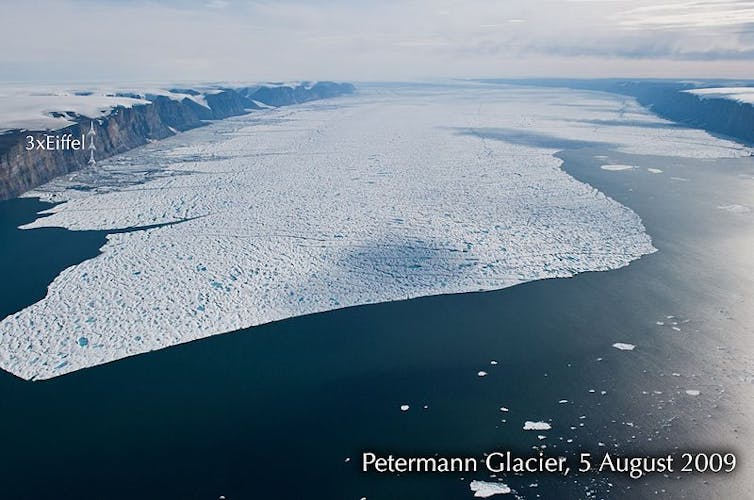
Breathtaking before-and-after pictures showing how fast a Greenland ice sheet has melted in just two years have shocked a climate change expert familiar with the glacier.
The melting of glaciers is seen as a yardstick by which the warming of the planet is measured. Climate change experts have warned that sea-level rises caused as the planet warms and the glaciers melt could devastate coastal and island communities.
A British glaciologist who has been studying the Petermann Glacier in north-west Greenland, which is over 300km long and makes up 6% of the Greenland ice sheet, described pictures showing how fast it had melted as “gob-smacking.”
“Although I knew what to expect in terms of ice loss from satellite imagery, I was still completely unprepared for the gob-smacking scale of the breakup, which rendered me speechless,” said Dr Alun Hubbard from the Institute of Geography and Earth Sciences at Aberystwyth University said in a statement released by the Welsh university.
Dr Hubbard visited the site in July 2009 and again in July this year to observe the change.
“It was incredible to see. This glacier is huge, 20km wide and over 600m thick and hemmed in by sheer cliffs that rise to 1000m on either side. It’s like looking into the Grand Canyon full of ice and coming back two years later to find it’s full of water.”
“What the breakup means in terms of inland ice acceleration and draw-down of the ice sheet remains to be seen, but will be revealed by the GPS data recovered, which we are now processing at Aberystwyth,” he said.


Nick Kermode
logged in via email @hotmail.com
Third photo should read 2009 rather than 2011.
Amazing photos. Any theories from the sceptics to explain this one? "Its cooling", "its not too bad" or "its the sun" obviously wont work.....
Andrew Glikson
logged in via email @iinet.net.au
Why does this information not appear in the main news media?
Sunanda Creagh
Editor at The Conversation
Thanks Nick, have corrected the caption. Well spotted!
Nick Kermode
logged in via email @hotmail.com
Could copy and paste that comment to a lot of The Conversation contributions. It is a great source of info. Keep it up I say!
Mark Harrigan
Dr
Because too many don't want to know? Tweet it as widely as you can. Email the link. News should be spread. Anyone know any mainstream journalists?
Tim Paton
Automotive Engineer
Far from being a glacier expert, I suspect the break-up of a glacier front is radically non-linear with time.
The fact that a glacier has retreated, say (making up numbers as an example - I repeat, I'm not a glaciologist), 1km in one year year, does not mean it's retreating at a rate of 1km per year. It may have been static for 10 years before this break-up event, and may be static again for 10 years after, until the next time a 1km chunk crumbles and floats away.
If you took a photo of my full…
Read moreNick Kermode
logged in via email @hotmail.com
Tom, not much to be argued with here as unlike your comment the researchers statement.....
http://www.aber.ac.uk/en/news/archive/2011/09/title-104239-en.html
contains no speculation, hypothetical or otherwise. Prudently they are waiting for more data.
Tim Paton
Automotive Engineer
...and there they go, James Doogue below (http://theconversation.edu.au/pics-of-greenland-glacier-melt-shocks-expert-3244#comment_8057).
"...Sensational photos which climate alarmists can somehow link to human activity".
In the public eye, comments like that stick, and are seen to discredit the reality of climate change. Leave the door open an inch, and in they come.
James Doogue
logged in via email @doogue.net
I have no problem with the reality of climate change. I think alarmists discredit themselves by over reaching.
This quote from the article is an example: "It’s like looking into the Grand Canyon full of ice and coming back two years later to find it’s full of water.”
It was a glacier ice sheet tongue which calved that is why even though it represented 25% of the area, it was only about 10% of the mass. And it's naturally occurring. At least as big a calving happened in 1962.
Would you be equally impressed if I showed you a picture of a glacier or ice sheet which has expanded in the last two years. Would that 'prove' global cooling? Of course not. If you are going to present single points of data as with this article, there is a responsibility to put it in perspective.
Mark Harrigan
Dr
This is a foolish or at least ignorant comment.
The VAST majority of claciers are retreating at increasing rates
http://www.skepticalscience.com/An-overview-of-glacier-trends.html
Just look at the data
These pictures are simply a visually powerful example - yet you call it alarmist. Why? On what basis?
I call the responses that continue to ignore the data "Ostrich"
James Doogue
logged in via email @doogue.net
You will have to be more specific Mark. What part of what i have written is either foolish or ignorant?
BTW it is not appropriate to equate a floating glacier tongue with a glacier. Further, the 'Vast Majority' of glaciers are not even monitored.
Having said that, I am not disputing that on average glaciers are retreating which they have been doing since well before industrialisation.
Andrew Glikson
logged in via email @iinet.net.au
As shown in one of the figures at
http://www.skepticalscience.com/An-overview-of-glacier-trends.html
In those instances where glaciers were measured prior to the industrial age (pre-1750), in France and Switzerland, little or no glacial retreat is recorded.
Mark Harrigan
Dr
You called the pictures alarmist - I call that statement foolish.
You wanted the pictures put in perspective - I did that by providing broader data which you have brushed off or dismissed. That is being ignorant.
Do you accept the reality of AGW and it being a problem or not? If not on what basis do you claim to know more than the vast majority of the world credible science institutes and climate scientists? Where is your date to refute the issue?
On the basis that it IS real and IS a problem these pictures provide a useful illustration of the problem.
No one is claiming they are prroof by themselves - but it is surely indicative - especially when placed in the context of the broader evdience of what glaciers, temperature, ocean acidification etc are doing.
To ignore it is a form of denialism
James Doogue
logged in via email @doogue.net
Now you are re-defining your comment Mark.
However, it was the author and what the author wrote to which my comments were directed, not the AGW debate in general. Pictures at two data points without mentioning a major calving event in between is very misleading and seems determined to create a certain alarmist impression. Then the quote about it being like the Grand Canyon full of ice then coming back to find it water is not analogous because as I pointed out, it was a ice tongue (floating on water…
Read moreMark Harrigan
Dr
I'm not redefining anything - what I said was crystal clear - you asked for a clarification - I gave it - it that results in s redefning of your understanding so be it.
You have not really addressed my broader points at all. I also find it arrogant on your part that you a re able to dismiss AGW as being in some way unimportant which flies in the face of the science, agreed by all the experts and credible bodies.
You claim to that "I'm keen to continue looking at the evidence" yet you in effect…
Read moreJames Doogue
logged in via email @doogue.net
Mark I get that you are a committed advocate of immediate action on AGW which you see as a major and immediate threat to the world.
I am sure what you say is crystal clear to you but that is within your narrow viewpoint.
I do not 'dismiss AGW' but the science is definitely not 'settled' as you seem to state with your comment "agreed by all the experts and credible bodies". If anthropogenic global warming is so obviously a problem to all experts and credible bodies, why is it that those experts…
Read moreMark Harrigan
Dr
James
Read moreI did not say I was in favour of "immediate action on AGW which you see as a major and immediate threat to the world" nor did I say the science was "settled". No science is ever truly "settled", although sometimes the word is used in vernacular sense to talk about science that is well established and on a solid basis.
What I did say is that there are abundant studies that show the problem is real and significant.
Have you, in fact, looked at the reports I suggested that provide substantiation…
Jane Rawson
Editor, Energy & Environment at The Conversation
Hi Andrew, while I'd love to gloat that we have stories no one else does, this was also in the Fairfax media http://www.theage.com.au/environment/climate-change/dramatic-shrinking-of-greenland-glacier-20110908-1jyym.html and
Mark Harrigan
Dr
Yes - but the Conversation has the jump by two days! So you "broke" the story in Aus? Well done :) If the mainstream media is following here that is a feather in the cap of the Conversation I think :)
Paul Richards
Paul Richards is a Friend of The Conversation.
It is interesting to look at the Petermann Glacier from Google Earth, the magnitude of the melt is even more obvious.
Petermann Glacier, Avannaarsua, Greenland
Dennis Alexander
logged in via LinkedIn
Wow, 24 hours and no sceptical comment by Marc Hendrix or John MacLean or Doug Cotton.
To be sure, they're probably examining the picture to find evidence of doctoring and satellite tampering, or launching submarine research vessels to prove that it is the work of an undersea volcano or such like.
Then again, I put it down to those pesky Adromedan wannabe invaders using their heat ray from their hiding place in the Van Allen Belts.
Justin Niven
Director
Hey Dennis,
Marc Hendricx could in fact be James Doogue.
"Astroturfers" often use multiple identities and switch between them.
Mark Harrigan
Dr
Justin - I am certainly no defender of the views of Marc Hendricx or James Doogue - quote the opposite as I find their denialist arguments without substance or merit and have frequently refuted them.
But - without evidence - I do not think it aids the debate to cast such an aspersion. Nor do I think it relevant. Even if they are the same person they are entitled to their view - however misinformed it may be
Michael J. I. Brown
ARC Future Fellow and Senior Lecturer at Monash University
I completely concur with Mark Harrigan on this topic. The alias / astroturf argument is a distraction unless it is backed up with evidence.
A quick google search for "James Doogue Climate" reveals a number of entries on "sceptic" websites (e.g., Jo Nova). This includes lodging a request for the BOM to be audited, with cosignatories including some well known climate "sceptics". Assuming that James Doogue and the contributor to this forum are one and the same, James Doogue is not an alias.
Nick Kermode
logged in via email @hotmail.com
I agree with Michael and Mark also.
Byron Smith
PhD candidate in Christian Ethics at University of Edinburgh
While I agree in specific instances it is probably a distraction, the documented existence of paid astroturfers is worthy of further journalistic investigation.
James Doogue
logged in via email @doogue.net
What this article implies is a gradual 'melt' over the two years shown. Also, readers who do not know may be confused between a glacier and a floating glacial tongue - which is what is pictured. Between the two photos, in August 2010, a giant sheet of ice measuring 260 square kilometres (100 sq mi) broke off from the Petermann Glacier reducing its area and volume by about 25% and 10%, respectively. Researchers from the Canadian Ice Service located the calving from NASA satellite images taken on August…
Read moreAndrew Glikson
logged in via email @iinet.net.au
James Doogue writes: "But it clearly makes for sensational photos which climate alarmists can somehow link to human activity."
According to the American Geophysical Union, "Melting ice sheets becoming largest contributor to sea level rise" 8 March 2011
http://www.agu.org/news/press/pr_archives/2011/2011-09.shtml
Based on satellite gravity studies by Rignot, E., Velicogna, I., van den Broeke, M.R., Monaghan, A., & Lenaerts, J. (2011) "acceleration of the contribution of the Greenland and Antarctic…
Read moreJames Doogue
logged in via email @doogue.net
How does this in any way address what I have written regarding the photos in this article. Also, Hansen and Sato do not prove a link between the observed melting and human activity. Nevertheless my point still stands, the photos presented by Sunanda in her article do not allow for such an assumption, and the presentation of the photos, without explanation of the major calving of the glacier ice tongue is misleading at best.
Ross James
Engineer
Andrew - "Why does this information not appear in the main news media?" - Possibly because they also should report the glaciers that are doing the opposite.
Andrew Glikson
logged in via email @iinet.net.au
Those who do not accept the basic laws and empirical observations inherent in science, whether evolutionary biology, medical science or atmospheric and ocean physics, will forever took for anecdotal evidence instead of attempt to understand the principles of the discipline.
As the globe warms (by 0.8C on average since early 20th century and 4C to 5C in the polar regions) as manifested by glacial melt (including the main continental ice sheets, glaciers, ice-covered fjords and sea ice) (as in the…
Read moreRoss James
Engineer
Andrew - there's a lot of hypothesis in your post - hypothesis that this would be happening if it weren't for the hypothesis that something else is offsetting it. But let's not get bogged down in this here - I'm very familiar with these. I'm particularly interested in your comment that polar regions have warmed by 4 - 5 degC in the past 100 years. Despite this, Antarctic ice extent has been increasing for the past 30 years, which I hope trust you can explain.
Can you direct me to temperature records that substantiate your claim of 4 - 5 degC in both Arctica and Antarctica, please.
Andrew Glikson
logged in via email @iinet.net.au
Climate and paleo-climate science are not based on "hypotheses" but on direct empirical observations, measaurements and the laws of physics and chemistry. Hyptheses and modelling constitute further steps and are inherent in all sciences.
For temperature records and other climate data sets refer to:
NASA/GISS at: http://data.giss.nasa.gov/gistemp/
National Snow and Ice Data Centre http://nsidc.org/
Met Office Hadley data centre http://www.metoffice.gov.uk/hadobs/
Australian Bureau of Meteorology http://www.bom.gov.au/
Andrew Glikson
logged in via email @iinet.net.au
Regarding sea ice extent:
Sea ice - a few meters to tens of meters thick - is subject to both seasonal and longer-term variations and are regarded as "fast fedback effects" to climate changes, namely they will fluctuate on a decadal time scale. Sea ice has receded in the Arctic Sea by more than 50% and fluctuates around Antarctic in connection as related to (1) temprature changes in part affected by ozone depletion and (2) wind speed, which increases as the Antarctic wind vortex shrnks.
By contrast continental ice sheets, up to several kilometer in thickness, signify "slow feedback effects" and represent decade to longer time-scale climate changes. For decade-scale changes in the latter look at Rignot et al. as in my earlier post.
Ross James
Engineer
Andrew, I'm fairly familiar with all these sites. However, can you direct me to the section that documents temperature measurements to verify your claim of 4 - 5 degC increase over the past 100 years in both Arctic and Antarctic.
Re long term and short term ice, wouldn't you expect a decease in long term ice over the past few hundred years as we come out of the Little Ice Age?
Paul Richards
Paul Richards is a Friend of The Conversation.
Dr Hubbard believes that the cracks and rifts in - what remains - of the ice shelf means it is also likely to break up at some point in the - near - future.
This slow forming glacier has no history of breaking up completely, apart from periodic calving of floating tongue of ice.
Dr. Hubbard gives clear indication of a highly probable scenario, and he is fully qualified to make this statement.
http://www.aber.ac.uk/en/news/archive/2011/09/title-104239-en.html
Andrew Glikson
logged in via email @iinet.net.au
Ross
On the NASA/GISS website click on the global temperature map on the right, a dialogue box will open which allows you to view temperature changes both regionally and with time.
When you normallize temperature changes for recent years (say 2005-2010 or any other recent period) to the base period of 1951-1980 (commonly used) or any other time interval, you will see by how much the poles have warmed, i.e. 4C - 5C over northern Canada and northern Siberia, less over the north Atlantic and north…
Read moreRoss James
Engineer
I've had a quick look at the plots on the GISS site - I'm already familiar with these.I'm trying to find a good reason to "normalize" temperatures between two periods. The temperatures are already on the same plot with the same axis scale, showing typical 0.8 degC change. (I might add that I regard GISS as the least reliable source of temperatures, but at least they all have a similar order of magnitude.)
I'll have another look tomorrow to try to work out how 0.8 degC can be expanded to 5 degC…
Read moreAndrew Glikson
logged in via email @iinet.net.au
Ross
You sound more than dismissive toward climate science and paleo-climate science.
While I am in the position of presenting the data which answer your points, this will take too much space to enter into a blog.
In so far as you wish to read up-to-date peer reviewed science papers which summarizes the database and evidence for dangerous climate change, I recommend the following:
Steffen, W., 2011. The Critical Decade (and references therein) (available on the web)
Read moreThe Copenhagen Synthesis Report…
Ross James
Engineer
I'm still interested in a comment on what you expect to be happening as we come out of the Little Ice Age.
Also, if we focus in glaciers that are melting, we can't ignore the ones that are growing. eg Alfortbreen (and many others) in Norway, about 2,000 in India, Helm and Place in Canada, Mt. Blanc France. Even Greenland has advancing glaciers (eg Berlingske). Should we be concerned about this? Is it indicative of a new ice age? I don't think so - it's just nature balancing things.
Andrew Glikson
logged in via email @iinet.net.au
Look at Figure 6.13 in the IPCC AR4 2007 Paleoclimate chapter
http://www.ncdc.noaa.gov/paleo/pubs/ipcc2007/fig613.html
or at the NOAA site http://www.ncdc.noaa.gov/paleo/pubs/ipcc2007/fig6-10b.png
Showing:
1. The medieval warm period 1050 - 1450 AD up to about +0.5C anomaly
2. A relatively stable period during 1500 - 1650 AD preceded and postadated by realtively minor (-0.3C) cold phases, the latter related to low sunsport activity.
3. A major rise from 1850 AD by near 0.8C - related during the first half of the 20th century to GHG forcing and a minor solar radiation rise and during the second half (in particular since 1975-6 mainly due to GHG forcing.
Ross James
Engineer
Fig 6.13 talks about simulated temperatures. I often refer to Loehle for the past 2,000 years. I know that there's been objections to this data, mainly by those whose theories don't agree, but I find it be in reasonably good agreement with other sources. They all follow a similar pattern, and all tell me that the small amount of warming we've experienced over the past few decades is fully expected, with or without CO2.
I'm mainly looking for something to get my teeth into that convinces me that…
Read moreAndrew Glikson
logged in via email @iinet.net.au
Ross.
As before, I could try and respond to every point you make, but most of it is published in the peer review literature and in websites which refer to the peer review literature, such as REALCLIMATE or SKEPTICAL CLIMATE.
Science is not based on opinions but on:
1. Original verified data sets.
2. The basic laws of nature
3. The peer review literature where specialists in the field examine papers and claims in view of points 1 and 2 above.
Had it not been for the masking effect of sulphur…
Read moreMark Harrigan
Dr
Ross, why do you, an engineer and not a trained climate scientist have to "get your teeth into something that convinces you".
Try this http://www.ucsusa.org/ssi/climate-change/scientific-consensus-on.html
Do you not accept the wisdom and expertise of those in fields where you have no knowledge or training? If not why not? Is it not arrogant presumption to assume you know better?
The objections you raise are furphies - obfuscations raised by the climate denialist lobby because they cannot accept…
Read moreRoss James
Engineer
I think the answers can be found within you post, and my last post.
Who are the climate scientists that we believe? I could take notice of the IPCC, but I'm disgusted by their abuse of the scientific process (I can detail these, but I'm sure you're aware of them.) Is Michael Mann and authority? When I first saw his Hockey Stick, without the Medieval Warm period, and Little Ice Age, I could see it couldn't be right. Yet it was peer reviewed, and published by the IPCC (later discretely withdrawn…
Read moreMark Harrigan
Dr
You say "There are plenty of qualified scientists who don't support the theory of catastrophic AGW - should I ignore them?"
Yes, because there are not plenty. Every atempt to claim otherwise has been shown to be rubbish.
There are few discredited people like Lindzen and Spencer etc which just a little bit of reading would clearly establish have been debunked countless times
I never said the "science is settled" - neither does any other scientist apart from using the term in the vernacular to…
Read moreRoss James
Engineer
It's unfortunate that you resort to personal insults. I won't join you at this level, as it does nothing but damage your credibility. I will address a couple of your comments.
The "science is settled" is seen all over the place. eg US EPA http://models-methods-software.com/2011/02/06/u-s-environmental-protection-agency-the-science-is-settled/ (They even refer to "carbon pollution" when they mean "carbon dioxide".) We bring it up because "this old chestnut" constantly thrown at us.
Many scientists…
Read moreMark Harrigan
Dr
Really? Not very convincing or credible.
Read moreYou say you will address a couple of my comments - why not address the actual established science?
I note, by the way, that you have not at all addressed why it is that you know better than every single science body of credibility (or is it all a big conspircacy?) other than to suggest that somehow because I have challenged you on this it is an "insult"
But let's examine your comments one by one
1) "The "science is settled" is seen all over the place…
Mark Harrigan
Dr
Ooh - here's more to put the Kirby work on clouds in perspective
http://www.scientificamerican.com/article.cfm?id=new-research-examines-role-of-clouds-in-climate-change&WT.mc_id=SA_CAT_ENGYSUS_20110908
"The analysis confirms - as most atmospheric scientists have long held - that the reverse is true: Clouds change in response to temperature changes. There is no evidence clouds can cause meaningful climate change"
Andrew Glikson
logged in via email @iinet.net.au
Ross
A. By calling the GHG and tempeature records a "Hockey stick", you are dismissing the hundreds of peer reviewed science papers on which the record is based (using ice cores, lake sediments, tree rings, cave and reef deposits, oxygen isotopes, trace elements etc.), summamrized in the IPCC Paleoclimate chapter 6 (http://www.ipcc.ch/publications_and_data/ar4/wg1/en/ch6.html).
Have you read this chapter, and if so what alternatives you suggest?
B. Clouding
Look at NASA's page: http://www.giss…
Read morePaul Richards
Paul Richards is a Friend of The Conversation.
http://nsidc.org/arcticseaicenews/
Ken Fabian
Mr
It would be a greater distortion by media to fail to give these images space (in some distorted effort at 'balance' or to avoid 'alarmism') than it is to highlight them. Not all glaciers have their terminus at sea level but this particular one has enough land ice behind it to be globally significant in it's own right; it's alarming and should be seen as alarming. When increasing dripping from the freezer is followed by big chunks of ice falling off it should be obvious that the thermostat's up too high.
Glacial retreat such as this one that includes some dramatic moments like big calving events look to me to be quite in keeping with wider expectations for how the current human driven warming period can and will unfold; there will be tipping points where dramatic impacts happen quite fast, unstoppable once initiated. Warming air temperatures and warming sea temperatures over decades led to that big calving. They will lead to more such events, in Greenland and in Antarctica.