

Plain speaking on the carbon tax and electricity prices

Confusion continues on how the carbon tax will hit the electricity bills of Australian households. While messages from electricity retailers may be on their way, Gujji Muthuswamy from Monash University’s Faculty of Business and Economics says this is the letter Prime Minister Julia Gillard should have…

Sk9wq73g-1341896301
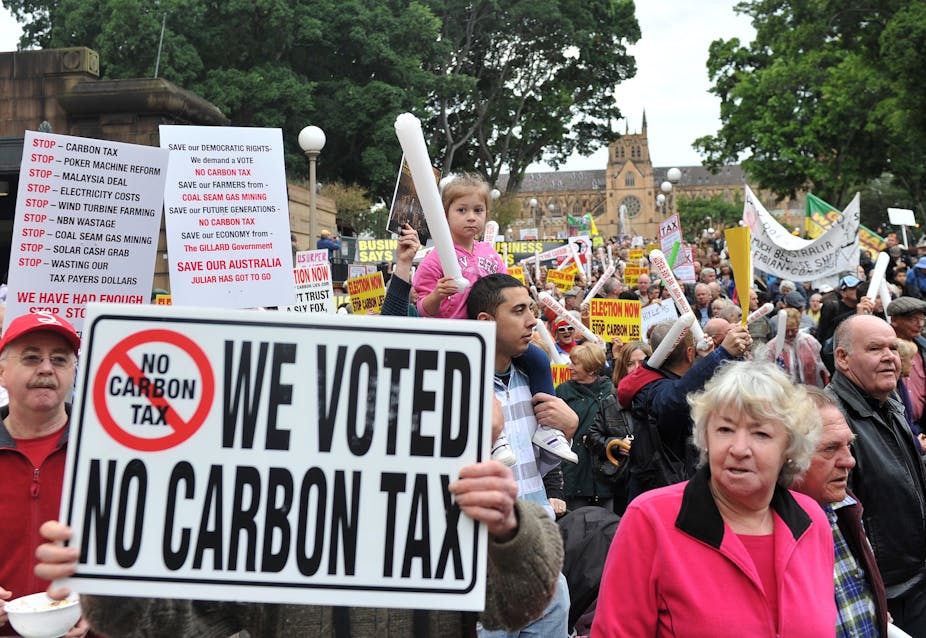
Not winning them over… some plain speaking might have helped the Gillard government explain just how the carbon tax will impact on electricity prices. AAP

Confusion continues on how the carbon tax will hit the electricity bills of Australian households.

While messages from electricity retailers may be on their way, Gujji Muthuswamy from Monash University’s Faculty of Business and Economics says this is the letter Prime Minister Julia Gillard should have sent to all Australians explaining – in plain English – how the carbon tax will affect the price of electricity.

Dear Australians,

Most of you would be aware that Australia has embarked on a major reform by putting a price on carbon. For the first three years, the price has been set by the Parliament starting at $23 per tonne of greenhouse gases emitted and increasing by 5% each year – this is referred to as the “carbon tax”.

Note that after 1 July 2015, the “carbon tax” will give way to a “carbon price” that is set by the market place and not by the Parliament.

While the carbon tax/price will be paid only by the top 300 or so businesses in the country, and not by householders or small businesses, much of the tax will be passed through to us – the end customers for goods and services in the form of increased prices, particularly for electricity.

In this letter, I will try to explain how electricity prices are set in Australia and how the carbon tax affects the prices that you pay.

Before the carbon tax was introduced, most residential customers were paying a total of about 20 to 28 cents per unit or so, depending on where they live.

But let me begin with a few words on how electricity is generated and delivered to your houses.

Three main stages are involved in this process.

The first step involves producing electricity from generator/turbine sets in huge power stations such as the ones in the La Trobe Valley, Hunter region, Snowy Mountains etc. About 80% of all electricity in Australia is generated from stations that burn coal to heat water and generate steam that drives the turbines. The other 20% comes from gas-fired power stations, hydro stations, wind and other renewable energy power stations.

Next, electricity is transported from various power stations via a vast electricity grid network of transmission towers, lines, transformers, street poles and wires to houses and businesses all over Australia. Just as roads are used to transport goods from factories and ports to consumers, electricity is transported from power stations to all households by the grid network.

The third stage is played by electricity retailers, who buy electricity from power stations in an open, competitive wholesale electricity market and pay a “transport fee” to the network operators, and bundle these up and make various offers to customers.

To use another analogy, these retailers are somewhat like your neighbourhood vegetable shop owners going to wholesale markets (such as the Victoria Market in Melbourne) early morning, buying fruit and veges in bulk, and selling to suburban retail customers. The rub here is that unlike vegetables, one cannot store electricity in large quantities; there is no viable technology. The amount that is consumed by all customers in Australia must be matched exactly by electricity generated in all of Australia every minute or so. Without going into details, this inability to store electricity in any large quantity is a major reason behind the complexities of electricity pricing.

Electricity generation costs

Coming back to costs, Australia can generate electricity cheaply in coal power stations because we have coal in abundance and about 7 to 10 cents per unit in your bill pays for generation costs. Unfortunately, this burning of coal releases carbon dioxide gas into the atmosphere, which most scientists in the world say causes climate change.

This is a very long term environmental issue, I mean 50 years or more, but we have to make a start now and work our way gradually over the next few decades to reduce our dependence on coal-based electricity and move towards more modern technologies and renewable energy. The longer we postpone this journey, the more difficult and more expensive it will be for our children and grandchildren.

Carbon tax was introduced with this aim in mind, so that power stations burning coal, gas or oil pay a tax and the resulting revenue is used to help develop modern technologies that don’t emit so much carbon dioxide. The effect of this carbon tax could probably add about 2.5 cents per unit or so to the current wholesale market prices. Note that this increase is more or less the same for all customers.

Network costs

The electricity grid in eastern Australia stretches all the way from Cape York to South Australia and Tasmania, different parts of which are owned and operated by either state-owned or private enterprises. A separate grid operates in Western Australia.

Given the vastness of land covered and the low population density outside major cities, the cost of transporting electricity is higher than generation costs. As our metropolitan and regional cities spread outwards, as our population increases, as mining activities increase, as more and more of us use plasma TV, air conditioners and other appliances, the peak demand for electricity goes up.

Though these peak demands may last only a few days in the year, for example heavy use of air conditioners on hot February days, the grid capacity must be built to withstand these peak pressures, even if much of these equipment are under-used during non-peak demand times. This means more capital works programs and more costs by network businesses which are passed on to customers as the network charge component of the bill. The “tyranny of distance” means that regional and rural networks incur more such costs per customer served than those operating in cities.

The cost of network charges is set by the Australian Energy Regulator (AER) based on detailed analyses of the various networks’ forecasts of load, capital and on-going costs. Until recently, these were set by state-based energy regulators. The cost of the regulated network charges has been going up markedly in recent years, much more than generation costs for all the reasons mentioned above.

But the point to note is that carbon tax does not affect network businesses as they mainly transport electricity, and do not generate electricity themselves by burning coal etc.

Thus the components of electricity prices paid by the customer (using a hypothetical case) may look like this:

Components of electricity price Before carbon tax After carbon tax of $23/Tonne
Generation costs (cents per unit) 10 12.5
Network costs (cents per unit) 13 Little change (13)
Retail and other costs (cents per unit) 3 Little change (3)
Total paid by customer (cents per unit) 26 28.5
Note that all figures used in this letter are only examples to help the reader understand the issue. The actual figures can be quite different to the ones quoted here

The total retail price in this example is likely go up by about 10% or so due to the introduction of the carbon tax.

Hope this clarifies the picture somewhat. Please do talk to your retailer if you want to further understand the exact implications of carbon tax/price for your specific account.

Yours sincerely

Australian government

Articles also by This Author

Sign in to Favourite

Want to follow The Conversation?

Sign up to our free newsletter to get the day's top stories in your inbox each morning, with a special wrap on Saturday.

Spinner
Help evidence based journalism become the norm and donate

Join the conversation

20 Comments sorted by

Comments on this article are now closed.

  1. Don Aitkin

    writer, speaker and teacher

    A good letter, indeed, though a mite long for most people. I am one of those not yet persuaded that global warming is either the result of human activity or even a matter for worry, but let that pass. I started at your statement: 'burning of coal releases carbon dioxide gas into the atmosphere, which most scientists in the world say causes climate change'. First of all, most scientists in the world have not offered an opinion. Second, if you mean the '97% of climate scientists' referred to in many…

    Read more
    1. Michael Shand

      Michael Shand is a Friend of The Conversation.

      Software Tester

      In reply to Don Aitkin

      Dude if you dont think climate change is an issue then obviously the carbon tax makes no sense. Not sure what you have been reading that tells you that climate change is not real.

      When every relevant national academy of science comes to the same conclusion across multiple countries, when the people doing the measuring and breaking new frontiers such as NASA, CISRO, have all come to the same conclusion, when every major world leader tells you they asked experts and the experts told them climate change is happening then yes.....yes, it could all be a massive conspiracy the logistics of which would involve the biggest political operation in history ....but more likely is that you have been mislead, mis-informed by someone and are now spreading this mis-information to others

      report
    2. Dan Abrahmsen

      Public Servant

      In reply to Don Aitkin

      To the best of my knowledge the "Carbon Price Backflip" is a direct result of our hung parliament. In order to form a majority, either Labor or Liberal would have needed the Green's support. The price of this support was the implementation of a Carbon Price. If Labor hadn't been offered first right of refusal of the deal, Abbott would have jumped all over it and we would STILL have a Carbon Price.

      In summing up, she didn't lie because she didn't say 'No carbon tax' while secretly planning to implement…

      Read more
    3. Chris O'Neill

      Telecommunications Engineer

      In reply to Don Aitkin

      Don Aitkin: "if you mean the '97% of climate scientists' referred to in many places, that figure comes from a postgraduate thesis which was not a great piece of work — and survey research was my game for fifteen years or so."

      Pity that in spite of all this mastery of survey research that you haven't managed to come up with any survey result worth mentioning and the best criticism you can manage is "it's contained in not a great piece of work".

      So convincing.

      report
    4. David Arthur

      n/a

      In reply to Don Aitkin

      Don, I've personally explained to you the science of climate change several times over, in both these pages and by emails. Your ongoing public declaration that you are yet to be persuaded that global warming is either attributable to human activity or a cause for concern is foolhardy at best, and may more reasonably be considered disingenuous.

      Once again, here are the observations and inferences which demonstrate this assessment.

      Observation 1. Sun irradiates earth with short-wave energy…

      Read more
    5. Don Aitkin

      writer, speaker and teacher

      In reply to Chris O'Neill

      Chris,

      I'm not sure what you mean by 'come up with any survey result worth mentioning'.

      But check the the work out yourself. You can find it at
      EOS, TRANSACTIONS AMERICAN GEOPHYSICAL UNION, VOL. 90, NO. 3, PAGE 22, 2009, the article by Doran and Zimmerman. In all, 10,257 survey questionnaires were sent out; 3,146 were returned. The authors decided that 77 of those were climate scientists (they had published more than half their papers in peer-reviewed climate science journals). Of those 77, 75 (98%) agreed that 'human activity is a significant contributing factor in changing mean global temperatures'.

      I could go on and on about the questionnaire, the sample and so on. But you can see that this is not a strong source for the claim that an overwhelming majority of climate scientists support AGW.

      report
    6. Don Aitkin

      writer, speaker and teacher

      In reply to David Arthur

      David,

      I've read your take on the issues and am not persuaded, for reasons I set out earlier in our correspondence.

      report
    7. Don Aitkin

      writer, speaker and teacher

      In reply to Michael Shand

      Michael,

      To the best of my knowledge no national academy of science has had a meeting in which its fellows vote on the issue. What has happened is that the executives of these bodies have issued statements endorsing AGW. Many of them, ours included, have been supported financially by their governments. Most universities have been supported financially by the Department of Climate Change to assist with the work of the IPCC. There is no need for a conspiracy. AGW is simply the current orthodoxy, much weaker now than it was a few years ago.

      report
    8. David Arthur

      n/a

      In reply to Don Aitkin

      My recollection is that I addressed each of the reasons you put forward in our correspondence.

      Perhaps the differences in our backgrounds accounts for our different understanding of the term "reason". I am a physical scientist, where reason is founded on impersonal logic. On the other hand, bloody-minded intransigence is a perfectly valid form of "reason" in political science.

      report
  2. Lincoln Fung

    Economist

    The problem with the Gillard government is she does not have creditability with most people in the street, implying no matter what she wrote it would not have good readers to like it.

    report
    1. Matthew Wyres

      Mechanical Engineer

      In reply to Lincoln Fung

      Actually the people she does not have credibility with is Liberal voters. The same way that Tony Abbot has no credibility with Labour voters.

      Unfortunately for our prime minister the Labour party is particularly terrible at public relations, whereas the Liberal party are quite practiced at using the media to persuade the public to their viewpoint. Without you realising what they are doing...

      The liberal party is doing a very good job of using the media to convince everyone that the Australian public has no confidence in their Prime Minister. Meanwhile she still polls higher as the preferred prime minister to Tony Abbot. That to me says that our Prime Minister actually does have quite good credibility with the Australian public.

      report
    2. Robin Bell

      Research Academic Public Health, at University of Newcastle

      In reply to Matthew Wyres

      Sorry Matthew, but I'm pretty sure you have no evidence for that at all. I am a labor voter of many years standing, but this labor government has no credibility at all. I find this attitude of "we're ok, its all Tony's fault" a bit thin.
      It's all labor's fault, especiall the whinning.
      As for the carbon tax.... I'm not a climate change skeptic, but even I can see that this kind of market approach to climate change will only ever work in theory.
      Most families I have discussed this with are just…

      Read more
    3. Paul Pagani

      Teacher

      In reply to Robin Bell

      While I agree with some of your statements I can't support this idea that major reforms cannot be implemented if they hurt the bank accounts and thus the happiness of the materialist hordes ("Most families I have discussed this with are just hurting from the price rises they are experiencing at the moment, and that's what they care about.").

      I would suggest these families work harder at using less electricity. There are many options. Or they could invest in solar. The only ones genuinely impacted financially have been compensated. The rest just need to show some greater initiative and resilience. Maybe they could also start caring about more than their wallets too.

      report
    4. Chris O'Neill

      Telecommunications Engineer

      In reply to Robin Bell

      Robin Bell: "What's needed today is not better explanations, but leadership in the political sphere."

      In that case you want the best rhetoric, in which case Tony Abbot is your man. You'll never need to worry about better explanations from him.

      report
  3. Matthew Wyres

    Mechanical Engineer

    I would definitely agree with Dan Abrahmsen that in all comments about the scientific community regarding climate change, that the distiction should be made between 'scientists', and scientists who are qualified in climate science. The misunderstanding in the general public that a qualificaiton in any science discipline makes someone's veiws on climate science valid, is what has allowed the media to transform a scientific theory into a political debate where both sides are portrayed as equally valid.

    Apart from that, a good article, and definitely something that the labour party should have done, as there has been a frustratingly poor effort by the government to inform people of the reasons behind the carbon tax, and the implications it will have. Rather than inform the public, they have left it up to the Liberal party and the mainstream media to mis-inform.

    report
  4. Bruce Waddell

    logged in via LinkedIn

    I agree with other readers. The letter is too long. Really, most of us want to clear up the air before it worsens. At the expense of reminding you, our political parties agreed with us too and like us they agreed that it was time to make a start. (Wong ((Rudd)) & Turnbull).
    Minchin and others took the chance to make political mileage at the expense of national interest in the last moments before passing the bill and installed Abbott.
    It was left to Brown and Gillard to institue what we have today as a compromise and the opportunity to govern.
    The article describes clearly this is a temporary step toward carbon pricing. The actual carbon price may be significantly different but its aim is to make a start toward clear air. Nationally we are making a start toward what we wanted 2 years ago

    report
  5. Gillian King

    logged in via Facebook

    Dear Australian Government.

    My electricity rates went up 15% on 1 July. Your 'should haves' have been overrun by 'actuals'.

    In addition, the NSW govt dropped my solar FIT by 10%.

    On the bright side, my energy retailer dropped the surcharge for greenpower by 25%.

    I agree the letter is too long. I skipped straight down to the table. And I'm annoyed by your last line that puts the onus on individuals to tackle their energy providers. The govt is running the system and YOU should be monitoring closely for rorts and cracking down on them.

    Yours sincerely,
    An Australian

    report
  6. Bruce Moon

    Bystander!

    Gujji

    As Don Aikin noted - a long winded example of a simple explanation.

    I suggest the points you make are well understood by a majority of Australians.

    What is less appreciated is the hyperbole by tweedle-dee and tweedle-dum seeking political mileage of the subject.

    That said, sadly your overview is simplistic.

    If the current debate over energy price rises was attributable purely to the carbon tax, I suggest there would be little concern.

    Instead, the carbon tax comes at a time…

    Read more
    1. Chris O'Neill

      Telecommunications Engineer

      In reply to Bruce Moon

      "So, explaining the carbon tax input isn't helping allay community concern over electricity price rises."

      Did you think it was intended to?

      report
  7. David Arthur

    n/a

    Thanks for this, Mr Muthuswamy.

    It will become widely recognised over the next decade or so that fossil fuel exploitation must cease altogether in order to minimise adverse effects of climate change.

    1. Studies of climate millions of years ago have already established that atmospheric CO2 already exceeds anything since the Pliocene Epoch (5.3 to 2.6 million years ago) when polar glaciation was somewhat less than present and sea levels were perhaps 10-20 metres higher than at present.

    2…

    Read more