


Regular readers of “The Conversation” will have probably seen the coverage of the speech delivered by Dr Ken Henry to the Australian Conference of Economists at Victoria University, Melbourne published on 12 July 2012. In this speech Dr Henry, who is a Special Advisor to the Prime Minister, observed that Australia’s two-speed economy was an almost inevitable consequence of the mining and resources boom.
His analysis was particularly gloomy for those industries that are not engaged in the resources sector and are seeking to compete within international markets. This includes many of our manufacturers and services businesses. A particularly telling quote in relation to what measures might be taken to help salvage these sectors was:
“But there is simply no feasible set of such adjustments that would reverse all, or even a large proportion, of the loss of international competitiveness that is presently being experienced by Australia’s trade exposed non-resources industries. The shock to resources prices has simply been so large that a considerable structural adjustment, including a reallocation of labour, is required. It will happen.”
In essence Dr Henry called for major structural adjustments to how our businesses operate. This included enhanced efficiencies in intermediate goods and services such as transportation and logistics. It also included greater use of “offshoring” of work to countries where labour costs are lower or workers more abundant. He called for a “new mindset” in government, business and the broader community.
I read this speech with some dismay as it suggested that Australia is in for some potentially turbulent times despite our apparently strong resource-led economy. Would this move to “offshoring” of work lead to the erosion of living standards and paucity of quality employment opportunities that seems to have beset the United States?
Productivity Déjà vu
Another speech presented at the same conference was that from Dr David Gruen, Executive Director of the Macroeconomic Group. His speech was based on a paper he co-authored with Ben Dolman entitled “Productivity and Structural Change”. This took a macro and micro level view of the Australian economy and how it has performed in relation to productivity and growth over recent decades.
The paper is worth reading if you have the time, but I will try to summarise some of the key issues that it raises. These issues accord with the warnings issued by Dr Henry. First, the paper points to the relative decline in “multifactor productivity” over the past twenty years when compared to labour productivity. This is illustrated in the following diagram.
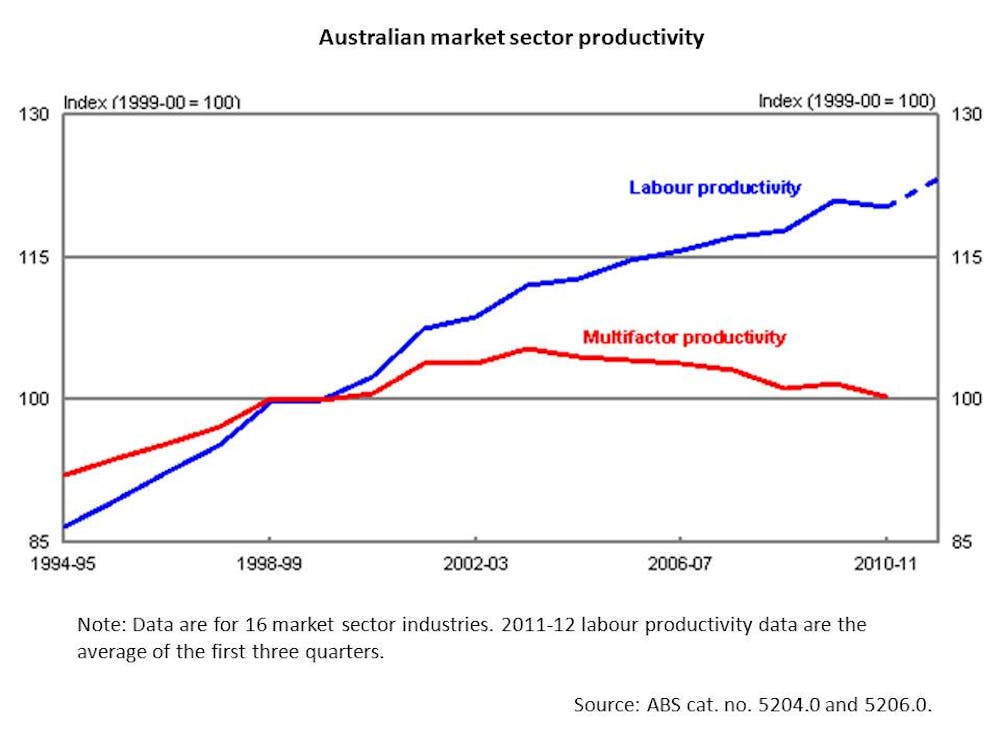
Multifactor productivity is the output generated from a bundle of labour and capital inputs. As shown in the preceding chart it has remained stagnant since the commencement of the first resources boom from 2003 to the Global Financial Crisis (GFC) in 2008-2009. It has declined since the start of the second boom that followed the GFC.
According to Gruen and Dolman’s analysis, this trend in multifactor productivity is due in large part to the poor performance of Australia’s non-mining and resources firms, in particular the manufacturing sector. While mining has surged ahead in terms of employment growth, areas such as manufacturing, transport and warehousing, agriculture and retailing have gone backwards.
This is why we have a two-speed economy and why many Australian’s seem so pessimistic despite the apparent strength of the nation’s economic performance at the macro-level. According to Gruen and Dolman, the issues that Australia faces in the future are similar to major structural adjustments that were experienced in the 1970s and 1980s. The reduction in tariffs and the opening up the Australian economy resulted in a major changes in how many industries operated.
For anyone who lived through those decades the memories are of constant change, structural unemployment, labour disputes and political divisions between perceived winners and losers.
Poor management performance particularly in manufacturing
Dr Gruen and Mr Dolman’s paper also touches on the problems at the firm level, with a clear finger point at what they view as poor management, particularly amongst our nation’s manufacturing firms. Here they draw upon some interesting research recently completed by the World Management Survey.
This is a multi-country study drawing on interviews with over 10,000 managers from 21 countries around the world. It seeks to understand the role that management plays in determining the competitive performance of firms and industries. The methodology looks at a range of management practices including operations, management of people and strategic planning, and workforce development and optimisation.
Australia has participated in the study and what it shows is that in terms of manufacturing our management performance is at best average. This is shown in the following chart, where we are ranked on par with France, Italy and the United Kingdom. However, we are significantly below the United States, Japan, Germany, Sweden and Canada.
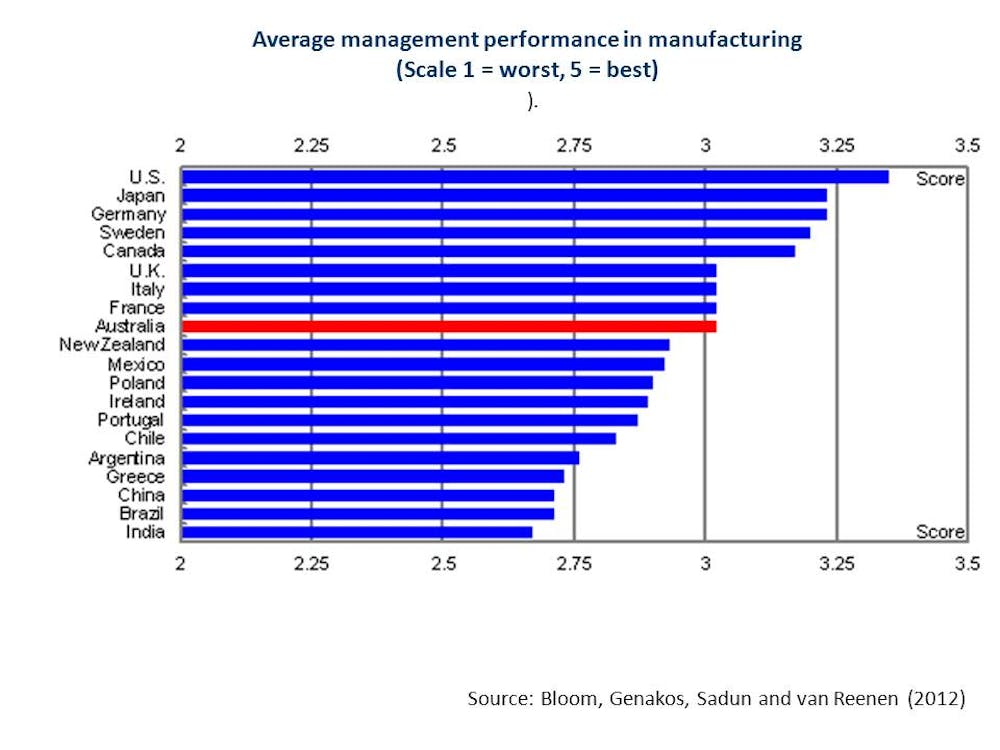
Research produced by the World Management Survey suggests that better managed firms are more innovative and have higher levels of productivity. With specific reference to manufacturing firms in Australia the research indicates that larger firms have better quality management than smaller ones, and multinational firms outperform domestically owned firms. Firms that are publicly listed on the ASX are likely to have more modern management practices than privately held ones, and the more that firms engage in international markets, the more their management performance improves.
Management education also plays a key role with firms that have better educated and qualified managers tending to perform better than those that don’t. Higher management performance was also positively correlated with enhanced sales, productivity, market valuation and employment growth.
So what is to be done?
The findings from this research into Australia’s manufacturing industries could be readily transferred to many other industry sectors. Not surprisingly, it suggests that the quality of management matters. It also suggests that to improve management and thereby firm performance, requires firms to be more internationally focused and benchmarked.
As Dr Gruen observed in his speech, the majority of Australia’s companies are small to medium sized enterprises (SMEs). Such firms generally lack the sophisticated management teams of their larger counterparts, and may also lack the same level of workforce training and development systems that such major companies enjoy.
The report “Management Matters in Australia: Just how productive are we?” was published in 2009 as part of the World Management Survey project. Authored by Professor Roy Green of University Technology Sydney, the report made several observations about what future action is required.
Key areas for attention were the need to focus on lifting the overall management performance within Australia’s SMEs, particularly family owned businesses. These firms were amongst the worst performing in terms of management practices. Often management roles were given to family members based on nepotism rather than competence.
Education of managers and enhanced skills building for employees were viewed as important. Best practice benchmarking and greater decentralisation of decision-making leading to enhanced self-management by employees were also highlighted as areas for future attention.
Governments were seen as having a critical role to play in providing investments in education and training. In particular to focus on specific programs designed to enhance management capabilities. However, the report noted the need for such programs to be accompanied by “a fair, flexible and balanced system of labour market regulation”.
In reviewing this research it is evident that Australia faces some potentially difficult challenges over the next decade or two. If Dr Henry’s gloomy predictions are correct Australia’s non-mining and energy, trade exposed industries will need to reinvent their business models. Many firms, even some of the smallest businesses, are already sourcing production offshore in China and other locations. The ability to compete within internationally contested markets, or even domestic ones that are open to overseas competitors, will demand some high calibre management.
Cost-based competition is unlikely to succeed. Innovation in all its forms (e.g. product, process, marketing and administration) will be critical to survival. This will not just impact on manufacturing; it will affect retailing and services businesses as well. Australia’s economic future will depend on how well we invest in management and workforce development, in particular how we can enhance the quality of such management within our SMEs. It is an area that requires a more systematic effort than we are presently giving.