The international credibility of Australia’s universities is being undermined by the increase in the “pseudoscientific” health courses they offer, two academics have written in the latest edition of the Medical Journal of Australia.
The strongly-worded editorial by Alastair MacLennan, a professor of obstetrics and gynaecology at the University of Adelaide, and Robert Morrison of Flinders University, is the latest shot in the acrimonious exchange between proponents of traditional medicine and practitioners of complementary and alternative varieties.
Professor MacLennan and Dr Morrison are both founding members of Friends of Science in Medicine, a collection of more than 460 people and organisations who say they are dedicated to fighting the growth of pseudoscience in medicine. In January the group wrote a letter to every vice-chancellor in Australia asking for a review of their health science courses to “ensure that primacy is given to scientific principles based on experimental evidence”.
In their editorial, Professor MacLennan and Dr Morrison write that academics at universities with courses such as homeopathy, iridology, reflexology, kinesiology, healing touch therapy, aromatherapy and energy medicine need to “stand up for science”.
“Pseudoscientific courses sully the genuinely scientific courses and research conducted at the same institutions. Their scientists and students should be concerned by any retreat from the primacy of an experimental, evidence-based approach in science and medicine.”
Alarmingly, they said, some chiropractors now extended their manipulation of the spine to children, and claimed that this could cure asthma, allergies, bedwetting, attention deficit hyperactivity disorder, colic, fever and numerous other problems, and could serve as a substitute for vaccination.
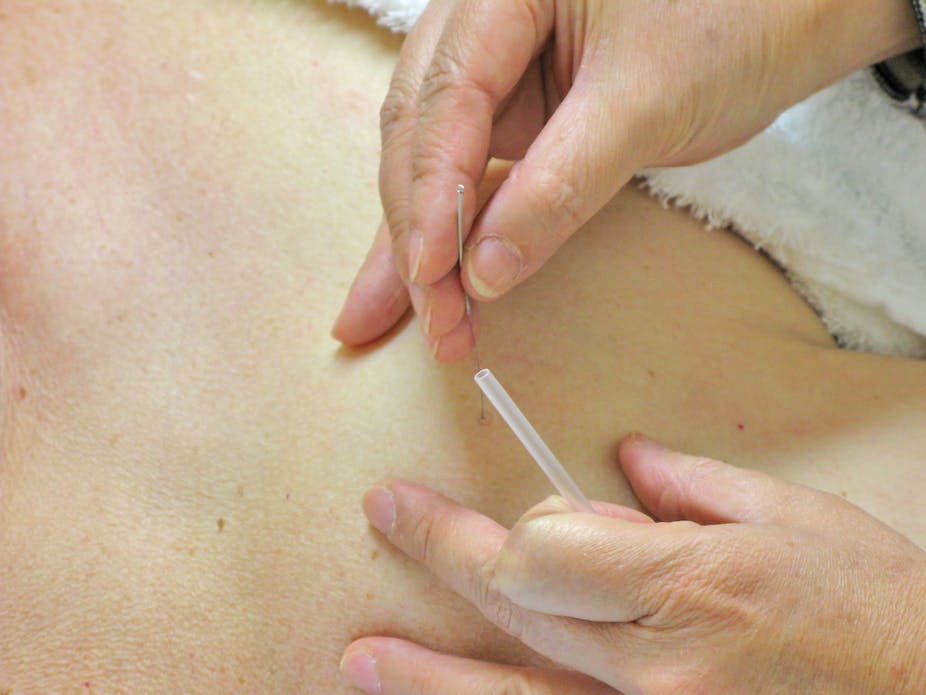
The authors cited a number of courses – including a Graduate Certificate in Medical Acupuncture at Monash University, a Bachelor of Health Science in Traditional Chinese Medicine at the University of Technology, Sydney, and a Bachelor of Health Science (Acupuncture and Chinese Manual Therapy) at RMIT University – as evidence that the problem was spreading.
The acting head of RMIT University’s School of Health Sciences, Dr Ray Myers, has defended the school’s health science programs, which he said promoted “evidence-based education and practice”.
Chinese medicine, chiropractic and osteopathy were all government regulated, Dr Myers said. RMIT’s education program incorporated the “best available evidence, while promoting further clinical research into these treatments."
The National Herbalist Association of Australia has also denounced the campaign to pressure universities and health funds to reject complementary medicine. Association President Leah Hechtman said that naturopathic and Western herbal medicine practitioners should be integrated into the healthcare system.
“To achieve this, we need to increase our evidence base which requires university training. Without university training, research opportunities for practitioners and complementary medicines will reduce. To exclude naturopathic and Western herbal medicine courses from undergraduate or post graduate programs at Australian Universities is irresponsible."
In their editorial, Professor MacLennan and Dr Morrison provide a list of complementary and alternative medicine courses, units and clinics at Australian universities and TAFEs:
Australian Catholic University: Introduction to Complementary Nursing Therapy
Charles Sturt University: Bachelor of Health Science (Complementary Medicine)
Canberra Institute of Technology: Advanced Diploma of Naturopathy
Central Queensland University: Bachelor of Science (Chiropractic); Master of Chiropractic Science
Curtin University: Evidence Based Complementary Medicine
Edith Cowan University: Complementary and Alternative Medicines
Macquarie University: Bachelor of Chiropractic Science; Master of Chiropractic; chiropractic clinics
Monash University: Graduate Certificate in Medical Acupuncture
Murdoch University: Bachelor of Science in Chiropractic; Postgraduate Diploma in Sports Chiropractic; chiropractic clinic
RMIT University Bachelor of Health Science (Chiropractic); Master of Clinical Chiropractic; Bachelor of Applied Science (Chinese Medicine/Human Biology); Bachelor of Health Science (Acupuncture and Chinese Manual Therapy); Master of Applied Science (Acupuncture); Master of Applied Science (Chinese Herbal Medicine); Energy Medicine
Southern Cross University: Bachelor of Clinical Sciences (majors in complementary medicine, naturopathy, osteopathy); SCU Health Clinic
Sunshine Coast TAFE: Certificate in Aromatherapy; Diploma of Reflexology; Certificate and Advanced Diploma in Ayurvedic Lifestyle Consultation
University of New England: Bachelor of Applied Health; Graduate Diploma of Health Science (Herbal Medicine); Master of Health Science (Herbal Medicine)
University of Newcastle: Complementary Therapies in Healthcare
University of Technology, Sydney: Bachelor of Health Science in Traditional Chinese Medicine; traditional Chinese medicine/acupuncture clinics
University of Western Sydney: Bachelor of Applied Science (Naturopathic Studies); Graduate Diploma in Naturopathy; Master of Health Science (Traditional Chinese Medicine); UniClinic
Janet Hiller
Associate Dean Research, Faculty of Health Sciences + Professor of Public Health at Australian Catholic University
I am pleased to say that there is no more pseudoscience at ACU.
The course
: Introduction to Complementary Nursing Therapy
is no longer taught here so you can remove ACU from your hit list.
Michael Shand
Michael Shand is a Friend of The Conversation.
Software Tester
I'm reminded of a line from Tim Minchin "Do you know what they call alternative medicine that works?....Medicine"
If the course can show that they actually make a positive contibution then why not teach it? if its true its true and surely after careful contemplative study of the subject they will either come up with positive results or null results (Maybe even harmful results), if they have done this and havent meet the same standards of rigor required from other subjects then stop teaching it - your wasting university time/resources, your wasting the students time and resources
Carole Hubbard
conservationist
Nice theory that any alternative therapy that works will become part of medicine, however, what is evident is there is a long history of suppression of any therapy that competes with pharmaceutical profits. Any therapy that competes is talked down, ridiculed, and made illegal by the FDA. They say that all that needs be done is show something works, ie evidence based but this isn't true. Homeopathy has a long history of curing disease, and many people have positive experiences with it. Yet EBM says it doesn't work. How can this be? Only through the use of dodgy studies, and mouth pieces like Randi who is a magician, not even a pretense at any medical qualifications, to ridicule and talk it down. Yet Randi is held in such high regard by the skeptics and those who insist on EBM.
Charles Miller
logged in via Facebook
"there is a long history of suppression of any therapy that competes with pharmaceutical profits"
There's a long history of suppression of any therapy that can't demonstrate any worth beyond vague hand-waving, and a long history of those hand-waving practices screaming "I'm being repressed! Come see the violence inherent in the system" when they're asked to provide proof that they're any more effective than a placebo.
Homeopathy has absolutely no valid claim of effectiveness. It's water and sugar pills packaged up with voodoo, sold to dupe the gullible, a fact that has been shown in independent study after independent study. To quote from the most recent from the UK parliament:
"Systematic reviews of rigorous trials of homeopathy fail to demonstrate that homeopathic remedies have effects beyond those of placebo. Monitoring the development of the evidence over time we find that the overall evidence-base of homeopathy is becoming more and more negative."
Grendelus Malleolus
Senior Nerd
Carole,
Many herbal remedies are now incorporated in medicine following identification and refinement of the active molecule. As for Homeopathy and its "long history of curing disease" and all other alternative therapies - seriously, if they worked we would use them but since (as is the case with homeopathy) it has been demonstrated to be no more effective than placebo we can be fairly certain that it has not real action in curing disease.
Joel Mayes
Bicycle Mechanic
Homeopathy was completely debunked and exposed as a fraud in 1842, well before the straw man of "Big Pharma" became a catch phrase.
Please read the essay Homeopathy and Its Kindred Delusions by Oliver Wendell Holmes, it is available for free here
http://www.gutenberg.org/ebooks/2700
Carole Hubbard
conservationist
You didn't mention whether you are one of the 400 signatories to the Friends of Medical Research. Arthur Wendall Holmes was a product of his environment. See http://en.wikipedia.org/wiki/Oliver_Wendell_Holmes,_Sr -- "Holmes promoted Boston culture and often wrote from a Boston-centric point of view, believing the city was "the thinking centre of the continent, and therefore of the planet" So while he may have been a much admired and intellectually active person in some ways, it appears that he merely took some things for granted on the basis of what was expected of a man in his position to support. There is plenty of evidence for the efficacy of homeopathy so such comments that homeopathy has been debunked needs to be reconsidered taking into account its history of cures.
Carole Hubbard
conservationist
Its not entirely true that if a remedy works it gets incorporated into mainstream allopathic medicine. This is a furphy. If a cure challenges the profits of big pharma it is routinely suppressed. For instance there are about 300 cancer cures that have been suppressed by big pharma with excuses that they didn't work, or that the people who came up with them were deluded, that the cures never passed any evidence-based testing etc. The inventors are written off as snake oil salesmen, charlatans, deluded, or otherwise have their reputations dealt with. Big pharma is in business to make money, and doesn't like competition.
Chuck Wolber
Engineer
Please cite a source to back up the following assertions:
* "If a cure challenges the profits of big pharma it is routinely suppressed."
* "there are about 300 cancer cures that have been suppressed by big pharma"
In the meantime, it may be helpful to point out that, at least in the United States, the "Big Pharma" companies are also the biggest makers of herbal and "alternative" remedies. Like any profit making entity, if people will buy it, they will make it.
Chuck Wolber
Engineer
Describing Holmes as "Boston-centric" proves nothing. What can you cite that directly refutes what is specifically said in the essay?
Joel Mayes
Bicycle Mechanic
Hi Carole;
I'm not a signatory to the Friends of Medical Research. I'm a self employed artisan with no financial interest in either the medical or the CAM fields.
You wrote:
"There is plenty of evidence for the efficacy of homeopathy so such comments that homeopathy has been debunked needs to be reconsidered taking into account its history of cures."
Can you provide good quality peer reviewed studies to back up this claim?
The preponderance of evidence, as I understand it, is that Homeopathy is fraud.
I notice you describe yourself as a conservationist, how does this sit with your support of homeopathy?
Given that making one molecule into a 15C solution requires more water then exists on the entire planet. Homoeopathic manufacturers are either;
1) The world biggest water wasters.
2) lying
Carole Hubbard
conservationist
Joel, Homeopathy hasn't been debunked at all. Some people might like to think it has along with all varieties of alternative medicine, but this is driven by vested interests.
Read moreI don't go along with evidence based medicine and don't think that traditional and classic remedies need to be put through the rigours of EBM. It is only allopathic medicine that is calling for this to be so and part of a plan to discredit it with dodgy studies.
The fact that they claim homeopathy hasn't passed any suitable…
Grendelus Malleolus
Senior Nerd
Sure it has been debunked - and by a trained Homoeopath.
http://www.ncbi.nlm.nih.gov/pmc/articles/PMC1874503/
Tom Keen
BSc
"Too much emphasis is placed on evidence based medicine, without any justification."
Wow. I don't think anyone can possibly respond to that, the logic is flawless...
Michael Vagg
Clinical Senior Lecturer at Deakin University School of Medicine & Pain Specialist at Barwon Health
Sadly it is a common position that people feel there is no place for empathy and caring within scientific healthcare. They perceive that either the empathy or the science has to go. There are many in the first group in the healthcare sector, but they are a separate problem from the second group. Criticism of the woeful scientifc claims made for alt med is not somehow rendered invalid by arguing that such modalities are necessary because 'mainstream healthcare just doesn't care'.
David Leigh
logged in via Facebook
The word 'University' has its origins in universitas, meaning ‘whole’. The medical profession is only part of the whole and therefore not complete. Every medical procedure had to start with an unknown and many so-called alternative treatments are now considered mainstream. If we don’t try anything new (or revived ancient) we will never progress. Maybe that’s the way some organisations like it?
Eran Segev
logged in via Facebook
You may have missed the point in that there is no objection to research, but to teaching of treatment modalities that are not supported by evidence. You are exactly right that some (not sure about many) alternative treatments became mainstream, but they did so by being scientifically proven to work and THEN used by doctors and tought at universities. You can't reverse the order.
Carole Hubbard
conservationist
The problem/s I see with evidence based medicine (EBM) are - it is expensive, not always reliable with most scientific studies being flawed in some way or another, it isn't always effective for some modalities such as accupuncture. Even chemo can't be scientifically tested against a placebo because as soon as a person begins to chuck their guts up and lose their hair, they know they've got the chemo option. Many alternative and traditional remedies may have centuries of use to their credit and as such EBM becomes irrelevant as if the EBM doesn't support the modality then it is more likely EBM at fault than the remedy. EB studies can be manipulated and there is plenty of evidence for that. EB medicine is just another fad that is more in the interests of the pharmaceutical cartel who can afford the studies, and eliminate competition, rather than anything else.
Chuck Wolber
Engineer
"Even chemo can't be scientifically tested against a placebo because as soon as a person begins to chuck their guts up and lose their hair, they know they've got the chemo option."
That is a textbook example of a straw man argument. Testing chemo against a placebo is not always necessary or desirable, specifically for the reason you point out. That does not mean there are not other ways of testing chemo.
I invite you to look at any of the testing procedures that were used for approved chemotherapy drugs if you require evidence for that assertion. It should not matter if that testing was done by "Big Pharma" or the kid next door. Simply look at the procedure.
Also, please provide a single example of an"alternative medicine" that replaced an evidence based modality and resulted in demonstrably improved outcomes.
Pera Lozac
Heat management assistant
I wonder - what is the main goal of "modern" medicine - to heal people or to stay "politically correct"?
I am amazed with the level of ignorance in this article. Some of the medical practices that author attacks without any justification have been helping people for thousands of years and there is a long list of approved medical treatments, on the other hand, of modern medicine (read pharmacological therapy) that caused unnecessary suffering and death of treated patients. So, what is more useful then? Is this article about the genuine concern about the patient wellbeing or about the endangered revenue for the pharmaceutical industry?
Why not trying to learn from each other and about one another rather than build walls and play blame games.
Eran Segev
logged in via Facebook
Can you provide examples of "medical practices that author attacks without any justification have been helping people for thousands of years"? And can you provide evidence that said practices actually do anything beyond being a very expensive placebo? Just saying something doesn't make it so, and there is no reason that alternatives to medicinec should be exempt from the standards of evidence required of real medicine. (Note that the fact that medicine isn't perfect is acknowledged but is also irrelevant).
Ian Musgrave
Senior lecturer in Pharmacology at University of Adelaide
Just because a treatment has been used for thousands of years doesn't mean that it works.
https://theconversation.edu.au/what-cam-courses-at-universities-should-look-like-5339
Ian Musgrave
Senior lecturer in Pharmacology at University of Adelaide
"Association President Leah Hechtman said that naturopathic and Western herbal medicine practitioners should be integrated into the healthcare system.
“To achieve this, we need to increase our evidence base which requires university training. Without university training, research opportunities for practitioners and complementary medicines will reduce. To exclude naturopathic and Western herbal medicine courses from undergraduate or post graduate programs at Australian Universities is irresponsible.""
This is putting the cart before the horse, you need to have a strong evidence base _before_ you start teaching things at undergraduate level, and you certainly should be teaching things that have no evidence base, or have been shown to not work at undergraduate level, let alone certifying courses in them.
https://theconversation.edu.au/what-cam-courses-at-universities-should-look-like-5339
Joel Mayes
Bicycle Mechanic
Your description of modern evidence based medicine
"on the other hand, of modern medicine (read pharmacological therapy)"
is inaccurate; modern medicine, unlike the disproved treatments mentioned in this article, is not a "modality" which claims its one method is a cure for every illness.
A doctors treatment kit will include dietary instruction, lifestyle advice, counselling, surgery, as well as pharmaceuticals.
Tom Hennessy
Retired
I suppose if one places a kid in an incubator and he begins to die , but when one places a smell into the incubator he doesn't die , means there HAS to be something happening ?
Aromatherapy.
"The introduction of a pleasant odor in the incubator is of therapeutic value in the treatment of apneas unresponsive to caffeine and doxapram"
Or if scientific tests show DIRECT measurable results ?
"Smelling lavender and rosemary increases free radical scavenging
activity and decreases cortisol level in saliva"
Charles Miller
logged in via Facebook
It was only a couple of centuries ago that we believed that some diseases were caused by bad smells, and carried around flowers to ward them off. We believed that other diseases were caused by an imbalance of "humours" and would commonly attempt to cure people by bleeding them.
Pardon me for not giving a great deal of credence to thousand-year old medical theories.
Angela Doolan
University trained Naturopath SCU, Law student UNE
Yes and likewise, just because a treatment used for thousands of years hasn't been researched also doesn't mean that it does not work.
Tom Hennessy
Retired
Quote: carried around flowers to ward them off
Answer: This has been shown to work. The citric acid has been found to ward off virus'.
Quote: commonly attempt to cure people by bleeding them
Answer: I suppose one could tell this girl her bi-polar isn't cured ?
"Patient's bipolar symptoms completely subsided after phlebotomic
reduction of iron overload"
Grendelus Malleolus
Senior Nerd
Angela - that is very true and a good place to start. The next step is to research to verify whether the treatment is effective, and why. For some treatments it may be the process rather than the substance - or vice versa. Understanding the mechanism of effectiveness is as important as knowing whether something is genuinely effective. Once we have this knowledge it is then entirely appropriate to include it within University courses.
At this point however we would usually just refer to it as 'medicine'.
Grendelus Malleolus
Senior Nerd
Sure Tom - some patients may have bipolar symptoms that are a result of iron overload and a decent physician will explore that option. Your problem is that you extrapolate a small unrepresentative proportion of people with bipolar symptoms into a claim that iron overload is the villain in ALL cases - and not just for bipolar but apparently for every human illness.
Tom Hennessy
Retired
Quote: Your problem is that you extrapolate a small unrepresentative proportion of people with bipolar symptoms into a claim that iron overload is the villain in ALL cases - and not just for bipolar but apparently for every human illness.
Answer: Unrepresentative ? I say iron causes bipolar , and supply a study which shows cure of bipolar by iron reduction / phlebotomy. I believe you MEANT to say "the study was too small" as opposed to unrepresentative.
"Neuropsychiatric manifestations of superficial siderosis"
"Manic, exhibiting nonstop talking, insomnia, and obsessive-compulsive behaviors"
I suppose the above is NOT to be treated with iron reduction / phlebotomy?
Joel Mayes
Bicycle Mechanic
The problem with your argument being that all the treatments outlined in the article have been researched and shown not to work.
Can you provide an example of a ancient treatment which hasn't been researched?
Angela Doolan
University trained Naturopath SCU, Law student UNE
Hi Grendels, alack, if only your last sentence were true. As I have alluded to on a slightly different conversation topic, medicine, in general, is quite slow at integrating strategies, techniques and medicines especially if they come from a CAM background. Case in point, St John's Wort. If a pharmaceutical grade, standardised preparation is available with good efficacy and safety profiles, why is this not first line treatment for mild to moderate depression, especially when it outperforms a pharmaceutical…
Read moreAngela Doolan
University trained Naturopath SCU, Law student UNE
Hi Joel. As you are well aware science is in it's infancy, let alone science in relation to CAM therapies. Any research not supporting CAM to this point may only be pointing towards preliminary possibilities which although somewhat helpful may require further investigation before a definate conclusion is arrived at. The need for adequately funded and trialled CAM therapies is of utmost importance for everyone. To shut these out of a university because some of the preliminary work is not looking good in certain areas is potentially a little presumptuous.
Eran Segev
logged in via Facebook
Hi Angela,
I think there's a bit of a misunderstanding here. There is no problem with research but rather with teaching as science unproven treatment methods and philosophies. If research proves them then they can be taught, but there is no reason at all to teach them until such time as they withstand the rigours of scientific inquiry.
Having said that about research, it's important to note that even in research there are usually boundaries. Spending any money on homeopathy, which is not only…
Read moreJoel Mayes
Bicycle Mechanic
Angela writes
"Case in point, St John's Wort. If a pharmaceutical grade, standardised preparation is available with good efficacy and safety profiles, why is this not first line treatment for mild to moderate depression, especially when it outperforms a pharmaceutical on both these counts?"
Can you provide peer reviewed clinical evidence for this please?
The best evidence I can find is that St John's Wort shows some effect better then a placebo in low or moderate depression. but the safety profile is questionable due to bad interactions with common anti-retroviral, and anti-cancer drugs.
Eran Segev
logged in via Facebook
I should probably have added that you can't prove an entire field (though you certainly can DISprove an entire field). So you can't prove that naturopathy works as a whole, but you can prove that a number (or a host) of treatments naturopaths use do work. That would, of course, lend credibility to naturoptahy as a field, but would still require any and all treatments to be tested. If, on the other hand, the entire premise of a field is shown to be wrong (as is the case with homeopathy) then you can discard anything that the field has to offer. Surely this is not very common, but it can happen.
Angela Doolan
University trained Naturopath SCU, Law student UNE
Sure. Here's a start. http://www.ncbi.nlm.nih.gov/pubmed/20708905
http://www.ncbi.nlm.nih.gov/pubmed/19299116
http://www.ncbi.nlm.nih.gov/pubmed/19015839
http://www.ncbi.nlm.nih.gov/pubmed/11518076
http://www.ncbi.nlm.nih.gov/pubmed/11518073
http://www.ncbi.nlm.nih.gov/pubmed/10968813
http://www.ncbi.nlm.nih.gov/pubmed/10625112
Ian Musgrave
Senior lecturer in Pharmacology at University of Adelaide
"Case in point, St John's Wort. If a pharmaceutical grade, standardised preparation is available with good efficacy and safety profiles, why is this not first line treatment for mild to moderate depression"
Because no one has made an application to the TGA to have it listed in the Australian Register of Therapeutic Goods as a *registered* drug (where claims of therapeutic efficacy and safety must be supported by an extensive evidence portfolio), so it can actually be prescribed as a medicine.
There is some cost associated with this, but as CAM is a billion dollar industry, with Australians spending twice as much on CAM products than their personal spend on PBS pharmaceuticals, surely the CAM industry can sponsor this preparation.
(It still wouldn't necessarily be first line, it is no more efficacious than other SSRI's and has a similar side effect profile, with more drug interaction problems)
Angela Doolan
University trained Naturopath SCU, Law student UNE
Hi Ian, I'd really appreciate a copy of those references for your last line, when you get a chance. As the preparation I mentioned is low in hyperforin some of the herb/drug interactions are not applicable. It is a listed product with the TGA. Are you saying GP's can't prescribe listed products? They are carried in most chemists.
Joel Mayes
Bicycle Mechanic
http://www.ncbi.nlm.nih.gov/pubmed/20708905
States similar efficacy not better.
http://www.ncbi.nlm.nih.gov/pubmed/19299116
This looks like a very poor study, from the abstract there appears to be no placebo group and so no statement can be made on patient outcomes. it also does not compare SJW to modern pharmaceuticals.
http://www.ncbi.nlm.nih.gov/pubmed/19015839
States that St. John Wort extract with low hyperforin content does not interfere with the oral contraceptive pill…
Read moreCarole Hubbard
conservationist
Ian, it is not up to the universities to decide what they should teach but rather the public who are turning to alternative medicine in increasing numbers.
Carole Hubbard
conservationist
Ian, just because a method has been EBM'd doesn't mean it is useful or not as evidenced by the following revealing quote -
"Even Sir Michael Rawlins (Chair of the UK's National Institute for Clinical Excellence and no great friend of homeopathy) in his 2008 Harveian Oration, [35] warned: "RCTs, long regarded as the 'gold standard' of evidence, have been put on an undeserved pedestal. Their appearance at the top of hierarchies of evidence is inappropriate; and hierarchies are illusory tools for assessing evidence. They should be replaced by a diversity of approaches that involve analysing the totality of the evidence base." --http://
tinyurl.com/7nssq48
Chuck Wolber
Engineer
Sorry, but that is just plain wrong. Believing something does not make it true. Evidence that can be demonstrated by anyone following the same procedure makes something true.
I am reminded of my Mother who once replied to my complaint, "everyone else is doing it" with, "if everyone decided it was a good idea to jump off of a bridge, it would still be a bad idea".
If the public turns to something in large numbers, it does indeed make for an interesting research target. However, it contains no truth value until it can be proven. And until it is proven, it should not be taught in a classroom.
Grendelus Malleolus
Senior Nerd
"a small unrepresentative proportion of people" Read that again several times then read what you wrote and explain how it is supposed to make sense.
You can say "iron causes bipolar" all you like. It doesn't make it true.
Treating people who have mental illness with chelation is unlikely to be effective if they have perfectly normal levels of iron. My point was that in the majority of cases iron is unlikely to be the culprit.
Pretending that it is won't help the patient.
jamie jardine
student
Maybe a more interesting question then Chuck may be why are the public turning away from traditional care in increasing numbers? Rather than the question posed previously by Corole.
Ian Musgrave
Senior lecturer in Pharmacology at University of Adelaide
No, you can only prescribe registered drugs for therapeutic indications. Some over the counter medicines are also registered such as panadol, but you don't need a prescription for them).
Compare the ARTG records for prozac
https://www.ebs.tga.gov.au/servlet/xmlmillr6?dbid=ebs/PublicHTML/pdfStore.nsf&docid=14653&agid=%28PrintDetailsPublic%29&actionid=1
and St John's Wort
https://www.ebs.tga.gov.au/servlet/xmlmillr6?dbid=ebs/PublicHTML/pdfStore.nsf&docid=119692&agid=%28PrintDetailsPublic%29&actionid=1
Ian Musgrave
Senior lecturer in Pharmacology at University of Adelaide
The different between registered and listed products is explained here
http://www.australianprescriber.com/magazine/27/6/156/8
Carole Hubbard
conservationist
Well guess what Jamie. I don't take pharmaceutical drugs at all but rather rely on nutritional remedies which fix everything that I get wrong with me -- so far. Now if I went to the local quack, which I have done on occasion, I would be prescribed pharmaceutical drugs for the very same things I fix with nutritonal cures.
Somewhere there is a problem in the system where nutritional cures are overlooked in favour of a drug-based mentality, no doubt due to the fact drugs can be patented whereas nutrients can't. The system is just corrupt and pushing for everything to be EBM before it is accepted by mainstream medicine just doesn't work for me, or many other people.
jamie jardine
student
With regard to Grendels comment on effectiveness, it is important to note the distinction between effectiveness and efficacy.
"Efficacy signifies superiority over placebo controls in randomized controlled trials (RCTs). Effectiveness implies greater or equal clinical benefits compared to an already established treatment."
http://www.ncbi.nlm.nih.gov/pmc/articles/PMC3057684/
Acupuncture has been proven effective in the treatment of lower back pain, should then this treatment be ignored because it hasn't yet been proven efficacious? Or based on these studies do you agree there may be a place for this type of treatment if proven more effective than conventional care?
jamie jardine
student
"Don't get me wrong - if the pharmaceutical industry could get away with this kind of behaviour they most certainly would."
And they do.. http://www.cbsnews.com/video/watch/?id=7399362n
Eran Segev
logged in via Facebook
Don't be ridiculous, Jamie. If you start looking for examples of misbehaviour, CAM will be on the losing side by a very large margin. I am not going to start providing you with a list because if you're interested enough in the truth you can do your own research very easily. In any case, this has nothing to do with the fact that pseudoscience is being taught at Australian Universities, to their detriment.
Tom Hennessy
Retired
I suppose the iron overloaded girl who no longer has bipolar since being treated for iron overload is saying she IS representative of people with bipolar disorder.
The others cured of their mania, nonstop talking, insomnia, and obsessive-compulsive behaviors will have to speak for themselves but I believe they would argue they TOO are representative of maniacal people , people who nonstop talk , insomniacs and people with obsessive compulsive disorder.
jamie jardine
student
What's good for the goose is good for the gander..
Quote from the psychiatrist in that piece.. "He (Kirsch) is confusing the results of studies versus what goes on in practice" he also say's that "the results of Kirsch's statistical analysis overlooks the benefits to individual patients.."
This is exactly the kind of thing CAM practitioners get attacked for saying, besides as far as misbehaviour goes if what is stated by Kirsch proves to be correct then this is no simple misdemeanour considering the negative side effects of these drugs. Maybe the FSM should consider including psychiatry on their list of pseudosciences which are destroying the reputatation of Australian universities..
Carole Hubbard
conservationist
You could say that most allopathic remedies are pseudoscience since so many of the drugs prescribed don't cure disease but rely on lifelong treatment of symptoms. Apparently there are over 300 alternative cancer remedies that are suppressed due to the fact they interfere with drug company profits. The problem with people trained in conventional medicine is they believe all the lies they are taught that conventional allopathic medicine is the best we have and that alternative is useless.
Tom Keen
BSc
"Some of the medical practices that author attacks without any justification have been helping people for thousands of years"
You know, 250 years ago the global average human life expectancy was ~35. Today it is over 69. Antibiotics have contributed to this increase. Vaccination has contributed to this increase. Microbiology, electrification, engineering and many, many forms of evidence-based medicine and science have contributed to this increase.
I'd hazard a guess that "complimentary" or "alternative" medicine practices have not contributed to a single year of the increase in average life expectancy. And I feel pretty comfortable saying that they still don't.
Michael Croft
logged in via LinkedIn
Dear Professors,
Please supply citations for the quantitative data and analysis that led to your claim that; "pseudoscientific" health courses are undermining the international credibility of Australia’s universities.
Your article's references in the Medical Journal of Australia neither support nor contradict your claim, they indicate no causal link between the international credibility of Australian universities and the offering or otherwise of alternative health courses.
Michael Croft
logged in via LinkedIn
Having done a quick search of the literature, no studies 'jump out' that offer evidence based support to the headline assertion that - "The international credibility of Australia’s universities is being undermined by the increase in the “pseudoscientific” health courses they offer".
This does not mean that the headline assertion by the professors is incorrect, or that studies don't exist to support it, but we ought to be provided with evidence for the claim from those asserting the intellectual…
Read moreEran Segev
logged in via Facebook
The questions "does homeopathy work" and "is the credibility of our universities undermined" are not on equal footing. The former can easily be tested, and indeed has been tested and the answer is "no it doesn't". The latter is a much more complex issue as there is no easily way to measure credibility (can you describe a credibility study? Or even a credibility quantisation method?) But there is also something else which you have to take into account, and that is that for things like credibility…
Read moreMichael Croft
logged in via LinkedIn
If pseudoscience is taught as science, I agree that this would undermine the credibility of any institution. However if you teach the study of alternative health and medicine from an evidenced based perspective, that would not undermine the medical science departments of tertiary institutions and is pro-science. It is not what is taught that matters, but rather how it is taught and by whom. I believe this is what the professors are saying, and so do their references amongst other things.
Your…
Read moreEran Segev
logged in via Facebook
Ockham's Razor - heard of it? You have multiplied entities not only unnecessarily but counterproductively. We would get nowhere if we had to list every obvious assumption in every post.
To wit:
1. I think it is clear that I was referring to whether homeopathy works as a scientific rather than commercial question. I have no idea what you were trying to achieve with what you said, but the answer is clearly "no it doesn't" rather than your "yes, no, and maybe".
2. The question of credibility…
Read moreGrendelus Malleolus
Senior Nerd
Michael, Can I recommend to you this monograph:
Shin, Jung Cheol; Toutkoushian, Robert K.; Teichler, Ulrich, Jan 01, 2011, University Rankings Springer, Dordrecht, ISBN: 9789400711167
The authors cover a wide range of issues relating to institutional reputation and the validity of ranking higher education facilities by various means. It is a good place to start to understand why academics are genuinely concerned at the increasing number of courses being offered that have at best only a very…
Read moreMichael Shearer
Research Consultant
It's not the lack of supporting that is the worry, it's the existence of contrary evidence. Perhaps it should be compulsory in every university to teach philosophy and logic in every course in the first year. I have been appalled at the inability of some staff to think and argue logically, and dismayed at the low standard of ability to form a logical argument of too many students.
John Harland
bicycle technician
Do pseudosciences include Economics? Or is it treated as a special case?
Laurie Willberg
Journalist
Readers may be interested in this fascinating evaluation of why Evidence-based Medicine is neither good evidence nor good medicine!
http://orthomolecular.org/resources/omns/v07n15.shtml
While certain factions are promoting the notion that anything other than the status quo constitutes "pseudoscience" they repeatedly offer only philosophical opinions. This is Scientism which compares more accurately with religious fundamentalism than health care technology. Medicine is not science. Philosophical…
Read moreFrances Walton
Retired
This debate splits families! If you follow the money trail, that is where you will find the 'evidence'. Who funds these courses? Such courses satisfy a growing section of society who are willing to believe unfounded claims, (both the students and clients). The alternative medicine industry is huge and relies to a great extent on the placebo effect. There is a place for 'hands on" therapies alongside medicine, but not accredited as degree courses from Australian universities.
jamie jardine
student
All medicine relies on the placebo effect to lesser and greater degrees, there's nothing new there see the 60 minutes piece I posted previously for an example of this. The growing section of society you mention are merely looking for alternatives to medicine that generally only offers pharmaceutical solutions to chronic problems that it is still unsure how to deal with. If more and more people are utilising these types of treatments then why wouldn't you want practitioners to be trained to the highest standard possible? These type of modalities i.e. acupuncture, naturopathy etc. are here to stay whether you like it or not, so why not regulate it properly, register all practitioners and have them trained to universtity standards, beats me what all the fuss is about..
Emma Anderson
Artist and Science Junkie
If universities are supposed to be places of advanced scholarly activities then it would seem reasonable to me to teach prospective researchers about 1) scientific and philosophical methods 2) allow a space for anything that can be tested by these methods to be uhrm, tested.
That way whether or not alternative medicines work or not (and some, like homeopathy don't, but we can't say the same for everything, that's called a generalisation) we can find out.
Aromatherapy for example. There may…
Read moreChristopher Yates
WHO Science Tech
If Chinese medicine worked, we would use it to cure disease. There would be no debate, and we would not call it Chinese medicine. We would call it medicine.