Qld a leader in solar? Not under current govt, say experts

Around the clock solar power could be a reality for Australians in the foreseeable future, but experts say a hostile state government stands in the way of Queensland becoming the solar power leader suggested by the Climate Commission. The latest instalment from the Climate Commission on the impacts…

7stnd8f4-1348636717
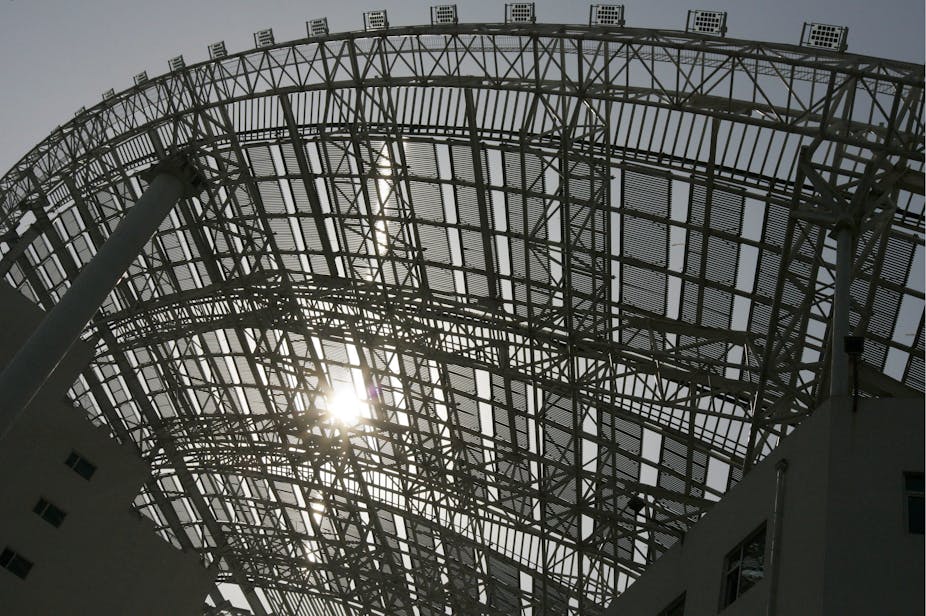
The Climate Commission says Queensland could be a leader in concentrated solar thermal power, but the political will is lacking. AAP

Around the clock solar power could be a reality for Australians in the foreseeable future, but experts say a hostile state government stands in the way of Queensland becoming the solar power leader suggested by the Climate Commission.

The latest instalment from the Climate Commission on the impacts and opportunities of climate change is “wilfully blind to reality”, with no mention of the massive coal and coal seam gas industries in Queensland, said Chris McGrath, senior lecturer in environmental regulation at the University of Queensland.

The report says Queensland’s solar resources are among the best in the world, and the state should take more advantage of the opportunity.

But in the absence of positive deployment policies from the state government, it will take some time to see large solar power stations serving retail customers, said Mark Diesendorf, deputy director of the Institute of Environmental Studies at University of New South Wales.

The Climate Commission’s report cites the Kogan Creek Solar Boost Project, which will provide a solar thermal addition to the neighbouring coal-fired power station, expected to be the largest solar integration project in the world.

But in July, Queensland Premier Campbell Newman withdrew $75 million in funding from the proposed stand-alone 250 megawatt Solar Dawn project near Chinchilla.

Dr Diesendorf said concentrated solar thermal could be vital to solar power generation in the longer term.

“It’s not very expensive to store the heat on concentrated solar thermal and therefore have 24 hour solar power.”

But with several coal-fired power stations running at less than capacity in Queensland, organisations investing in new solar infrastructure will find it difficult to compete, Dr McGrath said.

He added that the government’s focus remained on coal and coal seam gas, with renewables seen as a small component only.

“They’re talking about Queensland as a leader for solar, but Queensland’s going backwards in terms of participating in any funding for addressing climate change, and unwinding programs.”

Dr McGrath said the picture painted by the Climate Commission in its report is the same one that’s been painted for ten years with no action taken.

He said a blunter approach was needed from the Commission and agreed that while it may not be an advocacy group, it was up to scientists to point out the consequences of policy choices.

“It’s not advocating if you say the 5% by 2020 goal will lead to three degrees warming and we won’t have a Great Barrier Reef at this point. That’s just joining the dots for people to see.”

The Climate Commission’s report warns that the state’s agriculture, tourism and property are all at risk as a result of climate change, calling for a rethink of business models.

Sign in to Favourite

Want to follow The Conversation?

Sign up to our free newsletter to get the day's top stories in your inbox each morning, with a special wrap on Saturday.

Become a friend of The Conversation and donate

Join the conversation

32 Comments sorted by

Comments on this article are now closed.

  1. John Coochey

    Mr

    Well if The Commission is not an advocacy group it sure fooled me! Just to take one phrase
    "It’s not advocating if you say the 5% by 2020 goal will lead to three degrees warming and we won’t have a Great Barrier Reef at this point. That’s just joining the dots for people to see.”

    Well what does that actually mean? If we have a goal of five per cent the problem will be solved even if it is not achieved? Australia emissions could cease tomorrow and they would be made up by China in between six…

    Read more
    1. Chris McGrath

      Senior Lecturer at University of Queensland

      In reply to John Coochey

      Dear John,

      The quote is a little truncated. I was saying that Australia's (bipartisan) goal of a 5% reduction in direct greenhouse emissions by 2020 is based on contributing to a global regime to stabilise atmospheric concentrations of carbon dioxide around 550 parts per million, which will lead to a mean global temperature rise of around 3 degrees Centigrade. The Great Barrier Reef won't exist at those levels.

      I wrote about these matters in more detail at https://theconversation.edu.au/carbon

      Read more
    2. John Coochey

      Mr

      In reply to Chris McGrath

      Yes but at what cost? Especially if it would not make any difference even if calculations are correct?

      report
    3. Chris McGrath

      Senior Lecturer at University of Queensland

      In reply to Neil Gibson

      Dear Neil,

      Your argument is like a heavy smoker who refuses to give up cigarettes saying, "each one makes no difference".

      We can overcome fluctuations in solar and store solar energy. That is why Mark said in the article that "concentrated solar thermal could be vital to solar power generation in the longer term."

      Kind regards

      Chris

      report
    4. helen stream

      teacher

      In reply to Chris McGrath

      Chris McGrath:

      The biggest threats to the Great Barrier Reef are crown of thorns starfish and storms and cyclones, neither of which are directly attributable to CO2-induced global warming.

      The proliferation of crown of thorns is due to nutrients from agricultural run-offs, specifically from cane farms, and that impact is being targeted now—probably not enough.

      And storms and cyclones are no more frequent , and no stronger now than they have been many times in the past.

      There’s more property damage now because there’s more property in their path.

      And have you ever heard uber-alarmist and activist, James Hansen, recant this 1970 statement, despite his high profile and warmist agitation??

      “….although the addition of carbon dioxide in the atmosphere does increase the surface temperature, the rate of temperature increase diminishes with increasing carbon dioxide in the atmosphere.”

      report
    5. helen stream

      teacher

      In reply to Chris McGrath

      Chris McGrath:

      You would think if the problems could be solved as easily as you claim, the hundreds of millions in US taxpayers' money to Solyndra might have had more success.

      Most of these 'solutions' to storage and the 'dilute' problem sound wonderful in theory , but not when scaled up---and they often consume too much energy in the production or storage of it.

      And what about the whole new HVDC power grid that would have to be built to distribute the electricity from renewables on any…

      Read more
  2. John Newlands

    tree changer

    The Climate Commission are straying from their remit by endorsing solar technology. Perhaps they've already crossed a line in the sand since Minister Combet makes a point of mentioning PV has a CO2 avoided cost over $400/t. From memory the Kogan Ck solar steam boost was just a few megawatts when the sun shines and the economics of solar thermal in Spain and California is not convincing.

    We can go into all of this in mind numbing detail. The point is that CC should stick to identifying problems and broad objectives like 'burn less fossil fuel'. The danger is they will detract from their credibility by endorsing a specific technology.

    report
  3. Glen Daly

    Retired

    This article is a joke,albeit a sick one.
    It is proposing impractical solutions for an urgent problem,namely,reducing greenhouse gas emissions as quickly as possible.
    Because of the intermittent and unreliable source of the energy for solar and wind generation they can't supply base load electricity 24/7/365.Not all the storage and long distance transmission lines that the enthusiasts propose will achieve this. Their system will need fossil fuel backup,probably coal seam gas.

    What you end up…

    Read more
    1. Chris McGrath

      Senior Lecturer at University of Queensland

      In reply to Glen Daly

      Dear Glen,

      The views expressed in this article were in response to the Climate Commission report which looked at Queensland climate impacts and opportunities. The main technological solutions referred to in the report were solar and energy efficiency so the questions we were asked naturally focused on them.

      The main thing that saddens me about the Climate Commission report is that it fails to join-the-dots. It explains the severe impacts that the science clearly says will occur to things that…

      Read more
    2. Adam Richardt

      Landscaper

      In reply to Glen Daly

      Hi Glen,

      From my understanding, it would take between 10 and 12 years just to build a nuclear power station. Solar (and wind) technology is here and now.

      Something else that most people don't realise is the insurance costs of nuclear reactors. No insurance company touches them (given the risks) without government underwriting. So - ignoring the environmental risks/ issues most people have with this form of energy - to invest in nuclear imposes a massive cost on taxpayers for a very very…

      Read more
    3. Luke Weston

      Physicist / electronic engineer

      In reply to Adam Richardt

      It takes about 4 years to build a nuclear power plant.

      Suppose that a typical nuclear power plant consists of two power reactors with a nameplate capacity of 1000 MWe each, operating with a 90% capacity factor. Each year, then, the plant will generate 7.89 TWh of electrical energy.

      How many wind turbines or solar cells do you need to give you the same amount of energy, with the same availability factor?

      What length of time will it take to build that number?

      "In addition, nuclear power…

      Read more
    4. Adam Richardt

      Landscaper

      In reply to Luke Weston

      Hi Luke, firstly thanks for clarifying the output and length of time it would take to build a nuclear power plant. My 10-12 year scenario was based on an article I read quoting nuclear industry stalwarts, and I gather it was taking into account approvals, etc.

      But I should stick to MY area of expertise, and that's economics. I stand by my argument that the economics don't stack up. The nuclear industry wants the profits, but not the responsibility for the maintenance nor the risks. Privatise the…

      Read more
    5. Luke Weston

      Physicist / electronic engineer

      In reply to Adam Richardt

      And I suppose that, say, Solyndra for example, wants to take responsibility for its economic risks and losses, whereas, supposedly, nuclear energy does not?

      report
  4. John Nicol

    logged in via email @bigpond.com

    This is an uncritical article citing remarks by the Climate Commission, Dieseldorf and Mcgrarh, without considering their obvious vested interest. Dieldorf (a lawyer), McGrath (Founding Director of the Institute for Sustainable Futures) and the Climate Commission, all have either little appreciation of the economics of working with the huge structures in remote areas where there is no significant industry, no appreciation apparently of the destructive nature of cluttering the countryside with inefficient…

    Read more
    1. Chris McGrath

      Senior Lecturer at University of Queensland

      In reply to John Nicol

      Dear John,

      I think you might grossly insult Mark by calling him a lawyer (that's me).

      You are way off the mark with your views on the benign effect of climate change. There is very strong evidence that we will lose crucial ecosystems even at current levels of greenhouse gases - just look at the Arctic: https://theconversation.edu.au/groundhog-day-the-ice-extent-in-the-arctic-ocean-reaches-a-new-minimum-9070

      Kind regards

      Chris

      report
  5. Neil Gibson

    Retired Electronics Engineer

    The whole global warming scam is characterised by calling non-believers "deniers" and referring to "climate scientists" as the only expert people qualified to have opinions. Your article title referred to "experts" but I fail to see the writers having any real-world qualifications and experience in power generation, power distribution and control or anything that keeps the lights on for everybody. Now this might make for an interesting dinner party conversation but please spare me the "experts".

    report
    1. Neil Gibson

      Retired Electronics Engineer

      In reply to Riddley Walker

      Riddley,
      I suppose you think that Freeman Dyson is a moron too. I am quite happy to be in his company rather than yours even though your intellectually stimulating comments have added much to this debate. Re-iterating my argument: as we are supposed to only listen to qualified climate scientists on climate why is this site claiming people with no practical expertise in power systems are "experts".

      report
    2. Chris McGrath

      Senior Lecturer at University of Queensland

      In reply to Neil Gibson

      Dear Neil,

      Your points are too simplistic. These are complex multi-disciplinary problems. Your approach would rule out every politician from making decisions on energy and climate issues.

      Kind regards

      Chris

      report
    3. Chris McGrath

      Senior Lecturer at University of Queensland

      In reply to Neil Gibson

      Dear Neil,

      Great that you've got experience in power systems control and I hope that you can turn it to good use to become part of the solution. There is great work to be done to solve this problem. Simply continuing to burn enormous amounts of fossil fuels is no longer an option.

      Kind regards

      Chris

      report
    4. Neil Gibson

      Retired Electronics Engineer

      In reply to Joel Piotrovsky

      Freeman Dyson is arguably the world's greatest living physicist and mathematician who worked on climate science along with nuclear physics,astronomy and a multitude of other areas. It is a great embarrassment to the climate"scientists" that he describes their climate models as garbage-in garbage-out. Oddly enough Freeman Dyson does not even have a PhD so he would not be recognized by most of the pretend "scientists" in the climate pseudo-science area who would not even understand most of his work…

      Read more
    5. helen stream

      teacher

      In reply to Riddley Walker

      Riddley Walker:
      That’s a very substantive and devilishly incisive comment of yours.

      How do you explain these facts, and why do you think Flannery and Steffen of the Climate Commission completely ignore them, to admonish us that ‘the science is settled’, when Blind Freddie can see it’s not.

      Could it be that some facts are just inconvenient, and don’t fit with other agendas?
      If so, don’t you think an explanation is required for discounting facts from some of the world’s foremost scientific…

      Read more